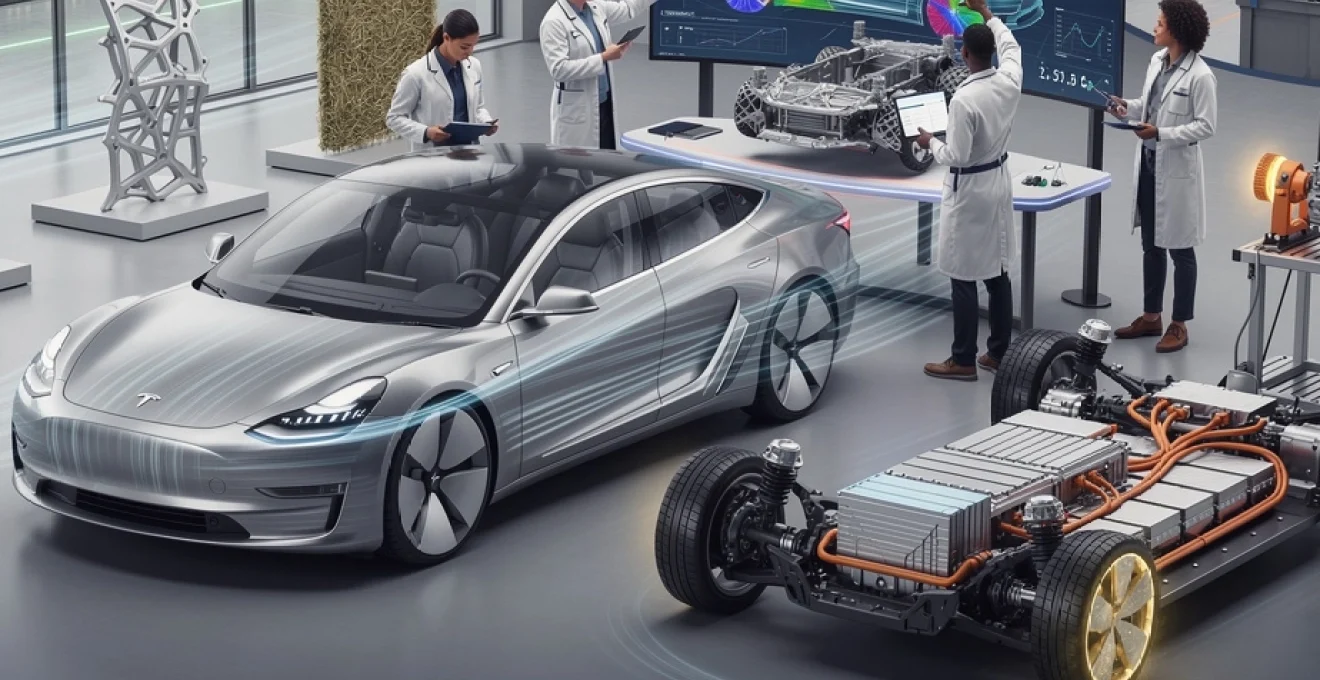
The automotive industry stands at a pivotal moment where sustainability and efficiency have become fundamental drivers of innovation. Modern vehicle design has evolved far beyond traditional aesthetic considerations, embracing a holistic approach that prioritises environmental responsibility whilst maintaining performance standards. This transformation represents a seismic shift in how manufacturers conceptualise, develop, and produce vehicles for an increasingly eco-conscious market.
Contemporary automotive design integrates cutting-edge technologies, revolutionary materials, and sophisticated manufacturing processes that collectively reduce environmental impact across the entire vehicle lifecycle. From aerodynamic optimisation to lightweight engineering, every aspect of modern car design serves a dual purpose: enhancing performance whilst minimising ecological footprint. This paradigm shift reflects not only regulatory pressures and consumer expectations but also the industry’s recognition that sustainable practices drive innovation and competitive advantage.
Aerodynamic design principles driving modern vehicle efficiency
Aerodynamic efficiency has emerged as a cornerstone of sustainable automotive design, fundamentally reshaping how vehicles cut through air resistance. Modern aerodynamic principles focus on reducing drag coefficients, which directly translates to improved fuel economy and extended electric vehicle range. The relationship between aerodynamics and efficiency is particularly crucial in electric vehicles, where every percentage point of drag reduction can significantly impact driving range and battery performance.
Contemporary vehicle design employs sophisticated wind tunnel testing and computational analysis to optimise airflow patterns around the entire vehicle body. Engineers meticulously sculpt body panels, bumpers, and even wheel designs to achieve laminar airflow that minimises turbulence and reduces energy consumption. These aerodynamic improvements can result in fuel efficiency gains of 10-15% compared to conventionally designed vehicles, making them essential for meeting stringent emissions regulations.
Computational fluid dynamics applications in tesla model S development
The Tesla Model S exemplifies how advanced computational fluid dynamics (CFD) revolutionises automotive aerodynamic design. Tesla’s engineering team utilised sophisticated CFD algorithms to simulate airflow patterns across thousands of design iterations before physical prototyping. This digital-first approach enabled engineers to optimise the vehicle’s coefficient of drag to an impressive 0.208, making it one of the most aerodynamically efficient production cars available today.
CFD analysis allows designers to visualise complex airflow phenomena that would be impossible to observe through traditional testing methods. Engineers can examine how air moves around the vehicle’s undercarriage, through the wheel wells, and across surface discontinuities with unprecedented precision. This computational approach significantly reduces development time and costs whilst enabling more aggressive aerodynamic optimisation than previously possible.
Active grille shutters and variable spoiler technologies
Active aerodynamic systems represent the next evolution in vehicle efficiency optimisation, allowing cars to adapt their aerodynamic characteristics based on driving conditions. Active grille shutters automatically close when cooling requirements are minimal, reducing frontal area and improving airflow around the vehicle. These systems can improve fuel efficiency by 2-5% whilst maintaining optimal engine operating temperatures across various driving scenarios.
Variable spoiler technologies take aerodynamic adaptability further by adjusting rear wing angles and positions based on speed, acceleration, and braking requirements. High-performance vehicles like the Porsche 911 Turbo employ sophisticated spoiler systems that balance aerodynamic efficiency with downforce generation. When cruising at steady speeds, the spoiler retracts to minimise drag, but extends during acceleration or high-speed driving to provide stability and traction.
Coefficient of drag reduction strategies in BMW i4 and mercedes EQS
The BMW i4 and Mercedes EQS demonstrate how manufacturers achieve exceptional drag coefficients through comprehensive design integration. The BMW i4 achieves a coefficient of drag of 0.24 through careful attention to surface continuity, optimised air curtain design, and strategically placed air deflectors. Every design element, from door handle integration to wheel arch sculpting, contributes to the vehicle’s overall aerodynamic efficiency.
Mercedes pushed aerodynamic boundaries further with the EQS, achieving a remarkable coefficient of drag of 0.20. This achievement required innovative solutions including flush door handles, a completely sealed underbody, and specially designed low-rolling-resistance tyres. The EQS demonstrates that luxury and aerodynamic efficiency can coexist, proving that sustainable design doesn’t require aesthetic compromise.
Underbody panelling
Underbody panelling plays a critical role in smoothing airflow beneath the vehicle, an area that traditionally generates significant turbulence and drag. By fitting flat composite panels along the chassis, designers create a cleaner airflow path that reduces resistance and helps stabilise the car at higher speeds. This is especially important for electric vehicles, where the battery pack typically forms a flat, aerodynamically advantageous base. Manufacturers such as Mercedes, Tesla, and Hyundai use extensive underbody shielding not only to optimise airflow but also to protect key components from debris and water ingress.
Wheel arch optimisation further enhances vehicle efficiency by managing the highly turbulent airflow around rotating wheels. Techniques include carefully shaped wheel arch liners, air curtains that channel air across the wheel face, and aero-optimised wheel designs that minimise drag without compromising brake cooling. Some models employ partial wheel covers, particularly on rear wheels, to reduce turbulence. When combined with low-rolling-resistance tyres, these measures can deliver measurable improvements in real-world energy consumption and support the broader shift towards sustainable vehicle design.
Lightweight materials engineering for sustainable automotive manufacturing
Reducing vehicle mass is one of the most effective ways to improve efficiency and lower emissions across the entire automotive lifecycle. Every 10% reduction in weight can translate into a 6–8% improvement in fuel economy, or a similar gain in electric vehicle range. This is why lightweight materials engineering now sits at the heart of sustainable car design, working hand in hand with aerodynamic optimisation and powertrain innovation. Instead of relying solely on traditional steel, manufacturers are increasingly adopting multi-material strategies that blend aluminium, composites, and advanced steels.
Lightweight construction delivers benefits that extend beyond efficiency. Lower mass improves handling, braking performance, and occupant safety by enabling more refined crash structures. It also allows engineers to downsize components such as brakes, suspension, and even battery packs without compromising performance. The challenge, however, is to balance weight reduction with cost, manufacturability, and recyclability. As we explore how brands like McLaren, Lotus, Volvo, Audi, and others are tackling this, you will see that sustainable automotive manufacturing is as much about smart material choices as it is about raw performance.
Carbon fibre reinforced plastic implementation in McLaren and lotus vehicles
Carbon fibre reinforced plastic (CFRP) has long been associated with motorsport and high-end supercars, and for good reason. It offers an exceptional strength-to-weight ratio, allowing engineers to create rigid yet lightweight structures that would be impossible with conventional metals. McLaren, for example, has built its road car identity around a CFRP “Monocell” or “Monocage” chassis, delivering outstanding torsional rigidity while keeping overall mass impressively low. This approach supports both dynamic performance and efficiency, as less weight means less energy required for acceleration and braking.
Lotus has taken a similar philosophy into its modern line-up, combining CFRP with aluminium to maintain the brand’s hallmark lightweight ethos. The Lotus Evija hypercar and Emira sports car make extensive use of carbon fibre for body panels, aero components, and structural elements. While CFRP remains expensive and energy-intensive to produce, these applications act as technology incubators. Lessons learned in resin systems, automated lay-up, and recycling techniques are gradually filtering down to more mainstream segments, opening the door to broader use of carbon-based composites in future mass-market vehicles.
Advanced high-strength steel grades in volvo XC40 recharge construction
Despite the excitement around exotic composites, steel is far from obsolete in sustainable automotive design. Instead, it is evolving. Advanced high-strength steel (AHSS) grades allow manufacturers to use thinner sections while maintaining or even improving crash performance. The Volvo XC40 Recharge is a case in point, employing a carefully tuned mix of AHSS and ultra-high-strength steel in key structural areas such as the safety cell, A- and B-pillars, and side-impact zones. This ensures excellent occupant protection while keeping overall body weight under control.
Using AHSS has another important sustainability benefit: steel is one of the most recycled materials on the planet, with established end-of-life recovery systems. By optimising the body-in-white with these sophisticated steels, Volvo and other manufacturers can maintain high recyclability rates whilst reducing the total amount of material required. The result is a more resource-efficient vehicle that aligns with circular economy principles without the cost penalties associated with some alternative materials. For many models, the smart use of AHSS offers the most practical pathway to lightweight, safe, and sustainable construction.
Aluminium space frame architecture in audi e-tron GT platform
Aluminium has become a cornerstone of lightweight vehicle design thanks to its low density and corrosion resistance. The Audi e-tron GT showcases how aluminium space frame principles can be blended with steel to create a highly optimised multi-material structure. Key components such as suspension towers, roof rails, and subframes leverage aluminium’s strengths, reducing mass while maintaining rigidity. Where higher local strength or specific crash behaviour is required, strategic use of hot-formed steels complements the aluminium skeleton.
Space frame architectures typically employ cast nodes, extrusions, and sheet sections that are bonded or welded together, much like the frame of a high-performance bicycle. This modular approach not only supports weight reduction but also improves repairability and flexibility in manufacturing. From a sustainability perspective, aluminium’s high recyclability is a major advantage, particularly as more smelters shift to renewable energy. However, because primary aluminium production is energy-intensive, manufacturers increasingly prioritise secondary (recycled) aluminium content, which can cut associated CO2 emissions by up to 95%.
Bio-based composite materials and hemp fibre integration
While metals and carbon fibre dominate structural applications, bio-based composite materials are rapidly gaining traction for interior and semi-structural components. Hemp fibre, flax, kenaf, and other natural fibres can be combined with bio-resins or recycled plastics to form panels that are lighter and more sustainable than traditional petrochemical-based plastics. Several European manufacturers have introduced hemp or flax-reinforced door cards, parcel shelves, and boot liners, leveraging their favourable mechanical properties and low environmental footprint.
These bio-based composites often act like nature’s version of carbon fibre: the fibres provide stiffness and strength, while the matrix material binds everything together. Compared to conventional plastics, they can reduce weight by 20–30% and cut CO2 emissions during production. Companies such as Bcomp have demonstrated that natural-fibre panels can meet stringent crash and durability requirements, even in motorsport. For design teams, hemp and flax composites unlock new textures and aesthetics, allowing sustainability to be visible and tangible rather than hidden beneath the surface.
Electric powertrain integration and battery pack design evolution
The migration from internal combustion engines to electric powertrains is reshaping vehicle architecture from the ground up. Without a bulky engine and transmission tunnel, designers can pursue “skateboard” platforms that integrate the battery pack within a flat floor. This layout, widely used by Tesla, Hyundai, Volkswagen, and others, enables a low centre of gravity, improved cabin space, and a more aerodynamically favourable silhouette. It also simplifies modular platform strategies, where multiple body styles share the same underlying electric chassis.
Battery pack design has evolved rapidly to support both sustainability and efficiency. Early packs were often collections of modules housed within heavy protective casings; newer designs integrate structural elements, using the battery as a stressed member of the body. This “cell-to-pack” and even “cell-to-vehicle” approach, pioneered by companies like BYD and Tesla, reduces material usage, improves energy density, and cuts manufacturing complexity. At the same time, thermal management systems have become more sophisticated, employing liquid cooling channels and heat pumps to maintain optimal cell temperatures, thereby extending battery lifespan and enhancing cold-weather performance.
From a sustainability perspective, engineers are increasingly designing battery systems with disassembly, repair, and reuse in mind. Modular sub-packs, standardised cell formats, and accessible fasteners make it easier to replace degraded modules rather than discarding the entire unit. This supports second-life applications, such as stationary energy storage, and improves the economics of battery recycling. As regulations tighten around battery traceability and recycling efficiency, we can expect future electric powertrains to be conceived not just as performance devices, but as circular energy assets across multiple lifecycles.
Regenerative systems and energy recovery technologies
Electric and hybrid vehicles have introduced a powerful new design lever for efficiency: regenerative systems that capture energy which would otherwise be wasted. Regenerative braking is the most familiar example, converting kinetic energy into electrical energy and feeding it back into the battery. In city driving, where frequent deceleration is common, these systems can recover a significant proportion of energy, effectively acting like a built-in charger every time you lift off the accelerator. Many drivers quickly adapt to “one-pedal driving”, where the regenerative effect slows the car without heavy brake use.
But regenerative technology extends beyond braking. Some manufacturers are experimenting with energy-harvesting suspension systems that convert vertical wheel movement into electricity, and with advanced thermal management that recycles waste heat from motors, inverters, and batteries to warm the cabin. Heat pumps, for instance, can reduce energy consumption for cabin heating by up to 50% compared with resistive heaters, directly increasing electric vehicle range in cold climates. By treating every energy flow within the vehicle as an opportunity for recovery, engineers are pushing overall system efficiency closer to theoretical limits.
For drivers and fleet operators, the practical impact of regenerative systems is clear: lower energy bills, reduced brake wear, and fewer emissions across the usage phase. The challenge for designers lies in balancing strong regeneration with a natural, confidence-inspiring pedal feel and predictable handling. Software plays a central role here, blending friction brakes and regenerative torque seamlessly. As we move further into an era of connected and autonomous vehicles, energy recovery strategies will become even more intelligent, anticipating traffic flow and terrain to maximise efficiency in real time.
Circular economy principles in automotive design lifecycle
Designing cars for sustainability is no longer limited to what happens on the road; it now encompasses the entire lifecycle from raw material extraction to end-of-life recycling. Circular economy principles encourage manufacturers to think in loops rather than straight lines, prioritising reuse, remanufacturing, and material recovery. This mindset is reshaping decisions at the drawing board, where engineers must ask: how will this component be disassembled, refurbished, or recycled 10 or 15 years from now? The answers increasingly influence material selection, joining techniques, and even software architecture.
Automotive companies are responding by forming cross-industry partnerships with recyclers, raw material suppliers, and energy providers. Shared data platforms help track material flows and verify recycled content, whilst regulatory frameworks in regions like the EU require manufacturers to meet specific recovery and reuse targets. In this context, sustainable car design becomes a collaborative exercise. The goal is not only to build efficient vehicles, but to ensure that, once retired, those vehicles become feedstock for the next generation of products with minimal waste.
End-of-life vehicle recycling and material recovery rates
End-of-life vehicle (ELV) recycling is the backbone of the automotive circular economy. In the European Union, current regulations require that at least 95% of a vehicle’s weight be reused or recovered, with a minimum of 85% being recycled. This has driven the development of sophisticated dismantling and shredding processes that separate metals, plastics, glass, and other materials. High-value metals such as steel, aluminium, and copper enjoy recovery rates often exceeding 90%, making them key contributors to circular material flows.
However, the rise of complex multi-material components and composite structures presents new challenges. Bonded joints, mixed-material laminates, and embedded electronics can make material separation more difficult. To address this, design teams increasingly adopt “design for disassembly” principles, using reversible fasteners, clear material labelling, and modular assemblies. The payoff is twofold: recyclers can achieve higher purity streams, and manufacturers gain access to more predictable supplies of secondary raw materials. Over time, these improvements help stabilise material costs and reduce dependence on virgin resources.
Cradle-to-cradle design philosophy in BMW i3 production
The BMW i3 stands as an early and influential example of applying cradle-to-cradle thinking in mainstream automotive production. From the outset, the car was conceived as an electric vehicle built around renewable energy and recyclable materials. Its CFRP passenger cell is manufactured using electricity from hydroelectric sources, while the interior showcases extensive use of natural fibres, recycled plastics, and sustainably sourced wood. Many of these components were designed to be separable at end of life, supporting high-quality material recovery.
Cradle-to-cradle design goes beyond recycling to consider how each material can feed into another beneficial cycle. In the i3, for example, recycled carbon fibres from production offcuts are used in non-critical components, closing internal loops and reducing waste. BMW also pioneered battery second-life projects, repurposing used i3 battery modules for stationary energy storage. This holistic approach highlights what is possible when sustainability is treated not as an add-on, but as a core design principle influencing every stage of the vehicle’s life.
Sustainable supply chain management for nissan leaf components
Supply chain sustainability has become a strategic priority, particularly for electric vehicles where battery materials are under intense scrutiny. The Nissan Leaf, one of the world’s best-selling electric cars, illustrates the importance of responsible sourcing and transparent logistics. Nissan has implemented measures to trace key materials such as cobalt, nickel, and lithium back to their origins, working with suppliers to uphold environmental and social standards. Third-party audits and certification schemes help verify that these materials are not linked to conflict zones or exploitative labour practices.
Beyond raw materials alone, sustainable supply chain management also encompasses logistics, packaging, and more localised production. By assembling vehicles closer to their end markets and optimising transport routes, manufacturers can significantly reduce associated emissions. Many employ sustainable freight management systems with recycled packaging and consolidated shipments to improve load efficiency. For organisations seeking to decarbonise their fleet, understanding how a car was built and transported can be just as important as its tailpipe—or lack of tailpipe—emissions.
Life cycle assessment methodologies for carbon footprint reduction
Life cycle assessment (LCA) provides the analytical backbone for credible sustainability claims in the automotive sector. Instead of focusing solely on use-phase emissions, LCA evaluates environmental impacts from cradle to grave: raw material extraction, manufacturing, distribution, use, and end-of-life processing. This holistic view often reveals trade-offs that might otherwise be missed. For example, a lighter component may reduce driving emissions but require more energy to produce; only by assessing the full life cycle can designers judge whether the net impact is positive.
Manufacturers are increasingly publishing LCA results for new models, using standardised methodologies such as ISO 14040/44 and, in some cases, third-party verification. These studies inform eco-design decisions, from material substitutions to energy sourcing and packaging choices. They also help identify “hotspots” where targeted improvements can yield substantial carbon reductions, such as switching to green electricity at a specific plant or redesigning a high-volume component. For fleet buyers and environmentally conscious consumers, LCA-based information offers a more reliable basis for comparing the true sustainability of different vehicles.
Smart manufacturing processes and industry 4.0 implementation
The shift toward sustainability and efficiency in car design is closely linked to how vehicles are built. Industry 4.0 technologies—such as industrial IoT, advanced robotics, digital twins, and AI-driven analytics—are transforming automotive manufacturing into a smarter, more resource-efficient process. Connected production lines constantly collect data on energy use, machine performance, and material flow, enabling real-time optimisation. By predicting equipment failures before they occur, manufacturers can reduce downtime, avoid scrap, and extend the life of critical assets.
Smart factories also support more flexible, modular production systems that align with evolving vehicle architectures. For instance, as electric platforms and modular interiors become more common, reprogrammable robots and adaptable assembly cells allow rapid reconfiguration with minimal physical changes. Digital twins—virtual replicas of plants and processes—let engineers test process variations and efficiency measures in a risk-free environment before implementing them on the shop floor. The result is a manufacturing ecosystem that can quickly respond to new sustainability targets, regulatory changes, or supply chain disruptions.
Energy management is another major benefit of Industry 4.0 implementation. By combining granular metering with AI analytics, factories can identify peak consumption periods, optimise HVAC and lighting, and shift energy-intensive tasks to times when renewable electricity is most available. Some plants are integrating on-site solar, wind, or battery storage, turning them into nearly self-sufficient energy hubs. When you connect these smart manufacturing practices with sustainable vehicle designs, the outcome is a genuinely lower-carbon car—from raw material to final assembly—that meets rising expectations for environmental responsibility without sacrificing quality or performance.