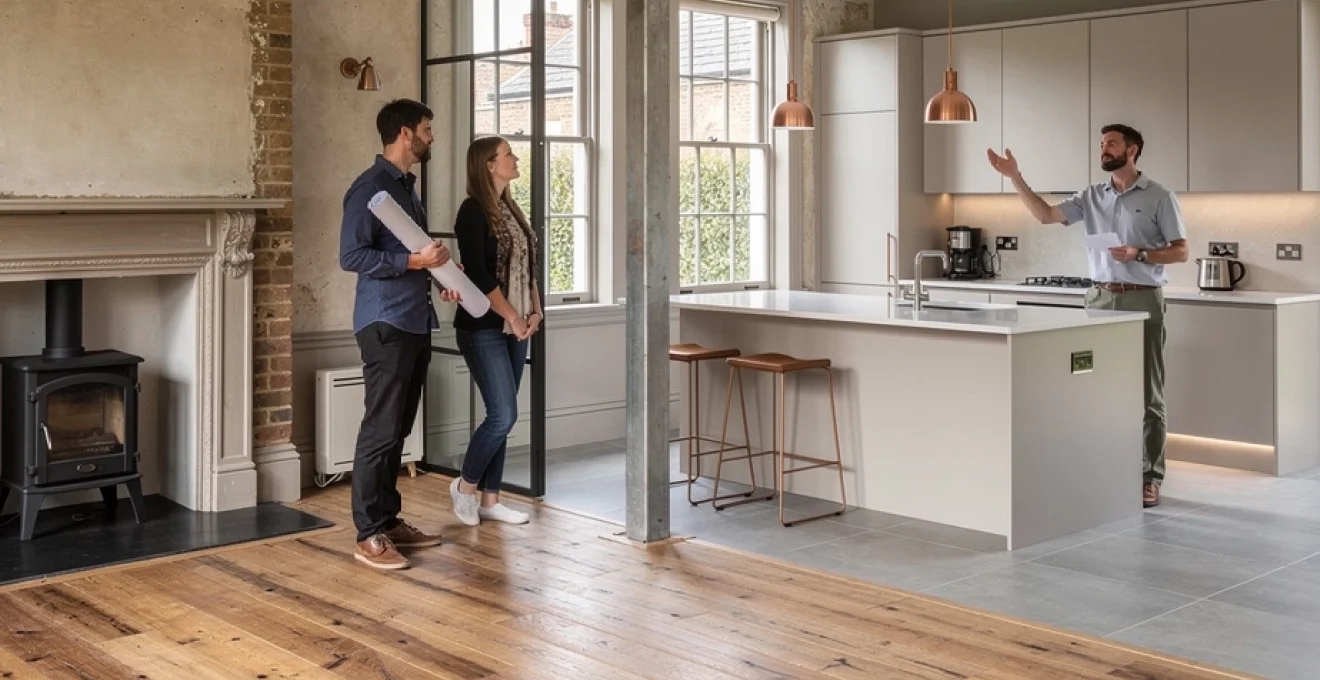
# Blending Modern and Traditional Styles in Renovations
Period properties across the UK—from Victorian terraces in London to Georgian townhouses in Bath—possess an undeniable charm that continues to captivate homeowners and property investors alike. Yet the challenge of adapting these historical spaces to contemporary living standards remains one of the most complex undertakings in residential design. The art of successfully blending modern and traditional styles in renovations requires more than aesthetic sensibility; it demands a thorough understanding of architectural heritage, material science, building regulations, and spatial planning principles. When executed thoughtfully, this hybrid approach creates interiors that honour the past whilst embracing the comfort, efficiency, and functionality that modern life requires. The result is a home that feels both timeless and entirely relevant—a space where original cornicing can coexist harmoniously with underfloor heating, and where Victorian sash windows frame views of sleek kitchen extensions clad in Crittal-style glazing.
Architectural principles for harmonising victorian features with contemporary design elements
The foundation of any successful period renovation lies in understanding which architectural features deserve preservation and how they can be integrated with modern interventions. Victorian properties, in particular, present fascinating opportunities for stylistic juxtaposition, as their ornate detailing and generous proportions provide an ideal canvas for contemporary design elements. The key is establishing a visual dialogue between old and new—allowing each element to retain its distinct character whilst contributing to a cohesive whole.
Preserving original cornice work and ceiling roses in minimalist interiors
Original plasterwork represents some of the most valuable architectural detailing in period properties, yet many homeowners worry these ornate features will clash with minimalist aesthetics. The solution lies in careful colour selection and spatial balance. Painting both cornicing and ceiling roses in the same shade as walls—typically crisp whites or soft greys—allows the three-dimensional relief to create subtle shadows and textural interest without overwhelming contemporary furnishings. This monochromatic approach enables Victorian craftsmanship to complement rather than compete with clean-lined modern furniture and fixtures.
Consider the scale of your ceiling details when planning furniture arrangements. High ceilings with elaborate cornicing actually benefit from the introduction of low-profile contemporary sofas and platform beds, as the contrast in vertical proportions creates dynamic tension. Research from Historic England suggests that approximately 68% of period property owners who retain original plasterwork report higher satisfaction with their renovations compared to those who remove these features—a statistic that underscores the enduring appeal of architectural authenticity.
Integrating sash windows with modern glazing technologies and thermal performance
Traditional sash windows pose one of the greatest challenges in period renovations, particularly when balancing heritage aesthetics with modern thermal efficiency standards. Single-glazed timber sashes, whilst beautiful, contribute significantly to heat loss and fail to meet current Building Regulations Part L requirements. Fortunately, advancements in glazing technology now allow for sympathetic upgrades that preserve external appearance whilst dramatically improving performance.
Specialist manufacturers now offer slim-profile double glazing specifically designed for period properties, with gap widths of just 6-8mm between panes compared to the standard 16-20mm. This technology can achieve U-values as low as 1.4 W/m²K—a substantial improvement over the 4.8 W/m²K typical of single glazing. When combined with draught-proofing systems and discreet trickle vents, upgraded sash windows can deliver contemporary comfort without compromising the visual integrity of your property’s façade. For properties in conservation areas, such upgrades typically receive approval provided external sight lines remain unchanged.
Balancing exposed brickwork with Clean-Lined joinery and Built-In storage solutions
Exposed brickwork has become something of a signature element in modern-traditional hybrid interiors, offering textural warmth and historical authenticity. However, the raw, industrial aesthetic of bare masonry requires careful counterbalancing to prevent spaces from feeling unfinished or overly rustic. The most successful approach involves pairing exposed brick with bespoke joinery that features clean lines, flush detailing, and sophisticated finishes.
Consider installing handleless kitchen
Consider installing handleless kitchen cabinetry in lacquered finishes or veneered oak, running full-height to frame an exposed chimney breast or feature wall. Built-in benches, media units, and wardrobes can be scribed neatly into irregular brick surfaces, visually “anchoring” the rough texture with crisp geometry. Where possible, conceal services—such as wiring and pipework—within stud partitions adjacent to brickwork, so the masonry can be left visually uncluttered. Finally, use a restrained palette for joinery (off-whites, soft blacks, or muted timber tones) so the brick remains the hero material rather than competing with overly decorative cabinetry.
Retrofitting period fireplaces with wood-burning stoves and contemporary surrounds
Original fireplaces are often the emotional heart of a Victorian renovation, yet they can be inefficient and draughty in their untouched state. Retrofitting a wood-burning or multi-fuel stove into an existing hearth offers a way to combine traditional character with modern heating performance. Current Ecodesign-ready stoves can be up to 80% efficient compared with around 30% for an open fire, significantly reducing fuel consumption and particulate emissions. The key is to retain as much original fabric as possible—mantels, tiled hearths, and cast-iron inserts—whilst carefully adapting the opening to meet manufacturer clearances and Building Regulations Part J.
To achieve a modern-traditional blend, many homeowners opt for a simple honed stone or concrete surround around an original cast-iron insert, or repaint an ornate mantel in a deep, contemporary tone such as charcoal or off-black. In properties where the original surround has been removed, a minimalist steel or limestone frame can be introduced to contrast with a heritage chimney breast, often finished in lime plaster or exposed brick. Always commission a HETAS-registered installer to assess flue integrity and ventilation; this not only ensures compliance but also protects the long-term fabric of the chimney. In some conservation areas, fitting a high-efficiency gas fire with a traditional cast fascia may be a more acceptable alternative to a stove, preserving period aesthetics whilst improving comfort.
Material selection strategies: juxtaposing heritage textures with industrial finishes
The success of any renovation that blends modern and traditional styles hinges on the materials you choose and how they interact. Heritage textures—such as reclaimed timber, stone, and lime plaster—carry a sense of history and tactility that industrial finishes alone rarely achieve. Conversely, polished concrete, resin, and metals like steel and aluminium introduce precision, reflectivity, and a crisp visual edge. When you deliberately juxtapose these elements, you create interiors that feel layered and purposeful rather than randomly assembled. Think of it as composing a piece of music: the heritage materials provide the bassline, while the industrial finishes add rhythm and sharpness on top.
Combining reclaimed timber flooring with polished concrete and resin surfaces
Reclaimed timber flooring—particularly boards salvaged from barns, schools, or even other Victorian properties—brings instant character to a renovation. The natural patina, minor imperfections, and colour variation add warmth that is difficult to replicate with new materials. Pairing this with polished concrete or resin in adjacent zones, such as kitchens or extensions, allows you to define different functions within an open-plan layout without erecting physical barriers. A popular strategy is to keep living rooms in reclaimed oak or pine while using concrete in high-traffic or spill-prone areas, ensuring a practical yet visually cohesive scheme.
To avoid a jarring transition, pay close attention to thresholds and levels. A flush junction between timber and concrete, often detailed with a slim brass or stainless-steel strip, creates a deliberate and tailored look. You might also echo the tone of the timber within the concrete by specifying a warmer aggregate or tint, so the two surfaces talk to each other rather than clash. From a technical standpoint, consider moisture levels, movement, and floor build-up: reclaimed boards typically require an engineered substrate or careful acclimatisation, while polished concrete and resin demand correct subfloor preparation and expansion joints. When handled properly, this combination delivers a contemporary interior grounded by the authenticity of aged wood.
Pairing original stone flagging with porcelain tiles and underfloor heating systems
Many period cottages and farmhouses still retain stone flags in entrance halls, kitchens, and utility spaces. These slabs of limestone, sandstone, or slate convey solidity and age, but they can be cold underfoot and uneven by modern standards. Rather than lifting or discarding them, a sensitive renovation might preserve the best-quality flags in key zones while introducing porcelain tiles elsewhere to improve comfort and practicality. High-quality porcelain can convincingly mimic stone while providing a consistent thickness and slip rating, making it ideal for bathrooms and contemporary kitchen extensions connected to the original house.
Underfloor heating is an invaluable tool in this context, especially if you are trying to modernise traditional interiors without resorting to intrusive radiators. Wet underfloor systems can often be laid over existing slabs using low-profile insulation and screeds, though structural loadings and floor heights must be checked by an engineer. In new-build sections, pairing porcelain tiles with underfloor heating produces efficient, even warmth while maintaining a visual dialogue with original flagging. The analogy here is like restoring a classic car but upgrading the engine: you keep the familiar appearance while dramatically improving performance. Careful selection of grout colours and tile formats ensures transitions feel intentional, not like a patchwork of old and new.
Contrasting lime plaster walls with brushed steel, copper, and aluminium accents
Lime plaster is central to the performance and character of many period properties, particularly those built before 1919 with solid walls. Its vapour-permeable nature allows moisture to move through the fabric, reducing the risk of trapped damp that can occur with modern gypsum or cement plasters. Retaining or reinstating lime plaster not only respects the building’s construction logic but also delivers a subtly textured, matte surface that pairs beautifully with modern metals. Brushed stainless steel, blackened steel, copper, and aluminium all stand out crisply against the soft, almost chalky quality of lime.
You might, for instance, run a simple black steel handrail along a gently undulating lime-plastered staircase wall, or specify copper kitchen hardware against pale plaster to create a warm, understated luxury. Spotlights, switch plates, and door furniture in metal finishes become contemporary punctuation marks against this heritage backdrop. From a design standpoint, the interplay is similar to wearing a tailored suit with modern sneakers: each element is distinct, but the contrast feels stylish and intentional when executed with restraint. Always ensure that any fixings into lime plaster are appropriately detailed, as it behaves differently from modern plaster in terms of strength and flexibility.
Selecting heritage paint palettes from farrow & ball alongside dulux modern emulsions
Colour selection is one of the most efficient tools for unifying traditional and modern design elements in a renovation. Heritage paint ranges—such as Farrow & Ball, Little Greene, or Dulux Heritage—offer historically informed palettes that sit naturally with period cornicing, sash windows, and panelled doors. These muted, complex hues can then be combined with high-performance modern emulsions and specialist finishes from mainstream manufacturers, giving you the best of both worlds: visual authenticity and durability. For example, you might choose a classic stone-toned shade for original reception rooms, and then pick up a deeper accent from the same family for a contemporary kitchen extension.
When balancing old and new, consider using one coherent palette that runs through the entire property, shifting tones rather than switching style entirely from room to room. A popular strategy in Victorian renovations is to keep ceilings and cornices in a soft off-white, walls in mid-tones, and joinery—such as skirtings and doors—in a darker complementary colour. Modern areas, like bathrooms or loft conversions, can then feature bolder accents within that same colour universe so nothing feels disconnected. Technical paint specifications also matter: high-traffic areas benefit from scrubbable, low-VOC emulsions, while existing lime plaster may require breathable mineral or casein-based paints. This layered approach to colour helps stitch together disparate interventions into a coherent whole.
Spatial planning techniques for open-plan conversions in period properties
Spatial planning is where the theoretical idea of blending modern and traditional styles becomes a lived reality. Period homes were often designed with cellular layouts, narrow corridors, and strict separation between front-of-house and service areas. Contemporary living, by contrast, typically favours open-plan kitchens, flexible family spaces, and improved sightlines. How do you reconcile these opposing logics without erasing the building’s character? The answer lies in carefully considered interventions that open up key areas while retaining enough original structure and detailing to preserve the narrative of the house.
Removing non-load-bearing walls whilst retaining original architraves and skirtings
One of the most straightforward ways to modernise a Victorian or Georgian home is to remove non-load-bearing walls between dining rooms and kitchens, or between double reception rooms. However, indiscriminate demolition can result in bland, featureless spaces that feel more like new-build apartments than period houses. A more nuanced approach involves retaining sections of wall, archways, and original architraves and skirting boards, even as you enlarge openings. By keeping these elements, you preserve the rhythm of the original plan while gaining the light and flow associated with open-plan living.
In practice, this might mean widening a doorway into a generous opening but reinstating or extending the original architrave profile around the new aperture. Skirtings can be run continuously across old and new sections, visually tying spaces together and avoiding the “knocked-through” look. Always instruct a structural engineer to confirm which walls are truly non-load-bearing, as Victorian construction can be unpredictable. Think of these retained fragments as the punctuation in your spatial sentence: they break up the flow just enough to add interest and maintain a sense of hierarchy between rooms.
Installing steel RSJ beams and structural glass partitions in georgian townhouses
Where substantial structural alterations are required—such as removing chimney breasts or opening rear walls to create large kitchen-dining areas—steel RSJ beams become unavoidable. Rather than hiding these entirely, many designers now choose to celebrate certain structural elements as part of the modern vocabulary within a traditional shell. Exposed steel beams, when painted in a deep neutral, can provide a crisp horizontal line that contrasts with ornate cornicing and panelled reveals. In Georgian townhouses, structural glass partitions and balustrades are often used in conjunction with steel to preserve borrowed light and long views through the plan.
Glass partitions are especially effective where you wish to maintain acoustic separation (for example, between a home office and a living space) without sacrificing openness. Framed in slim black or bronze-finished metal, they echo the finesse of original sash windows while clearly signalling their contemporary origin. From a regulatory perspective, all structural steelwork must be designed to Eurocode standards and fire-protected as required, which might involve boxing-in in certain locations. Where beams must be concealed, you can still express their presence through subtle soffits, lighting details, or changes in ceiling height that articulate the underlying structure of the renovated home.
Creating kitchen extensions with crittal-style doors and bi-fold glazing systems
Rear kitchen extensions have become almost synonymous with modernising traditional terraced houses across London and other UK cities. The most successful examples treat the extension as a clearly contemporary addition that nonetheless responds to the proportions and materials of the original building. Crittal-style steel doors and fixed screens, with their slender mullions and transoms, provide a visual link to traditional sash windows while enabling generous expanses of glazing. In contrast, aluminium bi-fold or sliding systems offer maximum flexibility and minimal sightlines, ideal for opening family spaces to the garden.
To avoid the common pitfall of a “glass box” that feels disconnected from the main house, bring materials and details from the interior out into the extension. Continue cornice profiles or ceiling heights where possible, or use the same timber flooring throughout, breaking only at threshold strips suited to external doors. Rooflights positioned over internal zones—such as original rear reception rooms now turned into dining areas—can draw daylight deep into the plan, ensuring the old heart of the house remains bright and usable. Planning policy in many boroughs encourages modest, subservient rear additions, so working with an architect familiar with local guidelines can help you achieve a contemporary intervention that respects both neighbours and the existing streetscape.
Lighting design approaches: merging vintage fixtures with LED and smart technologies
Lighting is one of the most powerful tools for uniting modern and traditional styles in a renovation because it influences both aesthetics and how you experience space day to day. Period properties often feature statement chandeliers, picture lights, and wall sconces that contribute significantly to their character. At the same time, modern expectations around energy efficiency, flexibility, and smart control demand an upgrade to LED and integrated systems. The objective is not to replace every fitting with something high-tech, but rather to create a layered scheme where heritage fixtures are carefully rewired and supplemented by discreet, contemporary sources.
A well-balanced lighting plan typically combines three layers: ambient, task, and accent lighting. You might retain a Victorian chandelier in a drawing room as the main ambient source, but retrofit it with dimmable LED filament lamps to reduce energy use and heat output. Recessed downlights or linear LED profiles can then provide subtle background wash, particularly in extensions or kitchens where ceiling heights and plaster conditions are more forgiving. Accent lighting—such as LED strips within alcove shelving, floor washers on staircases, or concealed uplights to highlight cornicing—adds drama and emphasises the building’s architectural bones. Integrating these layers within a smart control system allows you to create different scenes for entertaining, working, or relaxing at the touch of a button.
Vintage and contemporary fittings can coexist beautifully when united by finish or form. For example, antique brass picture lights above traditional panelling can be echoed by slim brass pendants over a minimalist island, creating a continuous visual language despite the difference in age. Modern track lighting with adjustable heads can be particularly useful in gallery-like hallways or converted lofts, providing flexibility without the need for multiple fixed fixtures. As always in older buildings, planning cable routes and switch positions early—ideally before plastering—will help you minimise surface trunking and maintain clean walls. Given that lighting accounts for around 15% of a typical home’s electricity use, according to the Energy Saving Trust, upgrading to efficient LED while preserving characterful fixtures offers both aesthetic and operational benefits.
Navigating listed building consent and conservation area regulations for hybrid renovations
Blending modern and traditional styles in renovations becomes more complex when your property is listed or located in a conservation area. In these contexts, local planning authorities place significant emphasis on preserving the character and appearance of buildings and streetscapes. However, this does not mean contemporary design is off the table; in fact, many conservation officers welcome high-quality modern interventions that are clearly legible as new additions. The challenge lies in understanding the regulatory framework and preparing robust, well-argued proposals that demonstrate respect for heritage significance.
For listed buildings, any work that affects the structure or character of the property—internally or externally—may require Listed Building Consent in addition to planning permission. This could include interventions that might seem minor, such as altering fireplaces, removing partitions, or replacing windows. Early engagement with a heritage consultant or architect experienced in historic buildings can help you identify which elements contribute most to the building’s significance and therefore must be handled with particular care. Detailed drawings, method statements, and material specifications will be expected as part of your application, alongside a Heritage Statement that explains how your design protects or enhances the asset.
In conservation areas, controls typically focus on external changes visible from the public realm, such as extensions, roof alterations, and replacement windows. Here, the key is to demonstrate that your proposal preserves or enhances the area’s character. A contemporary rear extension in zinc and glass may be acceptable if it is subordinate in scale, uses high-quality materials, and respects existing building lines. Conversely, poorly detailed pastiche additions that imitate period features without craftsmanship can actually undermine heritage value. Think of your renovation as being in conversation with the original building: your design should be clearly of its time, but polite and responsive.
Practical steps for navigating the process include conducting pre-application discussions with the local planning authority, which can provide informal feedback before you invest in full drawings. You should also gather historic documentation—original plans, old photographs, listing descriptions—to support your understanding of the building’s evolution. Where fabric must be removed, propose a strategy for recording and, where appropriate, reusing materials elsewhere on site. Although the approvals process can be time-consuming, successful applications tend to increase both the long-term resilience and market value of period properties by ensuring interventions are thoughtful and reversible where possible.
Case studies: successful traditional-modern renovations in cotswold cottages and london terraces
Examining real-world examples can help you visualise how the principles discussed throughout this article play out in practice. Two common scenarios for UK homeowners—renovating a Cotswold stone cottage and updating a Victorian or Edwardian London terrace—offer instructive contrasts. Both property types come with strong architectural identities, yet both can accommodate bold, contemporary interventions when handled with care. What unites the most successful schemes is not a specific style, but a disciplined commitment to quality materials, coherent palettes, and respect for the original fabric.
In a typical Cotswold cottage project, designers might begin by restoring exposed timber beams, flagstone floors, and lime-plastered walls, all of which contribute to the building’s warm, organic character. A modest rear extension in oak and glass is then added to create a light-filled kitchen-dining space overlooking the garden. Inside, handmade shaker cabinetry in a soft heritage green sits alongside poured concrete worktops and a minimalist black range cooker. A traditional inglenook fireplace in the sitting room is upgraded with a high-efficiency stove, while upstairs, low-ceilinged bedrooms are painted in breathable, pale tones to maximise light. The result is a home that feels unmistakably rural and historic, yet functions seamlessly for contemporary family life.
In contrast, a London terrace renovation often focuses on unlocking the potential of long, narrow plots and underused basements or lofts. A common strategy is to create a side-return or full-width rear extension with Crittal-style glazing, bringing daylight into previously dark middle rooms. Within this new volume, a sleek handleless kitchen might sit opposite a restored cast-iron fireplace relocated from elsewhere in the house, creating a playful dialogue between eras. Original floorboards are repaired and stained, while the extension floor switches to large-format porcelain tiles with underfloor heating. Throughout, a consistent colour palette—perhaps off-white walls, deep blue joinery, and brass hardware—threads together old and new spaces, so you experience the house as a unified whole rather than a patchwork of interventions.
Across both examples, lighting and furniture choices further reinforce the blend of modern and traditional style. Mid-century dining chairs might pull up to an antique farmhouse table; vintage rugs could soften polished concrete; and a mix of contemporary art and framed period prints adds personality to lime-plastered or delicately corniced walls. These projects demonstrate that you do not need to choose between preserving historic character and enjoying modern comfort. With thoughtful planning, informed material choices, and a clear design narrative, you can create a home where original features and contemporary design not only coexist but actively enhance one another.