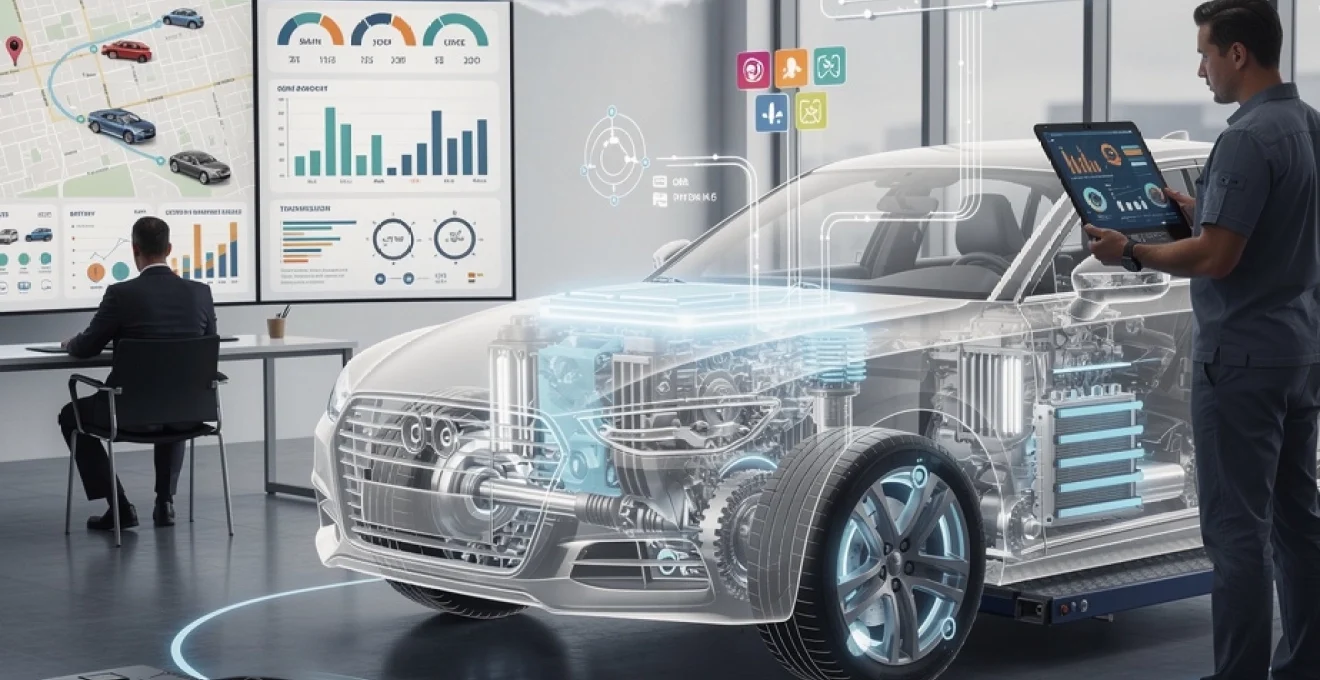
Vehicle breakdowns represent more than mere inconvenience—they translate into lost productivity, emergency repair costs, and potentially hazardous situations for drivers. The automotive industry has witnessed a remarkable transformation in recent years, shifting from reactive repair strategies to sophisticated predictive maintenance systems that anticipate failures before they occur. By leveraging advanced telematics, machine learning algorithms, and IoT sensor networks, modern vehicles can now communicate their health status in real-time, enabling proactive interventions that dramatically reduce the likelihood of unexpected breakdowns. This technological revolution is reshaping how vehicle owners, fleet managers, and automotive service providers approach maintenance, delivering substantial cost savings and unprecedented reliability improvements across the transportation sector.
Telematics and OBD-II systems: Real-Time vehicle health monitoring
Telematics technology has fundamentally transformed vehicle diagnostics by creating continuous communication channels between cars and monitoring systems. At the heart of this revolution lies the On-Board Diagnostics II (OBD-II) port, a standardized interface mandated in vehicles since 1996 that provides access to a wealth of operational data. Modern telematics devices connect to this port, extracting information about engine performance, fuel consumption, emission levels, and hundreds of other parameters that collectively paint a comprehensive picture of vehicle health. This real-time data transmission enables you to monitor your vehicle’s condition remotely, receiving alerts about potential issues long before they escalate into complete failures.
The integration of telematics with predictive maintenance systems creates a powerful early warning mechanism. When your vehicle’s engine begins exhibiting subtle performance degradation—perhaps a slight increase in combustion temperature or minor irregularities in fuel injection timing—telematics systems capture these anomalies immediately. Unlike traditional maintenance schedules that rely on predetermined intervals based on mileage or time, telematics-driven approaches respond to your vehicle’s actual condition, accounting for driving patterns, environmental factors, and component wear rates. This condition-based methodology proves particularly valuable for vehicles operating in demanding environments where standard maintenance intervals may prove inadequate.
CAN bus data acquisition and diagnostic trouble code analysis
The Controller Area Network (CAN) bus serves as the nervous system of modern vehicles, facilitating communication between dozens of electronic control units (ECUs) that manage everything from engine timing to safety systems. Telematics devices tap into this communication network, monitoring the constant stream of messages exchanged between vehicle components. When any system detects an abnormality, it generates a Diagnostic Trouble Code (DTC)—a standardized identifier that pinpoints the nature and location of the problem. Advanced predictive maintenance platforms analyze these codes not just individually but in patterns, recognizing combinations that indicate emerging failures even when no single code suggests immediate concern.
Consider a scenario where your vehicle’s oxygen sensor begins providing inconsistent readings while simultaneously the mass airflow sensor shows slight irregularities. Individually, these might not trigger urgent alerts, but together they suggest a developing air-fuel mixture problem that could lead to catalytic converter damage—an expensive repair. By analyzing CAN bus data holistically, predictive systems identify these interconnected issues early, recommending targeted interventions that prevent cascading failures. This approach has proven particularly effective in reducing warranty claims for manufacturers and extending component lifespans for vehicle owners.
Accelerometer and gyroscope sensors for driving pattern recognition
Beyond monitoring mechanical systems, modern telematics incorporates motion sensors that track how vehicles move through space. Accelerometers measure changes in velocity across three axes, detecting harsh braking, rapid acceleration, and sharp cornering, while gyroscopes monitor rotational movements that indicate turning behaviour and vehicle stability. These sensors provide crucial context for interpreting mechanical data—a vehicle experiencing frequent hard braking will naturally wear brake components faster than one driven conservatively. By correlating driving patterns with component wear rates, predictive systems can adjust maintenance recommendations to reflect your specific usage profile rather than relying on generic schedules.
This driving pattern analysis also reveals potential mechanical issues through changes in vehicle behaviour. If your car begins exhibiting unusual body roll during routine turns, gyroscope data may indicate suspension component wear before you consciously notice the change. Similarly, accelerometer readings showing increased vibration at specific speeds can signal wheel balance issues or failing drivetrain components. By establishing baseline motion profiles for each vehicle and continuously comparing current behaviour against these benchmarks, telematics systems detect subtle deviations
that point to underlying faults, rather than isolated driving events. Over time, these data-driven insights help you adapt your driving style, extend component life, and significantly reduce your risk of sudden breakdowns on the road.
Cloud-based fleet management platforms: verizon connect and geotab solutions
While individual telematics devices collect rich data, cloud-based fleet management platforms such as Verizon Connect and Geotab turn that raw information into actionable intelligence. These systems aggregate vehicle health data, GPS positions, fuel usage, and driver behaviour into a central dashboard accessible from any browser. For fleet operators managing dozens or hundreds of vehicles, this single source of truth is essential to orchestrate predictive maintenance, optimise routes, and reduce unexpected car breakdowns across the entire fleet.
Platforms like Verizon Connect and Geotab continuously analyse OBD-II and CAN bus data to flag anomalies, schedule condition-based maintenance, and forecast component wear. Instead of relying on spreadsheets or manual logs, you can view service alerts, Diagnostic Trouble Codes, and upcoming maintenance windows in one place, prioritised by severity. This holistic view allows maintenance managers to align workshop capacity with predicted repair needs, avoiding overloaded garages one week and idle bays the next. In practice, that means fewer last-minute roadside rescues and more planned, low-cost workshop visits.
Cloud connectivity also makes it easier to integrate predictive maintenance with other business systems such as ERP, fuel cards, or driver management tools. For example, when a platform predicts brake pad degradation, it can automatically generate a work order in your maintenance software and ensure the right parts are in stock before the vehicle arrives. You gain a data-driven, end-to-end maintenance pipeline that reduces administrative overhead and focuses your attention on the vehicles that need it most.
Integration with mobile applications for driver alert notifications
Even the most advanced predictive maintenance platform is only effective if the right people act on its insights at the right time. That is where mobile applications for drivers and supervisors come into play. Telematics and fleet management providers increasingly offer smartphone apps that push real-time maintenance alerts, check-engine notifications, and recommended actions directly to the people in the field. Instead of waiting for a light on the dashboard to be noticed, you receive clear, contextual messages explaining what might be wrong and how urgent it is.
Imagine you are midway through a long trip and your vehicle’s sensors detect a slight but consistent drop in coolant level combined with rising engine temperature trends. A connected mobile app can alert you with a concise message: “Potential coolant system issue detected—reduce load and schedule service within 200 km.” This kind of targeted guidance helps you avoid panic, keep safety first, and coordinate with your service provider before a minor leak turns into a roadside breakdown. In many cases, drivers can perform simple checks or adjustments guided by the app, preventing small problems from escalating.
For fleet managers, mobile notifications also enable faster decision-making. If a critical alert is triggered, both the driver and the operations team can see it simultaneously, discuss options, and reroute vehicles or reschedule deliveries when needed. This collaborative, always-on communication loop turns predictive maintenance into a practical tool rather than a purely back-office function. Ultimately, seamless integration with mobile apps ensures that predictive insights do not sit in a dashboard—they translate into real-world actions that keep vehicles running and drivers safe.
Machine learning algorithms for failure prediction in automotive components
Behind the scenes, predictive maintenance relies heavily on machine learning algorithms that continuously learn from historical and real-time data. Instead of using simple thresholds—such as “replace brake pads every 30,000 miles”—these models look at complex patterns across many variables to estimate how close a component is to failure. By analysing thousands of past breakdowns and normal operating cycles, machine learning can answer a critical question: given how this vehicle is being driven and what its sensors report, what is likely to fail next, and when?
Machine learning models excel at handling the messy, high-volume time-series data produced by telematics, OBD-II streams, and IoT sensors. They can recognise that a slight increase in vibration, combined with a subtle change in fuel efficiency and a specific fault code pattern, often precedes a particular kind of engine failure. Think of them as highly experienced technicians who have seen millions of vehicles, compressed into algorithms that operate in real time. As these models are retrained with new data, their predictions become increasingly accurate, further reducing the risk of unexpected car breakdowns.
Supervised learning models: random forest and XGBoost for brake pad degradation
Supervised learning models, such as Random Forest and XGBoost, play a central role in predicting wear on consumable parts like brake pads. These algorithms are trained on labelled datasets that include past examples of vehicles, their sensor readings, driving histories, and the exact mileage or conditions at which brake pads were replaced. Over thousands of instances, the model learns which combinations of factors—average deceleration rate, vehicle weight, urban versus highway driving, and ambient temperature—most strongly influence brake wear.
Random Forest uses ensembles of decision trees to capture non-linear relationships between variables, while XGBoost applies gradient boosting techniques to achieve high predictive accuracy even with noisy data. In practice, this means the system can tell you, for example, that based on your driving style and recent telematics data, your front brake pads are likely to reach a critical thickness in 2,000 kilometres rather than the generic 10,000 kilometres suggested by the manual. Would you rather discover that fact when a warning light appears—or weeks earlier when you can book a convenient service slot?
By feeding these predictions into your maintenance planning, you can batch brake pad replacements for multiple vehicles, minimise workshop downtime, and avoid dangerous situations where stopping distance is compromised. For fleets, this data-driven approach significantly reduces emergency brake repairs, which are often more expensive and disruptive than planned interventions. Over time, the system also learns which vehicle models or driving profiles are particularly hard on brakes, giving you valuable feedback when renewing or expanding your fleet.
Anomaly detection using isolation forests for engine oil contamination
Not all maintenance issues have clear labels or predictable wear patterns. Engine oil contamination, for instance, may develop due to fuel dilution, coolant leaks, or external debris, and it often manifests as subtle shifts in sensor readings rather than an obvious fault. This is where unsupervised learning techniques like Isolation Forests come into play. Instead of trying to predict a specific failure date, these models learn what “normal” looks like for your engine, then flag data points that deviate significantly from that norm.
Isolation Forests work by randomly partitioning the data space and measuring how easily a given point can be isolated from the rest. Contaminated oil typically affects parameters such as oil temperature, pressure stability, viscosity-related friction losses, and even exhaust gas composition. When these variables start behaving in unusual ways—compared to your engine’s own historical baseline and to similar vehicles—the model marks them as anomalies that warrant investigation. It is a bit like having a mechanic who knows the unique “heartbeat” of your engine and can hear when something sounds off, long before a conventional test would show a problem.
By combining anomaly detection with predictive maintenance workflows, you can schedule oil analysis or an early oil change when contamination is suspected, rather than waiting for a fixed interval. This reduces the risk of accelerated engine wear, unexpected car breakdowns, or catastrophic failures caused by lubrication issues. For high-mileage fleets, even modest improvements in oil-related reliability can translate into substantial savings and longer engine life.
Recurrent neural networks for battery state of health estimation
As vehicles become more electrified—whether through start-stop systems, mild hybrids, or full battery electric powertrains—accurate battery health estimation becomes vital. Recurrent Neural Networks (RNNs), designed to handle sequential data, are particularly well suited to modelling how battery performance evolves over time. These models take in streams of voltage, current, temperature, charge-discharge cycles, and driving conditions, then learn to estimate the battery’s State of Health (SoH)—essentially how much capacity and performance remain compared to a new unit.
Unlike simple voltage-based checks, RNNs can capture the complex “memory” effects batteries exhibit, such as degradation patterns under fast charging, frequent deep discharges, or operation in extreme temperatures. This enables more precise predictions of remaining useful life, helping you avoid surprises like a sudden failure to start on a cold morning or a rapid drop in driving range. For electric vehicles, knowing the battery’s SoH is as critical as knowing the tread depth on your tyres—it directly affects reliability and safety.
Accurate SoH estimation also supports smarter warranty management and resale decisions. If a predictive maintenance system shows that a battery is still at 90% health after several years, you might decide to keep the vehicle longer or command a higher price on the used market. Conversely, an early warning of accelerated degradation allows you to plan a replacement before the battery becomes a weak link in your operation. By leveraging RNN-based models, automotive manufacturers and fleet operators can treat batteries as monitored assets rather than black boxes.
Time-series forecasting with LSTM networks for transmission failure prevention
Long Short-Term Memory (LSTM) networks, a specialised type of RNN, excel at long-range time-series forecasting, making them ideal for predicting complex failures such as transmission issues. Transmissions generate distinctive patterns in parameters like gear shift timing, fluid temperature, vibration signatures, and torque delivery under different loads. Over many driving cycles, LSTMs learn to recognise what healthy behaviour looks like and how subtle drifts can signal emerging problems such as clutch wear, fluid breakdown, or valve body malfunctions.
For example, an LSTM model might detect that during upshifts at moderate throttle, the transmission is taking a fraction of a second longer to engage than it did a few months ago, while fluid temperature is slightly higher on long climbs. Individually, these changes might seem negligible, but together they suggest the early stages of internal wear. By forecasting how these trends will evolve, the model can predict when the transmission is likely to reach a critical threshold, giving you ample time to schedule fluid changes, software updates, or mechanical inspections.
Preventing transmission failures is particularly important because they are among the most expensive and disruptive automotive repairs. A single unexpected transmission breakdown can sideline a vehicle for days and cost thousands in parts and labour. By using LSTM-based forecasting as part of your predictive maintenance strategy, you effectively gain a radar system that scans weeks or months ahead, reducing both financial risk and operational disruption.
Iot sensor networks for critical component surveillance
While telematics and OBD-II provide a strong foundation for vehicle health monitoring, dedicated IoT sensor networks take predictive maintenance to the next level. These external or supplementary sensors focus on critical components that may not be fully covered by standard onboard systems, such as wheel bearings, suspension elements, or specific sections of the cooling system. By deploying targeted sensors wherever failures would be most costly or dangerous, you can achieve a granular view of component health that goes beyond generic vehicle diagnostics.
Think of IoT sensor networks as adding extra “sense organs” to your vehicle, allowing it to feel subtle vibrations, temperature gradients, or pressure changes that might otherwise go unnoticed. When connected to cloud platforms and machine learning models, these sensors create a continuous feedback loop: they measure, transmit, analyse, and trigger alerts in near real time. This is particularly valuable for high-utilisation fleets, heavy-duty trucks, or vehicles operating in harsh environments where traditional inspection intervals are not enough to prevent unexpected car breakdowns.
Temperature and vibration sensors in bearing and suspension monitoring
Bearings and suspension components endure constant mechanical stress, yet their failures are often hard to predict using basic mileage or time-based rules. Temperature and vibration sensors, strategically installed near wheel hubs, axles, and key suspension points, provide early warning signs of wear, misalignment, or lubrication issues. As friction increases, bearing temperatures tend to rise; similarly, developing faults generate distinctive vibration signatures that differ from normal road-induced motion.
By continuously tracking these parameters, predictive maintenance systems can flag when a particular wheel hub is running hotter than its counterparts or when vibration levels at certain speeds exceed the established baseline. This allows you to intervene before a bearing seizes or a suspension component fails, events that can cause serious safety incidents and expensive roadside recovery. In many industrial fleets, temperature and vibration monitoring has reduced catastrophic bearing failures by more than 50%, demonstrating the power of targeted sensor surveillance.
For everyday drivers, this level of monitoring may seem advanced, but it is increasingly becoming standard in connected and autonomous vehicle platforms. As costs for sensors and connectivity continue to fall, we can expect more consumer vehicles to benefit from the same early-warning capabilities that heavy-duty fleets rely on today.
Tyre pressure monitoring systems and TREAD act compliance
Tyres are among the most safety-critical components on any vehicle, yet they are also among the most neglected. Underinflated tyres increase fuel consumption, reduce grip, and raise the risk of blowouts, while overinflated tyres compromise comfort and traction. To address these risks, the U.S. TREAD Act mandated the inclusion of Tyre Pressure Monitoring Systems (TPMS) in light vehicles, a requirement that has since influenced regulations and best practices worldwide. TPMS sensors continuously measure tyre pressure (and often temperature), transmitting data to the vehicle and, in connected setups, to fleet management platforms.
From a predictive maintenance standpoint, TPMS data does more than trigger a dashboard warning when pressure drops below a certain threshold. Over time, persistent slow leaks, repeated underinflation events, or abnormal temperature spikes can indicate structural tyre damage, valve stem issues, or alignment problems. By analysing these trends, maintenance teams can decide whether a tyre simply needs topping up, closer inspection, or immediate replacement. This not only prevents dangerous on-road failures but also optimises tyre life and fuel efficiency.
For fleets, integrating TPMS data into a central platform allows proactive scheduling of tyre rotations, replacements, and alignment checks. Instead of waiting for drivers to report issues—or worse, for a tyre failure to occur—you gain a clear view of each tyre’s condition and history. Given that tyre-related incidents remain a leading cause of highway breakdowns, effective TPMS-based predictive maintenance is a straightforward way to enhance safety while cutting costs.
Coolant level sensors and thermal management system analytics
Engines and power electronics are highly sensitive to temperature, making effective thermal management essential for reliability. Coolant level sensors, temperature probes at key points in the cooling circuit, and even flow meters can feed into predictive analytics that monitor how efficiently heat is being removed from the engine, transmission, or battery pack. When coolant levels drop, flow rates decline, or temperature gradients shift, the system can infer issues such as small leaks, pump degradation, or partial blockages in radiators and hoses.
Thermal management system analytics look not only at absolute temperatures but also at how quickly temperatures rise and fall under different operating conditions. For example, if your engine reaches operating temperature much faster than usual and stays hotter during normal driving, it may signal restricted coolant flow or a failing thermostat. By correlating these patterns with environmental factors—such as ambient temperature and driving load—predictive models can distinguish between a genuine cooling problem and a temporary effect like towing a heavy trailer up a steep hill.
Addressing cooling system anomalies early is crucial because overheating can cause cascading damage, from warped cylinder heads to degraded transmission fluid or battery cells. In electric vehicles, sophisticated thermal management is directly linked to battery longevity and performance. As vehicles become more complex, leveraging coolant sensors and thermal analytics within a predictive maintenance framework becomes one of the most effective ways to prevent unexpected car breakdowns and expensive repairs.
Condition-based maintenance scheduling through digital twin technology
Digital twin technology takes predictive maintenance a step further by creating a virtual replica of your vehicle—or even of specific components—that mirrors its real-world behaviour. This digital counterpart ingests live telematics and sensor data, along with historical service records and engineering models, to simulate how the vehicle is ageing under its unique operating conditions. Instead of relying on generic assumptions, the digital twin provides a personalised, continuously updated view of component health and remaining useful life.
Imagine having a “virtual clone” of your car running in the cloud, constantly asking: if we continue driving like this, when will the brakes, suspension, or battery reach critical thresholds? The system can then recommend condition-based maintenance schedules tailored to your actual usage patterns rather than fixed calendar intervals. For fleets, digital twins allow you to cluster vehicles with similar wear profiles and optimise workshop planning—scheduling multiple vehicles for the same type of service when it is most cost-effective and least disruptive.
Digital twin platforms also support what-if analyses. What happens to your maintenance needs if you change routes, payloads, or driving policies? How would a switch to electric vehicles impact your workshop operations? By experimenting in the virtual world first, you can refine your maintenance strategies before implementing them in reality. This reduces trial-and-error costs and helps ensure that predictive maintenance decisions are grounded in both data and physics-based models.
As automotive systems become more software-defined, digital twins can integrate not only mechanical wear but also firmware versions, configuration changes, and over-the-air updates. This holistic perspective makes it easier to understand how software changes influence hardware reliability—crucial information when you are trying to prevent unexpected failures in complex, connected vehicles.
Cost-benefit analysis: predictive maintenance versus reactive repair strategies
Investing in predictive maintenance inevitably raises a practical question: does it really pay off compared to simply fixing vehicles when they break? To answer this, you need to look beyond the visible line items of parts and labour and consider the full cost of downtime, safety incidents, and reputational damage. Studies across transportation and industrial sectors suggest that predictive maintenance can reduce unplanned downtime by up to 30% and maintenance costs by 10–20%, depending on the maturity of the implementation and the type of assets involved.
Reactive repair strategies may appear cheaper upfront because you avoid spending on sensors, software, and data analysis. However, they often result in more frequent emergency call-outs, overtime labour, and premium-priced parts sourced at short notice. A breakdown on a busy highway or during peak delivery hours can trigger towing fees, missed service-level agreements, and customer dissatisfaction. When you account for these indirect costs, the total price of reactive maintenance quickly surpasses that of a well-designed predictive approach.
Predictive maintenance, by contrast, shifts spending from unpredictable crises to planned interventions. You replace parts at the optimal point in their life cycle, avoiding both premature replacement and catastrophic failure. Workshop workloads become more balanced, and technicians can follow standardised procedures rather than rushed, ad hoc fixes. Over the life of a vehicle, this translates into a lower total cost of ownership (TCO) and higher resale value, since the maintenance history shows consistent, proactive care.
Of course, implementing predictive maintenance is not without challenges. It requires investment in telematics, IoT sensors, data integration, and often in upskilling staff to interpret and act on analytics. The return on investment depends on fleet size, vehicle utilisation, and the criticality of uptime. Yet for most organisations that rely heavily on vehicles—logistics companies, field service providers, waste management fleets—the balance increasingly favours predictive strategies. When every minute of downtime has a measurable cost, avoiding even a handful of major breakdowns each year can more than cover the expense of advanced monitoring.
Case studies: tesla Over-the-Air updates and BMW ConnectedDrive predictive services
Real-world examples from leading automakers illustrate how predictive maintenance is already preventing unexpected car breakdowns on a large scale. Tesla, for instance, has pioneered the use of over-the-air (OTA) software updates combined with always-connected diagnostics. Tesla vehicles continuously transmit operational data to the cloud, where it is analysed to detect emerging issues, optimise performance, and even redesign control algorithms. When patterns of potential faults are detected across the fleet, Tesla can deploy OTA updates that adjust behaviour, introduce new safeguards, or refine maintenance recommendations—without drivers ever visiting a service centre.
This approach has allowed Tesla to proactively address issues ranging from battery management to braking behaviour and infotainment stability. In some cases, the vehicle can notify you that a part may need inspection or replacement before any symptoms are noticeable. By treating the car as a software-defined platform, Tesla leverages predictive analytics to resolve problems in code rather than hardware whenever possible, dramatically reducing the frequency and impact of physical breakdowns.
BMW’s ConnectedDrive services offer another compelling example of predictive maintenance in action. Through connected telematics and cloud analytics, BMW vehicles can assess the condition of key components—such as brakes, engine oil, and filters—and calculate when service will be needed based on actual usage. Instead of a generic countdown, the car displays personalised maintenance recommendations on the dashboard and in the companion app, and can even transmit this information directly to authorised workshops.
When you book a service appointment, the workshop already knows which parts are likely required and what diagnostic steps to perform, streamlining the visit and reducing the chance of repeat repairs. BMW’s backend systems aggregate data across millions of vehicles, refining the predictive models and enabling early detection of emerging quality issues. If a particular component shows unusual wear in certain conditions, BMW can adjust service guidance or design changes before widespread failures occur.
These case studies demonstrate that predictive maintenance is no longer a theoretical concept reserved for industrial plants or research labs. It is embedded in everyday vehicles, quietly working behind the scenes to keep you moving. As more manufacturers adopt connected platforms and as telematics solutions become standard across fleets of all sizes, the expectation will shift: instead of asking whether a vehicle has broken down, we will ask why the system did not predict and prevent it. In that emerging landscape, embracing predictive maintenance is not just about saving money—it is about redefining reliability for the connected car era.