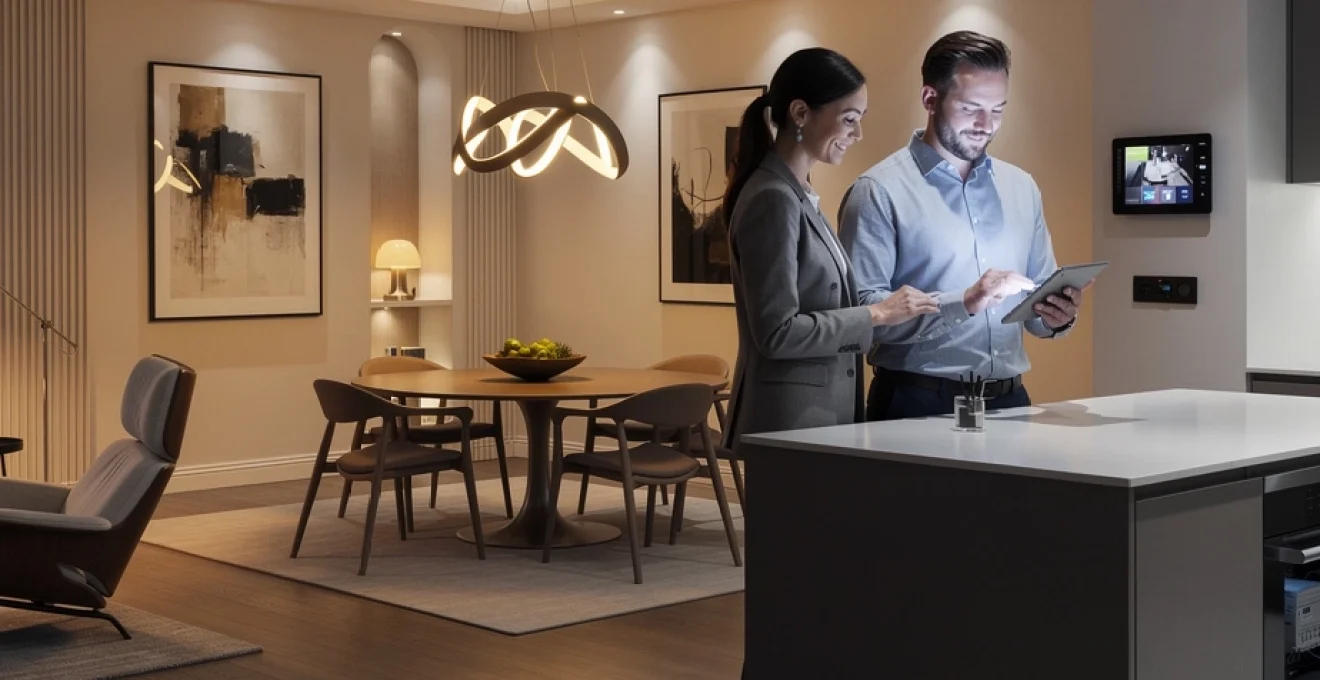
The strategic implementation of lighting design represents one of the most powerful tools in contemporary interior architecture, capable of fundamentally altering the perception, functionality, and emotional resonance of any space. Professional designers understand that thoughtful illumination choices extend far beyond mere visibility, serving as the invisible architect that shapes spatial experience through careful manipulation of brightness, colour temperature, and directional control. Modern lighting technologies have revolutionised the possibilities for creating dynamic, responsive environments that adapt to both functional requirements and aesthetic aspirations. Whether transforming a compact residential kitchen into an inviting culinary workspace or establishing the sophisticated ambiance of a high-end commercial venue, the right lighting choices can dramatically enhance spatial quality whilst supporting the intended use patterns and emotional responses of occupants.
Layered lighting design principles for spatial transformation
The foundation of exceptional lighting design rests upon the strategic implementation of multiple illumination layers, each serving distinct functional and aesthetic purposes whilst contributing to a cohesive visual environment. This multi-layered approach enables designers to create depth, visual interest, and flexible functionality that adapts to varying activities and moods throughout different times of day. Professional lighting schemes typically incorporate four primary layers: ambient, task, accent, and decorative lighting, each carefully calibrated to work harmoniously whilst maintaining individual effectiveness.
The sophisticated integration of these layers requires careful consideration of light distribution patterns, beam angles, and control systems to avoid unwanted shadows, glare, or visual conflicts between different sources. Think of layered lighting design as orchestrating a symphony where each instrument contributes unique tones whilst supporting the overall musical composition. The most successful installations demonstrate seamless coordination between layers, creating environments that feel naturally illuminated rather than artificially lit.
Ambient lighting distribution through recessed downlights and cove systems
Ambient lighting establishes the foundational illumination level throughout a space, providing general visibility whilst setting the overall brightness baseline for all other lighting layers. Recessed downlights remain the most popular choice for ambient distribution due to their clean aesthetic integration and controllable beam patterns. Modern LED downlight technology offers exceptional efficiency ratings of 100-120 lumens per watt, significantly reducing energy consumption whilst providing consistent colour rendering across extended operational periods.
Cove lighting systems create indirect ambient illumination by concealing LED strip fixtures within architectural details such as crown moulding, ceiling recesses, or wall niches. This technique produces soft, even light distribution that eliminates harsh shadows whilst adding architectural emphasis to room proportions. The optimal cove depth typically ranges from 150-300mm to ensure proper light mixing and prevent visible LED hotspots, with dimming capabilities essential for creating appropriate atmosphere adjustments.
Task lighting integration using Under-Cabinet LED strips and reading fixtures
Task lighting addresses specific functional requirements by delivering focused illumination precisely where visual activities occur, eliminating shadows and reducing eye strain during detailed work. Under-cabinet LED strips have revolutionised kitchen task lighting by providing shadow-free countertop illumination that enhances both safety and efficiency during food preparation activities. Professional-grade strip systems deliver 200-300 lumens per foot whilst maintaining colour temperatures between 3000K-4000K for optimal food colour rendering.
Reading fixtures require careful positioning to avoid glare whilst providing adequate light levels of 500-750 lux at the task surface. Modern swing-arm wall sconces and adjustable floor lamps incorporate LED technology with dimming capabilities, allowing users to customise brightness levels according to specific reading materials and personal preferences. The integration of task lighting into smart home systems enables programmable scenes that automatically adjust based on time of day or activity patterns.
Accent lighting placement with track systems and picture lights
Accent lighting creates visual hierarchy within spaces by highlighting architectural features, artwork, or decorative elements through precisely controlled illumination. Track lighting systems offer exceptional flexibility for accent applications, with adjustable heads that can be repositioned as room arrangements change. Professional track systems utilise low-voltage LED modules with narrow beam angles of 15-30 degrees to create dramatic highlighting effects whilst minimising spill light onto surrounding surfaces.
Picture lighting requires careful consideration of artwork dimensions, frame types, and viewing angles to avoid reflections whilst ensuring even illumination across the entire surface. Modern picture lights incorporate adjustable LED arrays with colour temperature options ranging from
2700K to 4000K to suit different art collections and interior palettes. Where conservation is a concern, particularly with sensitive works on paper or textiles, low-UV, low-heat LED picture lights are essential to prevent long-term damage. Mounting height and stand-off distance should be tested on-site, with the light source typically positioned at a 30-degree angle to minimise glare for viewers. For gallery-style spaces, a combination of picture lights and adjustable track heads allows you to refresh displays without extensive rewiring, giving you long-term flexibility as your collection evolves.
Decorative lighting elements through statement pendants and chandeliers
Decorative lighting acts as the visual jewellery of an interior, providing character and personality whilst still contributing meaningful illumination. Statement pendants above kitchen islands, dining tables, or stair voids draw the eye and help organise open-plan spaces into legible zones. When selecting decorative fixtures, proportion is critical: a fitting that is too small appears apologetic, whilst an oversized chandelier can overwhelm the room and create uncomfortable brightness contrasts. A useful guideline is to relate fixture diameter to both room dimensions and the scale of nearby furniture to maintain visual balance.
Suspended luminaires should never be considered in isolation from the broader layered lighting strategy. A dramatic dining-room pendant, for example, performs best when supported by dimmable wall sconces and subtle recessed downlights that can be dialled up for tasks and down for intimate dinners. Material selection also plays a significant role in how light is perceived; glass, crystal, and polished metal amplify sparkle and reflections, while fabric shades and matte finishes diffuse and soften light. By treating decorative lighting as both sculptural object and functional tool, you create interiors that feel curated yet highly usable.
Colour temperature manipulation for mood and atmosphere control
Beyond brightness and distribution, colour temperature has a profound impact on how we experience interior spaces. The perceived warmth or coolness of white light can subtly influence mood, productivity, and even how colours and materials appear. Thoughtful manipulation of temperature allows you to transform a space from energising to relaxing with a simple adjustment, without changing any physical furnishings. For designers, mastering colour temperature is akin to learning how to mix paints on a palette, blending different tones to achieve the perfect atmosphere.
Modern LED technologies give homeowners and professionals unprecedented control over colour temperature selection across an entire project. No longer restricted to a single fixed tone, you can now specify tunable systems that shift from warm candlelight to crisp daylight at the touch of a button. This flexibility is particularly valuable in multi-functional spaces, such as open-plan living areas that must support work, entertaining, and relaxation. By aligning colour temperature choices with both room function and time of day, lighting becomes an active part of your daily routine rather than a static background element.
Kelvin scale selection from 2700K warm white to 6500K daylight
The Kelvin scale provides the numerical framework for understanding colour temperature, ranging from warm, amber tones at the lower end to cool, bluish light at the higher end. In residential interiors, 2700K to 3000K is typically associated with cosy, intimate environments, similar to traditional incandescent lamps or candlelight. Moving into the 3500K to 4000K range introduces a neutral white that supports focus and accurate colour rendering, making it ideal for kitchens, home offices, and utility areas. At the upper end, 5000K to 6500K daylight tones are often reserved for task-intensive zones, workshops, or spaces where a clinical clarity is required.
How do you decide which point on the Kelvin scale is right for each room? Start by considering the primary activities that take place in the space and the emotional tone you want to convey. Bedrooms, living rooms, and dining areas generally benefit from warmer temperatures that encourage relaxation and social interaction. In contrast, studies, bathrooms, and wardrobes often demand neutral to cool light for accurate detail perception, particularly when applying makeup or evaluating clothing colours. Maintaining consistency of temperature within open sightlines prevents jarring transitions, while subtle variation between adjacent rooms can help define distinct functional zones.
Circadian rhythm lighting with tunable white technology
As wellness-focused design gains prominence, circadian lighting has become a key strategy for supporting healthy daily rhythms within the built environment. Humans evolved under dynamic natural light that changes in colour temperature and intensity from dawn to dusk; static interior lighting can disrupt this rhythm and contribute to fatigue or poor sleep quality. Tunable white LED systems allow you to mimic these natural variations by automatically shifting from cooler, higher-Kelvin settings in the morning to warmer tones in the evening. Many advanced systems pair this with gradual dimming profiles, creating gentle transitions that feel intuitive rather than abrupt.
In practical terms, circadian-aware lighting might deliver 4000K–5000K during early working hours in a home office or kitchen to boost alertness, before drifting towards 2700K in living areas as the evening progresses. Smart controls can integrate with your daily schedule, adjusting scenes based on time, occupancy, or even local sunrise and sunset times. For bedrooms, this approach supports winding down before sleep by reducing blue-rich light exposure that suppresses melatonin production. By aligning your interior lighting choices with your body’s natural clock, you transform your home into an ally for long-term health rather than a source of visual fatigue.
Room function optimisation through targeted temperature zones
Whilst whole-home colour temperature strategies promote cohesion, targeted temperature zones within individual rooms can deliver even greater precision. Consider a large open-plan living, dining, and kitchen area: you might specify warm 2700K pendants above the seating area, neutral 3000K downlights above circulation routes, and slightly cooler 3500K task lighting over the island and worktops. This subtle zoning supports each activity with optimal light quality while preserving an overall harmonious appearance. The key is to limit temperature jumps to 500K–1000K within a contiguous space to avoid disjointed visual impressions.
Bathrooms provide another excellent opportunity for temperature zoning. A vanity area can benefit from 3500K–4000K lighting for accurate skin tone rendering, while the bathing or spa zone might use 2700K sources for a relaxing, spa-like feel. In bedrooms, warmer bedside lamps can be balanced with slightly cooler ceiling fixtures for morning routines, particularly if those luminaires are independently switched or dimmable. By consciously assigning colour temperature to functional sub-zones, you gain the ability to fine-tune atmosphere without compromising on visual comfort or consistency.
Advanced dimming systems and smart lighting integration
Modern lighting control systems have transformed how we interact with illuminated spaces, enabling sophisticated dimming, scheduling, and scene-setting that were once reserved for commercial projects. Rather than relying on a single on/off switch, you can now manage multiple circuits, colour temperatures, and even individual fixtures from a unified interface. This level of control does more than add convenience; it significantly impacts energy efficiency, lamp longevity, and overall user satisfaction. Thoughtfully programmed scenes allow you to shift a room from focused task mode to soft evening ambiance in seconds, supporting both lifestyle and performance.
Smart lighting integration also opens the door to responsive environments that adapt to occupancy, daylight availability, and personal preferences. Voice assistants, smartphone apps, and wall-mounted keypads provide multiple points of control, ensuring that users of all ages can comfortably interact with the system. As these technologies become more accessible, we are seeing a convergence of residential and commercial-grade control philosophies, bringing professional-level flexibility into everyday homes. The result is lighting that feels intuitive, supportive, and inherently tailored to the way you live and work.
DALI protocol implementation for commercial-grade control
The Digital Addressable Lighting Interface (DALI) has long been a standard in commercial lighting design, prized for its reliability, flexibility, and fine-grained control. Unlike simple phase-cut dimming, DALI allows each luminaire or group of luminaires to be individually addressed, monitored, and controlled via a dedicated data network. This enables complex behaviours such as dynamic scenes, centralised fault reporting, and precise dimming curves that maintain colour stability across a wide range of light levels. For high-end residential projects, adopting DALI can deliver a commercial-grade backbone that supports evolving lighting choices over time.
However, DALI implementation requires careful coordination between lighting designers, electricians, and control-system integrators. Cable routing, addressing schemes, and emergency lighting provisions must be planned early in the design process to avoid costly revisions later. In mixed-use developments or large homes, DALI can also be integrated with building management systems (BMS) to align lighting with HVAC, shading, and security functions. For clients seeking long-term flexibility and robust performance, DALI offers a future-proof framework that accommodates both current and emerging LED technologies.
Lutron RadioRA and philips hue ecosystem integration
For many homeowners, wireless control ecosystems such as Lutron RadioRA and Philips Hue provide an accessible entry point into smart lighting without extensive rewiring. Lutron RadioRA leverages robust RF communication to connect keypads, dimmers, and shades, offering highly reliable performance even in large or architecturally complex homes. Its strength lies in seamlessly blending traditional wired circuits with intelligent control, delivering smooth dimming for a wide range of LED drivers and fixtures. Preconfigured “home”, “away”, and “goodnight” scenes simplify daily routines whilst enhancing security and energy management.
Philips Hue, by contrast, focuses on colour-tunable lamps and luminaires that screw into standard sockets, making it ideal for retrofits and rental properties. Through a combination of Zigbee or Bluetooth communication and intuitive apps, users can personalise colour temperature, brightness, and even full-colour effects without changing existing wiring. When integrated with voice assistants and third-party platforms, Hue systems can respond to triggers such as geolocation, calendar events, or media playback. In many projects, designers successfully combine ecosystems—using Lutron for architectural circuits and Hue for decorative fixtures—to achieve both reliability and creative flexibility.
Scene programming for multi-zone residential applications
Scene programming lies at the heart of effective smart lighting design, translating technical capabilities into everyday usability. Rather than controlling individual switches, you create pre-set combinations of light levels and colour temperatures that align with common activities: “Morning Routine”, “Work from Home”, “Family Dinner”, or “Movie Night”. Each scene may affect multiple zones simultaneously, harmonising task, ambient, and accent lighting with a single button press or voice command. For example, a “Cooking” scene could raise under-cabinet strips to 100%, set island pendants to a neutral 3500K at 70%, and dim adjacent living-room lamps to 30% for background comfort.
When designing multi-zone scenes, it is essential to consider both function and emotional impact. Ask yourself: how do you want the room to feel when this scene is active, and what visual hierarchy should be emphasised? Subtle changes in dimming levels can guide attention towards artwork, dining tables, or conversation areas without feeling contrived. During commissioning, on-site fine-tuning ensures that scenes respond appropriately to real-world conditions such as reflectance, daylight ingress, and occupant preferences. Over time, users can adjust and refine scenes as their routines evolve, ensuring that the system remains a living part of the home rather than a static installation.
Occupancy sensors and daylight harvesting technology
Occupancy sensors and daylight harvesting strategies offer powerful tools for enhancing both sustainability and convenience in residential and commercial interiors. Occupancy sensors detect movement or presence, automatically turning lights on when a room is in use and off when it is vacant, reducing unnecessary energy consumption. In circulation areas such as corridors, utility rooms, or guest bathrooms, this automation can be particularly effective, ensuring safety and visibility without relying on manual switching. Advanced sensors can differentiate between brief and extended occupancy, adjusting timeout periods accordingly to balance efficiency and user comfort.
Daylight harvesting takes the concept further by modulating artificial lighting in response to available natural light. Photocells or integrated sensors measure illuminance levels near windows and skylights, dimming electric lighting when daylight is abundant and increasing output as it fades. In well-designed systems, this transition is smooth and often imperceptible, maintaining consistent visual conditions throughout the day while significantly reducing energy use. Combined with smart controls and data analytics, daylight harvesting can inform broader design decisions about glazing, shading, and space planning, turning your lighting system into an active collaborator in sustainable design.
Architectural lighting techniques for space enhancement
Architectural lighting focuses on shaping how we perceive form, volume, and texture within a built environment, often blurring the line between illumination and structure. Rather than simply placing fixtures into a finished room, this approach integrates light into the architecture itself—within recesses, niches, joinery, and structural elements. Well-executed architectural lighting can visually expand low ceilings, elongate short corridors, or highlight craftsmanship that might otherwise go unnoticed. It is an incredibly effective way to transform interior spaces without altering the underlying floor plan.
One widely used technique is wall washing, where linear or recessed fixtures cast a uniform blanket of light across vertical surfaces. This makes rooms feel larger and brighter by drawing the eye outward and reducing contrast between walls and ceilings. In contrast, wall grazing positions luminaires close to textured surfaces such as stone, brick, or timber to emphasise relief and shadow, creating dramatic, tactile effects. Concealed linear LEDs under stair treads, within handrails, or along plinths provide subtle guidance and a sense of architectural refinement, particularly valuable in hospitality and high-end residential projects.
Ceiling details offer further opportunities for architectural enhancement. Indirect coves can visually lift ceilings by creating a halo of light around the perimeter, while recessed slot lights carve clean lines that reinforce circulation paths or align with key furniture groupings. In bathrooms and dressing spaces, backlit mirrors and integrated wardrobe lighting deliver both functional clarity and a boutique-like aesthetic. By considering architectural lighting early in the design process—ideally during concept and planning stages—you ensure that wiring routes, mounting details, and structural support are in place to create seamless, integrated results.
LED technology specification and energy-efficient solutions
LED technology sits at the core of contemporary lighting design, enabling high performance, long life, and remarkable design flexibility compared to legacy sources. Where traditional incandescent lamps might offer 10–15 lumens per watt, high-quality LEDs regularly achieve 90–120 lumens per watt, dramatically reducing energy consumption for equivalent light output. In practical terms, this means you can achieve ambitious lighting concepts with far fewer watts per square metre, lowering both operating costs and heat load on HVAC systems. For environmentally conscious projects, this efficiency is a cornerstone of sustainable interior transformation.
Specification, however, extends well beyond simple wattage comparisons. Colour rendering index (CRI) is a critical metric, with values of 90+ strongly recommended for residential and hospitality spaces where accurate colour perception is important. Poor CRI can make materials appear flat or distorted, undermining even the most carefully curated palettes. Additionally, parameters such as flicker percentage, beam angle, and driver compatibility influence both visual comfort and system reliability. By selecting reputable manufacturers with clear photometric data and robust warranties, you significantly reduce the risk of premature failures or inconsistent performance.
Energy-efficient solutions also involve intelligent control strategies and thoughtful fixture placement. Dimmable LEDs, when paired with compatible drivers and control systems, extend lamp life by operating at reduced output whenever full brightness is unnecessary. Zoning and scene control prevent over-illumination by targeting light only where it is needed, rather than flooding entire rooms indiscriminately. In renovations, retrofitting existing luminaires with high-quality LED retrofit lamps can offer a cost-effective transition, provided that thermal management and driver compatibility are properly assessed. Over the life of a building, these choices contribute to substantial carbon and cost savings without sacrificing visual quality.
Professional installation considerations and safety compliance
The most sophisticated lighting concept can only succeed if it is supported by meticulous installation and rigorous adherence to safety standards. Electrical work must comply with relevant local codes and regulations, including appropriate circuit protection, earthing, and cable sizing for the intended load. In many jurisdictions, fixed wiring and the installation of new circuits are legally restricted to licensed electricians—an essential safeguard against fire risk and electric shock. Engaging qualified professionals ensures that dimming systems, drivers, and fixtures are correctly matched, avoiding issues such as flicker, humming, or premature component failure.
Safety compliance extends beyond electrical fundamentals to considerations such as ingress protection (IP) ratings, fire-rated fittings, and emergency lighting where required. In bathrooms, for example, luminaires must be selected according to their proximity to water sources, with appropriate IP ratings to prevent moisture ingress and potential hazards. Fire-rated downlights may be necessary to maintain the integrity of fire-resistant ceilings, particularly in multi-storey dwellings or apartment buildings. When integrating architectural details like coves or concealed strips, adequate ventilation and access for maintenance must be planned to prevent overheating and facilitate future servicing.
Coordination between designers, electricians, joiners, and automation specialists is vital to deliver a coherent, safe, and maintainable system. Detailed lighting layouts, switching schedules, and control diagrams help prevent site-based improvisation that can compromise both aesthetics and performance. Before handover, thorough testing and commissioning confirm that all circuits, dimming channels, and scenes operate as intended, with documentation provided for future reference. By treating professional installation and safety compliance as integral components of the design—not afterthoughts—you protect both the long-term value of the project and the wellbeing of its occupants.