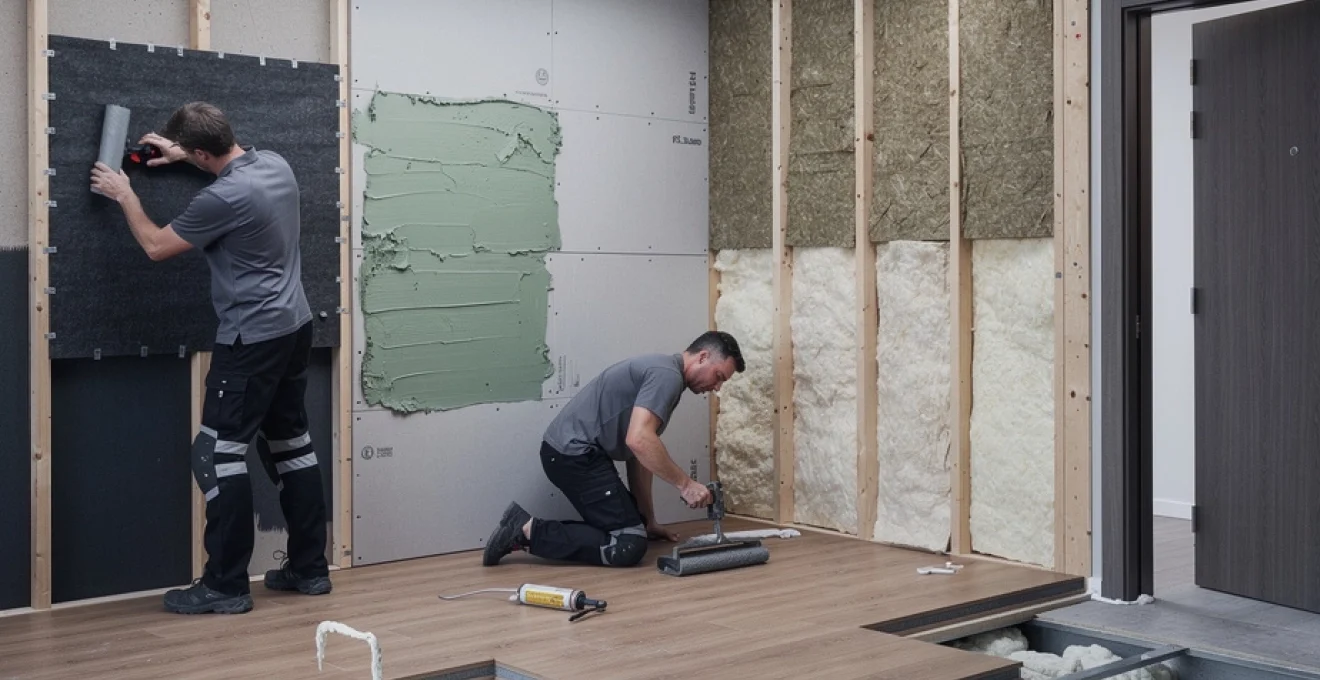
In today’s increasingly noisy world, creating a peaceful sanctuary within your home has become more critical than ever. Whether you’re dealing with bustling traffic, noisy neighbours, or simply seeking to contain sound within specific rooms, effective soundproofing techniques can dramatically transform your living environment. Modern soundproofing goes far beyond the stereotypical foam panels of recording studios, encompassing sophisticated materials and installation methods that can reduce noise transmission by up to 50 decibels or more. The science of acoustic engineering has evolved significantly, offering homeowners practical solutions that balance performance, aesthetics, and budget considerations. Understanding the fundamentals of sound transmission and implementing the right combination of materials and techniques can create the tranquil environment you deserve.
Sound transmission class (STC) ratings and acoustic performance metrics
Sound Transmission Class ratings serve as the industry standard for measuring how effectively building materials and assemblies reduce airborne sound transmission. The STC rating system uses a standardised testing protocol that measures sound reduction across 16 frequency bands, providing a single-number rating that makes it easier to compare different soundproofing solutions. Standard residential walls typically achieve STC ratings between 33-45, whilst properly soundproofed walls can reach STC 50-65 or higher.
Understanding these ratings becomes crucial when selecting appropriate materials for your specific noise concerns. An STC rating increase of 10 points represents a perceived halving of noise levels to the human ear, making seemingly small improvements in rating quite significant in practice. For context, normal conversation registers around 60 decibels, whilst a typical STC 45 wall would reduce this to approximately 15 decibels on the other side.
Professional acoustic engineers consistently emphasise that STC ratings alone don’t tell the complete story, as they don’t account for low-frequency sounds like bass music or traffic rumble, which require additional considerations in material selection and installation techniques.
Impact Insulation Class (IIC) ratings complement STC measurements by specifically addressing impact noise transmission through floors and ceilings. IIC ratings become particularly important for multi-storey homes where footsteps, dropped objects, and furniture movement can significantly disturb occupants below. Building codes typically require minimum IIC ratings of 45-50 for residential construction, though achieving ratings of 60 or higher provides substantially better comfort levels.
Mass-loaded vinyl (MLV) installation techniques for wall and ceiling applications
Mass-loaded vinyl represents one of the most versatile and effective soundproofing materials available to homeowners, offering exceptional noise reduction capabilities in a relatively thin profile. This dense, flexible material typically weighs between 0.5-2 pounds per square foot, with heavier versions providing superior sound blocking performance. MLV works by adding significant mass to existing wall and ceiling assemblies without requiring major structural modifications.
Proper MLV installation requires careful attention to sealing and overlap details to prevent acoustic flanking paths. The material should be installed with at least 2-inch overlaps at all seams, with joints sealed using appropriate acoustic caulking compounds. When installing MLV on walls, mechanical fasteners should penetrate into solid framing members, with fastening patterns following manufacturer specifications to prevent sagging or gaps over time.
Green glue noiseproofing compound application methods
Green Glue noiseproofing compound functions as a viscoelastic damping material that converts sound energy into minimal amounts of heat, significantly reducing noise transmission through wall and ceiling assemblies. This innovative compound works best when sandwiched between two rigid layers, such as drywall or plywood, creating a constrained layer damping system that can improve STC ratings by 5-9 points depending on the application.
Application technique proves critical for optimal performance, requiring a continuous bead pattern across the entire surface of the substrate material. Professional installers recommend applying Green Glue in a random squiggly pattern, using approximately 2 tubes per 4×8 sheet of drywall. The compound remains workable for about 15 minutes after application, allowing sufficient time for positioning and securing the second layer of material.
Resilient channel installation using RC-1 and RC deluxe systems
Resilient channels create mechanical isolation between drywall and
the framing members and following the correct orientation of the channel. RC‑1 and RC Deluxe systems use a thin metal profile that decouples the plasterboard from the studs, dramatically reducing the direct vibration path. Channels should run perpendicular to the studs, with the open side of the channel facing downwards or away from the gypsum board, depending on the manufacturer’s details. Screws must only attach the drywall to the resilient channels, never through into the studs, or you risk short‑circuiting the isolation effect and losing much of the soundproofing benefit.
In ceiling applications, resilient channels can be particularly effective in reducing footfall noise from above, especially when combined with insulation and a double layer of plasterboard. You’ll typically position channels at 400 mm or 600 mm centres, ensuring adequate support without creating unnecessary rigid connections. Care is needed around the perimeter of walls and ceilings: leaving a small gap between the plasterboard and adjoining surfaces, then filling it with acoustic caulk, helps maintain the “floating” effect that resilient systems are designed to achieve. When installed correctly, RC‑1 and RC Deluxe systems can contribute to STC ratings in the 55–65 range for walls and ceilings subject to high noise levels.
Double stud wall construction with staggered framing
Double stud walls and staggered stud framing represent some of the most effective structural methods for soundproofing a room in a house. Rather than relying solely on heavy materials, these assemblies create two separate framing lines with an air gap between them, breaking the direct vibration bridge through the structure. In a full double stud wall, two independent stud walls are built with a gap of 25–50 mm between them, each supporting its own layer of plasterboard. In a staggered stud wall, a single top and bottom plate support alternating studs on each side, so the plasterboard layers on either side are attached to different studs and never share the same framing member.
This technique can feel like building “a wall within a wall”, but the acoustic pay‑off is substantial, especially when you are trying to isolate loud home cinema systems, music studios, or noisy neighbours. By combining double stud construction with dense insulation in the cavity and multiple layers of plasterboard (ideally with Green Glue between them), it’s possible to achieve STC ratings well above 60. The main trade‑offs involve increased wall thickness, reduced floor space, and higher material and labour costs, so you’ll want to prioritise this approach for the most critical rooms rather than the entire house.
Acoustic caulking with OSI Pro-Series sealants
Even the most sophisticated soundproofing strategies can be undermined by small gaps and cracks, which is why acoustic caulking is an essential component of any high‑performance system. Products in the OSI Pro‑Series of acoustic sealants are designed to remain permanently flexible, allowing them to move with the building while maintaining an airtight, sound‑blocking seal. Unlike standard decorators’ caulk, acoustic sealants maintain their elasticity over time and adhere better to common construction materials such as plasterboard, timber, and metal.
For best results, you should apply acoustic caulk around the perimeter of each plasterboard sheet, at junctions between walls and ceilings, and around electrical boxes, pipe penetrations, and window or door frames. Any gap that could leak air can also leak sound, so treating these weaknesses is an inexpensive way to enhance overall performance. A simple rule of thumb is to complete all framing, insulation, and board work, then spend focused time sealing every visible joint you can access. This attention to detail can easily add several effective STC points to your wall or ceiling assembly.
High-performance insulation materials: rockwool Safe’n’Sound vs owens corning 703
High‑performance insulation plays a dual role in a quiet home, offering both thermal efficiency and improved acoustic comfort. Two of the most widely discussed products in residential soundproofing projects are Rockwool Safe’n’Sound and Owens Corning 703, each with distinct strengths. Rockwool Safe’n’Sound is a mineral wool batt designed specifically for internal walls, ceilings, and floor cavities, prized for its density, fire resistance, and ease of installation in stud cavities. Owens Corning 703, on the other hand, is a rigid fibreglass board more commonly used in acoustic panels and bass traps where precise control of sound absorption is needed.
When you’re choosing between these materials, it helps to consider whether your primary goal is to improve sound isolation between rooms or to fine‑tune the acoustic character within a room. Safe’n’Sound excels at reducing airborne sound transmission through partition walls and floors, especially when combined with additional mass and decoupling techniques. Owens Corning 703 is ideal when you need to tame echo, flutter, and reverberation in spaces like home theatres, control rooms, or podcast studios. In many cases, both products can work together: mineral wool in the cavities for isolation, and rigid boards on the room side as part of decorative absorber panels.
Mineral wool density classifications for sound absorption
Mineral wool insulation, including Rockwool Safe’n’Sound, is manufactured in various density classes, typically ranging from around 40 kg/m³ to over 80 kg/m³. Density directly influences how effectively the material absorbs different sound frequencies: lower‑density products are often better at mid‑ and high‑frequency absorption, while higher‑density boards can offer more efficient control of lower midrange sounds. In practice, most residential soundproofing benefits from mid‑density mineral wool in the 45–60 kg/m³ range, which provides a strong balance between sound absorption, cost, and ease of handling.
It’s important to remember that stuffing a cavity with the heaviest insulation you can find isn’t always the most efficient solution. Overly dense materials can sometimes reduce the absorption of certain frequencies by reflecting rather than dissipating sound energy, a bit like hitting a concrete wall instead of a thick curtain. For typical stud walls and ceiling joists, loosely filling the cavity with the recommended density of mineral wool, without compressing it, tends to produce the best real‑world performance. This approach helps to break up sound waves inside the cavity and reduce resonance, contributing to higher effective STC ratings.
Fiberglass batt r-values and acoustic properties
Fibreglass batt insulation remains a staple in many homes thanks to its affordability, availability, and strong thermal performance. Its acoustic performance is often misunderstood, however. While fibreglass batts are not as dense as some mineral wool products, they still offer meaningful reductions in airborne noise when installed correctly in wall, ceiling, or floor cavities. The thermal rating, expressed as an R‑value, indicates resistance to heat flow, but there is a loose correlation between higher R‑values and improved sound absorption because thicker batts cover more of the cavity depth.
From an acoustic standpoint, standard R‑13 or R‑15 fibreglass batts in 90 mm stud walls can help reduce the liveliness of the cavity, limiting resonance and sound transmission across a broad frequency range. You won’t see the same level of improvement as with purpose‑designed acoustic mineral wool, but combining fibreglass batts with mass‑loaded vinyl, double layers of plasterboard, or resilient channels can still deliver excellent results. When evaluating fibreglass batts for soundproofing a bedroom or living area, think of them as one layer in a composite system rather than a complete solution on their own.
Cellulose insulation blown-in techniques for soundproofing
Blown‑in cellulose insulation offers a flexible way to improve both thermal and acoustic performance, particularly in existing walls and ceilings where you want to avoid major demolition. Made largely from recycled paper treated for fire resistance, cellulose can be dense‑packed into cavities, reducing air gaps and creating a more uniform sound‑absorbing layer. Because it fills voids around wiring, pipes, and irregular framing, cellulose can outperform loosely fitted batts in older properties with uneven cavities.
Installation involves using a blowing machine to deliver the material through small holes drilled in the plasterboard or exterior sheathing. Once filled to the correct density, those access points are patched and finished. Does this method turn a standard wall into a recording studio partition? Not on its own, but adding blown‑in cellulose can meaningfully reduce everyday noise from traffic, neighbours, and internal household activity. It’s a particularly attractive option if you’re already upgrading insulation for energy efficiency and want to gain additional soundproofing benefits at the same time.
Polyurethane foam injection systems and noise reduction
Polyurethane foam injection systems, including both open‑cell and closed‑cell formulations, are often marketed as premium insulation solutions with secondary acoustic benefits. Open‑cell spray foam, in particular, has a porous structure that can absorb and dampen sound to some extent, reducing high‑frequency noise and improving overall comfort in lightweight constructions. Closed‑cell foam is denser and better for moisture control and structural reinforcement, but its sound absorption performance is more limited because it tends to reflect sound rather than absorb it.
From a pure soundproofing perspective, polyurethane foam should usually be combined with other strategies such as additional mass, resilient channels, and acoustic sealants. It does an excellent job of sealing leaks, which helps prevent sound flanking through cracks and gaps, but it isn’t a magic cure‑all for low‑frequency noise or impact sounds. If you’re already considering foam for its thermal and air‑sealing advantages, you can think of the noise reduction as a welcome bonus rather than the primary justification. For critical applications like home theatres or music rooms, mineral wool or specialised acoustic insulation typically offers better value in terms of noise isolation per pound spent.
Professional acoustic door solutions and solid core replacements
Doors are often the weakest link in a soundproofing strategy, especially in modern homes where lightweight, hollow‑core designs are common. Hollow doors act like thin drums, transmitting and amplifying sound rather than blocking it. Upgrading to a solid‑core door with proper acoustic seals around the perimeter can transform the performance of a bedroom, office, or media room, often yielding one of the most noticeable improvements per unit cost. Professional acoustic door assemblies go even further, incorporating specialised cores, heavy frames, and compression seals designed to achieve laboratory STC ratings in the 40–55 range.
For many homeowners, a practical middle ground involves replacing hollow‑core interior doors with off‑the‑shelf solid‑core models and then adding perimeter weatherstripping and an automatic door bottom or threshold seal. This combination dramatically reduces the gaps where sound can leak, especially along the floor where even a 5 mm gap can seriously compromise isolation. If you’ve already invested in soundproofing the surrounding walls, bringing the door up to a similar standard ensures you’re not leaving an acoustic “hole” in your otherwise robust design. When planning a quieter home environment, it’s worth prioritising doors to bedrooms, studies, and entertainment spaces where privacy and tranquillity matter most.
Window soundproofing: laminated glass and secondary glazing systems
Because glass is relatively light and rigid, windows can be one of the main entry points for external noise such as traffic, aircraft, or late‑night conversations. Fortunately, several advanced window soundproofing techniques can dramatically reduce noise without sacrificing natural light. Laminated glass, secondary glazing systems, and high‑quality seals all contribute to higher effective STC ratings and a more comfortable indoor environment. The key is to think in terms of both mass and air gaps: heavier glass blocks more sound, while larger, sealed air spaces disrupt sound transmission across the window assembly.
When you’re considering upgrading existing windows, you’ll need to decide whether to replace the entire unit, retrofit secondary glazing on the interior, or improve the performance with simpler measures such as acoustic films and weatherstripping. Full replacement with acoustic or triple‑pane units tends to offer the best overall performance but also comes with the highest cost and potential planning constraints, especially in heritage properties. Secondary glazing, by contrast, can often be installed internally with minimal changes to the building exterior, making it a popular choice in both period homes and modern apartments.
Milgard quiet line Triple-Pane window performance
Milgard’s Quiet Line Series is an example of a purpose‑built acoustic window system designed to tackle significant external noise problems. These triple‑pane units use varying glass thicknesses and wider air gaps to disrupt sound waves, achieving STC ratings that can exceed 40–45 when properly installed. By comparison, a standard double‑glazed window may only reach STC 28–32, which is often insufficient for homes near busy roads or flight paths where low‑frequency noise is a constant concern.
In addition to the glass configuration, Quiet Line windows incorporate robust frames and high‑quality sealing systems to minimise sound leakage around the perimeter. If you think of sound trying to “sneak in” through any weakness, you can see why the frame design is just as important as the glazing itself. For homeowners planning major window replacements, choosing an acoustic‑rated product like this can be a strategic way to future‑proof the property against increasing urban noise, particularly in bedrooms and living spaces where peace and quiet are a priority.
Indow window insert installation and effectiveness
Indow window inserts offer an alternative approach to window soundproofing by adding a removable, interior layer rather than replacing the existing window. Each insert is custom‑measured and fitted with a compression seal that presses snugly into the inside of the window frame, creating a trapped air space between the primary glass and the insert. This configuration mimics the principles of secondary glazing and can achieve substantial noise reduction, often in the range of 10–20 decibels depending on the original window and the frequency profile of the noise.
Installation is typically straightforward for competent DIYers: after measuring and ordering the inserts, you simply press them into place without the need for screws or damaging alterations. This makes Indow particularly attractive for renters or owners of listed buildings where exterior alterations are restricted. From a comfort perspective, you not only benefit from a quieter home but also from improved thermal performance and reduced drafts, which can help to lower heating and cooling costs. For many urban dwellers, this balance of performance, reversibility, and aesthetics makes window inserts one of the most compelling upgrades for creating a quieter home office or bedroom.
Acoustic window film applications using 3M safety films
Acoustic window films, such as certain 3M Safety and Security Films, are sometimes promoted as a way to improve both safety and sound control. These clear or tinted polyester layers bond to the glass, increasing its shatter resistance and slightly altering its vibration characteristics. While films cannot add significant mass, they can damp some of the higher‑frequency resonance in the glass panes, marginally improving perceived acoustic comfort in conjunction with other measures.
Realistically, window films should be viewed as a supplementary soundproofing tool rather than a primary solution for severe noise problems. Their strongest benefits lie in safety, UV reduction, and in some cases energy savings. However, if you’re already upgrading your windows with laminated glass or secondary glazing, adding an appropriate 3M film can be the finishing touch that fine‑tunes performance. Think of it as the acoustic equivalent of adding a topcoat to a painted wall: it doesn’t replace the work underneath but can enhance and protect the overall system.
Weatherstripping upgrades with EPDM and silicone seals
Even the most sophisticated glazing system will underperform if the seals around the window frame are worn, cracked, or missing. Upgrading weatherstripping with high‑quality EPDM or silicone seals is one of the most cost‑effective ways to reduce noise from outside, especially whistling drafts and high‑frequency sounds. EPDM rubber offers excellent durability and resistance to temperature extremes, while silicone seals maintain flexibility and performance over long periods, even in harsh sunlight.
By carefully inspecting each window and door and replacing compromised gaskets, you can significantly improve both acoustic and thermal performance. Focus on creating a continuous, unbroken seal around the perimeter, and pay particular attention to operable sashes where movement can create small, uneven gaps. You might be surprised by how much quieter a room feels once the tell‑tale gaps are properly sealed; in many cases, this simple upgrade is the missing piece that allows more advanced soundproofing techniques to deliver their full potential.
Floor impact noise control through underlayment and decoupling methods
Impact noise from footsteps, moving chairs, and dropped objects is one of the most intrusive disturbances in multi‑storey homes and apartments. Unlike airborne sound, which travels through the air and can be blocked by mass, impact noise is transmitted as vibration through the building structure itself. Controlling it requires a combination of resilient underlayments, floating floor systems, and sometimes structural modifications that decouple floor finishes from the underlying joists or concrete slab. When done correctly, these methods can significantly improve the IIC (Impact Insulation Class) rating of the floor assembly and create a more peaceful home environment for everyone below.
Common solutions include rubber or cork underlayments beneath engineered wood, laminate, or tile, as well as specialised acoustic mats designed to absorb and dissipate impact energy. In timber‑framed buildings, installing a floating floor—where the finished flooring “floats” on a resilient layer without rigidly connecting to the subfloor—can dramatically reduce the transmission of footfall noise. For concrete structures, adding a resilient underlayment beneath new floor finishes can be equally transformative, especially in open‑plan living areas where sound can otherwise travel widely.
If you’re planning a renovation, it’s wise to think about impact noise control at the design stage rather than trying to fix it after the fact. Simple choices, such as specifying thicker carpets with dense underlay in upstairs bedrooms or using acoustic underlayment beneath hard floors in hallways, can make a noticeable difference to everyday comfort. When combined with ceiling treatments below—such as resilient channels and insulated cavities—you can often achieve an impressively quiet result without resorting to extreme structural changes. In essence, by strategically layering materials and introducing resilient breaks in the structure, you create a home that not only looks good but also sounds and feels calm, even in a busy modern world.