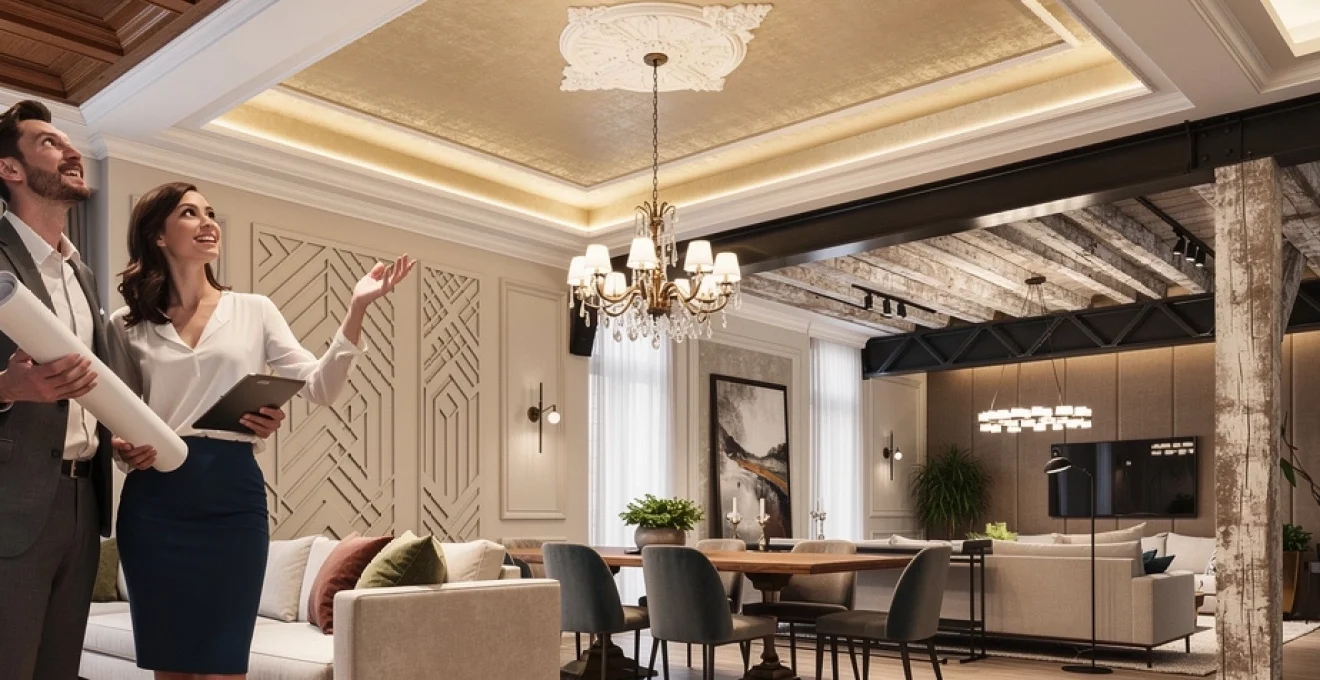
The ceiling represents one of the most underutilised canvases in interior design, yet it holds tremendous potential to transform ordinary rooms into extraordinary spaces. While walls and floors typically receive most of the decorating attention, the expanse above your head offers a vast opportunity to introduce architectural interest, visual drama, and sophisticated detailing that can fundamentally alter how you experience a room. From the grandeur of coffered panels to the sleek minimalism of stretch fabric systems, contemporary ceiling design has evolved beyond simple flat surfaces painted white. Today’s architectural innovations combine traditional craftsmanship with cutting-edge materials, allowing homeowners and designers to create overhead statements that reflect personal style whilst addressing practical concerns like acoustics, lighting integration, and spatial perception.
Coffered ceiling panels and box beam construction techniques
Coffered ceilings have graced prestigious buildings for centuries, from ancient Roman temples to Renaissance palaces, and their enduring appeal lies in the distinctive three-dimensional grid pattern that adds instant architectural gravitas to any space. These recessed panels create a sophisticated rhythm across the ceiling plane, breaking up what might otherwise be a monotonous expanse whilst introducing shadow lines that change throughout the day as natural light shifts. The perception of height and volume increases dramatically when you introduce this type of geometric patterning, as the eye travels across the various depths and planes rather than simply registering a flat surface. Modern coffered designs range from deeply recessed traditional styles with elaborate crown moulding to subtle contemporary interpretations featuring clean lines and minimal ornamentation. The scale of the coffer grid should always relate proportionally to the room dimensions—larger rooms benefit from more generous panel sizes, whilst smaller spaces require more delicate configurations to avoid overwhelming the architecture.
Traditional timber frame coffering with crown moulding integration
Authentic timber frame coffering represents the pinnacle of craftsmanship in ceiling design, with each box beam carefully constructed from solid wood and integrated with complementary crown moulding profiles. This approach typically involves creating a framework of beams that intersect at right angles, forming square or rectangular recessed panels between them. The beams themselves might measure anywhere from 100mm to 300mm in width depending on ceiling height and desired visual impact. Quality hardwoods such as oak, walnut, or mahogany deliver rich grain patterns and natural colour variations that enhance the tactile quality of the installation. The crown moulding serves as the transitional element between beam faces and the recessed panels, softening what would otherwise be harsh geometric edges whilst introducing an additional layer of detail. Professional installers often recommend a minimum ceiling height of 2.7 metres for traditional coffered designs, as anything lower can make the space feel compressed rather than enhanced.
MDF and polyurethane Pre-Fabricated coffer systems
For those seeking the aesthetic appeal of coffered ceilings without the substantial investment required for custom timber construction, engineered materials offer compelling alternatives. Medium-density fibreboard presents an economical yet durable option that accepts paint finishes beautifully, creating a seamless appearance indistinguishable from timber once installed. These systems typically arrive as component pieces that interlock or attach to a grid framework mounted directly to the existing ceiling surface. Polyurethane coffer systems have gained considerable traction in recent years due to their exceptional lightness, resistance to moisture and temperature fluctuations, and the intricate detailing achievable through moulding processes. Installation time decreases substantially with pre-fabricated systems, often requiring just days rather than weeks for completion. The reduced structural load also means fewer concerns about ceiling joist capacity, making these materials particularly suitable for renovation projects where existing framing might not support the weight of solid timber beams.
Geometric grid patterns: octagonal and waffle ceiling configurations
Moving beyond traditional square and rectangular layouts, adventurous designers have embraced more complex geometric arrangements that create striking visual interest. Octagonal coffering introduces diagonal elements that draw the eye in multiple directions simultaneously, creating a sense of movement and dynamism overhead. This configuration works particularly well in square rooms where the angles complement the underlying architecture rather than fighting against it. Waffle ceilings represent another sophisticated variation, featuring uniform grid patterns with consistently sized and shaped recesses that create an almost textile-like appearance. The repetitive nature of waffle designs produces a calming, ordered aesthetic that suits both traditional and contemporary interiors. When planning
beam depths and spacing, it is worth mocking up the pattern with painter’s tape on the existing ceiling first to verify proportions and sightlines from key seating positions. You will also want to coordinate sprinkler heads, HVAC diffusers, and access panels so they fall neatly within or between the geometric coffers rather than interrupting critical intersections.
Recessed lighting placement within coffer compartments
Thoughtful recessed lighting design is essential to ensure your coffered ceiling feels intentional rather than visually busy. Many designers prefer to position downlights within the centre of select coffer panels, creating evenly spaced pools of light that accentuate the three-dimensional depth of the grid. In living rooms and dining areas, you might opt to highlight perimeter coffers with adjustable fixtures while leaving central panels reserved for a statement chandelier or pendant composition. As a rule of thumb, avoid placing recessed fixtures directly on beam intersections, as this can create awkward shadowing and distract from the rhythm of the box beams themselves.
Integrating dimmable LED downlights with warm colour temperatures (around 2700–3000K) helps maintain a cosy ambience, especially when working with dark-stained timber coffers that could otherwise feel heavy. Consider using narrow-beam spots to graze the sides of the recessed panels, subtly emphasising texture in painted finishes or decorative insets. In home theatres or media rooms, you may prefer a more discreet lighting strategy with small-aperture fixtures or even miniature pin spots set deep into the coffers to limit glare on screens. By layering general illumination with accent and task lighting, your coffered ceiling design becomes a powerful tool for shaping the mood and functionality of the room.
Tray ceiling architecture and multi-level suspended designs
Tray ceilings—sometimes referred to as recessed or inverted ceilings—introduce a central raised portion bordered by one or more dropped perimeters, creating the effect of a “ceiling within a ceiling.” This architectural device can make a room feel both taller and more intimate at the same time, particularly when combined with strategic lighting and contrasting finishes. In new-build homes, tray ceiling architecture is often integrated into the structural design from the outset, but skilful contractors can also retrofit multi-level suspended designs in renovation contexts using lightweight framing and plasterboard. Because tray ceilings draw the eye upward, they are an excellent way to enhance interior aesthetics in principal bedrooms, formal living rooms, and dining spaces where you want a distinct sense of occasion.
Single-step and double-step tray ceiling construction methods
Single-step tray ceilings feature one dropped border surrounding a central raised area, delivering a clean, understated look that suits contemporary interiors and modern minimalist living rooms. Construction typically involves installing a perimeter soffit using timber or metal studs fixed to the existing ceiling joists, then boarding and plastering to create crisp horizontal and vertical planes. Double-step tray ceilings add a second tier, with each “step” recessed a little further towards the centre; this layered effect introduces more pronounced shadow lines and a heightened sense of depth. While double-step designs are more visually dramatic, they demand careful coordination of proportions so that the tray does not encroach excessively on usable ceiling height, especially in rooms below 2.7 metres.
When planning your tray ceiling construction method, you will need to account for existing services such as ductwork, wiring, and sprinkler systems that might influence soffit depths. It is often advantageous to align the lowest tray level with the height of adjacent door heads or built-in cabinetry, creating a continuous visual datum around the perimeter of the space. In open-plan areas, you can also use a tray ceiling to delineate specific zones—such as the living area within a larger kitchen–dining–living volume—without relying on walls or partitions. This makes tray ceilings a powerful, non-intrusive tool for space planning in modern homes.
Cove lighting installation along perimeter ledges
One of the most effective ways to enhance a tray ceiling is to integrate cove lighting along the perimeter ledges, allowing light to wash gently across the raised centre. LED strip lighting has revolutionised this technique thanks to its slim profile, low heat output, and long lifespan—ideal for concealed installations where maintenance access is limited. By recessing LED tape into a dedicated channel or behind a small lip on the tray edge, you can create a soft halo of indirect illumination that visually lifts the ceiling and emphasises the architectural layering. Have you ever noticed how hotel suites often feel luxurious without you being able to pinpoint exactly why? Discreet cove lighting in the ceiling is usually one of the secrets.
When specifying cove lighting for tray ceilings, pay attention to lumen output and diffusion. High-output strips may require opal diffusers or deeper coves to avoid visible hot spots or banding along the ceiling surface. Many designers favour warm white LEDs for bedrooms and living rooms, reserving slightly cooler temperatures for kitchens and workspaces where brighter, more energising light is desirable. Dimmable drivers and smart controls allow you to adjust intensity throughout the day, transforming the space from functional brightness to atmospheric glow with a single command. By pairing cove lighting with a separate circuit for central fixtures, you give yourself maximum flexibility to adapt the mood for entertaining, relaxing, or focused tasks.
Metallic leaf application and venetian plaster finishes for tray insets
The inset portion of a tray ceiling presents a prime opportunity to introduce luxe finishes that might feel overpowering if applied to walls. Metallic leaf—gold, silver, or copper—can be expertly laid onto a prepared substrate to create a luminous, subtly textured field that catches the light from chandeliers or cove lighting. Even small amounts of leafing within the inner tray can elevate a bedroom or dining room from ordinary to boutique-hotel level sophistication, especially when paired with understated wall treatments. Venetian plaster finishes, with their polished, stone-like appearance, offer a similarly refined option for tray insets, delivering depth and movement without overt pattern.
Applying these specialty finishes demands a high level of craftsmanship, as any imperfections are magnified when viewed overhead and lit from multiple directions. You will want to discuss with your finisher how the tray will be lit—raked light from coves will accentuate trowel marks and variations, which can be either desirable or distracting depending on the intended look. Metallic and plaster treatments also influence the perceived colour temperature of the light in the room, with warm-toned metals enriching warm LEDs and cooler silvers or pewters complementing neutral whites. As with jewellery accenting an outfit, the key is balance: a richly finished tray inset sings best when the surrounding elements are more restrained.
Fabric panel upholstery and acoustic treatment integration
For media rooms, home theatres, and open-plan living spaces where sound control is a priority, fabric panel upholstery within a tray ceiling can provide both visual softness and measurable acoustic benefits. Here, the recessed centre or even the vertical faces of the tray steps can be fitted with lightweight timber or aluminium frames, overlaid with acoustic batting and stretched fabric. The result is a ceiling that subtly absorbs echo and reverberation, making conversation clearer and cinematic experiences more immersive. From a design perspective, fabric insets offer a chance to introduce colour, pattern, or texture in a controlled, elevated plane that does not dominate the room.
Integrating acoustic treatments into tray ceilings is often more discreet than wall-mounted panels, which may clash with artwork or shelving. Think of the tray as a hidden sound sponge, quietly improving comfort while maintaining a clean aesthetic. You can specify everything from matte linen-look textiles for a relaxed, Scandinavian feel to plush velvets for a dramatic theatre atmosphere. It is important to coordinate fabric selections with fire-rating requirements and to ensure that any access hatches to services remain operable. When combined with perimeter cove lighting, upholstered tray ceilings can feel almost like a tailored canopy floating above the room.
Exposed structural ceiling elements: beams, trusses, and joists
Exposing structural ceiling elements has become a hallmark of both industrial loft aesthetics and contemporary rustic design, celebrating the “bones” of a building rather than hiding them. Beams, trusses, and joists introduce strong linear rhythms overhead, adding character and a sense of authenticity that painted plaster alone cannot achieve. Whether you are working with original century-old timbers or installing new decorative elements, the interplay between structure, light, and void profoundly influences how spacious and grounded a room feels. In taller spaces, exposed beams can visually lower the ceiling to create intimacy; in lower rooms, slender, well-spaced elements can elongate the perspective and emphasise length rather than height.
Reclaimed wood beam installation for industrial loft aesthetics
Reclaimed wood beams, sourced from barns, factories, or old warehouses, bring an immediate sense of history and texture to a space. Their weathered surfaces, bolt holes, and irregularities tell a story that new timber simply cannot replicate, making them ideal for industrial loft aesthetics and modern farmhouse interiors alike. Because reclaimed beams are often heavy and dimensionally unique, structural engineering input is usually necessary to confirm load paths and attachment methods. Installers may bolt them to existing joists or use concealed steel plates and brackets to secure them safely while maintaining a visually clean appearance.
From an interior design perspective, you will want to consider the balance between the rich tones of reclaimed wood and other materials in the room, such as polished concrete floors, exposed brick walls, or sleek cabinetry. Strong natural light can highlight grain and texture, but in darker rooms, supplementary track or spot lighting aimed along the beams can keep them from feeling oppressive. It is also worth asking your supplier about kiln drying and treatment to minimise the risk of pests or excessive movement once the beams are installed in a temperature-controlled environment. When handled correctly, reclaimed beams become a defining feature that anchors the entire design concept.
Faux timber beams: polyurethane versus hollow box construction
Not every project can accommodate the weight or cost of solid wood beams, which is where faux timber options such as polyurethane moulded beams or hollow box beams come into play. Polyurethane beams are extremely lightweight and can be installed directly onto plasterboard using adhesive and mechanical fixings, making them suitable even for ceilings with limited structural capacity. They are typically moulded from real timber to capture realistic grain patterns and can be finished with stains or paints to suit a wide range of interior styles. Hollow box beams, constructed from three or four sides of timber or MDF, create the visual impression of solid sections while remaining significantly lighter and often more economical.
When choosing between polyurethane and box beam construction, think about durability, span length, and the level of detail you want to achieve. Polyurethane performs well in environments with fluctuating humidity, such as bathrooms or coastal homes, as it will not warp or crack like natural wood. Box beams, on the other hand, allow you to customise exact dimensions and can conceal wiring, sprinkler pipes, or LED strips within their cavities—useful if you want to integrate indirect lighting or hide services. In many modern living rooms, designers combine faux beams with flat ceiling areas to create subtle zoning, using the beams to draw attention to a fireplace wall or dining table below.
Steel i-beam and metal truss exposure in contemporary spaces
In contemporary architecture, exposing steel I-beams and metal trusses aligns with a broader move towards honest, expressed structure. The crisp lines and engineered precision of steel elements can provide a striking counterpoint to softer materials like timber flooring and upholstered furniture. In loft conversions and warehouse refurbishments, leaving existing steelwork visible reduces the need for costly boxing in while preserving the raw character that many clients desire. Even in new construction, designers sometimes introduce decorative steel trusses or flitch beams purely for their sculptural impact, particularly in double-height living rooms or kitchen–dining spaces with vaulted ceilings.
Finishing options for steel range from clear-coated raw metal, which showcases welds and mill scale, to powder-coated colours that either blend with or deliberately contrast against the surrounding surfaces. Matte black steel against a white ceiling has become something of a modern classic, evoking both industrial and Japanese-inspired minimalism. Safety and fire protection remain critical considerations; fire-resistant coatings or encasements may be required depending on local building codes and occupancy type. By collaborating early with your structural engineer and contractor, you can ensure that exposed steel ceiling elements contribute to interior aesthetics without compromising performance.
Whitewashed and wire-brushed beam finishing techniques
Finishing treatments dramatically influence how ceiling beams read within a space, and whitewashing or wire-brushing have emerged as popular ways to lighten and modernise wood without erasing its character. Whitewashing involves applying a diluted paint or stain that partially obscures the wood’s natural colour while allowing grain to show through, creating a soft, coastal or Scandinavian feel. This is particularly effective in rooms where you want the rhythm of beams without the visual weight of dark timber competing with other elements. Wire-brushing, by contrast, physically abrades the softer earlywood, accentuating the grain and giving the surface a subtly rustic, tactile quality.
These techniques can also be combined: beams may be wire-brushed to enhance texture and then finished with a translucent white or grey stain to tone down orange or yellow undertones. The result is a ceiling that feels nuanced and layered, rather than flatly painted. From a practical standpoint, lightly textured finishes tend to hide minor scuffs and dust better than perfectly smooth, high-gloss surfaces—a useful consideration for elements that are not easily cleaned. When planning beam finishes, hold large samples overhead in the actual room lighting; colours and textures can look surprisingly different on the ceiling plane compared to a horizontal surface.
Decorative ceiling medallions and plasterwork ornamentation
Decorative ceiling medallions and plasterwork ornamentation offer a more concentrated approach to enhancing interior aesthetics, focusing attention around key fixtures such as chandeliers, pendant clusters, or ceiling fans. Rather than reworking the entire ceiling plane, you introduce sculptural detail at strategic points, much like placing a brooch on a garment. This can be especially appealing in heritage homes where you want to restore period character, or in newer properties where architectural detail is otherwise minimal. Modern medallion designs range from historically accurate reproductions to bold, geometric forms that suit contemporary settings.
Victorian-era ceiling rose installation around chandelier mounts
Victorian-era ceiling roses are typically characterised by intricate floral motifs, acanthus leaves, and concentric rings that radiate from the central light fitting. Installing a ceiling rose around a chandelier mount instantly adds gravitas to a space, framing the pendant and helping to transition from the flat ceiling to the vertical drop of the fixture. Traditionally crafted in plaster and applied wet-on-wet with the surrounding ceiling, today’s roses are more commonly supplied as precast plaster or lightweight polyurethane elements that can be adhered and mechanically fixed to existing surfaces. Careful centring on the electrical point is essential, as even a small misalignment will become obvious once the chandelier is hung.
Before installation, the ceiling surface should be clean, stable, and free of flaking paint to ensure strong adhesion. If you are replacing a smaller rose with a larger one, you have the added benefit of concealing old fixing marks or imperfections around the junction box. Many homeowners choose to paint ceiling roses in the same colour as the ceiling for a subtle, shadow-driven effect, while others highlight moulded details by using a slightly different tone or sheen level. In restoration projects, pairing a period-appropriate ceiling rose with complementary cornices and picture rails can help reinstate the original architectural hierarchy of the room.
Art deco geometric plaster relief panels
For those who prefer streamlined glamour to florid ornament, Art Deco-inspired plaster relief panels deliver a compelling alternative. These designs typically feature bold, geometric motifs—sunbursts, chevrons, stepped profiles—that echo the architecture of the 1920s and 1930s. Panels can be arranged as continuous friezes around the perimeter of a ceiling, as central motifs, or even as repeating tiles across the entire surface for a dramatic statement. Because the relief is integral to the plaster element, the play of light and shadow becomes the primary decorative driver, working particularly well with directional or grazing illumination.
In practice, you might install a band of Art Deco plaster panels around the edge of a dining room ceiling, with uplighters or cove lighting washing across the pattern to bring it to life during evening gatherings. These panels can also serve as a bridge between traditional and contemporary decor, introducing historical reference without the fussiness sometimes associated with Victorian styles. When planning such installations, consider the scale of the motif relative to the room; large, simplified patterns read better in spacious areas, while finer detailing is more suited to smaller, more intimate rooms. Plaster relief is also highly customisable, so working with a specialist artisan can result in one-of-a-kind ceiling art tailored to your project.
Contemporary polyurethane medallion options from ekena millwork and orac decor
Advances in polyurethane moulding technology have broadened the range of contemporary ceiling medallions available from manufacturers such as Ekena Millwork and Orac Decor. These products are lightweight, easy to cut on-site, and often come pre-primed for painting, making installation significantly faster than traditional plaster. Designs span from minimalist, flat-edged discs that simply provide a neat transition around a light fitting to sculptural, three-dimensional forms that become focal points in their own right. Some collections also include matching coving, wall panels, and mouldings, allowing you to create a coherent decorative language throughout your interior.
Because polyurethane medallions are less fragile than plaster, they are particularly well-suited to DIY installation or projects with tight timelines. They can be adhered with construction adhesive and secured with a few screws until the bond cures, after which fixings are easily concealed with filler and paint. For modern interiors, painting medallions in bold accent colours—charcoal, deep navy, or even metallic tones—can create a striking halo around a simple pendant, turning a purely functional connection point into an intentional design feature. If you are working with integrated ceiling speakers or sprinklers, shallow-profile medallions from these ranges can also help visually integrate necessary hardware into the overall scheme.
Stretch fabric ceiling systems and barrisol installations
Stretch fabric ceiling systems, sometimes referred to generically by the brand name Barrisol, offer an entirely different approach to ceiling design compared to traditional plaster and timber. These systems use a lightweight PVC or polyester membrane tensioned across a perimeter track to create a perfectly smooth, continuous surface with minimal disruption to existing structures. Depending on the finish you choose—matte, satin, high-gloss, translucent, or even acoustic—you can radically alter the perception of height, light, and space within a room. For example, a glossy white stretch ceiling can behave almost like a subtle mirror, bouncing daylight deeper into the interior, while a matte black installation in a home theatre effectively “disappears” once the lights are dimmed.
PVC membrane tensioning and perimeter track mounting
The core of any stretch ceiling system is the perimeter track, typically made from aluminium or PVC, securely fixed around the room at the desired finished height. The flexible membrane is then heated and mechanically locked into the track using a specialised harpoon or wedge detail, creating uniform tension much like a drum skin. This method allows installers to accommodate complex room geometries, curves, and even three-dimensional sculpted forms that would be difficult and time-consuming to achieve with traditional plaster. Because the stretch membrane hangs slightly below the existing ceiling, it also creates a convenient void for concealing wiring, ductwork, and uneven substrates.
From a practical standpoint, stretch ceilings are remarkably quick to install—many residential rooms can be completed in a single day—making them attractive for both renovations and new builds. The surface is also highly durable, washable, and resistant to cracking, which is particularly beneficial in environments prone to movement or minor structural shifts. Should access be required to services above, the membrane can be partially removed and re-tensioned by trained installers without needing full replacement. If you have ever wrestled with repeated plaster repairs due to hairline cracks, a stretch system can feel like a revelation in long-term ceiling maintenance.
Backlit translucent fabric panels for ambient illumination
One of the most compelling uses of stretch ceiling technology is the creation of backlit translucent fabric panels that function as giant, evenly illuminated light sources. By installing LED panels or continuous strip lighting above a translucent membrane, you effectively transform the ceiling into a luminous sky-like plane. This approach is particularly popular in windowless spaces such as internal bathrooms, corridors, or basements, where natural light is limited. The result can be surprisingly convincing, giving the psychological impression of an overcast sky or soft daylight even where none exists.
To achieve uniform illumination, lighting designers pay close attention to the spacing and output of LEDs relative to the membrane, often using diffusers or reflective baffles to eliminate hot spots. Dimmable and tunable-white systems enable you to adjust brightness and colour temperature throughout the day, supporting circadian rhythms or setting different moods for work and relaxation. In commercial interiors, large-format backlit ceilings are often used in reception areas and retail environments to create a welcoming, high-end atmosphere; there is no reason you cannot borrow the same strategy for a residential kitchen or living room. The key is ensuring that the supporting structure is well ventilated and that LED drivers are accessible for future maintenance.
Custom printed graphics and digital imagery on stretch ceilings
For ultimate customisation, stretch ceiling membranes can be digitally printed with virtually any graphic, pattern, or photographic image. Imagine a child’s bedroom ceiling transformed into a starry galaxy, a spa bathroom capped with a canopy of forest leaves, or a minimalist living room featuring a subtle, oversized geometric motif overhead. Because the print is applied to the reverse side of the membrane or encapsulated within the material, it remains protected from dust and cleaning, maintaining its vibrancy over time. When combined with backlighting, printed translucent ceilings can create immersive environments that feel almost theatrical.
In residential projects, you may choose to limit printed stretch ceilings to specific rooms or zones to avoid visual overload, much as you would with a feature wall. It is wise to test a scaled-down sample first, evaluating colour accuracy and resolution under the actual lighting conditions of the space. For those concerned about future flexibility, neutral or abstract patterns often age better than highly literal imagery. Because the membrane can be removed and replaced while reusing the existing perimeter track, you retain the option to change the design later without major construction work—an appealing prospect if your tastes evolve or you sell the property.
Architectural ceiling textures: venetian plaster, limewash, and specialty finishes
While many ceiling design ideas focus on form and structure, surface texture and finish play an equally important role in shaping how a room feels. Architectural ceiling textures such as Venetian plaster, limewash, and other specialty coatings add depth and nuance that flat emulsion paint cannot match. They interact with light in sophisticated ways, refracting and absorbing rather than simply reflecting, which can make even modest rooms feel richer and more layered. These finishes are particularly powerful when paired with considered lighting design, as subtle variations in sheen and texture become more apparent under raking or grazing light.
Stucco veneziano application and polished marble effect techniques
Stucco Veneziano, commonly known as Venetian plaster, is a traditional lime-based finish applied in multiple thin coats using a trowel to build up a smooth, dense surface with delicate movement and depth. When burnished, it takes on a soft sheen reminiscent of polished marble, making it a sophisticated choice for ceilings in formal living rooms, dining rooms, or principal suites. The application process is more time-intensive and skill-dependent than standard plastering or painting, typically involving three or more passes plus final polishing and sealing. However, the resulting surface is both breathable and durable, with fine variations in tone that change subtly throughout the day.
On ceilings, Venetian plaster works best in rooms with good natural or artificial lighting that can skim across the surface and reveal its complexity. Think of it as a finely tailored suit for your ceiling: understated at a distance but richly detailed up close. Colour choices range from pale, chalky neutrals that add quiet sophistication to deeper, moodier hues ideal for intimate spaces or statement dining rooms. Because the material is lime-based, it also offers inherent resistance to mould and mildew, which can be an advantage in older properties where moisture levels are harder to control.
Grasscloth and natural fibre ceiling wallcoverings
For those looking to introduce warmth and organic texture overhead, grasscloth and other natural fibre wallcoverings can be thoughtfully adapted for ceiling use. Made from materials such as jute, sisal, hemp, or seagrass hand-woven onto backing papers, these coverings bring a tactile, handcrafted quality that instantly softens crisp architectural lines. When installed on a ceiling, they create a cocooning effect, much like the inside of a finely lined jewellery box, making bedrooms, libraries, and dens feel particularly inviting. Because the fibres catch light differently depending on angle and weave, the ceiling surface remains visually engaging without relying on pattern or bold colour.
Installing natural fibre coverings overhead requires meticulous surface preparation and the use of strong, appropriate adhesives, as gravity is not your friend in this context. Joints should be carefully planned and aligned with room proportions; in some schemes, designers allow seams to remain visible as part of the material’s authentic charm. It is important to remember that natural fibres can be sensitive to moisture and UV exposure, so they are best suited to dry, interior rooms with limited direct sunlight. Regular, gentle vacuuming with a soft brush attachment will help keep dust at bay and preserve the clarity of the weave.
Metallic pigments and mica powder integration in plaster compounds
Integrating metallic pigments or mica powders into plaster compounds opens up a spectrum of subtle, light-responsive ceiling finishes that bridge the gap between plain paint and full metallic leaf. When applied in thin, semi-translucent layers, these enhanced plasters catch and reflect light in a way that feels more like a shimmer than a shine, adding depth without overt glossiness. The effect can be likened to the surface of a pearl or a river stone—complex, lustrous, yet still grounded. In contemporary interiors, designers often use softly metallic ceilings to balance matte wall finishes and natural materials, creating a sophisticated interplay of surfaces.
Because metallic and mica-infused plasters are highly dependent on application technique, working with an experienced decorative finisher is crucial to achieving the desired result. Sample boards viewed under the actual room lighting will help you fine-tune the ratio of pigment to base material and decide on the direction and intensity of trowel marks. For spaces like dining rooms or entry halls where you want a touch of drama, slightly stronger metallic content combined with focused downlighting can be particularly effective. In more relaxed rooms, keeping the metallic component low and pairing it with diffuse lighting maintains a calm, enveloping atmosphere while still elevating the ceiling beyond standard paint.