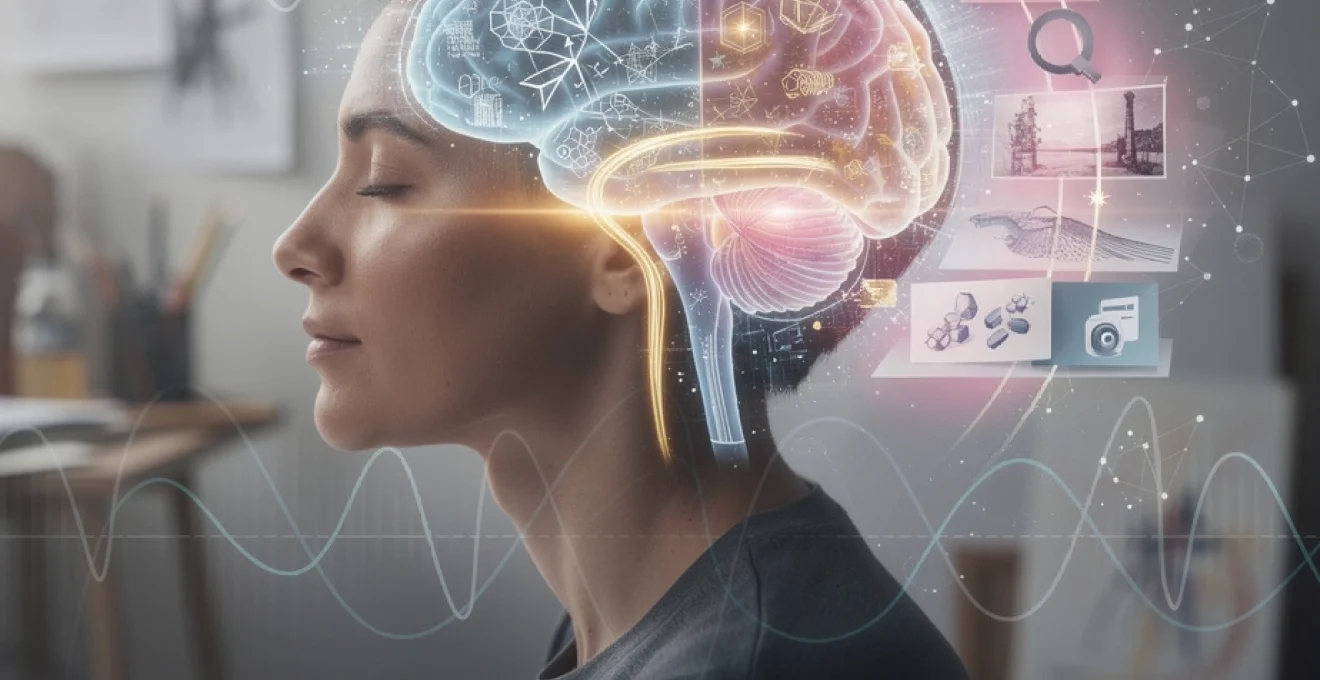
The human brain transforms into a symphony of neural activity during creative moments, orchestrating complex interactions between conscious thought and unconscious processing. Modern neuroscience reveals that creativity isn’t confined to a single brain region but emerges from dynamic networks spanning multiple areas, each contributing unique functions to the creative experience. Understanding these intricate mental processes provides fascinating insights into how breakthrough ideas emerge from the depths of human consciousness.
Recent advances in neuroimaging technology have enabled researchers to peer inside the creative mind, revealing patterns of brain activity that were previously invisible. These discoveries challenge traditional notions about creativity, showing that both logical reasoning and intuitive insights work together in sophisticated ways. The creative process engages everything from memory systems to emotional centres, creating a rich tapestry of mental activity that produces innovation and artistic expression.
Neuroscientific foundations of creative cognition and default mode network activation
The default mode network (DMN) represents one of the most significant discoveries in understanding creative cognition. This network, which includes the medial prefrontal cortex, posterior cingulate cortex, and angular gyrus, becomes highly active during periods of rest and introspection. Research demonstrates that the DMN plays a crucial role in generating spontaneous thoughts, autobiographical reflection, and creative ideation. When your mind wanders during mundane tasks, the DMN activates, potentially fostering the conditions necessary for creative insights.
Studies using functional magnetic resonance imaging (fMRI) reveal that creative individuals often show enhanced connectivity within the DMN, suggesting that their brains are naturally wired for innovative thinking. The network’s ability to combine disparate memories and concepts creates fertile ground for novel associations. This neurological foundation explains why many breakthrough ideas emerge during relaxed states rather than periods of intense concentration.
Prefrontal cortex executive function during divergent thinking tasks
The prefrontal cortex serves as the brain’s executive centre, coordinating complex cognitive processes during creative endeavours. During divergent thinking tasks, which involve generating multiple solutions to a single problem, this region demonstrates remarkable flexibility. The dorsolateral prefrontal cortex manages working memory and cognitive control, whilst the ventromedial prefrontal cortex processes emotional significance and personal relevance.
Neuroscientists have observed that creative thinking involves a delicate balance between cognitive control and cognitive flexibility. When solving creative problems, the prefrontal cortex must simultaneously maintain focus on the task whilst remaining open to unexpected connections. This dual requirement creates a unique pattern of activation that distinguishes creative cognition from routine problem-solving.
Temporal lobe memory consolidation in creative insight formation
The temporal lobes, particularly the hippocampus, play an essential role in creative insight formation through their memory consolidation functions. These regions store and retrieve episodic memories, which serve as raw material for creative combinations. Research indicates that the hippocampus doesn’t merely store memories passively but actively recombines them in novel ways during creative tasks.
The process of memory consolidation during sleep has profound implications for creativity. Studies show that REM sleep facilitates the integration of new information with existing knowledge, often leading to creative breakthroughs upon awakening. This explains why many artists and inventors report receiving inspiration during dreams or immediately after waking.
Limbic system emotional processing and creative expression pathways
The limbic system, encompassing structures such as the amygdala and nucleus accumbens, provides the emotional fuel for creative expression. These regions process the emotional significance of ideas and experiences, determining which concepts deserve further exploration. The amygdala’s role in emotional memory explains why powerful emotions often trigger artistic inspiration and creative breakthroughs.
Dopamine pathways within the limbic system create the rewarding feelings associated with creative discovery. When you experience that satisfying “aha!” moment, dopamine neurons in the ventral tegmental area release neurotransmitters that reinforce the creative behaviour. This neurochemical reward system motivates continued creative exploration and risk-taking in artistic endeavours.
Corpus callosum interhemispheric communication in artistic innovation
The corpus callosum, a thick band of nerve fibres connecting the brain’s two hemispheres, facilitates crucial communication during creative processes. Contrary to popular myths about “left-
brain” and “right-brain” thinkers, modern neuroscience shows that creative thinking relies on efficient collaboration between both hemispheres. The corpus callosum acts like a high-speed data cable, allowing logical, analytical processing in the left hemisphere to blend with spatial, musical, and emotional processing in the right hemisphere.
Studies using diffusion tensor imaging suggest that individuals who excel in artistic innovation often show greater white matter integrity in the corpus callosum. This enhanced connectivity supports rapid switching between different modes of thought, such as shifting from detail-oriented editing to big-picture visioning. When you engage in complex creative tasks, interhemispheric communication helps you integrate structure with spontaneity, turning raw ideas into coherent, impactful work.
Psychological theories and cognitive models of creative process architecture
While neuroscience maps the brain regions involved in creativity, psychological theories explain how mental processes unfold over time. Cognitive models of creativity describe the stages, mechanisms, and patterns that shape how ideas emerge, develop, and are refined. By understanding these frameworks, you can better recognise what happens inside your mind during the creative process and adjust your habits accordingly.
From classic stage models to contemporary dual-process accounts, these theories converge on one core insight: creativity is not a single moment of inspiration, but an evolving interaction between deliberate effort and spontaneous insight. Whether you are writing, designing, coding, or composing, your mind cycles through preparation, exploration, evaluation, and implementation. Becoming aware of this architecture helps you navigate creative blocks and harness creative cognition more intentionally.
Wallas Four-Stage model: preparation through verification phases
British psychologist Graham Wallas proposed one of the most enduring models of the creative process, organised into four stages: preparation, incubation, illumination, and verification. In the preparation phase, you actively gather information, define the problem, and explore existing solutions. This is where research, brainstorming, and deliberate practice lay the cognitive groundwork for later insights.
During incubation, conscious effort relaxes and the unconscious mind takes over, engaging in what Einstein called “combinatory play”. Ideas drift below awareness, where remote associations can form without the constraints of linear logic. The famous “aha moment” or illumination emerges when these hidden connections surface suddenly into consciousness, often when you are engaged in unrelated activities such as walking, showering, or daydreaming.
The final stage, verification, involves evaluating, testing, and refining the newly formed idea. Here, critical thinking, feedback, and iteration transform a fragile insight into a robust solution or finished work of art. Importantly, these stages do not always occur in a strict sequence; you might cycle back to preparation after new questions arise, or re-enter incubation when you hit a creative wall. Recognising which stage you are in can help you decide whether to push harder or step back and let your mind wander.
Geneplore model generative and exploratory cognitive mechanisms
The Geneplore model, developed by Ronald Finke, Thomas Ward, and Steven Smith, offers a more detailed look at the internal workings of creative thought. “Geneplore” combines “generate” and “explore”, capturing the two main phases of creative cognition. In the generative phase, you produce preliminary mental representations called “preinventive structures”—rough sketches of ideas, mental images, analogies, or conceptual blends that are not yet fully formed.
These preinventive structures are then examined in the exploratory phase, where you interpret, elaborate, and transform them. You might mentally rotate images, change perspectives, impose new constraints, or seek hidden patterns. Much like sculpting from a block of marble, you gradually reveal the core idea by systematically exploring variations and possibilities.
What makes the Geneplore model particularly useful is that it highlights how even wild, unfinished ideas can be valuable raw material. Instead of waiting for a perfect concept, you can deliberately generate many imperfect preinventive structures and then explore them. This iterative loop between generation and exploration is at the heart of creative problem solving in domains ranging from product design to scientific discovery.
Dual process theory system 1 and system 2 creative problem solving
Dual process theory divides thinking into two interacting systems: fast, intuitive System 1 and slow, analytical System 2. In creative problem solving, both systems play essential roles. System 1 operates automatically, drawing on implicit memories, gut feelings, and pattern recognition to produce surprising associations and quick ideas. It is central to sudden insights and imaginative leaps.
System 2, by contrast, is deliberate and effortful. It evaluates, organises, and refines the suggestions offered by System 1, filtering out weak options and strengthening promising ones. When you are editing a draft, testing a business model, or debugging code, you are engaging System 2 to ensure that creative ideas are feasible and coherent.
Productive creativity depends on a dynamic dialogue between these systems. If System 1 dominates, you may generate many ideas but fail to implement them effectively. If System 2 is too strict, you may censor original thoughts before they have a chance to develop. Learning when to suspend judgement and when to apply critical scrutiny allows you to use both systems in harmony, rather than letting them work at cross-purposes.
Associative theory remote semantic networks and conceptual blending
Associative theories of creativity focus on how ideas connect within the brain’s semantic networks. According to this view, creative individuals can traverse “remote associations” more easily, linking concepts that seem unrelated on the surface. When you combine knowledge from distant domains—such as biology and architecture, or music and mathematics—you are engaging in this kind of remote associative thinking.
Conceptual blending, a key mechanism in associative theory, involves merging elements from different mental spaces to form a new, integrated concept. A classic example is the invention of the “desktop” metaphor in computing, which blends office objects (folders, files, bins) with digital interfaces. This process allows your mind to construct novel frameworks that feel intuitive because they reuse familiar components in unfamiliar ways.
The capacity to navigate wide semantic networks can be cultivated. Exposing yourself to diverse fields, cultures, and experiences enriches the “mental library” that associative processes draw from. When you later face a creative challenge, your brain has more raw material to connect, increasing the likelihood of innovative, cross-domain solutions.
Neurochemical mechanisms and neurotransmitter modulation during creative states
Behind the visible behaviours of brainstorming, sketching, or composing, subtle neurochemical shifts are constantly shaping your creative experience. Neurotransmitters regulate mood, attention, motivation, and inhibition, all of which influence how freely ideas flow and how effectively you can focus on refining them. Understanding these neurochemical mechanisms helps explain why some days creativity feels effortless, while on others even simple tasks seem difficult.
Creative states do not rely on a single “creativity chemical”. Instead, they emerge from a complex interplay between dopamine, norepinephrine, serotonin, GABA, and other neuromodulators. These chemicals adjust the sensitivity and connectivity of neural circuits, tuning your brain for exploration, concentration, or reflection depending on the context. By learning how lifestyle, environment, and habits affect these systems, you can create conditions that are more conducive to sustained creative performance.
Dopamine reward pathways and intrinsic motivation in creative flow
Dopamine is central to the brain’s reward system and plays a pivotal role in intrinsic motivation and creative flow. When you pursue an activity for its own sake—because it is interesting, challenging, or meaningful—dopamine pathways in the mesolimbic system support that engagement. This is why losing yourself in a painting, a complex coding problem, or a musical improvisation can feel inherently rewarding, even before any external recognition.
Research suggests that moderate levels of dopamine facilitate cognitive flexibility, allowing you to switch between ideas and explore new possibilities. Too little dopamine can lead to apathy and difficulty initiating creative work, while excessive levels may result in distractibility or impulsive idea chasing. Finding tasks that strike a balance between novelty and mastery helps stabilise dopamine-driven motivation and makes it easier to enter and sustain creative flow.
Practically, this means choosing projects that are just beyond your current skill level, setting clear but challenging goals, and celebrating small creative wins. These strategies reinforce dopamine release in healthy ways, strengthening the link between effort and reward without relying solely on external validation.
Norepinephrine attention regulation and focused creative concentration
Norepinephrine, often associated with alertness and the body’s stress response, also plays a crucial role in attention regulation during creative work. Released primarily by the locus coeruleus, it helps determine whether your brain operates in a state of broad, exploratory attention or narrow, focused concentration. Both modes are vital for creativity: you need expansive attention to generate ideas and focused attention to develop and execute them.
According to the “adaptive gain” theory, moderate arousal levels optimise norepinephrine function, supporting sustained attention without tipping into anxiety. When levels are too low, you may feel bored or unfocused; when too high, your thinking can become rigid or overwhelmed. This inverted-U relationship explains why mild time pressure or excitement can boost productivity, whereas chronic stress often undermines creative thinking.
To harness norepinephrine effectively, you can structure your environment and routines. Short, timed work sprints, limited digital distractions, and clear task definitions help stabilise attention. Brief physical activity or exposure to natural light can also gently increase arousal, making it easier to enter a state of focused creative concentration when you sit down to work.
Serotonin mood enhancement and openness to creative experience
Serotonin is widely known for its role in mood regulation, but it also influences cognitive flexibility and openness to new experiences—both essential for creative thinking. Balanced serotonin levels are associated with emotional stability, which provides a secure base from which you can take intellectual and artistic risks. When you feel relatively safe and grounded, you are more willing to experiment, fail, and try again.
Positive mood states, often linked to healthy serotonin function, have been shown to broaden attentional scope and increase the range of associations you can access. This “broaden-and-build” effect helps you see connections you might otherwise miss, making it easier to combine ideas from different domains. However, some research also indicates that mild negative moods can enhance analytical scrutiny, suggesting that varying emotional tones may support different stages of the creative process.
Supporting serotonin balance through sleep, nutrition, social connection, and stress management is therefore indirectly beneficial for creativity. Simple practices—regular exercise, time outdoors, and meaningful conversations—can stabilise mood and maintain the psychological flexibility needed to approach creative challenges with curiosity rather than fear.
GABA inhibitory control and cognitive disinhibition theory
GABA (gamma-aminobutyric acid) is the brain’s primary inhibitory neurotransmitter, responsible for dampening excessive neural activity. In the context of creativity, GABA contributes to the delicate balance between control and freedom in thought. Adequate inhibition prevents your mind from becoming chaotic, while selective reduction in inhibition can allow unusual associations to surface—a phenomenon linked to “cognitive disinhibition”.
Cognitive disinhibition theory suggests that highly creative individuals may allow more information, including seemingly irrelevant stimuli, into conscious awareness. This can expand the pool of ideas available for recombination, increasing the likelihood of original insights. However, without sufficient GABA-mediated control, this openness could become overwhelming or distracting, highlighting the need for flexible rather than uniformly low inhibition.
From a practical perspective, relaxation techniques such as deep breathing, meditation, or listening to calming music can enhance GABA activity, helping to quiet mental noise when you need to focus. At the same time, deliberately exposing yourself to diverse, even slightly chaotic inputs—like exploring new environments or engaging with unfamiliar art—can temporarily lower rigid filters, supporting the exploratory side of creative cognition.
Brainwave patterns and electroencephalography studies of creative minds
Electroencephalography (EEG) studies provide a window into the brain’s electrical activity during creative tasks, revealing distinct brainwave patterns linked to different stages of the creative process. Brainwaves are typically categorised into delta, theta, alpha, beta, and gamma frequencies, each associated with particular mental states. Creative cognition often involves transitions between these states rather than a single fixed pattern.
For example, increased alpha and theta activity—especially in frontal and parietal regions—has been observed during moments of insight and relaxed, open attention. These slower waves are commonly associated with meditative states, daydreaming, and internal focus, all of which support the incubation and idea generation phases. In contrast, beta and gamma activity tends to rise during focused evaluation and problem solving, when you are actively selecting, testing, and refining ideas.
Interestingly, creative individuals often show greater flexibility in shifting between brainwave patterns, suggesting that the ability to move fluidly from relaxed to focused states is more important than staying in any single “creative frequency”. Practices like mindfulness meditation, deliberate breaks, and alternating between divergent and convergent tasks can enhance this flexibility. By respecting your brain’s natural rhythms—rather than forcing constant high-intensity focus—you can work with, rather than against, the neural dynamics of creativity.
Environmental and contextual factors influencing creative neural processing
Creativity does not occur in a vacuum; the physical and social environments you inhabit continuously shape your brain’s activity. Factors such as ambient noise, lighting, spatial layout, and even the presence of other people can influence neural networks involved in attention, emotion, and memory. Certain contexts prime the brain for exploration and play, while others support deep focus and refinement.
Open, flexible spaces with access to natural light and varied textures tend to foster mind-wandering, perspective shifts, and cross-pollination of ideas. In contrast, quieter, more contained environments are better suited for detailed execution and analytical work. Some research even suggests that moderate background noise, like that found in cafés, can enhance creative performance by introducing a slight level of distraction that encourages broader thinking.
Spaces specifically designed for creativity—such as coworking and coliving environments that integrate communal areas with private work zones—can support the full arc of the creative process, from spontaneous idea sharing to focused production.
Social context also matters. Collaborative settings activate brain circuits involved in empathy, reward, and social cognition, which can energise creative risk-taking and feedback-driven refinement. At the same time, intermittent solitude allows deeper incubation and individual exploration. By consciously shaping your environment—switching locations for different tasks, curating sensory inputs, and balancing collaboration with alone time—you can align external conditions with the internal demands of each creative phase.
Individual differences in creative brain function and personality correlates
Not everyone approaches creativity in the same way, and these differences have measurable neural and psychological correlates. Variations in brain structure, connectivity, and neurotransmitter function can influence whether you tend to be an “idea generator” who excels at producing concepts or an “executor” who shines in implementing and refining them. Recognising your natural profile helps you design workflows that play to your strengths while compensating for weaknesses.
Personality traits from the Big Five model provide additional insight. High openness to experience—characterised by curiosity, imagination, and preference for novelty—is consistently linked with creative achievement and more flexible neural networks. Traits like conscientiousness and grit contribute to the persistence needed to carry ideas through the lengthy verification and execution stages, activating executive control regions in the prefrontal cortex.
So where do you fit along this spectrum? If you generate many ideas but struggle to finish projects, you may benefit from structures, deadlines, and partnerships that support follow-through. If you are strong on execution but less comfortable with ambiguity, intentionally scheduling time for unstructured exploration, play, and reflection can strengthen your generative capacities. Ultimately, the most effective creative minds learn to balance inspiration with implementation, harnessing both their biological predispositions and deliberate habits to bring ideas to life.