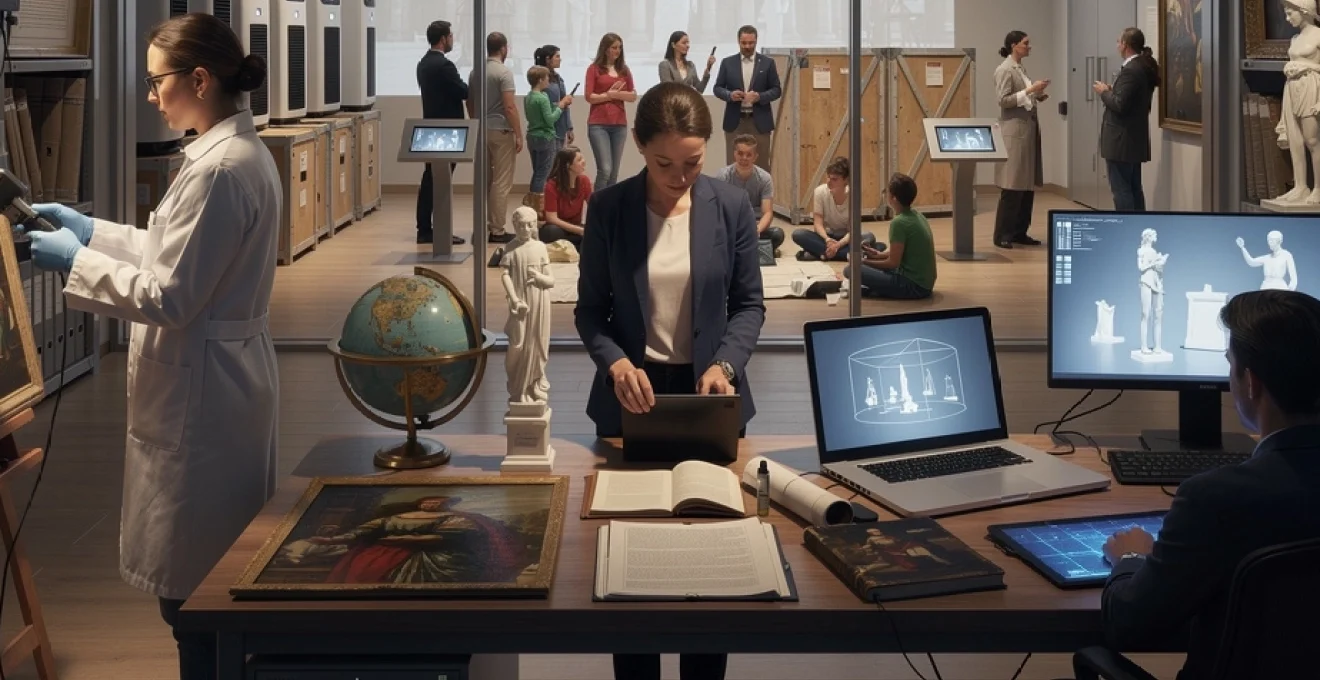
Museums stand as monumental guardians of humanity’s creative achievements, bridging the chasm between fleeting moments of artistic brilliance and the infinite expanse of future generations. These institutions shoulder an extraordinary responsibility: safeguarding the tangible evidence of human imagination, innovation, and cultural expression against the relentless forces of time, neglect, and environmental degradation. From Renaissance masterpieces to contemporary installations, from ancient artefacts to digital works, museums deploy sophisticated methodologies that combine traditional conservation wisdom with cutting-edge technological innovation. The preservation of artistic heritage represents far more than simply storing objects in climate-controlled rooms; it encompasses a complex ecosystem of acquisition strategies, scientific conservation, digital documentation, public engagement, and international collaboration that collectively ensures our cultural legacy remains accessible and meaningful.
Acquisition strategies and provenance documentation in museum collections
The foundation of any museum’s preservation mission begins with how institutions build their collections. Strategic acquisition represents a deliberate, carefully orchestrated process that shapes not only what future generations will study but also which artistic narratives receive institutional validation and scholarly attention. Museum acquisition committees typically evaluate potential additions through multiple lenses: artistic merit, historical significance, condition assessment, provenance verification, and alignment with institutional mandates. This multifaceted evaluation ensures that each accessioned work contributes meaningfully to the museum’s overall collection narrative whilst meeting rigorous standards for authenticity and legal ownership.
Due diligence protocols for authenticating artwork provenance
Provenance research has evolved from a supplementary concern into an absolute imperative for contemporary museums. The authentication process now demands exhaustive documentation tracing an artwork’s ownership history from creation to present day. Museums employ specialist provenance researchers who scrutinise auction records, dealer archives, exhibition catalogues, and historical documents to establish unbroken chains of custody. Advanced techniques such as archival analysis, forensic examination of materials, and cross-referencing with databases of stolen artworks create multiple verification layers. The 1970 UNESCO Convention and subsequent national legislation have fundamentally transformed acquisition protocols, compelling institutions to reject works with questionable origins regardless of their artistic significance.
Consider the heightened scrutiny surrounding works potentially looted during colonial periods or wartime. Museums increasingly conduct cultural sensitivity assessments alongside traditional provenance checks, examining whether acquisitions might perpetuate historical injustices. This ethical dimension extends beyond legal compliance, reflecting evolving professional standards that prioritise cultural respect and community relationships. Institutions such as the Smithsonian have established dedicated provenance units employing historians, researchers, and legal specialists who investigate ownership histories spanning centuries, sometimes discovering uncomfortable truths that necessitate difficult institutional decisions.
Strategic acquisitions through donor bequests and private collectors
Museum collections grow through diverse channels, with private donations constituting a substantial acquisition pathway. When collectors bequeath significant works, they often impose conditions regarding display, conservation, or attribution that museums must carefully negotiate. These philanthropic relationships require diplomatic finesse, balancing donor wishes against curatorial judgement and institutional policies. Strategic cultivation of collector relationships enables museums to acquire exceptional works that might otherwise remain inaccessible to public view, though such arrangements demand transparent documentation to maintain institutional integrity.
Direct purchases represent another critical acquisition method, typically funded through designated acquisition budgets, special fundraising campaigns, or endowment allocations. Museums compete in increasingly competitive art markets where prices for significant works can reach astronomical figures. This economic reality compels institutions to develop sophisticated acquisition strategies, sometimes pursuing fractional ownership arrangements or deferred purchase agreements that enable gradual payment structures. The rise of contemporary art collecting has introduced new dynamics, as museums seek to acquire works by living artists whose market values fluctuate unpredictably, requiring careful financial planning and artistic risk assessment.
Repatriation debates and cultural property legislation compliance
Few aspects of museum acquisition generate more intense discussion than repatriation claims. Indigenous communities, national governments, and cultural organisations increasingly challenge museum ownership of objects acquired during colonial periods, wartime, or through legally questionable transactions. Recent high-profile repatriations, including Cambodian sculptures returned from American institutions and Benin Bronzes repatriated from European museums, signal a fundamental shift in professional attitudes toward cultural property rights. Museums now recognise that legal ownership doesn’t automatically confer moral authority to retain contested objects, particularly when acquisition circumstances involved coercion
or severe power imbalances. Compliance with instruments such as the 1970 UNESCO Convention, the UNIDROIT Convention on Stolen or Illegally Exported Cultural Objects, and national cultural property laws now underpins acquisition policies in most major museums. Many institutions undertake proactive audits of their holdings, identifying works at risk of repatriation claims and opening dialogue with claimant states and communities to pursue negotiated solutions such as long-term loans, shared custody, or full restitution.
This shift has reframed museums not as ultimate owners but as temporary custodians of cultural heritage. Repatriation debates also encourage museums to rethink how they interpret contested works still on display, incorporating provenance narratives, community voices, and critical discussion of colonial histories into wall texts and catalogues. For artistic heritage, this more transparent and dialogic approach does not weaken museums’ authority; rather, it enhances their legitimacy in the eyes of increasingly informed and ethically conscious audiences. As public expectations continue to evolve, institutions that embrace transparent provenance and cultural property compliance will be better positioned to fulfil their preservation mandates.
Digital cataloguing systems for permanent collection management
Once an artwork enters the collection, robust documentation becomes as important as physical protection. Digital cataloguing systems function as the institutional memory of a museum, recording every detail of an object’s life: creator, date, medium, dimensions, exhibition history, conservation treatments, provenance, and intellectual property status. Modern museum collection management systems such as TMS, MuseumPlus, or CollectionSpace support complex data fields and relational links, allowing curators and conservators to track how individual works connect to broader artistic movements, historical events, or donor networks.
Digital catalogues also play a critical role in risk management and disaster recovery. By maintaining secure, regularly backed-up databases—often mirrored in off-site or cloud-based servers—museums ensure that core collection information survives even if physical works are damaged or displaced. Increasingly, institutions integrate high-resolution images, conservation reports, and 3D models directly into object records, turning the database into a comprehensive digital archive. For researchers, artists, and the public, these systems underpin searchable online catalogues that democratise access to artistic heritage far beyond the museum’s physical walls.
Conservation science and preventive care techniques
Collecting artistic heritage is only the beginning; preserving it over decades and centuries demands a sophisticated blend of conservation science and preventive care. Rather than waiting for visible deterioration, contemporary museums emphasise preventive conservation—controlling the environment, handling, and display conditions to slow or halt damage before it occurs. This approach treats the museum like a carefully tuned ecosystem, where light, temperature, humidity, pollutants, and even visitor movement are monitored and calibrated to protect vulnerable works of art.
Behind the scenes, specialised conservation laboratories resemble scientific research facilities as much as traditional workshops. Chemists, materials scientists, conservators, and art historians collaborate to understand how materials age, how past restoration campaigns have altered works, and which new treatments offer the most stable and reversible results. For anyone who cares about artistic heritage, this scientific infrastructure is the unseen shield that allows fragile objects to survive in a world of fluctuating climates and increasing environmental pressures.
Climate-controlled storage environments and humidity monitoring systems
At the core of preventive conservation are stable, climate-controlled environments. Most organic materials—canvas, wood, paper, textiles—expand and contract in response to temperature and relative humidity changes, leading over time to cracking, warping, and delamination. Museums therefore maintain storage and exhibition spaces within narrowly defined climate bands, often around 18–22°C and 45–55% relative humidity, though exact parameters vary by material. Sophisticated HVAC systems, combined with insulation and buffering materials, aim to minimise daily and seasonal fluctuations that are especially damaging.
Continuous monitoring is essential. Data loggers and wireless sensors placed throughout galleries, storage rooms, and display cases feed real-time information to central dashboards, alerting staff to deviations that might threaten sensitive works. In some institutions, predictive analytics tools model how external weather patterns could impact internal conditions, helping facilities teams respond proactively. This kind of environmental management may sound technical, but it is one of the most direct ways museums protect artworks you might hope to see in pristine condition decades from now.
Non-invasive analysis methods: x-ray fluorescence and infrared reflectography
Before conservators can intervene on an artwork, they must understand its structure, materials, and past alterations. Non-invasive analytical methods such as X-ray fluorescence (XRF) and infrared reflectography (IRR) have revolutionised this investigative phase. XRF allows scientists to identify the elemental composition of pigments and metal alloys without taking physical samples, shedding light on an artist’s palette, the presence of later overpainting, or even forgeries that employ anachronistic materials. IRR, by contrast, penetrates upper paint layers to reveal underdrawings and compositional changes, offering a glimpse into the artist’s creative process.
These technologies function like medical imaging for artworks, enabling diagnosis without surgery. For example, IRR has uncovered detailed preliminary sketches beneath works by Leonardo da Vinci and Rembrandt, reshaping art historical narratives. For conservation planning, knowing where an artist reworked a composition or where previous restorers added material helps determine how far new treatments should go. As analytical instrumentation becomes more portable and affordable, even smaller museums can partner with universities or regional labs to access these powerful tools.
Restoration ethics following the ICOM code of ethics for museums
When active restoration is necessary, ethical questions come to the forefront. The International Council of Museums (ICOM) Code of Ethics emphasises principles such as minimal intervention, reversibility of treatments where possible, and respect for the integrity and historical authenticity of artworks. Conservators must navigate a delicate balance: improve stability and legibility without erasing age, patina, or traces of use that are themselves part of an object’s cultural significance. Should a damaged fresco be visually reintegrated to appear “whole,” or should losses remain visible to acknowledge its history?
Most institutions today favour approaches that distinguish clearly between original material and modern additions, often using techniques like tratteggio or neutral infilling that are discernible under close inspection. Detailed documentation—photography, reports, material analyses—accompanies every intervention, ensuring future professionals can understand and, if necessary, reverse previous work. For the public, transparent communication about restoration ethics, through labels, blogs, or behind-the-scenes tours, fosters trust and invites visitors into the complex decision-making that shapes how artistic heritage appears in the gallery.
Material degradation assessment for oil paintings and paper-based works
Different artistic media age in distinct ways, requiring tailored conservation strategies. Oil paintings, for instance, are multilayered systems of support, ground, paint, and varnish, each with its own vulnerabilities. Over time, drying oils oxidise and become brittle, pigments can fade or darken, and varnishes may yellow, obscuring original colour relationships. Conservators use microscopy, cross-section analysis, and accelerated ageing tests to predict how particular combinations of materials will behave, guiding choices about cleaning, consolidation, or varnish removal.
Paper-based works—drawings, prints, photographs, manuscripts—are even more sensitive to light, humidity, and pollutants. Acidic components in paper, inks, or mounting materials can trigger discolouration and embrittlement, while exposure to UV light causes fading that is often irreversible. As a result, museums limit light levels for works on paper to very low lux values and rotate them on and off display to reduce cumulative exposure. By understanding these degradation mechanisms in detail, institutions can develop exhibition and storage policies that maximise public access without sacrificing long-term survival.
Digital archiving and virtual collections management
While physical conservation remains essential, the digital realm has become an equally important arena for preserving artistic heritage. Digital archiving and virtual collections management extend the museum’s reach, providing resilient backups of vulnerable works and new ways for audiences to encounter art. A high-quality digital surrogate cannot replace the aura of an original painting or sculpture, but it can function like a detailed map: not the territory itself, yet invaluable for navigation, study, and exploration when physical access is limited.
The COVID-19 pandemic underscored this reality. Institutions with mature digital infrastructures were able to pivot rapidly, offering virtual tours, online exhibitions, and open-access image repositories to global audiences confined at home. As we move forward, the question is no longer whether museums should invest in digital preservation strategies, but how they can do so in ways that are sustainable, interoperable, and respectful of artists’ and communities’ rights.
High-resolution photogrammetry for three-dimensional artefact capture
For three-dimensional artworks—sculptures, architectural fragments, installation components—photogrammetry and 3D scanning provide powerful tools for digital preservation. Photogrammetry uses overlapping high-resolution photographs taken from multiple angles to generate accurate 3D models, capturing both geometry and surface texture. When combined with laser scanning or structured light scanning, museums can achieve sub-millimetre precision, creating digital twins suitable for research, virtual display, or even 3D-printed replicas.
These models serve multiple purposes. Conservators can use them to monitor structural changes over time, comparing scans taken years apart to detect warping or cracking invisible to the naked eye. Curators can incorporate 3D views into online catalogues, allowing users to rotate and zoom in on intricate details from home. In contexts where physical objects are at risk from conflict, climate change, or mass tourism, 3D documentation also acts as a last-resort record, preserving form and decoration even if the original is lost or damaged.
Metadata standards and CIDOC-CRM implementation
Digital files alone do not constitute a meaningful archive; without structured metadata, images and models become isolated fragments. To ensure that digital resources remain findable, interoperable, and intelligible over time, museums adopt metadata standards such as Dublin Core, VRA Core, or LIDO, and increasingly align their data with the CIDOC Conceptual Reference Model (CIDOC-CRM). CIDOC-CRM is an ontology designed specifically for cultural heritage, enabling institutions to model complex relationships between people, objects, events, and places in a machine-readable way.
Implementing CIDOC-CRM can feel, at first, like learning a new language, yet the payoff is significant. When multiple institutions describe their collections using compatible frameworks, their data can be aggregated, compared, and analysed across borders—forming the backbone of international portals and research infrastructures. For scholars tracing artistic networks or provenance histories, linked open data built on CIDOC-CRM allows queries that would be impossible within a single museum’s siloed database.
Online collection portals: europeana and google arts & culture partnerships
Online collection portals have become vital gateways to preserved artistic heritage. Europeana, for instance, aggregates digital content from thousands of European museums, libraries, and archives, offering users a single interface to search paintings, photographs, manuscripts, and more. Similarly, platforms like Google Arts & Culture partner with institutions worldwide to provide gigapixel zoom, virtual tours, and curated stories that bring lesser-known collections into the global spotlight. For many users, these portals are now the first contact point with a museum they may never visit in person.
Partnerships with such platforms require careful negotiation. Museums must balance the desire for broad access with concerns about image rights, contextual integrity, and the risk of their collections being decontextualised in a generic digital environment. The most effective collaborations treat online portals not as simple image galleries but as extensions of curatorial practice, embedding rich descriptions, thematic narratives, and educational resources. When done thoughtfully, virtual access multiplies the impact of physical preservation work, turning local efforts into global cultural resources.
Blockchain technology for digital provenance tracking
As more artistic heritage takes digital or hybrid forms—video installations, generative art, NFTs—the question of provenance tracking extends into the virtual domain. Blockchain technology, with its decentralised and tamper-evident ledgers, offers one possible tool for documenting creation, ownership, and exhibition history of both physical and digital works. By recording key events—minting, acquisition, loan, conservation treatment—on a blockchain, museums can create transparent, verifiable chains of custody that complement traditional paper and database records.
However, blockchain is not a panacea. Institutions must weigh environmental impacts, long-term sustainability of specific platforms, and the legal status of on-chain records. You might think of blockchain as a high-tech seal and logbook: useful for signalling authenticity and tracing transactions, but only as reliable as the governance and data input behind it. For now, pilot projects and consortial experiments are helping museums test where blockchain genuinely adds value, particularly for born-digital artworks and complex collaborative projects.
Educational programming and public engagement frameworks
No matter how advanced their conservation labs or digital archives, museums ultimately preserve artistic heritage for people: current communities and those yet to come. Educational programming and public engagement frameworks translate preserved objects into lived cultural experiences, fostering the knowledge and empathy necessary to sustain support for preservation itself. In this sense, every well-designed tour, workshop, or digital learning module is also a long-term investment in the future of cultural stewardship.
Contemporary museums increasingly adopt audience-centred approaches, moving beyond didactic lectures towards participatory, inclusive models. School programmes align with curricula and invite students to analyse artworks as historical evidence, visual texts, and emotional expressions. Public talks and symposia bring artists, conservators, and community representatives into dialogue, demystifying how decisions about acquisition, restoration, and display are made. Family days, maker spaces, and hands-on activities encourage intergenerational learning, showing younger visitors that museums are not silent temples but dynamic spaces where their perspectives matter.
Digital engagement strategies extend these efforts. Interactive apps, audio guides in multiple languages, and social media campaigns invite users to co-create content, share personal responses, and participate in crowdsourced research projects such as tagging or transcribing archives. By opening channels for feedback and collaboration, museums learn more about how different communities perceive their collections and can refine interpretation accordingly. Over time, this reciprocal relationship turns visitors into advocates who understand why safeguarding artistic heritage—through funding, policy support, or everyday respect—is a shared civic responsibility.
Collaborative networks: UNESCO world heritage sites and ICOM
Preserving artistic heritage is not a task any single institution can accomplish alone. Museums operate within a web of collaborative networks that provide shared standards, advocacy, and practical support. UNESCO’s World Heritage framework, for example, recognises sites of “outstanding universal value,” many of which contain monumental artworks, historic urban ensembles, or cultural landscapes shaped by artistic practice. When museums steward collections linked to such sites—through archaeological material, architectural fragments, or documentation—they often work closely with heritage authorities to coordinate conservation and interpretation strategies.
ICOM, meanwhile, functions as a global professional body, connecting more than 50,000 museum professionals across 138 countries. Through its committees on conservation (ICOM-CC), documentation (CIDOC), ethics, and specific collection types, it develops guidelines, organises conferences, and issues recommendations that help align practices worldwide. During crises—armed conflict, natural disasters, pandemics—ICOM also plays a role in coordinating responses, issuing red lists of at-risk cultural objects, and advocating for the protection of museums and heritage workers.
Regional and thematic networks further strengthen this collaborative fabric. Consortiums of contemporary art museums share expertise on time-based media preservation; university museums partner on joint research projects and student training; community-focused institutions exchange methodologies for participatory curation. For you as a museum visitor or supporter, these relationships are largely invisible, yet they underpin the resilience of the entire cultural heritage ecosystem. When a painting survives a flood in one country thanks to lessons learned from another’s experience, or when repatriation negotiations draw on international precedent, we see how networked collaboration safeguards the story of art at a planetary scale.
Emergency preparedness and disaster recovery protocols for cultural assets
Despite meticulous planning, museums are never entirely shielded from emergencies: fires, floods, earthquakes, civil unrest, or even slow-onset threats like rising sea levels. Emergency preparedness and disaster recovery protocols translate risk awareness into concrete action plans, ensuring that when the unexpected happens, staff can respond swiftly to protect cultural assets. In this context, preserving artistic heritage is akin to safeguarding a fragile archive of human memory against events that could erase entire chapters overnight.
Comprehensive emergency plans typically include risk assessments, priority lists of objects for evacuation or special protection, staff training, and agreements with external partners such as fire services, conservation studios, or temporary storage providers. Regular drills familiarise teams with roles and procedures, from safely removing works from galleries to stabilising water-damaged materials. Simple measures—elevating storage shelving above flood-prone floors, using fire-resistant construction materials, installing early-warning sensors—can make a decisive difference when minutes count.
Disaster recovery extends far beyond the initial crisis response. After an event, conservators must triage affected works, deciding which can be treated in-house and which need specialised facilities. Documentation of damage, already critical for insurance and accountability, also contributes to collective learning: what worked, what failed, and how future resilience can be improved. International initiatives like the Blue Shield network and UNESCO’s emergency missions often support museums in conflict or disaster zones, providing expertise, supplies, and advocacy. In a world where climate-related extreme events are becoming more frequent, integrating emergency planning into everyday operations is no longer optional; it is a central pillar of responsible cultural stewardship.