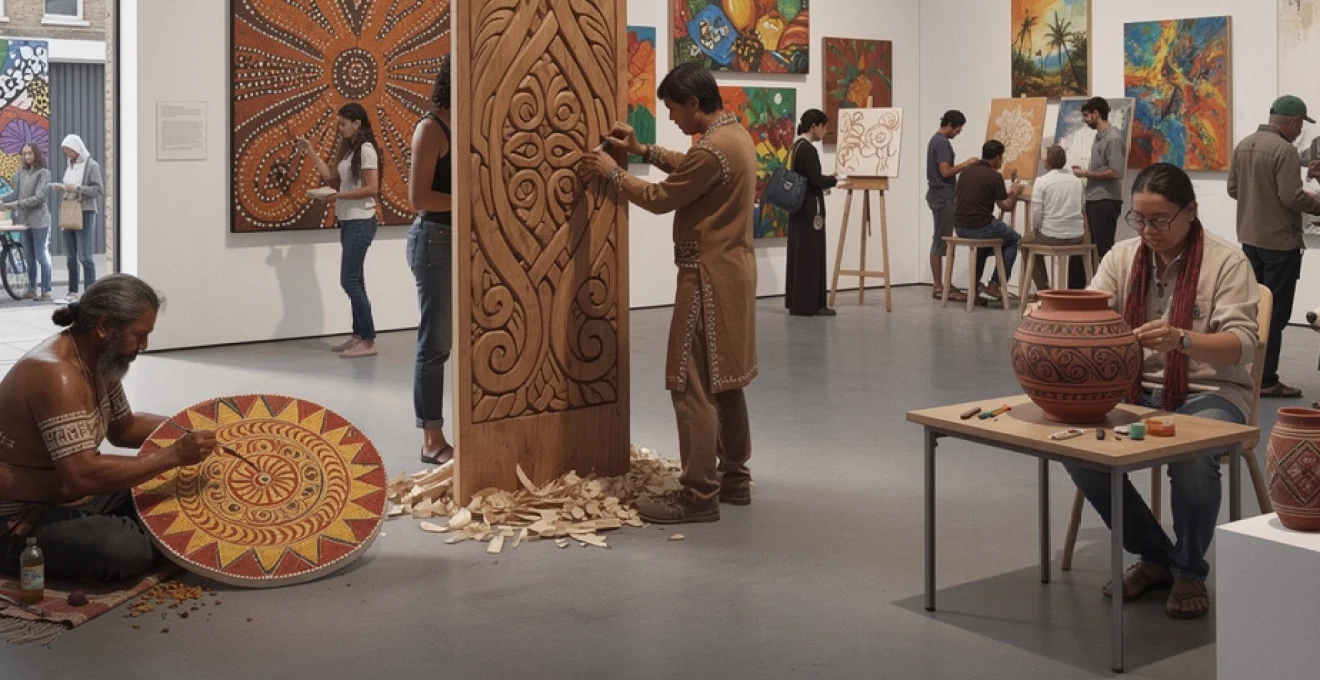
Cultural diversity serves as the lifeblood of artistic expression, weaving together traditions, techniques, and perspectives from every corner of our planet into a vibrant tapestry of creative innovation. From the ancient Aboriginal dot paintings of Australia to the contemporary digital installations emerging in global art capitals, the influence of cultural heritage on artistic creation continues to shape how we understand and interpret the human experience. This dynamic interplay between tradition and modernity, local customs and global exchange, creates a rich foundation for artistic exploration that transcends geographical boundaries.
The profound impact of cultural diversity on artistic creation extends far beyond mere aesthetic considerations. It encompasses the methodologies, materials, spiritual beliefs, and social narratives that inform creative practice across different societies. As migration patterns reshape communities and digital technologies connect artists across continents, the traditional boundaries between distinct cultural artistic practices become increasingly fluid, giving rise to hybrid forms that reflect our interconnected world.
Indigenous artistic traditions and cultural authenticity in contemporary art
Indigenous artistic practices represent some of humanity’s oldest and most sophisticated creative traditions, offering unique insights into the relationship between cultural identity and artistic expression. These traditions, developed over millennia, demonstrate how environmental factors, spiritual beliefs, and community structures directly influence artistic creation. The preservation and evolution of indigenous art forms in contemporary contexts highlight the tension between maintaining cultural authenticity and adapting to modern artistic landscapes.
The significance of indigenous artistic traditions extends beyond their historical value, serving as living repositories of cultural knowledge and wisdom. Contemporary indigenous artists navigate complex questions about tradition, innovation, and cultural ownership while creating works that speak to both their heritage and contemporary experiences. This dynamic process illustrates how cultural diversity continues to influence artistic creation through the ongoing dialogue between past and present.
Aboriginal dot painting techniques in modern australian gallery spaces
Aboriginal dot painting represents one of the world’s oldest continuous artistic traditions, with techniques dating back over 40,000 years. The intricate pointillist style, originally created using ochre and natural pigments on rock surfaces, has evolved to incorporate contemporary materials while maintaining its spiritual and cultural significance. Modern practitioners use acrylic paints on canvas, adapting traditional techniques to suit gallery exhibition requirements without compromising the sacred narratives embedded within each work.
The transition of Aboriginal art into contemporary gallery spaces has sparked important conversations about cultural appropriation and authentic representation. Traditional owners maintain strict protocols regarding which stories can be shared publicly, with many dot paintings containing layers of meaning accessible only to initiated community members. This careful balance between cultural preservation and artistic accessibility demonstrates how indigenous artists successfully navigate the complexities of presenting traditional work in modern contexts.
Maori carving methodologies and their integration in new zealand sculpture
Maori carving traditions, known as whakairo, exemplify how indigenous methodologies continue to influence contemporary sculptural practice in New Zealand. Traditional techniques involving jade (pounamu), wood, and bone have been adapted to incorporate modern materials and tools, creating sculptures that honour ancestral knowledge while engaging with contemporary artistic discourse. The integration of Maori design principles into public art installations demonstrates the ongoing relevance of indigenous cultural practices in shaping national artistic identity.
Contemporary Maori artists employ traditional carving methodologies to address modern themes such as urbanisation, climate change, and cultural revitalisation. These works often incorporate traditional motifs like the koru spiral and taniko patterns, connecting contemporary audiences with ancestral wisdom through visual symbolism. The collaborative nature of traditional Maori carving practices also influences how these artists approach community engagement and cultural education within gallery contexts.
Native american pottery glazing methods in southwestern united states ceramics
Native American pottery traditions from the Southwestern United States showcase how environmental factors directly influence artistic techniques and aesthetic choices. Pueblo peoples developed sophisticated glazing methods using natural minerals and plant materials found in their local landscapes, creating distinctive surface treatments that reflect both technical mastery and deep cultural connections to place. These traditional methods continue to influence contemporary ceramic artists throughout the region.
The revival and preservation of traditional pottery techniques among Native American communities demonstrate how cultural diversity maintains its influence on artistic creation through intergenerational knowledge transfer. Contemporary potters combine ancestral methods with modern kiln technologies, creating works that honour traditional aesthetics while exploring new expressive possibilities. This ongoing evolution illustrates how cultural authenticity</em
of traditional practice can coexist with experimentation when artists are given the space and resources to learn from elders while engaging with contemporary art markets.
Inuit stone carving practices and arctic cultural preservation
Inuit stone carving is a powerful example of how cultural diversity influences artistic creation through intimate knowledge of local materials and stories. Working primarily with serpentine, soapstone, and whalebone, Inuit artists translate oral histories, hunting traditions, and spiritual beliefs into sculptural form. Each carving, whether of animals, shamans, or everyday scenes, functions not only as an artwork but as a vessel for Arctic cultural preservation.
The growth of global interest in Inuit carving since the mid-20th century has created both opportunities and challenges. On one hand, international demand has provided vital income for remote communities and encouraged younger generations to learn traditional techniques. On the other, market pressure for “Northern” motifs can risk reducing complex cultural narratives to easily recognisable stereotypes. Many contemporary Inuit artists respond by asserting greater control over subject matter and pricing, working with ethical cooperatives to ensure that cultural knowledge and economic benefits remain rooted in their communities.
Migration patterns and cross-cultural artistic synthesis
As people move across borders for work, safety, or opportunity, they bring with them visual languages, musical traditions, and craft techniques that inevitably reshape local art scenes. Migration patterns have made cultural diversity in art more visible, giving rise to cross-cultural artistic synthesis that blends multiple identities into single works. Rather than erasing origins, this hybrid art often foregrounds the tension between home and host cultures, between memory and adaptation.
In many global cities, you can see this synthesis in neighbourhood galleries, community murals, and experimental performance spaces. Artists from diaspora communities navigate questions of belonging and representation, often using art to negotiate complex feelings of displacement and resilience. This raises an important question: when cultural influences overlap so deeply, how do artists maintain a sense of authenticity without being confined to a single label or identity?
Diaspora communities and hybrid art forms in london’s east end
London’s East End has long been a laboratory for cultural diversity in art, shaped by successive waves of migration from Huguenot weavers to Bangladeshi, Somali, and Eastern European communities. In recent decades, former industrial spaces have become studios and project rooms where artists from these communities experiment with hybrid art forms. Walls painted with Bengali typography, murals mixing Islamic calligraphy with punk aesthetics, and installations incorporating market textiles all testify to a dynamic cross-cultural artistic synthesis.
Contemporary artists in the East End often combine media and references the way a DJ samples tracks, creating visual “mashups” that reflect layered identities. For instance, a single artwork might combine archival photographs from a family’s migration journey with motifs from South Asian miniature painting and graffiti-style lettering. Curators who work in this area increasingly collaborate with local residents, ensuring that exhibitions reflect lived experiences rather than outsider fantasies. This participatory approach not only enriches the art itself but also helps galleries avoid tokenism and build longer-term cultural dialogue.
Post-colonial artistic expression in caribbean visual culture
Caribbean visual culture offers one of the clearest examples of how colonial history, forced migration, and cultural resistance shape artistic creation. Artists from islands such as Jamaica, Trinidad, and Martinique draw on African, European, Indigenous, and Asian influences, creating work that critiques colonial narratives while celebrating creole identities. Bright colour palettes, carnival aesthetics, and syncretic religious imagery often co-exist with sharp political commentary on tourism, climate change, and economic inequality.
Post-colonial artistic expression in the Caribbean frequently uses strategies of parody and inversion. Painters rework colonial portrait conventions by placing Black and mixed-race figures at the centre of power, while installation artists use sugar, rum bottles, or shipping crates to critique the legacies of plantation economies. In this context, cultural diversity is not a neutral descriptor but an active site of struggle and reclamation. By reconfiguring visual symbols inherited from empire, Caribbean artists demonstrate how art can rewrite historical narratives from the perspective of those once relegated to the margins.
Syrian refugee artists and european contemporary art integration
Since 2011, millions of Syrians have been displaced by conflict, and a growing number of Syrian artists now live and work across Europe. Their integration into European contemporary art scenes highlights both the promise and the fragility of cultural diversity in art. Many of these artists use painting, photography, and performance to address themes of loss, memory, and rebuilding, challenging audiences to confront the human cost of geopolitical decisions.
At the same time, refugee artists often face barriers such as language, legal status, and limited access to institutional networks. Some are invited into exhibitions under the narrow label of “refugee art,” which can risk freezing their identity in a single traumatic moment. Forward-thinking curators respond by offering long-term residencies, mentorship, and professional development, allowing Syrian artists to be seen not only as witnesses to war but as full participants in European artistic innovation. This shift from emergency visibility to sustained inclusion is crucial if cultural diversity is to move beyond symbolic gestures.
Chinese calligraphy adaptation in western abstract expressionism
The dialogue between Chinese calligraphy and Western abstract expressionism illustrates how cross-cultural encounters can transform artistic languages on both sides. In the mid-20th century, Western painters such as Franz Kline and Mark Tobey drew inspiration from the gestural energy and controlled spontaneity of East Asian ink traditions. Thick black strokes, dynamic compositions, and an emphasis on process over representation entered Western canvases, often without full acknowledgement of their Asian sources.
Today, this conversation has become more reciprocal. Chinese and diasporic artists trained in calligraphy reinterpret its principles through large-scale installations, digital projections, and mixed-media works. Rather than simply imitating Western abstraction, they question what happens when a character becomes a shape, or when language dissolves into rhythm and movement. For viewers, these works act like visual bridges, encouraging us to see that what appears “abstract” in one cultural framework may be deeply loaded with meaning in another. This raises an important question for curators and critics: how can we credit and contextualise these influences without collapsing them into a single global style?
Religious and spiritual iconography across artistic mediums
Religious and spiritual iconography has always been a powerful vehicle for cultural diversity in art, shaping everything from architecture and textiles to film and digital installations. Symbols associated with faith traditions are not static; they evolve as artists reinterpret them for new audiences and technologies. When we look at a mandala projected in a contemporary gallery or a mosaic restored with laser precision, we are seeing centuries of belief refracted through modern tools.
Because religious imagery carries profound emotional and ethical weight, artists working with sacred motifs must navigate questions of respect, appropriation, and audience understanding. What does it mean to use an Islamic pattern purely for its geometry, or a Christian icon simply as a vintage aesthetic? Thoughtful artists often respond by collaborating with communities of faith, engaging in research, or contextualising their work through accompanying texts and talks. In doing so, they show that cultural diversity in religious art is not about collecting exotic symbols, but about sustaining meaningful conversations across belief systems.
Islamic geometric patterns in moroccan architectural ornamentation
Moroccan architecture is renowned for its intricate zellige tilework and carved plaster, both of which rely heavily on Islamic geometric patterns. These designs, based on complex mathematical principles and repeated motifs, express theological ideas about unity, infinity, and the order of creation. In mosques, madrasas, and riads, patterns flow across walls and courtyards, turning built environments into visual meditations on the divine.
Contemporary Moroccan and diaspora artists increasingly lift these patterns out of traditional contexts and reimagine them in new materials. We see laser-cut steel screens, 3D-printed tiles, and light installations that project shifting geometries onto urban facades. The challenge is to balance innovation with an awareness of the spiritual roots of these designs. When geometric motifs become global design trends, artists and designers who understand their symbolic depth can help prevent them from being reduced to mere décor, keeping the connection between form, faith, and cultural history alive.
Buddhist mandala construction techniques in tibetan sand art
Tibetan sand mandalas offer a striking example of how meticulous technique and spiritual philosophy intertwine. Monks spend days or weeks placing coloured sand grain by grain to form intricate cosmic diagrams representing deities, teachings, or entire universes. Once completed, the mandala is ceremonially swept away, symbolising impermanence and the non-attachment central to Buddhist practice.
As these practices travel beyond monasteries into museums and universities, they reshape how global audiences understand cultural diversity in art. Live mandala-making events have become educational tools as well as spiritual performances, inviting viewers to reflect on patience, focus, and the transient nature of beauty. Some contemporary artists, both Tibetan and non-Tibetan, borrow mandala structures to explore psychological states or ecological cycles. When they do so with guidance or collaboration, they can extend mandala principles into new domains without losing sight of their deep philosophical origin.
Hindu temple sculpture and south indian bronze casting methods
Hindu temple sculpture in South India, from towering gopuram gateways to intimate shrine figures, demonstrates how religious iconography, ritual function, and technical skill converge. Stone carvers follow strict iconographic treatises that dictate proportions, gestures, and attributes of deities, ensuring that the sculptures are not just representations but vessels for divine presence. Alongside stone, South Indian bronze casting—especially the lost-wax method used for Chola-style icons—produces elegant, flowing figures that are carried in processions and bathed in ritual ceremonies.
In the contemporary art world, these casting methods have influenced sculptors far beyond the temple context. Artists adapt the lost-wax process to create secular figures, abstract forms, or hybrid deities that speak to modern concerns such as gender fluidity or environmental crisis. For practitioners rooted in Hindu communities, every adaptation prompts reflection: how far can one innovate while maintaining the sanctity associated with certain forms? Galleries that exhibit such work often provide interpretive materials or host talks with scholars, helping audiences see that these bronzes are not simply “ethnic artefacts” but part of an evolving and intellectually rich sculptural tradition.
Christian byzantine mosaic restoration in ravenna cathedral works
The mosaics of Ravenna’s early Christian churches and baptisteries are key witnesses to how belief, politics, and artistry interacted in the Byzantine world. Gold tesserae, stylised figures, and intricate borders create a luminous environment intended to evoke the heavenly realm. Over centuries, these mosaics have suffered from humidity, war, and previous restoration attempts, prompting complex conservation efforts that blend science, art history, and theology.
Modern restoration teams in Ravenna use digital mapping, microscopic analysis, and reversible adhesives to stabilise and, where necessary, reconstruct damaged sections. Their goal is not to make the mosaics look brand new, but to maintain legibility while respecting patina and historical change. This careful work turns conservation itself into a kind of artistic practice, one that embodies respect for cultural diversity in religious heritage. By training international conservators and sharing methodologies, Ravenna has become a hub where techniques developed for Christian mosaics inform the preservation of Islamic tilework, Roman floors, and secular murals worldwide.
Digital technology and globalised cultural expression
Digital technology has transformed how cultural diversity influences artistic creation, compressing distances and opening new channels for collaboration. Social media platforms, virtual reality, and AI-driven tools allow artists from different backgrounds to co-create works without ever sharing a physical studio. A Nigerian illustrator can collaborate with a Brazilian musician and a Korean animator in real time, producing cross-cultural artworks that would have been logistically impossible a generation ago.
This digital shift has also changed how audiences encounter diverse art forms. Online exhibitions, livestreamed performances, and augmented reality public art make it easier for you to explore indigenous weaving, street art activism, or experimental calligraphy from your phone. At the same time, digital circulation brings new ethical questions: how do we credit source communities when motifs are remixed at lightning speed, and how can artists protect their work from unlicensed reproduction? Developing fair licensing models, community-led archives, and digital watermarking are some of the strategies emerging to balance openness with respect and rights.
Economic factors and cultural art market dynamics
The global art market plays a decisive role in which forms of cultural diversity are celebrated, commodified, or overlooked. Auction results, biennial selections, and gallery trends shape not only artistic careers but also how cultures are perceived. When certain “exotic” aesthetics become fashionable, demand can push artists to repeat a narrow set of motifs that sell well, even if those motifs represent only a sliver of their cultural experience.
Yet economic factors can also empower communities when managed thoughtfully. Cooperative galleries, fair-trade craft initiatives, and community-controlled artist residencies enable cultural groups to negotiate better prices, retain intellectual property, and invest profits in local education and infrastructure. For collectors and institutions, one practical step is to support artists and organisations that prioritise ethical sourcing, transparent contracts, and shared decision-making. In this way, the art market can move from extracting value from cultural diversity to actively sustaining it.
Educational institutions and cross-cultural artistic pedagogy
Art schools, universities, and community education centres are crucial sites where the next generation learns how to think about cultural diversity in art. Curricula that once focused almost exclusively on European canons are slowly expanding to include histories of African, Asian, Indigenous, and diasporic art. When students encounter these traditions as central rather than peripheral, they gain a more accurate sense of how global artistic innovation actually develops.
Cross-cultural artistic pedagogy also involves how teaching happens, not just what is taught. Inviting guest artists from diverse backgrounds, organising exchange programmes, and embedding community-based projects into courses all help students move beyond textbook knowledge. For example, a ceramics class might partner with a local Native community to learn about traditional firing techniques, or a digital arts course might collaborate with a migrant support centre on storytelling projects. By structuring education as a two-way exchange rather than a one-way transfer of expertise, institutions can model the kind of respectful, reciprocal cultural relationships that vibrant artistic ecosystems require.