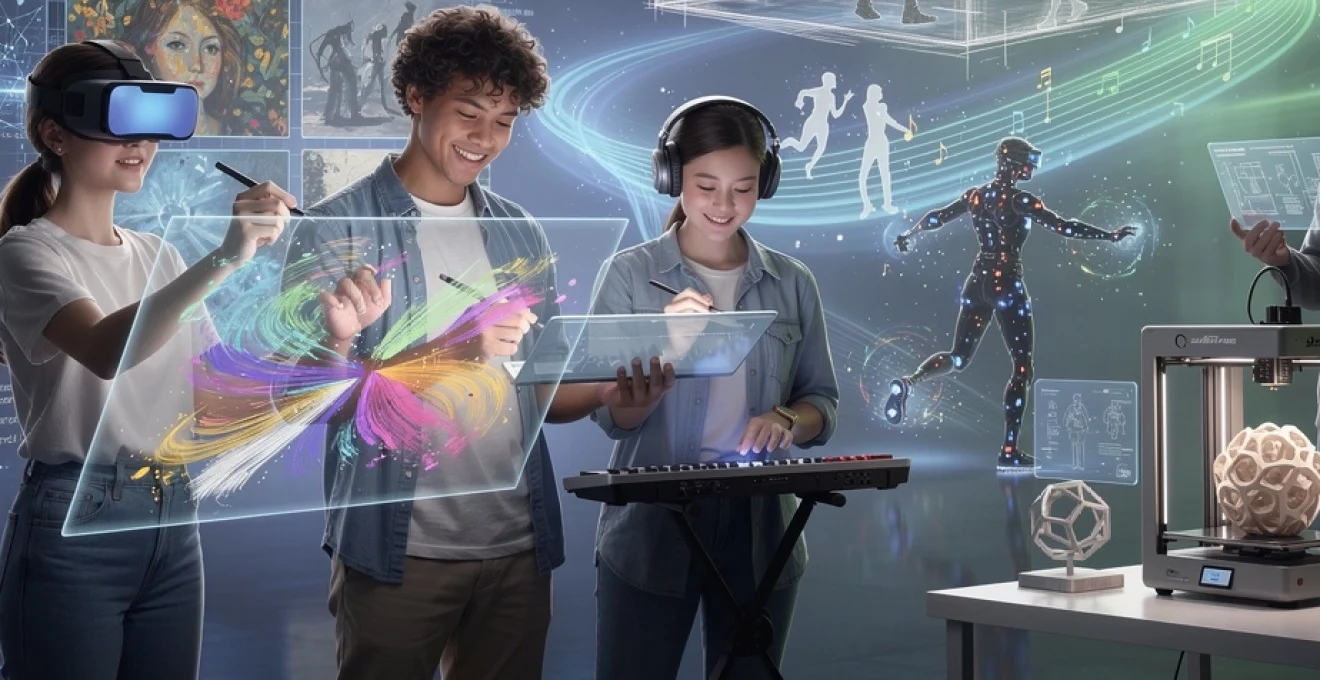
The digital revolution has fundamentally transformed the landscape of artistic expression, breaking down traditional barriers and opening unprecedented avenues for creative exploration. Modern technology is not merely a tool in the artist’s arsenal; it has become a collaborative partner that challenges conventional notions of authorship, medium, and artistic possibility. From artificial intelligence generating stunning visual masterpieces to virtual reality creating immersive worlds that transcend physical limitations, technology is redefining what it means to create art in the 21st century.
This technological evolution represents more than just an upgrade to existing artistic methods. It embodies a paradigm shift that democratises artistic creation while simultaneously raising profound questions about the nature of creativity itself. As algorithms learn to paint, virtual environments become galleries, and blockchain technology revolutionises ownership models, artists find themselves working with tools that previous generations could never have imagined.
Artificial intelligence and machine learning applications in contemporary art production
Artificial intelligence has emerged as one of the most transformative forces in contemporary art, fundamentally altering how artists conceive, create, and distribute their work. The integration of machine learning algorithms into creative processes has sparked both excitement and debate within the artistic community, as these technologies challenge traditional notions of human creativity and artistic authorship.
The sophistication of AI-driven art tools has reached remarkable levels, enabling artists to explore new aesthetic territories that were previously impossible to navigate. These systems can analyse vast datasets of existing artworks, learning patterns, styles, and techniques to generate entirely new pieces that blend familiar elements in unexpected ways. The result is often surprisingly innovative artwork that pushes the boundaries of conventional artistic expression.
Gans (generative adversarial networks) in visual art creation: DeepDream and DALL-E 2
Generative Adversarial Networks represent a breakthrough in AI-assisted visual art creation, employing two neural networks in a competitive relationship to produce increasingly sophisticated imagery. Google’s DeepDream, one of the earliest mainstream applications of this technology, transforms ordinary photographs into surreal, dream-like compositions by enhancing patterns that the neural network recognises.
DALL-E 2, developed by OpenAI, has revolutionised the field by enabling users to generate highly detailed images from simple text descriptions. This technology allows artists to explore concepts visually before committing to traditional media, serving as a powerful brainstorming tool that can generate hundreds of variations on a theme within minutes. The system’s ability to understand complex prompts and combine disparate concepts has opened new possibilities for conceptual art exploration.
Neural style transfer techniques: prisma app and adobe’s neural filters
Neural style transfer technology has made sophisticated artistic techniques accessible to millions of users worldwide through applications like Prisma and Adobe’s Neural Filters. These tools can apply the visual style of famous paintings to photographs or other images, creating hybrid works that blend photographic realism with artistic interpretation.
The democratisation of these techniques has profound implications for artistic education and practice. Artists can now experiment with styles and techniques that previously required years of study to master, using neural networks to understand how different artistic approaches affect visual perception. This technology serves as both a learning tool and a creative medium, allowing for rapid experimentation with various aesthetic approaches.
Ai-assisted music composition: AIVA, amper music, and OpenAI’s jukebox
The realm of musical composition has been equally transformed by artificial intelligence, with platforms like AIVA (Artificial Intelligence Virtual Artist) composing symphonic pieces that rival human-created works. These systems analyse thousands of musical compositions to understand harmonic progressions, melodic structures, and rhythmic patterns, then generate original compositions in specified styles or genres.
OpenAI’s Jukebox represents another leap forward, capable of generating music with singing voices in various genres and artist styles. The technology can create full songs with lyrics, melodies, and instrumental arrangements, providing composers with a powerful tool for exploring musical ideas and overcoming creative blocks. This AI assistance doesn’t replace human creativity but rather amplifies creative potential by handling technical aspects while artists focus on emotional expression and conceptual development.
Procedural content generation in interactive media: no man’s sky and minecraft
Procedural generation algorithms have transformed interactive
Procedural generation algorithms have transformed interactive experiences by allowing developers and artists to create vast, dynamic worlds from compact rule sets rather than manually crafting every element. In No Man’s Sky, for example, entire planets, ecosystems, and even alien species are generated algorithmically, offering a near-infinite universe for players to explore. Minecraft similarly uses procedural content generation to build endless landscapes of mountains, caves, and oceans, which players then reshape through their own creative input. This fusion of algorithmic design and player agency blurs the line between artist, tool, and audience, turning each play session into a unique act of co-creation.
For contemporary creators, procedural content generation becomes a powerful way to expand the limits of artistic creation without proportionally increasing production time or budget. By defining aesthetic rules, parameters, and constraints, artists can “grow” complex structures, narratives, or soundscapes that would be impossible to design manually. However, relying too heavily on procedural systems can also lead to homogeneity, where different works start to feel algorithmically similar. The challenge is to balance automation with deliberate artistic control, using procedural methods as a framework within which human creativity can still surprise and subvert expectations.
Natural language processing for creative writing: GPT-3 poetry and script generation
Natural Language Processing (NLP) has opened new frontiers for creative writing, with models like GPT-3 generating poetry, short stories, and even full scripts based on text prompts. These systems are trained on vast corpora of literature, film dialogue, and online writing, enabling them to mimic a range of voices, genres, and narrative structures. For writers, this can act like an endlessly patient brainstorming partner, offering plot twists, character backstories, or evocative descriptions on demand. You might, for instance, feed a model a rough story outline and receive multiple variations of a scene that you can refine and edit.
Yet, the use of NLP in artistic creation raises crucial questions about originality and authorship. When a GPT-3 poem resonates with us emotionally, who is the true creator: the model, the engineers who designed it, the writers whose texts it was trained on, or the human who curated the prompts and edits? Many artists treat NLP tools like a sophisticated sketchbook, a place to generate raw material rather than finished works. The most compelling applications often involve a tight feedback loop where the human sets constraints, evaluates the generated text, and then reworks it to fit a deeper conceptual or emotional vision.
Beyond individual projects, NLP also changes how we think about collaborative storytelling at scale. Interactive narratives, chat-based experiences, and dynamic theatre scripts can now adapt in real time to audience input, making each reading or performance unique. For creators willing to embrace this unpredictability, language models become a kind of narrative engine, constantly recombining themes and motifs. As with other AI art technologies, the key is not to outsource creativity but to consciously direct these tools, using their generative power to explore narrative territories we might never have reached alone.
Virtual and augmented reality technologies transforming immersive art experiences
Virtual reality (VR) and augmented reality (AR) have fundamentally redefined what it means to experience a work of art by placing viewers inside the artwork itself. Instead of passively observing a painting on a wall or a sculpture on a plinth, we can now move through immersive environments, interact with virtual objects, and influence how a piece unfolds in real time. This shift from static observation to embodied participation is one of the most profound ways technology is expanding the limits of artistic creation. It invites us to ask: when you are literally inside the artwork, are you still just a viewer, or have you become part of the creative process?
For artists, VR and AR provide a three-dimensional canvas unconstrained by gravity, scale, or material cost. Vast architectural spaces, impossible geometries, and dreamlike physics can be prototyped and experienced without traditional fabrication. At the same time, AR overlays digital layers onto our physical world, turning city streets, museums, or even our living rooms into sites of artistic intervention. This blending of realities enables creators to craft location-aware experiences that feel intimately tied to a particular place yet remain infinitely adaptable and shareable.
VR installation art: laurie anderson’s “chalkroom” and marina abramović’s “the life”
VR installation art pushes immersion to its logical extreme, placing audiences in fully virtual environments that are experienced as performances or exhibitions. Laurie Anderson’s “Chalkroom” invites participants to fly through a vast, dark universe of floating words, drawings, and stories, transforming language into a navigable architecture. Rather than reading text linearly on a page, visitors drift through fragments of memory and narrative, assembling their own interpretation through movement. This spatialisation of storytelling would be impossible without VR technology, which turns metaphorical “mental landscapes” into navigable spaces.
Marina Abramović’s “The Life” similarly uses mixed reality to extend her signature performance art into a new medium. Participants wear headsets to encounter a volumetric capture of Abramović herself, appearing as a life-sized, ghostly presence within the exhibition space. The work explores themes of presence, absence, and mortality, leveraging technology to create an uncanny sense of intimacy with a virtual performer. In both cases, VR does not merely add spectacle; it becomes integral to the conceptual framework, allowing these artists to ask: how does our perception of the body, time, and memory change when reality is mediated through immersive technology?
From a practical standpoint, VR installations also offer new distribution models for contemporary art. Once a piece is created, it can be exhibited in multiple locations simultaneously or even experienced at home, provided the viewer has compatible hardware. This raises exciting possibilities for accessibility while also challenging traditional notions of scarcity and originality in installation art. As more artists experiment with VR galleries and virtual exhibitions, the boundary between the physical museum and its digital counterpart continues to blur.
Webxr and browser-based AR art platforms: 8th wall and A-Frame
While high-end VR headsets still represent a barrier to entry for many audiences, browser-based XR platforms like WebXR, A-Frame, and 8th Wall are making immersive art more accessible. These technologies allow creators to build interactive 3D and AR experiences that run directly in a web browser, often on standard smartphones or laptops. For artists, this means they can share immersive works through a simple link or QR code, dramatically lowering friction for viewers. It also supports rapid experimentation, since changes can be deployed instantly without complex app store pipelines.
Using frameworks such as A-Frame, creators can design 3D scenes with relatively simple markup, combining geometry, textures, and interactivity in ways that feel familiar to web developers. 8th Wall extends these capabilities with robust AR tracking in the browser, enabling site-specific artworks where virtual sculptures appear on public squares or murals come alive through a phone camera. This convergence of web technology and immersive media is particularly powerful for artists working in public art or cultural heritage, as it allows them to layer digital stories over physical locations without demanding specialised hardware.
For those exploring how technology is expanding the limits of artistic creation, WebXR illustrates an important principle: innovation is not just about more powerful tools, but about more open and reachable ones. When an AR artwork can be experienced by anyone with a smartphone and a browser, the potential audience multiplies. At the same time, browser-based experiences must often be optimised and simplified to run smoothly on diverse devices, forcing artists to make careful aesthetic choices. The challenge is to craft meaningful, well-designed interactions that work within these constraints rather than relying solely on technical spectacle.
Mixed reality sculpture and 3D modelling: oculus medium and gravity sketch
Mixed reality sculpture tools such as Oculus Medium and Gravity Sketch have revolutionised how artists create three-dimensional forms, effectively turning the air around them into a malleable material. Instead of pushing clay or chiselling stone, creators use motion controllers and headsets to carve, paint, and assemble virtual objects at full scale. This can feel almost like sculpting in a dream, where you can walk around your work, change its size with a gesture, or instantly undo a cut that does not feel right. The tactile immediacy of these interactions helps bridge the gap between traditional craft and digital modelling.
For product designers, concept artists, and sculptors, these tools provide an intuitive way to prototype complex forms and spaces. Gravity Sketch, for example, is widely used in automotive and industrial design to sketch vehicles and environments directly in 3D, dramatically shortening iteration cycles. In the context of artistic creation, this means large-scale sculptures, installations, or props can be envisioned and refined long before any physical material is purchased. It also allows artists to experiment with impossible geometries and transformations that might later inspire physical hybrids created through 3D printing or CNC machining.
However, as with any powerful technology, there is a risk that the novelty of mixed reality interfaces can overshadow deeper conceptual development. It is tempting to equate the complexity of a digital model with artistic depth, when in reality a simple, well-conceived form may communicate more powerfully. Artists who use Oculus Medium or Gravity Sketch most effectively tend to treat them as sketchbooks and prototyping environments rather than as ends in themselves. By integrating these tools into a broader creative process—one that may still involve drawing, maquettes, or material testing—they leverage their strengths without becoming dependent on their visual flashiness.
Spatial audio design in virtual environments: dolby atmos and facebook spatial workstation
In immersive art, sound is just as critical as visuals, and spatial audio technologies like Dolby Atmos and Facebook Spatial Workstation (now integrated into other Meta tools) allow artists to place sounds precisely within a 3D environment. Instead of a flat stereo mix, audio sources can be positioned above, behind, or beside the listener, moving dynamically as they navigate a virtual space. This can transform a VR artwork from a silent diorama into a living, responsive world where footsteps echo realistically, voices whisper from specific corners, or musical elements swirl around the viewer. In many cases, sound becomes the primary guide, leading us through invisible narratives or emotional arcs.
For creators, learning to craft spatial audio is a bit like shifting from painting on a canvas to composing in a sphere. Tools such as the Facebook Spatial Workstation plugin for digital audio workstations allow artists to map sounds to virtual coordinates and simulate how they will be perceived in a headset. Dolby Atmos pushes these capabilities further with object-based audio that can adapt to different playback systems, from cinema setups to headphones. This means a single immersive sound design can be experienced across multiple platforms, widening the reach of VR and AR artworks.
Designing effective spatial audio also requires careful attention to human perception and comfort. Overly dense or chaotic sound fields can quickly lead to fatigue, just as cluttered visuals can overwhelm the eye. The most compelling immersive experiences often use silence and minimalism strategically, creating contrast that heightens key moments. As artists continue to explore how technology is expanding the limits of artistic creation, spatial audio reminds us that immersion is not only about what we see but also about how we feel enclosed, guided, and moved by sound.
Blockchain technology and NFTs revolutionising digital art ownership
Blockchain technology has introduced a new paradigm for digital art ownership, enabling artists to authenticate, sell, and track their works in ways that were previously difficult or impossible. Non-fungible tokens (NFTs) function as unique, verifiable records on a blockchain, linking a specific digital asset to a single token or a defined set of tokens. This creates a kind of digital provenance, answering a long-standing question: how can you claim ownership over a file that can be copied infinitely? While NFTs do not prevent copying, they provide a transparent ledger of who owns the original, much like a certificate of authenticity for a physical painting.
The NFT boom of 2020–2021 brought both massive attention and intense controversy to this space. Artists suddenly had access to a global market of collectors willing to pay substantial sums for digital artworks, animations, and even generative art series minted on platforms like Ethereum. At the same time, concerns arose about speculative bubbles, environmental impact, and the potential for scams or plagiarism. To navigate this landscape responsibly, creators need to understand not just the financial upside but also the ethical and technical dimensions of blockchain-based art. When used thoughtfully, however, NFTs can offer new revenue streams, perpetual royalties, and greater control over how art circulates online.
Smart contract implementation for artist royalties: ethereum and tezos protocols
One of the most powerful aspects of blockchain technology for artists is the ability to encode royalty structures directly into smart contracts. On platforms built on Ethereum or Tezos, creators can set a percentage that will automatically be paid to them whenever their artwork is resold on compatible marketplaces. This is a significant departure from traditional art markets, where artists typically benefit only from the initial sale and rarely share in the upside if their work appreciates in value. Smart contracts thus help align long-term incentives between artists and collectors, rewarding sustained creative practice.
Ethereum was the first major blockchain to popularise this model, and many leading NFT marketplaces still rely on its ecosystem. However, high transaction fees and environmental concerns have prompted some artists to explore alternatives. Tezos, for instance, has positioned itself as a more energy-efficient, lower-cost option for minting NFTs, attracting a vibrant community of digital artists and experimental creators. Regardless of the specific protocol, the core innovation is the same: programmable agreements that enforce royalty payments without requiring intermediaries or manual tracking.
From a practical perspective, artists should carefully review how different platforms implement royalty standards, as not all marketplaces honour the same rules or offer cross-platform compatibility. It is also wise to seek legal and financial advice when large sums are involved, since tax obligations and jurisdictional issues can be complex. Nevertheless, smart contracts represent a critical step toward a more equitable digital art economy, where the ongoing success of a work continues to support the person who created it.
Decentralised art marketplaces: SuperRare, foundation, and async art
Decentralised art marketplaces such as SuperRare, Foundation, and Async Art have become key venues for exhibiting and selling blockchain-based artworks. These platforms combine social features, curation mechanisms, and smart contracts to create ecosystems where artists can mint NFTs, collectors can bid or purchase pieces, and the broader community can discover emerging talent. SuperRare, for example, focuses on single-edition works and positions itself as a digital gallery, emphasising scarcity and high-quality curation. Foundation offers a more open, invitation-based system that has attracted a wide range of creators from illustrators and photographers to musicians and coders.
Async Art introduces a particularly innovative concept: programmable art that can change over time or in response to external data. An artwork might be composed of multiple “layers,” each owned by different collectors who can modify certain attributes, such as colours, text, or character positions. This transforms the artwork into a living, collaborative system where ownership and authorship are intertwined. It also illustrates how blockchain is not just a financial infrastructure but a creative medium in its own right, enabling dynamic, multi-author works that could not exist in traditional formats.
For artists entering decentralised marketplaces, visibility and community engagement are crucial. With thousands of works minted daily, standing out requires thoughtful presentation, consistent branding, and active participation in conversations on platforms like Twitter and Discord. It is also important to be transparent about editions, licensing, and long-term plans for a series to build trust with collectors. When approached strategically, decentralised marketplaces can open doors to global audiences and collectors that many artists would never reach through conventional gallery networks.
Fractional NFT ownership models: NIFTEX and otis investment platforms
Fractional NFT ownership platforms such as NIFTEX and Otis have introduced the possibility for multiple people to collectively own a share of a single digital artwork. Instead of requiring one collector to purchase an entire high-value piece, these systems break the token into smaller, tradable units that represent proportional ownership. This is somewhat analogous to buying shares in a company rather than purchasing the whole business, or co-owning a rare physical artwork with other investors. For artists, fractionalisation can increase liquidity and widen the pool of potential supporters by making participation more affordable.
From a cultural perspective, fractional ownership also raises intriguing questions about how we relate to art. Does owning 1% of a digital artwork change our sense of connection or responsibility to it? Are we patrons, investors, or both? For some, these models are primarily financial instruments, designed to speculate on the future value of iconic NFTs. For others, they represent a more collaborative approach to collecting, where communities can collectively back artists they believe in. The line between art appreciation and asset management becomes blurred, reflecting broader trends in the financialisation of culture.
It is important to note that fractional NFTs can introduce additional regulatory and legal complexities, especially where they resemble securities. Artists and collectors should be cautious and informed, understanding the risks as well as the opportunities. Nevertheless, as part of the broader movement of how technology is expanding the limits of artistic creation, fractional ownership showcases yet another way digital infrastructure can reshape the relationships between artists, audiences, and value.
Environmental impact solutions: proof-of-stake consensus and carbon-neutral blockchains
One of the most significant criticisms of early NFT ecosystems was their environmental footprint, particularly on proof-of-work blockchains like pre-merge Ethereum. High energy consumption led many artists to question whether participating in these markets aligned with their ethical commitments. In response, the industry has seen a rapid shift toward more sustainable consensus mechanisms, notably proof-of-stake (PoS), which can reduce energy usage by over 99% compared to proof-of-work. Ethereum’s transition to PoS in 2022 was a landmark moment, dramatically lowering the carbon cost of minting and trading NFTs on its network.
Alongside Ethereum, several blockchains have positioned themselves as eco-friendly options for digital art. Networks such as Tezos, Polygon, and Flow use PoS or similar mechanisms from the outset, often highlighting low transaction fees and carbon-neutral or carbon-negative operations. Some marketplaces and projects also purchase carbon offsets or support environmental initiatives to further mitigate their impact. While offsets are not a perfect solution, these efforts reflect a growing recognition that technological innovation must be aligned with sustainability to be truly future-proof.
For artists considering NFTs as part of their practice, evaluating the environmental policies and consensus mechanisms of different platforms is now a practical step. By choosing energy-efficient blockchains and supporting projects with transparent sustainability commitments, creators can participate in blockchain-based art while minimising ecological harm. This convergence of art, technology, and climate responsibility underscores a broader lesson: expanding the limits of artistic creation should not come at the expense of the planet on which all culture ultimately depends.
Advanced digital fabrication methods expanding physical art possibilities
Advanced digital fabrication technologies such as 3D printing, CNC machining, and laser cutting have dramatically expanded what is possible in physical art production. These methods allow artists to translate complex digital designs into tangible objects with a level of precision and repeatability that would be extremely difficult to achieve by hand. Sculptures can be built layer by layer from materials like resin, metal, or even bio-based composites, while intricate patterns can be cut or engraved into wood, acrylic, or stone. In effect, the artist’s digital studio becomes a workshop where pixels and vectors are directly converted into physical form.
One of the most transformative aspects of digital fabrication is its support for iterative prototyping. An artist can design a piece in 3D software, print a small-scale model overnight, and then refine dimensions, textures, or structural details before committing to a full-size version. This reduces material waste and lowers the risk associated with ambitious projects, encouraging experimentation with more daring geometries or modular constructions. When combined with generative design algorithms, which automatically optimise structures for strength and material efficiency, digital fabrication can yield forms that look almost organic, as if grown rather than manufactured.
Despite these advantages, integrating digital fabrication into an artistic practice also requires new skills and workflows. Creators must consider factors such as tolerances, support structures, tool paths, and material properties, which can feel more like engineering than traditional studio craft. Some worry that the “hand of the artist” might be lost in the process. Yet many practitioners intentionally reintroduce traces of imperfection or post-process their digitally fabricated pieces—through sanding, painting, or assemblage—to retain a sense of human touch. In this hybrid approach, technology becomes an extension of the artist’s body and imagination rather than a replacement.
For artists interested in exploring how technology is expanding the limits of artistic creation, access to fabrication tools has become easier than ever. Maker spaces, fabrication labs, and community workshops offer shared equipment and training, lowering the entry barrier for those without their own machines. As these resources spread globally, we can expect to see even more cross-pollination between digital design, traditional craftsmanship, architecture, and sculpture, leading to new forms that sit somewhere between art object, prototype, and experimental artefact.
Real-time motion capture and performance art integration
Real-time motion capture technology has opened up powerful new possibilities for performance art, dance, theatre, and live visuals by translating bodily movement directly into digital form. Using wearable sensors or optical tracking systems, performers’ gestures can drive animations, manipulate virtual environments, or generate dynamic audio-visual compositions on the fly. This creates a feedback loop where the performer and the digital artwork respond to each other in real time, turning the stage into a living interface. It is akin to painting with your whole body, where every movement leaves a trail of light, sound, or transformation in a shared virtual space.
In contemporary practice, motion capture is no longer limited to large film studios; tools such as depth cameras, inertial suits, and even smartphone-based systems make it accessible to independent artists. Choreographers can design pieces where dancers control particle systems, deform virtual sculptures, or trigger narrative events through specific poses. Musicians and VJs can map body movements to parameters like tempo, filters, or visual effects, creating performances where sound and image flow directly from physical expression. This tight integration between motion and media aligns with the broader trend of interactive art, where audiences and performers alike become active agents in shaping the work.
However, incorporating real-time motion capture into performance art also introduces technical and conceptual challenges. Systems must be calibrated carefully to avoid lag, jitter, or tracking loss that can break immersion, and artists often need to collaborate with technologists to build robust setups. There is also a risk that the technology becomes a gimmick if it is not conceptually integrated, overshadowing the emotional and narrative core of the performance. The most compelling works use motion capture to reveal aspects of the body and movement that we could not otherwise perceive: invisible forces, emotional states, or symbolic transformations rendered visible through data-driven visuals.
As these tools continue to evolve, we can imagine performances where multiple remote performers, each captured in real time, appear together in a shared virtual stage, or where audiences’ movements subtly influence the direction of a piece. In this sense, motion capture is not only expanding the formal vocabulary of performance but also redefining collaboration and presence in an increasingly networked world.
Cloud computing infrastructure enabling collaborative creative workflows
Cloud computing has quietly become one of the most important infrastructures underpinning modern artistic creation, even when it is not visible in the final work. By shifting storage, processing, and software tools to remote servers, the cloud enables artists to collaborate across distances, access powerful computing resources, and synchronise complex projects in real time. Whether we are co-editing a video timeline, co-painting a digital canvas, or co-composing a piece of music, cloud-based platforms make it possible to work together as if we were in the same studio, even when we are continents apart.
In practical terms, cloud workflows manifest in tools such as shared project folders, version-controlled repositories, and browser-based creative applications. Video and 3D artists can render scenes on distributed cloud render farms rather than relying solely on local hardware, dramatically cutting production times for high-resolution content. Musicians can record stems in different locations and upload them to shared sessions, where producers mix and master tracks with minimal latency. For digital artists using AI, VR, or procedural generation, the cloud often hosts the heavy computation, ensuring that even modest devices can harness advanced technologies.
Collaborative cloud platforms also reshape how creative teams organise and manage their work. Project management tools, integrated chat, and live review sessions help align directors, designers, programmers, and performers, reducing miscommunication and enabling more iterative, experimental approaches. This can be especially valuable in complex, cross-disciplinary projects such as immersive installations or transmedia narratives, where many moving parts must converge. Yet, as we lean more heavily on cloud ecosystems, questions of data ownership, privacy, and platform dependence become pressing. Who controls the servers that host our artworks-in-progress, and what happens if a service shuts down or changes its terms?
For individual artists and small studios, embracing cloud-based creative workflows does not mean abandoning local tools but rather augmenting them. A balanced approach might involve keeping critical source files backed up offline while using the cloud for collaboration, rendering, and distribution. By understanding both the opportunities and the risks, we can harness cloud infrastructure to expand the scale, speed, and reach of artistic projects without losing sight of long-term resilience. Ultimately, cloud computing serves as a connective tissue in the contemporary art ecosystem, linking technologies, people, and ideas in ways that make genuinely global, collaborative creativity possible.