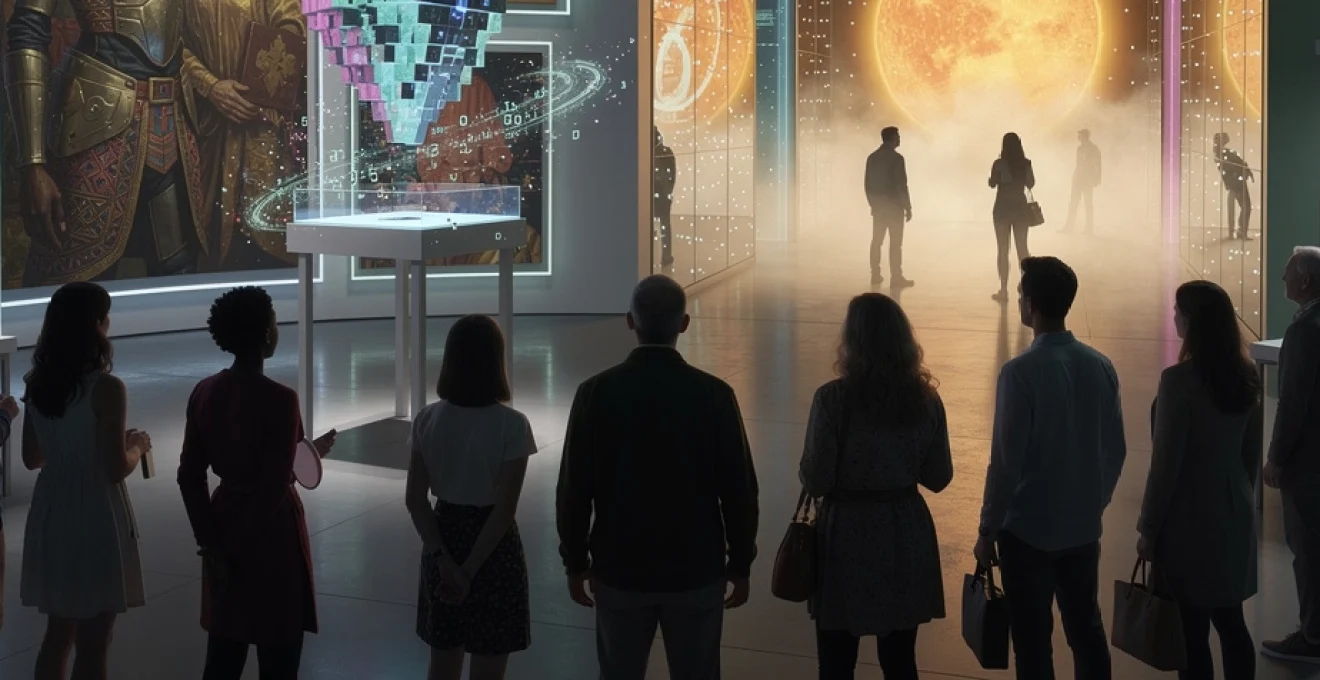
The art world stands at a remarkable intersection of technological innovation, social consciousness, and creative experimentation. From AI-generated installations displayed at the Museum of Modern Art to immersive digital environments that transport viewers into alternate realities, contemporary artists are fundamentally redefining what art can be and how it engages with audiences. These visionaries are not merely creating aesthetically pleasing objects—they’re challenging our perceptions of authorship, ownership, identity, and the very nature of artistic experience itself. The emergence of blockchain technology, advances in biotechnology, and growing awareness of climate emergency have created unprecedented opportunities for artists to explore new territories and address pressing global concerns through their practice.
Digital art pioneers: NFT creators redefining artistic ownership and value
The digital art revolution has fundamentally transformed how we conceive of artistic ownership, authenticity, and value. Non-fungible tokens have emerged as more than a technological novelty—they represent a paradigm shift in the relationship between creators, collectors, and cultural institutions. This transformation has enabled artists working in digital mediums to establish provenance and scarcity in ways previously impossible, challenging the centuries-old assumption that art must exist in physical form to hold genuine value.
Beeple’s everydays series and the $69 million christie’s auction revolution
When Mike Winkelmann, known professionally as Beeple, sold his digital collage Everydays: The First 5000 Days for $69.3 million at Christie’s in March 2021, the art world experienced a seismic shift. This watershed moment represented more than a record-breaking sale—it signified institutional validation of digital art as a legitimate collecting category. The work itself, a compilation of 5,000 individual images created daily over thirteen years, demonstrates extraordinary commitment to artistic practice whilst embodying the internet age’s information density and visual saturation.
Beeple’s success has opened doors for countless digital creators who previously struggled to monetise their work. His approach combines technical virtuosity with cultural commentary, creating imagery that reflects contemporary anxieties about technology, politics, and popular culture. The astronomical sale price forced traditional auction houses and galleries to reconsider their dismissive attitudes toward digitally native art, establishing a new benchmark for what collectors might pay for works existing solely as data.
Pak’s cryptoart experiments with the merge and decentralised collecting models
The enigmatic artist known only as Pak has pushed the boundaries of digital ownership even further than Beeple, creating conceptual frameworks that challenge conventional notions of what constitutes an artwork. The Merge, which generated $91.8 million in sales through a novel distribution mechanism, wasn’t sold as a single piece but as fungible units that collectors could accumulate and merge. This innovative approach transformed the collecting experience into a participatory process, blurring the distinction between artwork and collaborative social experiment.
Pak’s practice demonstrates how blockchain technology enables entirely new artistic forms—not merely digital versions of traditional paintings or sculptures, but concepts impossible to realise through conventional means. By creating works that exist as dynamic, evolving entities dependent on collector interaction, Pak has expanded the definition of contemporary art practice. The artist’s exploration of scarcity, value creation, and communal ownership raises profound questions about authorship and the relationship between creator and audience in the digital age.
Refik anadol’s AI-Generated data sculptures at MoMA and institutional acceptance
Turkish-American artist Refik Anadol represents the vanguard of artists exploring artificial intelligence as a creative collaborator rather than merely a tool. His monumental installation Unsupervised, featured prominently at MoMA, transformed the museum’s architectural façade into a flowing, ever-changing canvas of AI-generated imagery. By training machine learning algorithms on MoMA’s collection metadata, Anadol created a work that functions as both homage to art history and radical reimagining of how we might experience cultural heritage.
What distinguishes Anadol’s approach is his treatment of data as an artistic medium with aesthetic properties waiting to be discovered and visualised. His “data paintings” and “data sculptures” render visible the invisible flows of information that increasingly structure contemporary life. This practice resonates particularly strongly in an era where algorithms
shape everything from the news we consume to the prices we pay, yet often remain opaque. By giving these vast datasets a kind of dreamlike visual form, Anadol invites us to contemplate how machine intelligence “sees” the world and what it might mean to collaborate with algorithms as co-creators. For museums, this work has been crucial in legitimising AI art and prompting serious curatorial conversations about preservation, authorship, and the ethics of training data.
Xcopy’s glitch aesthetics and the CryptoPunks cultural movement
While some digital art embraces sleek interfaces and seamless visuals, the anonymous artist XCOPY has become emblematic of a grittier, glitch-driven aesthetic rooted in early internet culture. His animated works, often looping GIFs with strobing colours and distorted figures, channel the anxiety and nihilism of life lived permanently online. Pieces such as Right-click and Save As Guy satirise scepticism about NFTs by turning the act of “stealing” a JPEG into the core subject of the work itself.
XCOPY’s rise coincided with the explosive growth of crypto-native communities around projects like CryptoPunks, the pioneering 10,000-piece NFT collection created by Larva Labs in 2017. Although CryptoPunks are not the work of a single fine artist in the traditional sense, their pixelated portraits have become cultural icons, influencing fashion, gaming, and even music. Together, XCOPY and the CryptoPunks movement demonstrate how decentralised networks can rapidly establish new visual languages and alternative systems of cultural value that operate in parallel to, and increasingly intersect with, the traditional art market.
Afrofuturism and postcolonial narratives in contemporary visual practice
Alongside technological innovation, some of the most influential contemporary artists are reshaping the future of art by reworking art history itself. Afrofuturist and postcolonial practices place Black and Global South perspectives at the centre of visual culture, rather than at its margins. They do this not only by depicting underrepresented communities, but by reimagining the past, present, and future through lenses that challenge entrenched narratives of power, race, and empire.
These artists are asking: who has historically been allowed to appear in paintings, monuments, and museum collections—and on what terms? By appropriating and subverting classical European iconography, reworking colonial-era archives, and inventing speculative futures, they propose alternative visual histories that feel both corrective and visionary. For collectors, curators, and viewers, engaging with this work is an opportunity to understand how representation in art is inseparable from broader social justice movements.
Kerry james marshall’s figurative black representation in museum collections
Kerry James Marshall has been pivotal in rewriting the canon of Western painting by centring Black figures in monumental, exquisitely composed scenes. His paintings, often rendered in rich, velvety blacks against vibrant backgrounds, depict everyday life in Black communities—barbershops, housing projects, domestic interiors—with the compositional gravitas once reserved for biblical stories or aristocratic portraiture. Works like School of Beauty, School of Culture demonstrate how he marries art-historical references with contemporary cultural motifs.
Marshall has stated that when he was a young artist, he rarely saw Black subjects represented in major museum collections except as servants or stereotypes. His response was to create a body of work that would make the presence of Black figures unavoidable in institutional spaces. Today, his paintings are held by leading museums worldwide, and their acquisition has prompted critical reflection on how collections are built. For anyone asking which contemporary artists are reshaping the future of art, Marshall’s influence on both content and institutional policy makes him impossible to ignore.
Wangechi mutu’s biomorphic collages challenging gender and identity constructs
Kenyan-American artist Wangechi Mutu extends postcolonial critique into the realm of the body itself. Her collages, sculptures, and video works feature hybrid, often unsettling female forms that blend human, animal, and mechanical elements. Drawing from fashion magazines, ethnographic photography, medical illustration, and science fiction, Mutu constructs figures that resist easy categorisation, simultaneously seductive and monstrous, powerful and vulnerable.
These biomorphic bodies function as allegories for how Black and female identities have been fragmented, objectified, and exoticised by colonial and contemporary visual culture. At the same time, they point toward speculative futures in which new forms of embodiment become possible. Her monumental bronze sculptures installed on the facade of the Metropolitan Museum of Art in 2019—part of the series The NewOnes, will free Us—signalled a major shift in who is symbolically allowed to “guard” the entrance to one of the world’s most influential art institutions.
Kehinde wiley’s presidential portraiture and classical european art subversion
Kehinde Wiley is perhaps best known to a broad public for his official portrait of President Barack Obama, but his larger project spans more than two decades of reimagining European Old Master paintings with contemporary Black sitters. Wiley’s subjects—often people he encounters on the street—are placed in poses lifted from canonical works by artists such as Titian, Ingres, and Rubens, their bodies enveloped by ornate floral and textile patterns that threaten to overrun the frame.
By inserting Black bodies into this visual lineage, Wiley not only critiques the historical exclusion of people of colour from the grand tradition of Western portraiture; he also claims that tradition as a resource to be actively reworked. The Obama portrait, with its lush foliage background and an introspective sitter, crystallised this strategy for a global audience and demonstrated how state power, popular culture, and art history can intersect in new ways. For younger artists, Wiley’s practice offers a model of how to engage the museum canon without being constrained by it.
Immersive installation artists transforming spatial experience and perception
Parallel to developments in digital art and postcolonial practice, a generation of artists is redefining how we physically encounter artworks. Rather than presenting discrete objects on walls or plinths, these practitioners treat space, light, and time as sculptural materials, creating environments that envelop viewers. Often shared widely on social media, they challenge us to ask whether the “future of art” lies in singular masterpieces or in shared, time-based experiences.
Immersive installation art has become a powerful tool for museums and galleries seeking to attract new audiences, but its impact goes far beyond Instagrammable moments. By altering our perception of space and inviting active participation, these works can evoke empathy, wonder, and heightened awareness in ways that traditional formats may not. At their best, they prompt us to notice our own sensory and psychological responses as much as the artworks themselves.
Yayoi kusama’s infinity mirror rooms and mass cultural phenomenon
Few artists exemplify the power of immersive experience more than Yayoi Kusama. Her Infinity Mirror Rooms, first developed in the 1960s and now hosted by major institutions worldwide, use mirrored walls, carefully calibrated lighting, and simple sculptural forms—such as polka-dotted spheres or hanging LED lights—to create the illusion of endless space. Visitors, limited to short timed entries, find themselves visually multiplied to the point of near-disappearance.
The popularity of these installations, which often generate long queues and viral social media content, has sparked debate about spectacle and depth in contemporary art. Yet beneath their apparent simplicity lies a complex exploration of self-obliteration, mental health, and the relationship between the individual and the infinite. Kusama’s lifelong struggle with hallucinations and her voluntary residence in a psychiatric hospital in Tokyo give added resonance to these rooms, which transform personal psychological experiences into shared, almost cosmic environments.
Olafur eliasson’s environmental interventions and climate change discourse
Danish-Icelandic artist Olafur Eliasson uses light, water, fog, and natural materials to heighten our awareness of environmental systems and our place within them. From his iconic 2003 installation The Weather Project at Tate Modern—where a colossal artificial sun filled the Turbine Hall—to projects that bring glacial ice blocks into city centres, Eliasson is known for turning climate data and ecological science into sensorial experiences. His works often operate like laboratories, inviting viewers to test their own perception.
In recent years, Eliasson has increasingly foregrounded the climate emergency, collaborating with scientists and NGOs to link his installations to concrete environmental initiatives. This raises an important question for contemporary art: can immersive aesthetics meaningfully contribute to climate action, or do they risk becoming mere entertainment? Eliasson’s practice suggests that by making complex issues emotionally tangible—like standing inches away from melting Arctic ice—we may be more likely to move from abstract concern to personal responsibility.
Teamlab’s digital nature environments and interactive light projections
The Tokyo-based collective teamLab operates at the intersection of art, technology, and entertainment, creating vast digital environments in which projected light responds in real time to visitor movement. Their “borderless” museums in Tokyo and other cities immerse viewers in shifting floral landscapes, cascading waterfalls, and swarms of digital creatures that flow seamlessly from one room to another. Nothing is fixed; the artwork exists as a continuous, networked ecosystem.
Unlike traditional installations, where touching or altering the work is often prohibited, teamLab’s pieces only fully come alive through interaction. If you stand still, flowers may bloom around you; if you rush forward, they scatter. This sense of agency transforms spectators into co-creators, blurring the line between artwork and audience. For many, teamLab embodies how contemporary artists can harness gaming engines, motion tracking, and real-time rendering to rethink what a “museum visit” looks and feels like in the digital age.
James turrell’s skyspaces and perceptual psychology experiments
Long before immersive art became a social media phenomenon, James Turrell was quietly investigating how light and space shape human perception. His Skyspaces—architectural chambers with apertures cut into the ceiling—frame the sky as if it were a flat, painted surface, subtly manipulating our sense of depth and colour through controlled lighting. At sunrise and sunset, programmed sequences cause the sky to appear impossibly saturated or strangely solid, revealing how our brains construct reality from sensory input.
Turrell’s work draws as much from perceptual psychology and aviation (he is a trained pilot) as from traditional art history. Experiencing one of his installations can feel like participating in an experiment where you are both subject and observer, watching your own perception shift in real time. In this respect, Turrell anticipates many of the questions now pursued by artists working with VR and XR technologies: how malleable is our sense of space, and what happens when artworks target the mechanisms of perception rather than merely its content?
Bioart and speculative design: artists working with living systems
As developments in genetics, synthetic biology, and biotechnology accelerate, a growing number of artists are turning to living matter itself as their primary medium. Often working in collaboration with scientists and research labs, these practitioners create projects that resemble scientific experiments as much as traditional artworks. Their goal is not to produce new therapies or commercial products, but to probe the cultural, ethical, and philosophical implications of manipulating life.
This field—variously called bioart, art-science, or speculative design—asks provocative questions: if we can edit genomes as easily as we edit photographs, what responsibilities come with that power? Who owns genetic information? And how might engineered organisms challenge our definitions of nature and the human? By staging these issues in galleries, museums, and public spaces, bioartists bring debates that might otherwise remain confined to scientific journals into broader civic discussion.
Heather Dewey-Hagborg’s DNA portraiture and genetic privacy questions
Heather Dewey-Hagborg became widely known for her project Stranger Visions, in which she collected discarded items like cigarette butts and chewing gum from public spaces, extracted DNA from them, and used forensic analysis software to generate 3D-printed facial sculptures of the presumed owners. The resulting portraits, eerie and approximate, highlighted both the power and the limitations of contemporary genetic profiling.
By turning invisible genetic traces into visible faces, Dewey-Hagborg demonstrated how easily our biological data can be captured without consent and used to infer personal characteristics. In later works, such as her collaboration with whistleblower Chelsea Manning, she explored how DNA could be manipulated to produce multiple, contradictory portraits from the same sample, undermining the notion that genetics offers a simple, objective truth about identity. For viewers, these projects crystallise urgent concerns about genetic privacy in an era of consumer DNA testing and expanding state surveillance.
Eduardo kac’s transgenic organisms and biotechnology ethics
Brazilian-born artist Eduardo Kac has been a central figure in bioart since the 1990s, often courting controversy with projects that involve creating or proposing transgenic organisms. His most famous work, GFP Bunny, centred on an albino rabbit purportedly engineered to glow green under blue light thanks to the insertion of a jellyfish gene. Whether understood as literal or partly symbolic, the project ignited heated debate about the instrumentalisation of animals in both art and science.
Kac’s broader practice, which includes telepresence installations and plant-human communication experiments, consistently foregrounds the ethical dimensions of biotechnology. By staging speculative scenarios—such as a family adopting a genetically modified pet—he encourages us to think through the social and moral consequences of technologies that, in the commercial sphere, are often framed purely in terms of innovation and progress. His work raises a crucial question for contemporary culture: just because we can engineer new forms of life, does that mean we should, and under whose terms?
Suzanne anker’s bio fabrication studios and laboratory-based art practice
Suzanne Anker approaches bioart as both a conceptual and pedagogical practice, operating at the interface of art, design, and life sciences. Working with Petri dishes, micro-scans, preserved specimens, and 3D-printed forms, she explores the aesthetics of biological imagery—from chromosomes and embryos to botanical structures. Her installations often resemble hybrid spaces between a natural history museum and a design showroom, prompting viewers to consider how scientific visualisation shapes our understanding of life.
As a professor and founder of a Bio Art Lab at the School of Visual Arts in New York, Anker has also been instrumental in training a new generation of artists to work safely and critically with living materials. By treating the laboratory itself as a studio, she normalises the idea that contemporary art can involve aseptic procedures, microscopes, and incubators alongside brushes and cameras. For institutions wondering how to support art that relies on specialised equipment and biohazard protocols, her model provides a practical blueprint.
Social practice artists addressing climate emergency and ecological collapse
Not all artists responding to the climate crisis do so through large-scale installations or scientific collaboration. Many operate within the field of social practice, where the primary medium is not objects but relationships, conversations, and collective action. These practitioners often work directly with communities affected by environmental degradation, co-creating projects that blend art, activism, and local knowledge.
Social practice artists might organise seed-sharing networks, stage collaborative mapping exercises of polluted sites, or co-design climate adaptation strategies with residents of vulnerable coastal regions. The artistic “output” may take the form of workshops, policy proposals, or community gardens rather than saleable artworks. For collectors and institutions used to tangible objects, this can be challenging, yet such practices are vital in demonstrating how art can catalyse real-world change rather than merely representing it at a distance.
Engaging with this kind of work invites us to reconsider what we value in contemporary art: is it the singular, authored masterpiece, or the sustained process that builds resilience and awareness over time? As climate models grow more alarming, we may find that participatory, community-based projects—however modest they appear—have an outsized impact on how people understand and respond to ecological collapse.
Performance and durational work: marina abramović’s legacy and contemporary practitioners
Finally, any discussion of artists shaping the future of art must reckon with performance and durational practices that foreground the body, time, and endurance. Marina Abramović, often dubbed the “grandmother of performance art,” has profoundly influenced how live actions are staged, documented, and collected. Works such as Rhythm 0 (1974), in which she invited the audience to use any of 72 objects on her body, and The Artist Is Present (2010), where she silently sat opposite museum visitors for over 700 hours, pushed the limits of vulnerability, presence, and audience participation.
Abramović’s legacy can be seen in a generation of contemporary artists who treat performance not as a one-off event, but as a research method and a way of testing social boundaries. Some explore issues of labour and precarity by staging exhausting, repetitive actions; others investigate gender, migration, or disability through long-term, embodied projects. As museums increasingly collect performance works—not just as video documentation but as scores to be re-enacted—they are forced to rethink what it means to preserve and display time-based, body-centred art.
For viewers, durational performance can be both demanding and transformative. It asks us to slow down, to sit with discomfort, and to recognise that our own presence completes the work. In an era dominated by rapid scrolling and constant distraction, this insistence on sustained attention might be one of the most radical gestures contemporary art can offer.