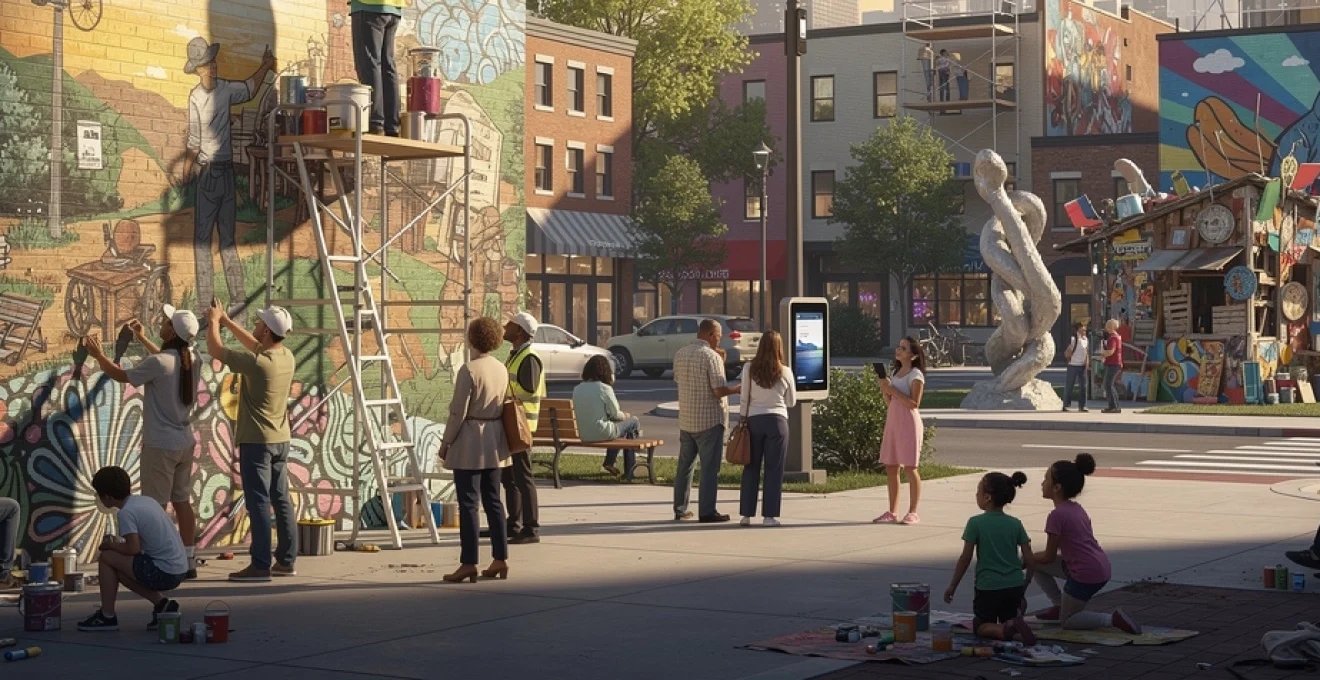
Public art has emerged as one of the most powerful catalysts for urban transformation in the 21st century. From sprawling murals that chronicle neighbourhood histories to interactive installations that foster community dialogue, artistic interventions in public spaces fundamentally reshape how residents and visitors experience their cities. This transformation extends far beyond aesthetic enhancement, penetrating deep into the social, economic, and cultural fabric of urban communities.
The relationship between public art and urban identity operates on multiple levels simultaneously. Street art creates visual landmarks that help residents navigate their daily lives, whilst simultaneously broadcasting cultural values and community aspirations to the wider world. Recent studies indicate that neighbourhoods with significant public art installations experience up to 32% increases in property values, alongside measurable improvements in community cohesion and civic engagement.
Modern cities increasingly recognise public art as essential infrastructure rather than decorative afterthought. Barcelona’s investment of €15 million annually in public art programmes demonstrates how strategic artistic planning can drive tourism revenue whilst strengthening local cultural identity. Similarly, cities from Melbourne to Mumbai are implementing comprehensive public art strategies that address everything from urban heat reduction to crime prevention through creative placemaking initiatives.
Muralism and Large-Scale installations: catalysts for urban renaissance
Large-scale murals and installations function as powerful agents of neighbourhood transformation, serving multiple purposes simultaneously. These works create instant visual impact whilst providing platforms for community storytelling, historical preservation, and social commentary. The scale itself becomes significant—murals visible from considerable distances establish new landmarks and reference points that help define neighbourhood character and boundaries.
Contemporary mural programmes demonstrate remarkable sophistication in their approach to community engagement and urban planning integration. Cities worldwide are moving beyond simple beautification projects towards comprehensive strategies that address specific local challenges through artistic intervention. The effectiveness of these programmes often depends on their ability to balance artistic vision with genuine community input and ongoing maintenance considerations.
Banksy’s bristol legacy: from vandalism to cultural tourism driver
Bristol’s transformation from a city that criminalised street art to one that celebrates it as a major tourist attraction illustrates the complex relationship between unauthorised public art and official cultural policy. Banksy’s emergence from Bristol’s underground scene in the late 1990s fundamentally altered perceptions of street art both locally and internationally. The economic impact of Banksy tourism now generates an estimated £5 million annually for the local economy.
The preservation challenges surrounding Banksy works highlight broader questions about ownership, authenticity, and commodification in public art. When pieces like “Girl with a Pierced Eardrum” appear overnight, they immediately become contested spaces where artistic expression, property rights, and cultural value intersect. Bristol’s approach to managing this phenomenon through selective preservation and interpretation programmes offers valuable lessons for other cities grappling with similar dynamics.
Detroit’s heidelberg project: Community-Led artistic neighbourhood transformation
The Heidelberg Project, spanning several city blocks on Detroit’s east side, represents one of the most ambitious examples of community-led artistic intervention in urban decline. Created by artist Tyree Guyton beginning in 1986, the project transformed abandoned houses and vacant lots into an immersive outdoor art environment using found materials and community participation. Despite facing demolition orders and ongoing political controversy, the project has persisted for over three decades.
This initiative demonstrates how public art can serve as a form of community resistance and renewal simultaneously. The project’s emphasis on found materials and community participation creates ongoing opportunities for local engagement whilst addressing issues of economic accessibility in artistic production. The Heidelberg Project’s evolution from neighbourhood intervention to international destination illustrates both the potential and the tensions inherent in community-based public art.
Philadelphia mural arts program: systematic approach to crime reduction through art
Philadelphia’s Mural Arts Program represents the most comprehensive municipal approach to public art as social intervention. Launched in 1984 as an anti-graffiti initiative, the programme has evolved into a sophisticated model for addressing multiple urban challenges through artistic practice. With over 4,000 murals completed, the programme demonstrates measurable impacts on crime reduction, youth engagement, and community cohesion.
The programme’s methodology emphasises community collaboration throughout the artistic process, from initial concept development through long-term maintenance. This approach ensures that murals reflect genuine community priorities rather
than simply acting as surface-level decoration. Independent evaluations have linked mural installations to reduced incidents of vandalism and blight in adjacent areas, alongside increased perceptions of safety among residents. By integrating art with programmes in restorative justice, behavioural health, and education, Philadelphia demonstrates how public art can be systematically embedded within broader urban policy frameworks.
Wynwood walls miami: strategic gentrification through curated street art
Wynwood Walls in Miami exemplifies how curated street art can intentionally drive neighbourhood repositioning and cultural tourism. Launched in 2009 by developer Tony Goldman, the project transformed a declining warehouse district into one of the world’s most recognisable outdoor art destinations. Internationally acclaimed street artists were commissioned to create monumental works, turning blank walls into a constantly evolving open-air museum and generating a powerful visual brand for the district.
The economic impact of Wynwood’s transformation is substantial: footfall increased by hundreds of thousands of visitors annually, and local business openings and property values followed suit. Yet this strategic gentrification also raises critical questions about displacement and cultural equity. As rents climb and original residents and small businesses are priced out, Wynwood illustrates the double-edged nature of public art as an urban development tool—simultaneously creating opportunity and pressure within the same community.
Placemaking theory and spatial identity formation through public art
Beyond individual case studies, public art can be understood through the lens of placemaking theory and spatial identity. Urban theorists have long examined how people construct mental maps of their environment and how certain spaces gain symbolic significance. Public art operates at the intersection of these processes, turning anonymous streets into recognisable places and embedding cultural memory into the built environment.
When we talk about how public art transforms cities and community identity, we are really describing shifts in how space is perceived, used, and contested. Murals, sculptures, and installations function as anchors in the urban fabric, helping residents orient themselves physically and emotionally. They also become focal points for social interaction, activism, and everyday rituals, gradually shaping a shared sense of belonging.
Kevin lynch’s image of the city: how artistic landmarks create mental maps
Urban planner Kevin Lynch argued that people navigate cities through five key elements—paths, edges, districts, nodes, and landmarks. Public art significantly enhances what Lynch called the “imageability” of a city by turning ordinary walls, intersections, or underpasses into memorable landmarks. A striking mural on a corner shop or an unexpected sculpture in a small plaza becomes part of how residents describe routes, give directions, and remember experiences.
This process of mental mapping is crucial for spatial identity formation. When artistic landmarks are rooted in local stories or cultural references, they help residents see their own histories and identities reflected in the urban landscape. Over time, these visual cues become shorthand for entire neighbourhood narratives—just as the East Side Gallery in Berlin or the Lodhi Art District in Delhi now stand in for broader stories of political change, resilience, and creative energy.
Jane jacobs’ eyes on the street: public art as natural surveillance mechanism
Jane Jacobs famously described healthy urban streets as those with many “eyes on the street”—residents, shopkeepers, and passers-by who informally observe public space. Well-designed public art can reinforce this informal surveillance by attracting people to linger, gather, and interact in previously underused areas. A colourful plaza installation or interactive light artwork can transform a quiet passageway into a social node, naturally increasing safety through presence.
Several studies on crime prevention through environmental design (CPTED) suggest that public art contributes to perceived safety and reduced anti-social behaviour. When a neglected underpass is transformed into a vibrant mural corridor, residents are more likely to walk through it, local businesses benefit from increased footfall, and illicit activities are pushed to the margins. In this way, art supports Jacobs’ principles not through enforcement, but by making streets more inviting, legible, and socially active.
Henri lefebvre’s right to the city: democratising urban space through accessible art
Henri Lefebvre’s notion of the “right to the city” emphasises that urban inhabitants should shape the spaces they live in, rather than passively accept top-down planning decisions. Public art, when genuinely participatory, becomes a practical expression of this right. Murals co-created with residents, community-led installations, and open-call art projects give people tools to inscribe their perspectives onto shared spaces.
This democratisation of urban space is especially important in neighbourhoods that have historically been marginalised or underrepresented in official narratives. When residents see their languages, heroes, and histories rendered visibly on city walls, it challenges the dominance of commercial advertising and institutional messaging. Instead of public space being defined solely by corporate logos and traffic signage, it becomes a pluralistic canvas of community voices.
Marc augé’s non-places: converting transit zones into meaningful cultural spaces
Anthropologist Marc Augé coined the term “non-places” to describe spaces such as airports, highways, and shopping centres that lack distinct identity or historical connection. Many contemporary cities are dominated by these transient environments, where people pass through but rarely form emotional attachments. Public art can intervene directly in these non-places, turning them into sites of reflection, orientation, and cultural expression.
Consider how murals in metro stations, sculptural bus shelters, or projection art in airport terminals shift the experience of waiting and moving. A once-generic underpass becomes a community gateway; a car park façade becomes a visual narrative about local ecology or migration. By embedding meaning and memory into these liminal zones, public art helps convert non-places into genuine places—spaces where people pause, recognise themselves, and feel momentarily anchored.
Economic impact measurement and cultural capital quantification
While the symbolic and social benefits of public art are widely recognised, city planners and investors increasingly demand quantifiable evidence of its economic impact. Measuring the contribution of murals and installations to local economies is complex, but not impossible. Researchers now combine tourism statistics, footfall data, business openings, and property value trends to estimate how public art districts influence urban regeneration and cultural capital.
For example, studies on creative districts such as Shoreditch in London or Wynwood in Miami show correlations between concentrated public art and increased hospitality revenue, co-working spaces, and cultural tourism. However, quantification must also account for negative externalities like displacement and speculative property investment. Cultural capital—the symbolic value attached to a neighbourhood’s creative reputation—can quickly be converted into financial capital, sometimes at the expense of the very communities that nurtured the art in the first place.
To create a more balanced picture, cities are beginning to pair hard economic indicators with qualitative metrics such as resident satisfaction, perceptions of belonging, and participation levels in cultural programmes. Mixed-method evaluations—combining surveys, interviews, and geospatial data—offer more nuanced insights into how public art shapes both market value and social value. As we refine these tools, public art advocates can better demonstrate why murals and installations deserve inclusion in infrastructure budgets alongside transport, parks, and housing.
Digital integration and smart city art infrastructure
The rise of smart city technologies is opening new possibilities for how public art is created, experienced, and managed. Interactive installations that respond to real-time data—air quality sensors, pedestrian flows, or noise levels—turn artworks into living interfaces between residents and their urban environment. Light façades that shift colour based on energy consumption, or soundscapes that evolve with local weather conditions, make abstract systems visible and emotionally resonant.
Augmented reality (AR) and mobile applications further extend the reach of public art by layering digital content over physical spaces. Visitors can scan a mural to access oral histories, artist interviews, or multilingual translations, deepening engagement without altering the wall itself. For city authorities, digital integration also supports asset management: geo-tagged inventories, condition-reporting apps, and predictive maintenance tools help preserve outdoor artworks more efficiently in harsh climates.
Yet digital public art also raises questions of access and equity. Who gets to programme the content of interactive works, and whose stories are represented in AR overlays? How do we ensure that digital experiences do not exclude those without smartphones or reliable connectivity? As we experiment with smart city art infrastructure, keeping community co-governance and digital inclusion at the forefront will be essential to avoid reproducing existing inequalities in new technological forms.
Community engagement methodologies in participatory art projects
Successful public art is rarely the product of a lone genius working in isolation. Instead, it increasingly emerges from structured processes of community engagement that align artistic ambition with local needs and aspirations. From early-stage visioning workshops to long-term stewardship plans, participatory methodologies help ensure that public art strengthens, rather than disrupts, community identity.
For practitioners, the key question is not just “What should we build?” but “How do we involve people meaningfully at each stage?” Thoughtful engagement acknowledges existing community assets, respects local knowledge, and creates clear pathways for residents to shape both the content and context of new artworks. When done well, the process itself can be as transformative as the final mural or installation.
Asset-based community development (ABCD) model in public art planning
The Asset-Based Community Development (ABCD) approach starts from the premise that every neighbourhood already possesses valuable resources—skills, traditions, social networks, and physical spaces—that can underpin positive change. Applied to public art, ABCD shifts the focus from deficits (“this area is blighted”) to strengths (“this area has rich cultural traditions and active youth groups”). Artists and planners work with residents to map these assets and explore how they can be expressed visually in public space.
In practice, this might involve identifying local storytellers to contribute narratives, craftspeople to co-create installations, or community gardens as sites for eco-art. By foregrounding what already exists, ABCD-based art projects tend to foster stronger ownership and longer-term care. Residents are not passive recipients of an external artwork; they are co-authors whose knowledge and creativity are embedded in the final piece.
Co-design workshops and stakeholder mapping techniques
Co-design workshops provide structured environments where artists, residents, businesses, and public agencies can collaboratively shape the direction of a project. Through tools such as visual prompts, model-making, and storytelling exercises, participants articulate what matters to them about a place and how art might amplify or protect those qualities. This is where you start to hear crucial insights—about safety concerns, historical sensitivities, or cultural symbols—that no desktop study could capture.
Stakeholder mapping complements these workshops by identifying who holds influence, who is affected, and who might be missing from the conversation. Schools, faith groups, youth organisations, elders, and local traders may all have different perspectives and capacities to contribute. Systematically mapping these relationships helps project teams design engagement strategies that are inclusive rather than tokenistic, reducing the risk of conflict or backlash when the artwork is finally installed.
Cultural impact assessment frameworks for neighbourhood art initiatives
As public art projects grow in scale and ambition, cultural impact assessments (CIAs) are becoming an important tool for evaluating their broader consequences. Similar to environmental impact assessments, CIAs explore how a proposed artwork might affect local cultural practices, heritage, and social dynamics. Will a new sculpture respect existing rituals in a public square? Could a mural unintentionally reinforce stereotypes or exclude certain groups?
Robust CIAs combine desk research with participatory methods such as focus groups, walkabouts, and scenario mapping. They help project teams anticipate potential tensions and adjust designs before installation, rather than retrofitting solutions after controversy arises. Crucially, CIAs also identify positive impacts—such as renewed interest in local history or increased intergenerational dialogue—that can be amplified through complementary programming like tours, workshops, or festivals.
Social return on investment (SROI) analysis for community art programs
Social Return on Investment (SROI) offers a structured way to quantify the wider social, cultural, and environmental value generated by public art initiatives. Unlike conventional cost–benefit analyses, SROI attempts to monetise outcomes such as improved mental wellbeing, increased social cohesion, or reduced vandalism, based on stakeholder input and evidence from comparable projects. The resulting ratio—such as £4 of social value for every £1 invested—provides a compelling narrative for funders and policymakers.
Conducting an SROI analysis typically involves mapping all stakeholders, identifying intended and unintended outcomes, gathering baseline and follow-up data, and applying financial proxies to intangible benefits. While no model can capture the full richness of cultural experience, SROI encourages project teams to think clearly about their theory of change: how exactly do they believe a mural, festival, or installation will improve lives, and how will they know if it has worked? When used transparently and critically, SROI becomes less about justifying art and more about continuously improving its community impact.
Preservation challenges and conservation strategies for outdoor artworks
Outdoor public art faces a constant battle with time, weather, pollution, and human intervention. Sunlight fades pigments, moisture damages substrates, and air contaminants gradually erode surfaces. In some cases, these traces of ageing add character and authenticity; in others, they undermine legibility and safety. Cities that invest in public art must therefore also invest in its care, developing clear maintenance plans and conservation protocols from the outset.
Effective strategies range from using UV-resistant paints and anti-graffiti coatings to designing modular installations that can be repaired or updated without losing their integrity. Regular condition surveys, community stewardship programmes, and dedicated maintenance budgets help extend the life of artworks and avoid costly emergency interventions. Some cities involve local residents in “adopt-a-mural” schemes, where schools or associations help monitor and lightly maintain nearby pieces, strengthening the sense of shared responsibility.
Conservation is not only a technical issue but also a cultural one. Which works are deemed worthy of preservation, and who decides when it is acceptable for a mural to be painted over or an installation removed? In rapidly changing neighbourhoods, these decisions can become flashpoints for debates about memory, ownership, and identity. Navigating them requires transparent processes, clear criteria, and ongoing dialogue with the communities for whom these artworks are more than just decoration—they are visual anchors of their collective story.