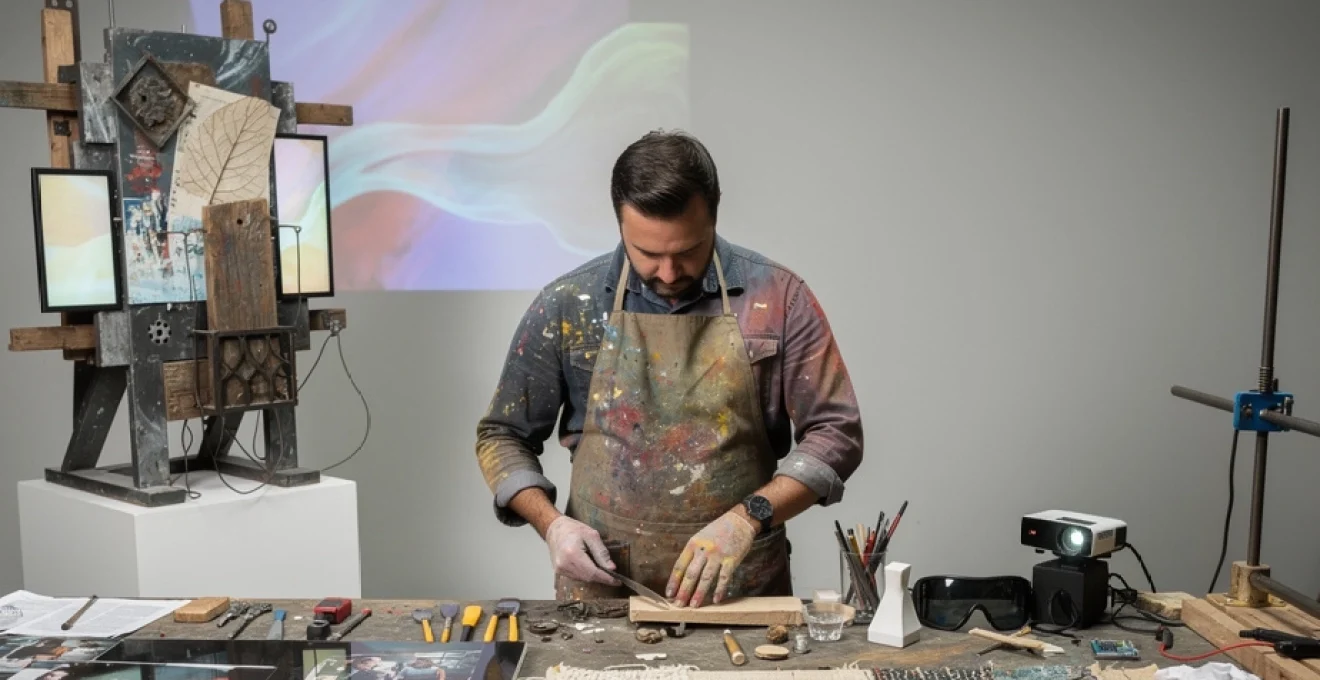
The evolution of artistic expression has always been marked by the willingness of creators to challenge established conventions. Mixed media art stands as one of the most dynamic and revolutionary approaches to visual creation, fundamentally transforming how artists conceptualize, construct, and communicate their visions. By combining disparate materials, techniques, and even technologies, mixed media practitioners have expanded the definition of what constitutes art itself. This multidisciplinary approach doesn’t simply add variety to the creative process—it fundamentally alters the relationship between artist, material, and viewer, creating works that exist in entirely new aesthetic territories. From the pioneering collages of the early twentieth century to today’s technology-integrated installations, mixed media continues to redefine the possibilities of creative expression.
Collage techniques and material juxtaposition in contemporary mixed media practice
The art of collage remains one of the most accessible yet profoundly versatile techniques within mixed media practice. At its core, collage involves the deliberate juxtaposition of materials that were never intended to coexist—torn magazine pages beside oil paint, vintage photographs overlaying acrylic washes, fabric fragments interwoven with drawn elements. This technique creates a visual dialogue between textures, colors, and contexts that can convey complex narratives impossible to achieve through singular mediums. Contemporary artists have elevated collage far beyond simple paper arrangements, incorporating three-dimensional elements, digital prints, and even organic materials to create richly layered compositions that demand close examination and repeated viewing.
What makes collage particularly powerful is its inherent ability to reference multiple realities simultaneously. A single artwork might incorporate imagery from different decades, cultures, or artistic traditions, creating temporal and conceptual bridges that challenge linear thinking. The material choices themselves become part of the artwork’s meaning—a fragment of newsprint carries the weight of public discourse, while a piece of silk might evoke luxury or sensuality. This symbolic layering allows artists to communicate on multiple levels, engaging viewers intellectually, emotionally, and aesthetically. The accessibility of collage materials also democratizes the creative process, allowing artists to work with found objects and repurposed materials rather than expensive art supplies.
Robert rauschenberg’s combine paintings and assemblage revolution
Robert Rauschenberg fundamentally altered the trajectory of contemporary art with his innovative Combine paintings, works that existed somewhere between painting and sculpture. These revolutionary pieces incorporated found objects—stuffed animals, street signs, bed quilts, rubber tires—directly onto painted canvases, creating artworks that physically extended into the viewer’s space. Rauschenberg’s approach demolished the hierarchy between “high art” materials like oil paint and “low” everyday objects, arguing that anything could serve as artistic material if employed with intention and vision. His 1955 work “Bed,” which consisted of his own pillow, sheet, and quilt splattered with paint and hung vertically, provoked controversy precisely because it challenged fundamental assumptions about what constituted a legitimate artwork.
The significance of Rauschenberg’s Combines extended beyond their visual impact. They represented a philosophical stance that art should engage directly with the world as it exists, incorporating the actual materials of daily life rather than simply representing them. This approach anticipated many developments in contemporary art, from installation art to participatory practices. The assemblage technique he pioneered—constructing artworks from disparate found objects—has become a cornerstone of mixed media practice, inspiring generations of artists to see creative potential in unexpected places. Rauschenberg demonstrated that the boundaries between art and life were far more porous than traditional aesthetics suggested, and that powerful artistic statements could emerge from radical material combinations.
Photomontage layering through digital and analogue integration
The integration of photographic elements into mixed media work creates particularly compelling results, especially when artists combine traditional analogue processes with digital manipulation. Photomontage—the technique of cutting and combining photographic images—has evolved dramatically with technology, yet many contemporary artists deliberately employ both historical and cutting-edge methods within single works. An artist might begin with vintage photographs printed using historical processes, digitally manipulate certain elements, print sections using modern inkjet technology, then physically collage the results with painted passages and drawn details. This temporal layering of techniques creates works that exist simultaneously in multiple technological eras.
The visual texture achieved through photomontage layering offers unique aesthetic possibilities. Transparent overl
transparent overlays, torn edges, and variable print resolutions introduce subtle disruptions that draw the eye and suggest memory, distortion, or fragmentation. When combined with paint splatters, ink washes, or scratched surfaces, photographic elements lose their documentary neutrality and become malleable symbols that can be reshaped to support a broader conceptual framework. For artists exploring how mixed media art pushes the boundaries of creativity, this hybrid photomontage process becomes a powerful way to question authenticity, authorship, and the reliability of images in our visually saturated culture. It also invites viewers to look more slowly, decoding the visual strata rather than passively consuming a single, seamless picture.
Practically speaking, artists working with digital–analogue photomontage must consider issues such as print permanence, paper choice, and compatibility with wet media. Archival inkjet prints on cotton rag paper, for example, tolerate light acrylic washes far better than standard office paper. Likewise, sealing printed surfaces with clear gesso or matte medium before adding additional layers can prevent ink bleeding and preserve crisp detail. By approaching each stage of photomontage layering with intention—planning how digital manipulation, hand-drawn marks, and physical collage will interact—you can transform straightforward photographs into complex mixed media narratives that feel both contemporary and timeless.
Found object incorporation and three-dimensional surface construction
Found object incorporation lies at the heart of many mixed media practices, extending the artwork beyond the flat plane and into sculptural territory. Buttons, keys, fragments of machinery, packaging materials, and natural elements like stones or branches can all be embedded into a surface to construct low-relief or fully three-dimensional compositions. This approach not only enriches texture but also smuggles everyday history into the work: each object arrives with its own provenance, wear patterns, and cultural associations. When you integrate these elements thoughtfully, the artwork becomes a kind of material archive, compressing personal and collective narratives into a single, tactile field.
From a technical standpoint, successful three-dimensional surface construction in mixed media requires attention to weight, adhesion, and long-term stability. Lightweight objects such as paper ephemera, fabrics, and plastics can usually be secured with heavy gel mediums, while denser materials may need mechanical supports, screws, or wire armatures anchored into wood panels rather than stretched canvas. Artists often build up understructures using modeling paste, plaster cloth, or carved foam to create topographical forms that found objects can sit within or around. By thinking like both a painter and a sculptor—considering silhouette, balance, and how shadows fall—you can construct mixed media surfaces that physically engage viewers as they move around the piece, encouraging a more embodied experience of the artwork.
Textile fragment integration in fabric-based mixed media works
Textile fragments have become increasingly prominent in contemporary mixed media art, bridging the gap between fine art, craft, and design. Scraps of linen, silk, denim, or netting can be stitched, glued, or embedded into painted surfaces to create intricate patterns of weave and fray that paint alone cannot replicate. Because fabrics are so closely associated with the body, domesticity, and cultural identity, their integration allows mixed media artists to address themes such as memory, labor, and gender with particular resonance. A single piece of worn cloth can function like a visible scar, a whispered story, or a relic of everyday life, depending on how it is positioned and combined with other materials.
Fabric-based mixed media works often employ techniques borrowed from both quilting and collage: piecing, appliqué, hand-stitching, and visible mending become compositional tools alongside brushwork and drawing. Artists might prime fabrics with gesso to accept acrylic paint, or intentionally leave them unprimed so that dyes and inks bleed through, echoing the unpredictability of emotional states. When layering textiles, it is crucial to consider how fiber content, thickness, and stretch will respond over time, especially if works are displayed unstretched or as soft wall hangings. By embracing textile fragments as active structural and conceptual components rather than mere decoration, mixed media artists can construct surfaces that feel intimate, lived-in, and deeply human.
Cross-disciplinary material experimentation beyond traditional art mediums
As mixed media art continues to expand, many practitioners are pushing well beyond conventional art supplies into territories once reserved for engineering, design, or science. This cross-disciplinary material experimentation is one of the most striking ways mixed media art pushes the boundaries of creativity, inviting collaboration between artists, fabricators, scientists, and even biologists. Instead of treating canvases and panels as fixed endpoints, artists increasingly regard them as platforms for chemical reactions, environmental interactions, and mechanical systems. The result is a body of work that can shift, glow, decay, or respond to its surroundings, blurring the line between static artwork and evolving environment.
Engaging with non-traditional materials does, however, demand a more rigorous understanding of safety, durability, and ethics. Resin, solvents, and welding processes require proper ventilation and protective gear; living materials introduce questions about care, consent, and longevity. Yet for many mixed media artists, these challenges are part of the appeal. By embracing materials from fields such as industrial design, architecture, and biotechnology, they not only expand their aesthetic vocabulary but also participate in broader conversations about technology, sustainability, and the future of creative practice.
Resin encapsulation and epoxy integration with organic materials
Resin encapsulation has become a hallmark technique for artists seeking to freeze time or protect delicate organic components within mixed media works. Transparent epoxy resins can encase leaves, flowers, insects, textiles, or even entire sculptural assemblages, suspending them in a glossy, glass-like matrix. This process creates a compelling tension between preservation and transformation: while the resin shields objects from immediate decay, it also alters their appearance, saturating colors, amplifying textures, and adding a reflective surface that invites viewers to peer in. In this way, resin-based mixed media pieces often evoke museum vitrines, scientific specimens, or fossils locked in amber.
When integrating resin into mixed media art, careful planning is essential. Different brands vary widely in viscosity, UV resistance, and curing time, and improper mixing can lead to bubbles, tacky surfaces, or yellowing over time. Artists typically seal porous materials before pouring to prevent air release, and they may build containment walls with tape or silicone to shape the resin into precise layers. For those interested in sustainable practice, newer bio-based resins and low-VOC formulations offer ways to engage this powerful material while reducing environmental impact. Used thoughtfully, resin encapsulation allows you to combine fragile organic matter with more robust structural elements, creating hybrid works that feel both scientific and poetic.
Industrial metal and welding techniques in sculptural mixed media
Industrial metals—steel, aluminum, copper, and brass—introduce a radically different physical and conceptual register into mixed media sculptures. When artists cut, bend, weld, or rivet these materials, they bring the language of fabrication, infrastructure, and industry directly into the studio. A welded steel armature can serve as the skeleton for a complex assemblage, supporting found objects, cast elements, or painted panels that would otherwise be too heavy or fragile to stand alone. These metallic frameworks can be left raw and rusted to emphasize entropy, or finely polished and patinated to echo jewelry, architecture, or machinery.
Working metal into mixed media practice inevitably involves specialized tools and skills, from angle grinders and MIG welders to oxy-acetylene torches. For artists new to this territory, partnering with metal fabricators or taking introductory welding courses can open up transformative possibilities. Safety remains paramount: proper ventilation, eye protection, and fire precautions are non-negotiable. Conceptually, industrial metal components can underscore themes of labor, resilience, or environmental degradation, especially when juxtaposed with softer elements like fabric or paper. This sharp contrast of hardness and fragility helps mixed media works embody the tensions of contemporary life—between permanence and vulnerability, mass production and individual expression.
Bio-art materials and living organism integration
One of the most radical frontiers in mixed media art is the integration of living organisms and bio-art materials. Artists working in this realm may cultivate moss on sculptural forms, embed seeds within paper that later sprouts, or collaborate with bacteria and fungi to create evolving color patterns and textures. In these works, the artwork is not a finished object but a process unfolding over time, responsive to light, humidity, temperature, and human interaction. This living dimension can powerfully underscore themes of climate change, interdependence, and the fragility of ecosystems, making bio-integrated mixed media pieces feel less like objects to own and more like relationships to tend.
Because bio-art straddles art, science, and ethics, practitioners must navigate additional layers of responsibility. Sourcing non-invasive species, ensuring containment, and considering how works will be maintained—or allowed to decay—in exhibition contexts are essential. Collaborations with laboratories, botanical gardens, or universities can provide both technical guidance and ethical oversight. For viewers, encountering a mixed media artwork that literally grows, wilts, or changes in response to their presence can be a profound reminder that creativity is not limited to inert materials. Instead, it can become a dialogue with life itself, expanding what we mean by both “art” and “medium.”
Architectural salvage and reclaimed wood in large-scale installations
Architectural salvage and reclaimed wood have emerged as key resources for large-scale mixed media installations, especially among artists concerned with sustainability and urban history. Beams from demolished factories, doors from abandoned houses, and weathered floorboards all bear visible traces of previous use—nail holes, paint layers, burn marks—that function like geological strata of human activity. When reassembled into new configurations, these materials allow artists to literally reconstruct alternative narratives out of the debris of development, gentrification, or deindustrialization. The result is often immersive environments that viewers can walk through, touch, and inhabit, rather than simply observe from a distance.
From a practical perspective, working with architectural salvage demands attention to structural engineering and logistics. Heavy components may require reinforced substructures, ceiling rigging, or modular design so they can be transported and reinstalled safely. Surface treatments such as sanding, sealing, or selectively preserving patina help stabilize the wood while retaining its character. By pairing reclaimed materials with contemporary elements—LED lighting, printed graphics, or sound—the artist can create a dialogue between past and present, decay and renewal. In this way, architectural salvage becomes more than just a cost-effective resource; it becomes a conceptual backbone that anchors mixed media installations in real-world histories.
Digital technology fusion with physical art materials
As digital tools become ever more woven into daily life, it is no surprise that they have become central to how mixed media art pushes the boundaries of creativity. Today’s artists are as likely to experiment with coding, sensors, and projection as they are with paint, charcoal, or plaster. Rather than treating digital and physical media as opposing camps, many practitioners are interested in their fusion—using technology to activate traditional materials, and conversely, using tangible textures to ground high-tech experiences. This fusion shifts mixed media art from being merely multi-material to being multi-modal, engaging sight, sound, movement, and interaction.
For audiences, digitally augmented mixed media works can feel particularly immersive. Sculptures that respond to touch, canvases that reveal hidden layers through augmented reality, or installations that shift in real time based on data streams all invite active participation. For artists, these tools open new avenues for storytelling, allowing them to visualize invisible phenomena—such as heartbeats, weather patterns, or social media activity—within material forms. The challenge lies in ensuring that technology serves the concept rather than overshadowing it, so that viewers walk away remembering the ideas and emotions rather than just the gadgets involved.
Projection mapping onto mixed media sculptural surfaces
Projection mapping allows artists to cast precisely aligned images and animations onto irregular surfaces, transforming mixed media sculptures into dynamic, light-based canvases. When projected imagery interacts with physical textures—catching on raised edges, vanishing into crevices, or dissolving across translucent elements—the result is a rich interplay between the permanent and the ephemeral. A static assemblage of cardboard, fabric, and plaster can become a shifting landscape of color and motion, its perceived materiality changing with each sequence of light. This technique is particularly powerful for large-scale works, where viewers can move around and experience different visual effects from various vantage points.
Technically, successful projection mapping requires a combination of artistic vision and precise calibration. Artists must design visuals that complement, rather than obscure, the underlying structure, often creating digital content based on 3D scans or meticulous measurements of the sculptural surface. Lighting conditions, projector brightness, and viewing distance also play crucial roles in determining clarity and impact. When executed thoughtfully, projection mapping turns mixed media pieces into time-based artworks, merging sculpture, cinema, and performance into a single, cohesive experience.
Arduino-controlled kinetic elements in interactive assemblages
Microcontroller platforms such as Arduino have made it dramatically easier for mixed media artists to add motion, light, and interactivity to their work. By embedding small motors, servos, LEDs, and sensors into assemblages, artists can create pieces that respond to touch, sound, or proximity—fluttering, rotating, pulsing, or illuminating as viewers engage with them. This kinetic layer introduces a sense of agency and unpredictability: the artwork no longer behaves the same way for every viewer, but instead participates in a series of unique encounters. In this sense, Arduino-controlled mixed media pieces function less like fixed compositions and more like systems with open-ended behavior.
When integrating electronics into physical artworks, planning for wiring paths, power sources, and maintenance is as important as the aesthetic design. Components must be secured and accessible for repair, and any exposed elements need to be robust enough to withstand repeated interaction. Artists who are new to electronics often start with simple circuits—such as an LED triggered by a button or a servo activated by a distance sensor—before progressing to more complex behaviors. The reward for this technical investment is a body of work that literally moves beyond the static picture plane, inviting viewers to become co-creators through their actions.
Augmented reality overlay applications for static mixed media pieces
Augmented reality (AR) has opened an entirely new avenue for expanding static mixed media artworks without altering their physical surface. By developing AR overlays that appear when viewers point a smartphone or tablet at a piece, artists can reveal hidden animations, explanatory texts, soundscapes, or alternate visual layers. Imagine a collage that looks deceptively simple at first glance, but, through AR, unfolds into a time-lapse of its own construction, or reveals archival footage related to the materials used. This dual existence—physical and digital—allows artists to pack far more information and narrative into a single piece than would otherwise be possible.
From a practical perspective, creating effective AR experiences requires collaboration between visual design and user experience. Trigger images must be distinct enough for reliable recognition, and overlays should enhance, not overwhelm, the underlying composition. Accessibility is another consideration: not every viewer will have a compatible device or be willing to download an app, so the artwork must remain compelling even without the augmented component. When balanced thoughtfully, however, AR overlays can transform how audiences engage with mixed media, turning quiet contemplation into an exploratory journey layer by layer.
3D printing integration with traditional painting and drawing substrates
3D printing has become a valuable tool for mixed media artists interested in precise, repeatable forms that can be seamlessly integrated with hand-made elements. Printed components—ranging from delicate lattices to architectural fragments—can be affixed to canvases, wood panels, or paper supports, creating sculptural reliefs that invite further painting, drawing, or collage. This combination of digitally fabricated structure and analog mark-making produces a compelling tension between the machined and the gestural, the perfectly symmetrical and the intentionally imperfect. It also enables intricate forms that would be difficult or time-consuming to carve by hand.
Artists working with 3D printing must make choices about filament type, resolution, and post-processing. PLA or resin components can be sanded, primed, and painted to match or contrast with surrounding materials, while transparent prints can be backlit or layered with color washes. File sharing platforms and open-source modeling tools have also democratized access to complex geometries, allowing artists without extensive CAD training to experiment with parametric or generative forms. Integrated thoughtfully, 3D printed elements become not a gimmick but a structural and conceptual asset within the broader language of mixed media.
Conceptual frameworks enabled through Multi-Medium approaches
Beyond their material innovation, mixed media practices profoundly expand the conceptual possibilities available to artists. Each medium carries its own history and associations—photography suggests documentation, fabric implies intimacy or labor, metal evokes industry or warfare. When you combine these in a single work, you are not just layering textures; you are layering meanings. This capacity to orchestrate multiple visual “voices” within one composition allows mixed media art to tackle complex, multilayered subjects such as migration, identity, environmental crisis, or digital surveillance with particular nuance.
Multi-medium approaches also challenge traditional notions of authorship and originality. By incorporating found imagery, pre-existing objects, or data streams, artists acknowledge that creativity today often involves recombination rather than creation ex nihilo. Viewers are encouraged to navigate these dense fields of reference, drawing connections between disparate elements in a way that mirrors how we process information in a hyperlinked world. In this sense, mixed media artworks function as cognitive maps or thought-structures, inviting us to consider how different aspects of contemporary life intersect—and sometimes collide.
Preservation challenges and archival solutions for hybrid artworks
The same qualities that make mixed media art so compelling—its diversity of materials, its experimental spirit—also pose significant challenges for preservation. Organic components may decay, adhesives can fail, digital elements risk obsolescence, and chemical incompatibilities between materials can lead to cracking, discoloration, or delamination. Conservation surveys from major museums have shown that hybrid works often require more frequent monitoring and specialized treatment plans than traditional paintings or sculptures. For artists who want their work to endure, thinking archivally from the outset is no longer optional; it is a core part of the creative process.
Practical archival strategies begin with informed material selection. Choosing acid-free substrates, artist-grade pigments, and adhesives designed for long-term stability can significantly improve a piece’s lifespan. Sealing vulnerable layers with appropriate varnishes or isolating incompatible materials using barrier coats (such as clear acrylic mediums between oil and paper) helps prevent future damage. For works involving electronics or digital files, providing detailed schematics, spare components, and documentation of software versions can assist future conservators in maintaining functionality. Even simple habits—labeling works with creation dates and material lists—can make a substantial difference in how effectively hybrid artworks can be cared for over time.
Commercial gallery representation and market positioning for mixed media artists
As mixed media art has gained prominence, commercial galleries have increasingly recognized its appeal to collectors who value originality, tactility, and conceptual richness. Nonetheless, positioning mixed media within the art market comes with specific strategic considerations. Works that combine unconventional materials or interactive elements may challenge traditional display norms, requiring customized framing, installation support, or even dedicated technicians. Galleries must balance these logistical demands with the desire to present cohesive, compelling exhibitions that communicate the artist’s vision clearly to potential buyers.
For mixed media artists seeking representation, clarity of identity is crucial. While versatility is a strength, galleries often look for a recognizable through-line—a consistent conceptual focus, visual language, or technical approach that ties diverse works together. Clear documentation, professional photography that captures both detail and overall form, and concise statements explaining how various materials contribute to the overarching themes can all enhance marketability. Pricing strategy should factor in not only material cost and labor but also the complexity of installation and the uniqueness of interactive or time-based components.
From the collector’s perspective, mixed media artworks offer both opportunities and responsibilities. Owning a piece that incorporates delicate or technological elements may involve following specific care instructions or even occasional maintenance. However, this added engagement can make the ownership experience more personal and dynamic. As more galleries, fairs, and online platforms showcase mixed media alongside painting, photography, and sculpture, the category is gradually shedding any residual perception of being “secondary” or experimental-only. Instead, it is increasingly understood as a central, driving force in how contemporary art continues to evolve and push the boundaries of creativity.