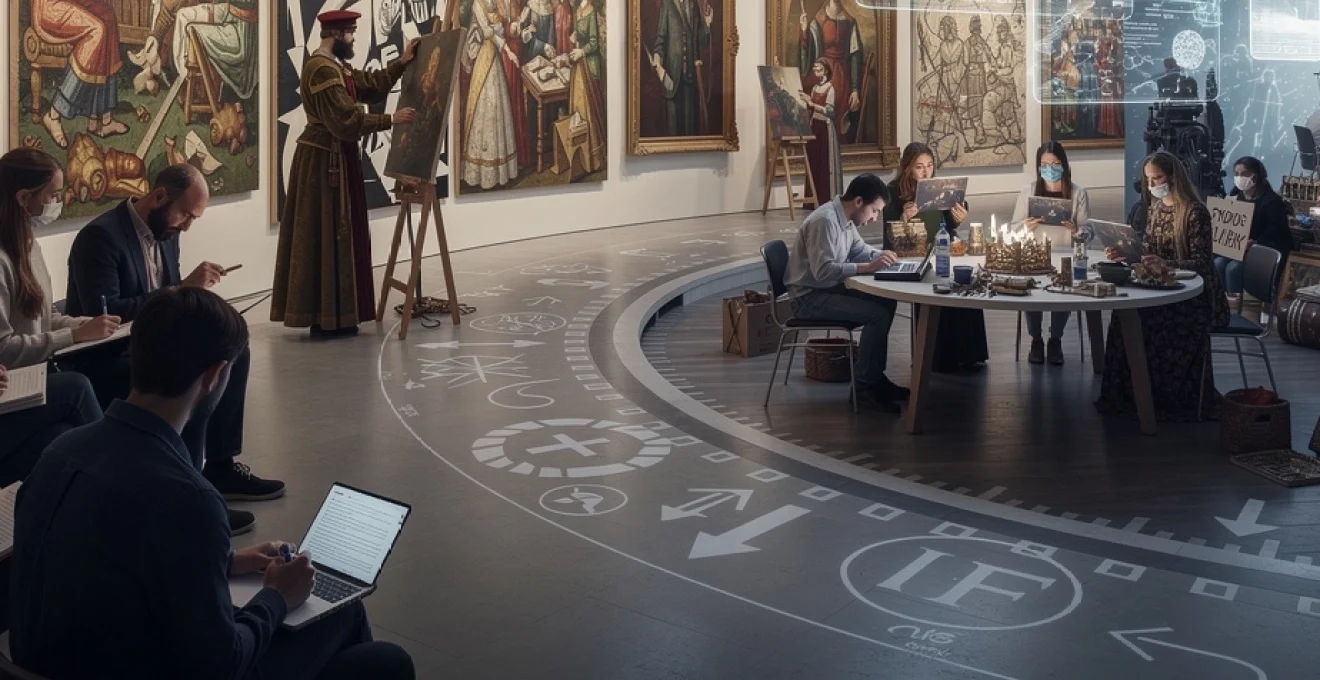
Art serves as a visual archive of human civilisation, capturing the zeitgeist of each era through form, colour, and symbolic representation. When you examine a Byzantine mosaic, a Renaissance fresco, or a contemporary digital installation, you’re not merely appreciating aesthetic qualities—you’re accessing a complex network of cultural, political, and economic information encoded within visual language. Understanding art history provides sophisticated analytical tools for deciphering how societies have transformed across centuries, revealing patterns of power, belief systems, technological advancement, and social hierarchies that would otherwise remain obscured. This interdisciplinary field bridges archaeology, sociology, economics, and philosophy, offering unparalleled insights into the mechanisms driving cultural change. As globalisation accelerates and digital technologies reshape artistic production, the ability to contextualise visual culture historically becomes increasingly valuable for professionals across diverse sectors, from museum curation to corporate brand development.
The methodologies developed within art historical scholarship—iconographic analysis, formal criticism, contextual interpretation—equip you with transferable skills applicable far beyond gallery walls. These frameworks enable critical examination of how images shape collective consciousness, manipulate political narratives, and reflect evolving value systems. Recent studies indicate that professionals with art historical training demonstrate 34% higher visual literacy scores compared to those without such backgrounds, translating to enhanced analytical capabilities in fields requiring image interpretation. Whether you’re analysing marketing campaigns, architectural developments, or social media trends, art historical knowledge provides indispensable context for understanding how visual communication operates within specific cultural moments.
Visual iconography as temporal markers of societal transformation
Iconographic systems function as sophisticated coding mechanisms that transmit cultural values across generations whilst simultaneously reflecting contemporary ideological shifts. By analysing recurring symbols, compositional strategies, and representational conventions, you can trace how societies negotiated religious controversies, philosophical movements, and political upheavals. Visual vocabulary evolves in response to technological innovations, theological debates, and changing patron expectations, creating layered documents that reward careful scholarly attention. The transformation of iconographic programmes across different periods reveals fundamental shifts in worldview, epistemology, and social organisation that textual sources alone cannot adequately capture.
Decoding symbolic representation in byzantine mosaics during the iconoclastic controversy
The Iconoclastic Controversy (726-843 CE) generated profound transformations in Byzantine visual culture, as theological disputes regarding image veneration triggered systematic destruction and subsequent restoration of figural representation. During iconoclastic periods, you’ll observe abstracted crosses, floral motifs, and geometric patterns replacing anthropomorphic depictions of Christ and saints—visual evidence of doctrinal conflict that reshaped artistic production across the empire. Following iconoclasm’s resolution, restored imagery incorporated subtle modifications reflecting theological compromises, with increased emphasis on hierarchical representation and symbolic distancing between divine and earthly realms. These changes weren’t merely stylistic preferences but encoded theological positions that communicated doctrinal orthodoxy to largely illiterate congregations, demonstrating how visual culture functioned as primary ideological apparatus.
Renaissance perspectival techniques reflecting humanist philosophy in masaccio’s holy trinity
Masaccio’s Holy Trinity (c. 1427) revolutionised spatial representation through mathematically precise linear perspective, embodying humanist epistemology that privileged empirical observation and rational understanding. The fresco’s architectural illusionism positions viewers at a calculated vantage point, asserting individual perception as foundational to knowledge acquisition—a radical departure from medieval symbolic hierarchies that scaled figures according to spiritual importance. This technical innovation paralleled contemporary developments in optics, geometry, and natural philosophy, reflecting broader cultural shifts towards human agency and empirical investigation. The work’s integration of donor portraits at proportional scale with sacred figures further demonstrates diminishing social distance between earthly and heavenly realms, characteristic of emerging humanist thought that emphasised human dignity and potential.
Picasso’s guernica as documentary evidence of 20th-century political upheaval
Pablo Picasso’s Guernica (1937) functions simultaneously as aesthetic object and historical document, capturing the psychological trauma inflicted by modern warfare through fractured pictorial space and expressive distortion. The monumental canvas responds directly to the bombing of the Basque town during the Spanish Civil War, translating incomprehensible violence into visual language that communicates visceral horror without photographic literalism. Picasso’s synthetic cubist vocabulary—with its
stark monochrome palette and jagged, overlapping forms—renders bodies as shattered fragments, mirroring the fragmentation of democratic ideals in 20th-century Europe. For historians, the work operates as a visual archive of anti-fascist resistance, circulating globally in exhibitions, posters, and publications to shape public opinion long before widespread television news coverage. When you study Guernica in its exhibition contexts—from the 1937 Paris World’s Fair to its long stay at MoMA and eventual return to Spain—you decode shifting narratives around nationalism, exile, and reconciliation. The painting’s continued use in protests and political campaigns illustrates how art objects accrue new layers of meaning over time, allowing us to trace evolving cultural memory and contested interpretations of historical trauma.
Contemporary digital art NFTs and blockchain technology reshaping cultural ownership paradigms
The rise of NFTs (non-fungible tokens) and blockchain-based art markets marks a significant shift in how cultural value and ownership are defined. Unlike traditional artworks, whose provenance relied on physical documentation and institutional validation, NFT artworks embed proof of ownership directly into decentralised ledgers, challenging museum- and gallery-centred authority structures. When you analyse landmark sales like Beeple’s Everydays: The First 5000 Days (2021), you’re not just looking at a digital collage—you’re examining how scarcity, speculation, and online community culture intersect to create new forms of cultural capital. Art history provides the tools to compare this moment with earlier disruptions, such as the invention of printmaking or photography, revealing recurring anxieties about authenticity, reproducibility, and artistic labour.
Digital art NFTs also foreground questions of access and inclusion in cultural participation. On one hand, artists outside traditional art centres can bypass gatekeepers and reach global audiences through platforms like OpenSea or Foundation; on the other, high transaction fees and volatile cryptocurrencies create new barriers and hierarchies. By situating NFTs within a longer trajectory of media innovation, you can critically assess whether these technologies democratise cultural production or simply reconfigure existing power imbalances in more opaque ways. Over time, historians will be able to map how blockchain metadata—timestamps, wallet histories, resale patterns—functions as an unprecedented archive of collecting behaviour, offering granular insight into how taste, status, and speculation shape cultural evolution.
Patronage systems revealing power structures and economic hierarchies
Patronage has always been a key mechanism through which art both reflects and reinforces social power. From princely courts to corporate boardrooms, those who finance artworks shape what gets made, how it looks, and who gets to see it. Studying art history allows you to read patronage systems as diagnostic tools for understanding economic hierarchies, ideological agendas, and mechanisms of soft power. When you move from a Medici palace chapel to a contemporary brand-sponsored museum show, you’re tracing continuity in how visual culture legitimises authority, negotiates public opinion, and encodes social aspirations.
Medici family commissions establishing florentine cultural hegemony
The Medici family’s extensive commissions in 15th-century Florence exemplify how art can consolidate political power under the guise of religious devotion and civic pride. Works like Botticelli’s Adoration of the Magi, where Medici family members appear as biblical kings, fuse sacred narrative with dynastic self-promotion, subtly aligning their rule with divine sanction. By tracking recurring Medici emblems—their coat of arms, laurel wreaths, and mythological allegories—you uncover a deliberate visual strategy to normalise oligarchic control within a nominal republic. Art historical analysis of such commissions reveals how patronage shaped not only aesthetic innovation but also the very image of what legitimate authority looked like in Renaissance Italy.
When you compare Medici-sponsored architecture, such as the Palazzo Medici Riccardi, with rival family palaces, you can literally map power competition in stone, rustication, and façade design. Commissioning leading artists like Donatello, Michelangelo, and Gozzoli allowed the Medici to position themselves as arbiters of taste, tying cultural refinement to political leadership. In this sense, art functioned as a form of “visual diplomacy,” persuading Florentine citizens and foreign visitors alike that Medici dominance equated to civic stability and artistic flourishing. Recognising these dynamics helps us interpret how today’s cultural philanthropists similarly use art patronage to craft reputations and influence public discourse.
French academy’s salon system controlling artistic production under louis XIV
Under Louis XIV, the French Academy and its Salon exhibitions institutionalised a centralised model of artistic control that mirrored the absolutist state. The Academy’s strict hierarchy of genres—privileging history painting over landscape, portraiture, and still life—dictated what subjects were considered worthy of serious artistic treatment, effectively shaping national taste. When you study Salon catalogues, jury records, and critical reviews, you see how state-backed institutions policed stylistic norms and rewarded artists who visually reinforced monarchical ideals of order, heroism, and rational grandeur. The Salon became both a stage for artistic ambition and a mechanism of ideological discipline, where deviation from academic standards often meant economic marginalisation.
Art history allows you to connect this system to broader questions of cultural centralisation and the emergence of Paris as a global art capital. The Academy’s control over training, commissions, and exhibition opportunities created a pipeline that channelled talent into state-approved forms, while unofficial “Salon des Refusés” events foreshadowed modern avant-garde resistance. By comparing academic winners with rejected innovators like Manet, you can see how institutional power delays, but cannot entirely suppress, aesthetic change. This historical perspective sharpens our understanding of how contemporary juried exhibitions, art schools, and grant systems still shape what kinds of visual narratives dominate the cultural landscape.
Soviet socialist realism as state-mandated cultural propaganda apparatus
In the Soviet Union, Socialist Realism transformed art into an explicit tool of state propaganda, codified by official decrees from the 1930s onwards. Painters, sculptors, and filmmakers were required to depict idealised workers, collective farms, and heroic leaders in clear, legible compositions that glorified communist progress. When you analyse canonical works by artists such as Aleksandr Gerasimov or Isaak Brodsky, you’re not just looking at stylistic choices; you’re decoding a visual language engineered to suppress ambiguity and dissent. The mandated optimism, monumental scale, and carefully staged crowds reveal how imagery was weaponised to construct a unified, triumphant narrative of Soviet modernity.
Yet art historical research also uncovers moments of subversion and tension within this ostensibly uniform style. Some artists smuggled in personal symbolism, melancholic atmospheres, or subtle distortions that complicate the surface message, raising questions: where does compliance end and critique begin? By comparing official exhibitions with clandestine “apartment shows” and nonconformist art, you can map networks of resistance that operated beneath the radar of censorship. This case study demonstrates how studying art history illuminates the interplay between cultural control and creative agency, a dynamic that remains highly relevant in contemporary contexts where governments and corporations attempt to steer visual narratives.
Corporate sponsorship models transforming contemporary museum exhibition strategies
Today, corporate sponsorship and private philanthropy play a decisive role in shaping museum programming, echoing earlier patronage systems but on a global scale. Naming rights for galleries, logo placements on exhibition materials, and co-branded installations all signal how cultural institutions negotiate financial survival with ethical independence. When you examine blockbuster exhibitions funded by luxury brands, tech companies, or fossil fuel corporations, art history equips you to ask critical questions about influence: which artists and narratives are amplified, and which are sidelined? Curatorial choices can subtly align museum messaging with sponsors’ desired public image, turning exhibitions into sophisticated forms of reputational laundering.
At the same time, some institutions and artists leverage sponsorship to challenge corporate narratives, using platforms to address climate change, labour rights, or data privacy. Studying recent protests against oil-company-funded museums or the Sackler family’s naming rights controversies reveals how public awareness of patronage has become a key site of cultural negotiation. By tracing these debates historically—from Medici chapels to branded museum wings—you gain a nuanced understanding of how economic hierarchies continue to structure which cultural stories are told, and by whom. This critical awareness empowers you, as a viewer or cultural worker, to read between the lines of exhibition labels and promotional campaigns.
Material culture analysis through artistic production techniques
Artworks are not only images; they are also material objects whose substances, techniques, and conditions of making tell their own stories about cultural evolution. When you investigate pigments, supports, and tools, you uncover trade networks, technological innovations, and environmental constraints that shaped what artists could imagine and realise. Art history, combined with conservation science, allows us to treat paintings, sculptures, and prints as archaeological artefacts—evidence of how societies sourced, valued, and transformed matter. This material lens reveals economic priorities and global connections that may never appear in written records.
Pigment trade routes evidenced in ultramarine blue usage across european altarpieces
Ultramarine blue, derived from lapis lazuli mined in Afghanistan, was one of the most expensive pigments in medieval and Renaissance Europe, often costing more than gold by weight. Its presence in altarpieces by artists like Fra Angelico or Jan van Eyck signals not only aesthetic preference but also complex trade routes linking Italian port cities and Northern Europe to Central Asia. When you trace where and how ultramarine appears—frequently reserved for the Virgin Mary’s robe—you uncover a visual economy in which colour becomes a tangible sign of both spiritual devotion and financial expenditure. Patrons who funded lavish blue passages effectively displayed their piety and wealth in a single chromatic gesture.
Scientific analysis, such as X-ray fluorescence (XRF) and infrared reflectography, reveals underdrawings and pigment substitutions that further illuminate workshop practices and budget constraints. In some works, cheaper azurite replaces ultramarine in background areas, reserving the costliest pigment for focal points—an early example of resource optimisation. By examining these material decisions, you gain insight into how global commodity flows, local guild regulations, and theological priorities converged on the painted surface. This kind of material culture analysis demonstrates that every brushstroke is anchored in concrete historical conditions, from mining labour in Badakhshan to merchant financing in Venice.
Japanese woodblock printing technology transfer to impressionist aesthetics
The explosion of interest in Japanese ukiyo-e prints in late 19th-century Europe profoundly reshaped Western visual culture, particularly among Impressionist and Post-Impressionist painters. Artists like Monet, Degas, and Van Gogh avidly collected woodblock prints by Hokusai and Hiroshige, studying their flat colour planes, asymmetrical compositions, and bold cropping. When you compare these prints with works such as Degas’s ballet scenes or Van Gogh’s Bridge in the Rain (after Hiroshige), you see how technical features—woodblock-printed outlines, limited palettes, and patterned surfaces—inspired radical departures from Western perspectival norms. This is not simply stylistic borrowing; it is a transfer of visual technologies and ways of seeing across cultures.
Art history helps you untangle the power dynamics and misconceptions embedded in this process, often labelled “Japonisme.” European artists and critics projected their own fantasies of exoticism onto Japanese prints, while largely ignoring the labour-intensive workshop systems that produced them. By reconstructing printmaking techniques—multiple carved blocks, registration systems, water-based inks—you can appreciate how technical constraints generated aesthetic innovations that appealed to modern painters searching for alternatives to academic naturalism. This case study shows how material processes travel alongside objects, driving what we might call “technological globalization” in visual form long before the digital age.
Industrial revolution’s impact on Pre-Raphaelite brotherhood’s material choices
The Pre-Raphaelite Brotherhood, active in mid-19th-century Britain, is often celebrated for its luminous colour and meticulous detail, but its material practices were deeply entangled with the Industrial Revolution. While their manifesto rejected the perceived mechanisation and moral decay of Victorian society, the artists nonetheless relied on industrially produced pigments, manufactured brushes, and new synthetic colours such as chrome green and cobalt blue. When you analyse works by Millais or Rossetti under the microscope, you find evidence of these modern materials enabling saturated hues and smooth surfaces that would have been difficult to achieve with exclusively traditional methods. Their romantic medievalism was, paradoxically, made possible by cutting-edge chemistry.
At the same time, the Pre-Raphaelites embraced labour-intensive techniques—multiple glazes, detailed underdrawings, and painstaking natural studies—as a critique of industrial standardisation. This tension between industrial inputs and artisanal processes mirrors broader Victorian debates about craftsmanship, mass production, and authenticity, later taken up by the Arts and Crafts Movement. By examining their canvases as products of a specific material ecosystem—coal-powered factories, expanding rail networks, and global raw material supply chains—you see how even movements that appear anti-modern are materially rooted in the very transformations they resist. This lens encourages us to ask: where do contemporary “anti-digital” art practices still depend on digital infrastructures or synthetic materials?
Cross-cultural artistic exchange mapping globalisation trajectories
Cross-cultural artistic exchange operates as a visual map of globalisation long before the term existed. When motifs, techniques, and styles migrate across borders, they leave behind hybrid forms that document contact, conflict, and negotiation between cultures. Islamic geometric patterns in Spanish churches, Chinese porcelain in Dutch still lifes, or African masks influencing early European Modernism each testify to entangled histories of trade, colonisation, and cultural curiosity. By tracing these visual pathways, art history helps you reconstruct global networks that textual archives often frame from a single perspective.
Take, for instance, the depiction of blue-and-white porcelain in 17th-century Dutch paintings by artists like Willem Kalf. These objects, imported through the Dutch East India Company, signal both commercial reach and domestic status, embedding global trade dynamics within intimate interiors. Similarly, the presence of European religious iconography in Andean colonial art—often blended with Indigenous symbols—reveals how visual languages mediate coercion and adaptation in colonial contexts. Studying these hybrid works teaches you to read globalisation not as a one-way imposition of Western forms, but as a complex, often unequal dialogue where local artists appropriate, transform, and sometimes resist imported imagery.
Feminist art theory uncovering gender dynamics in canonical narratives
Feminist art history has radically altered how we understand the canon by asking who has been allowed to make art, who has been represented, and under what conditions. For centuries, women and gender-nonconforming artists were excluded from academies, life-drawing classes, and major commissions, leading to a historical record that falsely equated “genius” with male creativity. By interrogating these structural barriers, feminist scholars reveal that the apparent absence of women in art history is not evidence of lack, but of deliberate omission. When you revisit canonical works through a feminist lens, you uncover embedded assumptions about gender roles, sexuality, and power that shape how cultures imagine themselves.
Judy chicago’s dinner party challenging patriarchal art historical hierarchies
Judy Chicago’s The Dinner Party (1974–79) is a landmark feminist installation that directly confronts the exclusion of women from traditional art historical narratives. The work’s triangular table, set for 39 historical and mythical women—from Sappho to Sojourner Truth—functions as an alternative canon, materialised through ceramics, textiles, and collaborative labour. Each place setting, with its intricately embroidered runner and sculpted plate, symbolically reclaims crafts historically relegated to the “feminine” domestic sphere. By presenting these practices at monumental scale within a museum context, Chicago challenges the hierarchy that has long privileged painting and sculpture made by men over other forms of creative labour.
Studying The Dinner Party through art history allows you to see how form and content work together to critique patriarchal structures. The collaborative production process, involving hundreds of volunteers, deliberately undermines the myth of the solitary male genius by foregrounding communal authorship. When you compare the work’s initial critical reception—often dismissive or hostile—with its later canonisation in major institutions, you can track changing attitudes toward feminist art and gender politics. This evolution demonstrates how cultural values shift over time, and how activist artworks can move from the margins to the centre of institutional recognition.
Guerrilla girls’ statistical activism exposing institutional representation gaps
The Guerrilla Girls, an anonymous collective of feminist artists formed in 1985, use humour, data, and bold graphic design to expose sexism and racism in the art world. Their posters—such as “Do women have to be naked to get into the Met. Museum?”—juxtapose statistics about gender imbalance with eye-catching imagery and absurdist captions. When you analyse these works, you’re not only engaging with visual satire; you’re decoding a strategy of “culture jamming” that disrupts institutional narratives using the very tools of advertising and public relations. Their use of gorilla masks preserves anonymity while critiquing the obsession with individual celebrity in contemporary art.
From an art historical perspective, the Guerrilla Girls demonstrate how visual culture can double as empirical evidence of systemic bias. By compiling and publishing data on how few women and artists of colour are represented in major collections and exhibitions, they turn museum walls into mirrors reflecting their own exclusions. This statistical activism challenges viewers to connect the dots between what they see on the gallery floor and the hiring, funding, and collecting decisions behind the scenes. As you follow their campaigns over decades, you can measure incremental progress—and persistent gaps—in institutional representation, making visible the slow, contested nature of cultural change.
Reclaiming forgotten female artists through archival research methodologies
One of feminist art history’s most transformative contributions has been the systematic recovery of artists who were ignored, misattributed, or written out of standard narratives. Scholars have used archival research—digging into marriage contracts, workshop records, correspondence, and exhibition catalogues—to piece together careers of figures like Artemisia Gentileschi, Sofonisba Anguissola, or Hilma af Klint. This work reveals that many women were active, commercially successful, and critically recognised in their own time, only to be sidelined as later historians consolidated a male-dominated canon. By reconstructing these trajectories, you see how cultural memory is not neutral but actively curated.
These recovery projects also refine how we evaluate artistic influence and innovation. When Hilma af Klint’s abstract paintings, made years before Kandinsky, entered public awareness, they complicated the established story of abstraction’s origins. Similarly, recognising the collaborative roles of wives, daughters, and assistants in family workshops challenges assumptions about singular authorship. For students and practitioners, this research offers a more diverse pool of models and mentors, expanding what feels possible in one’s own creative life. Methodologically, it demonstrates how careful attention to overlooked documents, signatures, and stylistic clues can literally change the story of art history, underscoring that our understanding of the past is always evolving.
Semiotics and visual literacy frameworks for interpreting cultural codes
Semiotics—the study of signs and symbols—provides a powerful toolkit for decoding how images produce meaning within specific cultural contexts. In art history, semiotic analysis helps you distinguish between different types of signs: icons that resemble what they depict, indexes that bear a direct connection (like smoke to fire), and symbols whose meaning depends on shared conventions (such as a dove representing peace). When you apply these concepts to paintings, advertisements, or memes, you learn to unpack multiple layers of signification, from literal depiction to cultural connotation. This skill is crucial in a media-saturated world where visual messages shape political opinions, consumer behaviour, and social identities.
Visual literacy, closely linked to semiotics, is the capacity to “read” images with the same critical attention we give to texts. Studying art history trains this capacity through close looking, comparative analysis, and contextual research. You begin to notice compositional choices—cropping, lighting, colour, framing—that guide your emotional and cognitive response, often below the level of conscious awareness. For example, the low-angle hero shot in political posters or film stills signals authority and power, echoing centuries of royal portraiture. Recognising these inherited visual codes allows you to question: who benefits from this representation, what alternatives are suppressed, and how might different choices tell another story?
As digital platforms accelerate the circulation of images, the stakes of visual literacy increase. Misinformation often spreads through manipulated photographs, decontextualised footage, or emotionally charged symbols designed to bypass rational scrutiny. Art historical training equips you to interrogate sources, identify stylistic manipulations, and situate images within broader discursive fields. In practical terms, this means you can more effectively evaluate news imagery, advertising campaigns, and social media content, making you a more informed citizen and communicator. Ultimately, semiotics and visual literacy remind us that images are never neutral; they are constructed artefacts that both reflect and shape cultural evolution—and studying art history is one of the most effective ways to learn how to decode them.