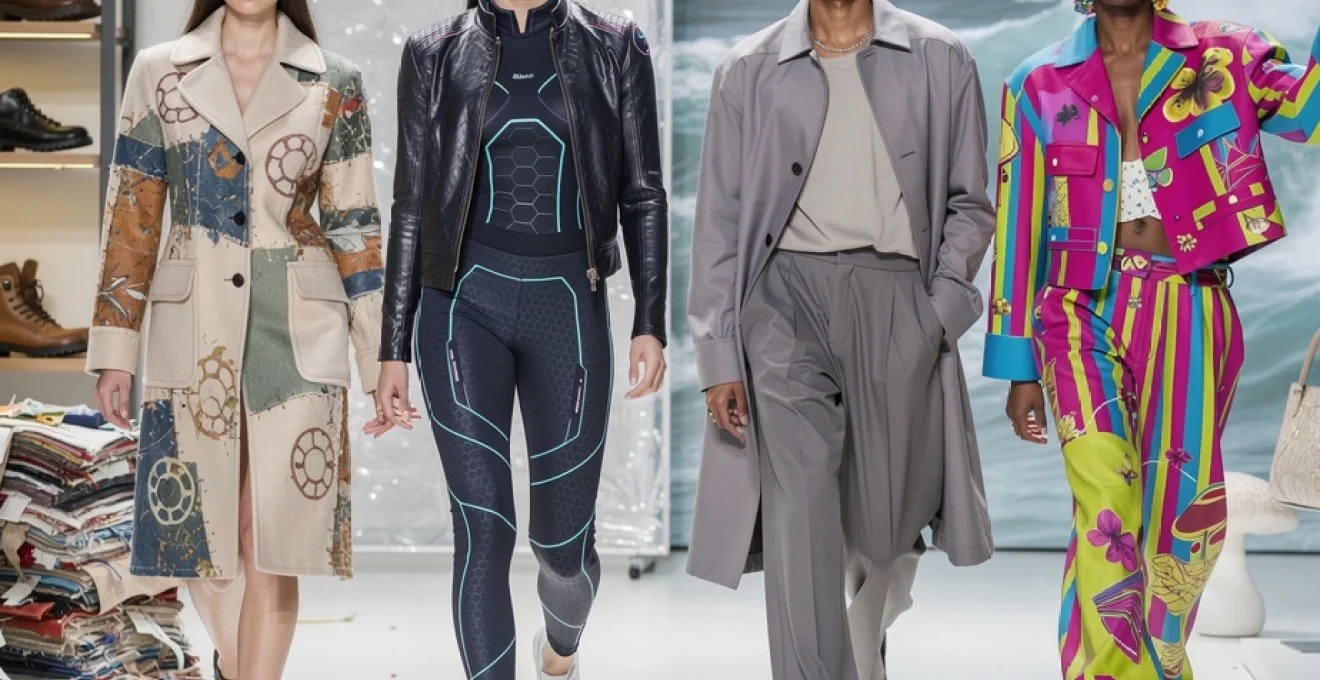
The fashion landscape is experiencing unprecedented transformation as technological innovation converges with environmental consciousness and social inclusivity. From sustainable manufacturing processes that reimagine the entire product lifecycle to digital fashion platforms that challenge traditional notions of physical clothing, the industry stands at a remarkable crossroads. Contemporary fashion movements are reshaping not only how garments are designed and produced, but also how consumers engage with style and personal expression. This evolution encompasses everything from biomaterial innovations that could replace traditional textiles to virtual garment technologies that exist solely in digital spaces. The trends emerging today represent a fundamental shift towards more responsible, inclusive, and technologically advanced fashion ecosystems that prioritise both environmental stewardship and creative innovation.
Sustainable fashion revolution: circular economy integration and Zero-Waste manufacturing
The sustainable fashion revolution has evolved far beyond simple eco-friendly marketing claims, establishing itself as a comprehensive transformation of industry practices. Modern sustainability initiatives focus on implementing circular economy principles that eliminate waste through innovative design methodologies and closed-loop production systems. Fashion brands are increasingly adopting regenerative practices that not only reduce environmental impact but actively contribute to ecological restoration. Zero-waste manufacturing techniques have gained significant traction, with designers creating patterns that utilise every fragment of fabric material.
Contemporary sustainability metrics extend beyond carbon footprint calculations to encompass water usage, chemical impact, and social responsibility measures. The integration of blockchain technology in supply chain management has enabled unprecedented transparency, allowing consumers to trace garments from raw material sourcing through final production. Circular fashion initiatives are generating substantial market growth, with the global sustainable fashion market projected to reach £15.2 billion by 2030, representing a compound annual growth rate of 7.8%.
Cradle-to-cradle design philosophy in contemporary fashion collections
Cradle-to-cradle design philosophy has become a cornerstone of progressive fashion development, emphasising the creation of garments that contribute positively to ecological systems throughout their entire lifecycle. This approach requires designers to consider material biodegradability, manufacturing energy sources, and end-of-life disposal options from the initial conceptualisation stage. Fashion houses implementing this methodology utilise materials that can either biodegrade safely or be infinitely recycled without quality degradation. The philosophy extends to packaging design, retail space construction, and even employee working conditions, creating holistic sustainability frameworks.
Patagonia’s worn wear programme: resale market innovation
Patagonia’s Worn Wear programme exemplifies how established fashion brands can successfully integrate circular economy principles whilst maintaining profitability and brand integrity. The initiative encompasses repair services, trade-in programmes, and resale platforms that extend garment lifecycles significantly beyond traditional expectations. This model has inspired numerous fashion companies to develop similar programmes, creating a secondary market that reduces demand for new production whilst generating additional revenue streams. Resale market dynamics have shifted consumer perceptions about pre-owned fashion, with 73% of millennials now expressing willingness to purchase second-hand clothing.
Stella McCartney’s mylo mushroom leather implementation
Stella McCartney’s pioneering work with Mylo mushroom leather represents a breakthrough in biomaterial innovation, demonstrating how luxury fashion can embrace sustainable alternatives without compromising aesthetic quality or performance standards. Mylo leather, produced from mushroom mycelium, offers comparable durability and texture to traditional animal leather whilst requiring significantly fewer resources and generating minimal environmental impact. The material’s production process involves growing mycelium roots on organic substrates in controlled environments, creating leather-like sheets that can be processed using conventional leather-working techniques. This innovation addresses ethical concerns about animal welfare whilst providing designers with versatile, high-quality materials suitable for luxury applications.
Econyl regenerated nylon applications in luxury swimwear
Econyl regenerated nylon has revolutionised luxury swimwear production by transforming ocean waste and discarded fishing nets into high-performance textile materials. This innovative process involves depolymerising waste nylon back to its original molecular structure, enabling infinite regeneration without quality loss. Luxury brands utilising Econyl report performance characteristics that match or exceed traditional nylon specifications, whilst achieving significant environmental benefits. Ocean plastic recovery initiatives connected to Econyl production have removed over 640,000 tonnes of waste materials from
landfill and marine environments, illustrating how circular textile innovation can turn a pollution crisis into a valuable resource stream. For consumers, Econyl-powered swimwear offers a tangible way to participate in sustainable fashion without sacrificing performance, fit, or style. For designers, it unlocks a reliable, scalable material that aligns with stricter environmental regulations and rising expectations around traceability. As more luxury labels publicly disclose their material mix and impact reports, regenerated nylon is poised to become a benchmark for responsible, future-ready fabric sourcing.
Digital fashion and virtual garment technologies
Alongside material innovation, digital fashion is redefining what we even mean by “a garment”. Virtual collections, NFT fashion drops, and 3D prototyping tools are enabling designers to experiment without the constraints of physical production. For consumers, digital fashion offers new ways to express identity across social media, gaming platforms, and emerging metaverse environments. As brands test virtual runways and augmented reality experiences, digital fashion trends are reshaping marketing, sampling, and ownership models throughout the industry.
NFT fashion collections: the fabricant’s digital-only couture
The Fabricant has become a reference point for NFT fashion collections and digital-only couture, demonstrating how clothing can exist purely as data. Instead of manufacturing physical garments, the studio creates ultra-high-resolution 3D pieces that are minted as non-fungible tokens, ensuring verifiable ownership and scarcity. These NFT garments can be worn virtually in gaming environments, social media filters, and metaverse platforms, enabling fashion enthusiasts to build a “wardrobe” that has zero physical footprint.
For fashion brands, this model functions like a digital laboratory, allowing radical silhouettes, impossible materials, and animated textures that would be impractical in real life. It also offers an alternative revenue stream that decouples creative output from physical inventory risk. While the NFT market has cooled since its 2021 peak, digital couture continues to evolve, moving from speculative collectibles towards more utility-driven assets, such as interoperable skins and membership tokens linked to exclusive communities or events.
Augmented reality try-on solutions via snapchat lens studio
Augmented reality try-on technology has rapidly moved from novelty to necessity, and Snapchat’s Lens Studio platform sits at the heart of this shift. By using smartphone cameras and advanced body or face tracking, brands can offer virtual try-on lenses that let users “wear” sunglasses, trainers, beauty products, or even full outfits in real time. This reduces the uncertainty surrounding online purchases and can meaningfully decrease return rates, a significant cost and sustainability issue for e-commerce.
For smaller labels, Lens Studio provides accessible tools to develop branded AR experiences without a large in-house development team. You can, for instance, launch a limited-edition capsule and allow your audience to test colourways and styling combinations through a simple lens before buying. As AR fitting rooms become more accurate, we are likely to see them integrated directly into brand apps and websites, turning the customer’s smartphone into a portable, personalised dressing room. The key challenge will be ensuring data privacy and avoiding over-reliance on novelty at the expense of genuine usability.
CLO 3D virtual prototyping in fast fashion production
CLO 3D has emerged as a cornerstone tool for virtual prototyping, particularly in fast fashion production where speed-to-market is critical. Instead of relying on multiple physical samples, design teams can build accurate 3D garments, simulate drape and fit on digital avatars, and make real-time adjustments before a single fabric is cut. This significantly reduces material waste, shipping emissions from sample transport, and the long lead times associated with traditional development cycles.
For businesses, CLO 3D-driven virtual prototyping also improves cross-team communication. Merchandisers, pattern cutters, and marketing teams can all visualise the same 3D assets, reducing misinterpretation and costly last-minute changes. When paired with PLM (Product Lifecycle Management) systems, virtual samples can be integrated directly into production workflows and line sheets, streamlining everything from costing to e-commerce photography (via rendered imagery). The main barrier to adoption remains training: brands need to invest in upskilling designers so they can translate creative ideas into technically robust 3D files.
RTFKT studios’ virtual sneaker ecosystem integration
RTFKT Studios, acquired by Nike in 2021, illustrates how virtual sneaker ecosystems can blend gaming culture, collectibles, and real-world fashion. Their digital trainers, often released as NFTs, can be worn by avatars in supported platforms while also unlocking access to physical drops, events, or customisation opportunities. This dual existence blurs the line between physical and digital ownership, creating a hybrid consumer journey that resonates strongly with Gen Z and Gen Alpha audiences.
By integrating limited-edition virtual sneakers with token-gated communities, RTFKT has turned sneaker collecting into a full-stack digital experience. We are already seeing more mainstream brands experiment with similar structures—digital twins for every physical shoe, loyalty rewards linked to on-chain activity, and co-creation projects where communities vote on design features. As interoperability between virtual worlds improves, expect virtual sneaker ecosystems to evolve from isolated experiments into a standard engagement layer for performance and lifestyle footwear brands.
Gender-neutral fashion and inclusive sizing methodologies
Gender-neutral fashion and inclusive sizing are no longer niche experiments; they are fast becoming baseline expectations for a modern fashion brand. Consumers increasingly reject rigid menswear/womenswear binaries and demand collections that prioritise fit, comfort, and self-expression over traditional gender codes. At the same time, inclusive sizing methodologies are expanding size ranges, refining grading rules, and investing in diverse fit models so that more bodies are properly accommodated.
Forward-thinking labels are redesigning entire product hierarchies to be genderless from the outset, using modular silhouettes, adjustable features, and neutral fit blocks that work across body types. We are also seeing the rise of micro-collections that respond to specific communities, such as trans and non-binary customers, who have historically been underserved by mainstream retail. Inclusive sizing, meanwhile, is leveraging 3D body-scanning data and AI-driven fit prediction to move beyond simplistic S–XL scales towards more nuanced size systems. This can significantly reduce returns, improve customer loyalty, and align brands with broader cultural shifts towards body positivity and representation.
Maximalist dopamine dressing: chromotherapy and pattern maximisation
In contrast to the clean lines of minimalism, maximalist dopamine dressing embraces bold colour, exuberant prints, and layered textures to create outfits that literally boost mood. Driven partly by post-pandemic optimism and partly by social media aesthetics, this fashion trend uses chromotherapy principles—how colour influences emotion—to craft wardrobes designed to energise and uplift. Think saturated fuchsia suiting, clashing florals, sequins for daytime, and accessories that border on costume.
Psychologically, dopamine dressing operates like wearable joy: when you choose a bright orange coat over a beige trench, you are making a deliberate decision to be seen, to take up space, and to shift your internal state. Pattern maximisation plays a central role here, with designers layering stripes over checks, abstract prints over animal motifs, and embellished surfaces over metallic fabrics. For brands, this is an opportunity to experiment with smaller, high-impact capsule drops that encourage play—printed scarves, statement knitwear, or limited-edition bags—without overhauling an entire core collection.
Of course, maximalist fashion trends come with practical considerations. How do you incorporate bold pieces without feeling overwhelmed or drifting into costume territory? A strategic approach is to anchor one or two statement items with more neutral basics, or to focus on a single colour family for cohesion. As resale platforms continue to grow, many consumers are also turning to second-hand markets for unique vintage prints and 1980s maximalism, reducing the environmental footprint of experimentation while still leaning fully into this joyful aesthetic.
Advanced textile innovations: smart fabrics and biomaterial integration
Behind the runway, advanced textile innovations are quietly transforming what our clothes can do. Smart fabrics embed sensors, conductive yarns, or responsive polymers into textiles, enabling garments to regulate temperature, track biometrics, or interact with digital devices. In parallel, biomaterial integration is challenging the dominance of petrochemical-based synthetics and animal-derived hides, introducing lab-grown or bioengineered alternatives with lower environmental impacts. These emerging fashion trends point towards a future where functionality, sustainability, and aesthetics are deeply intertwined.
Graphene-enhanced conductive textiles in wearable technology
Graphene-enhanced conductive textiles represent a major leap forward in wearable technology. Graphene, a single layer of carbon atoms arranged in a hexagonal lattice, is incredibly strong, lightweight, and highly conductive. When integrated into fibres or coatings, it enables fabrics that can transmit electrical signals while remaining flexible and comfortable. This opens the door to garments that can power low-energy devices, monitor heart rate or muscle activity, and communicate with smartphones or health platforms.
For sportswear and performance brands, graphene textiles offer clear advantages: improved moisture management, enhanced thermal regulation, and built-in sensor pathways without bulky hardware. We are already seeing collaborations between tech startups and established labels to develop smart jerseys, posture-correcting tops, and safety gear with integrated lighting. The analogy often used is that of turning the fabric into a “wearable circuit board”—but unlike rigid electronics, these textiles can stretch, bend, and be laundered. The key challenges will be standardising durability, ensuring skin safety, and scaling production so that graphene integration moves from experimental capsules into accessible price points.
Phase change materials in temperature-regulating activewear
Phase change materials (PCMs) in temperature-regulating activewear are another example of textile science moving into the mainstream. PCMs work by absorbing, storing, and releasing heat as they change state—typically from solid to liquid and back—at specific temperature thresholds. When embedded into fibres, microcapsules, or coatings, they act like a microscopic climate-control system for your clothing.
In practical terms, this means a running top or ski base layer can help keep you cooler when your body temperature rises and warmer when conditions cool down, smoothing out uncomfortable spikes. For consumers who train in variable weather or move between indoor and outdoor environments, PCM-enhanced garments provide consistent comfort without constant layering adjustments. From a sustainability perspective, better thermal regulation can also reduce dependence on energy-intensive climate control in indoor spaces. As with many advanced fabrics, the trick is communicating these benefits clearly at retail: instead of technical jargon, brands need simple, relatable explanations—“it works like an ice cube that never melts on your skin”—to help shoppers understand why these garments command a premium.
Biofabricated leather alternatives: modern meadow’s zoa material
Biofabricated leather alternatives are gaining momentum as ethical, scalable replacements for conventional hides, and Modern Meadow’s Zoa material is a leading example. Rather than raising animals or relying on petrochemical PU, Zoa is created by growing collagen—the main protein in animal skin—through a fermentation process using engineered yeast. This collagen is then assembled into sheets that can be finished to resemble traditional leather or reimagined in entirely new ways, such as translucent or patterned constructions.
For luxury fashion, Zoa offers several compelling advantages. It can be produced to precise thickness and performance specifications, reducing waste associated with irregular hides, and it can be engineered for specific applications, from soft drapey garments to structured accessories. Because the process is controlled in bioreactors, it has the potential to be far less resource-intensive than livestock agriculture, with lower land, water, and methane emissions. As regulatory scrutiny around animal welfare and carbon-intensive supply chains increases, biofabricated materials like Zoa could become central to a new generation of “next-gen” leather goods that align high design with high responsibility.
Self-healing polymer integration in luxury outerwear
Self-healing polymers integrated into luxury outerwear might sound like science fiction, but they are rapidly moving towards commercial reality. These advanced materials are engineered with microcapsules or reversible chemical bonds that can repair minor cuts or abrasions when exposed to heat, pressure, or simply ambient conditions. Imagine a trench coat that can “heal” a small snag from a sharp edge, or a technical parka that closes micro-tears caused by backcountry use—extending the functional life of the garment and preserving its appearance.
For luxury brands, self-healing technology aligns strongly with both premium positioning and sustainability goals. Longer-lasting pieces reduce the need for frequent replacement, supporting circular fashion strategies that prioritise durability and repair over disposability. At the same time, the self-healing narrative offers a powerful storytelling angle: outerwear that actively looks after itself, much like a high-end watch that maintains precision over decades. The main considerations will include balancing performance with handfeel (so fabrics remain pleasant to touch), ensuring safe chemistry, and educating consumers about realistic expectations—self-healing polymers are not indestructible, but they can make everyday wear and tear far less of a concern.