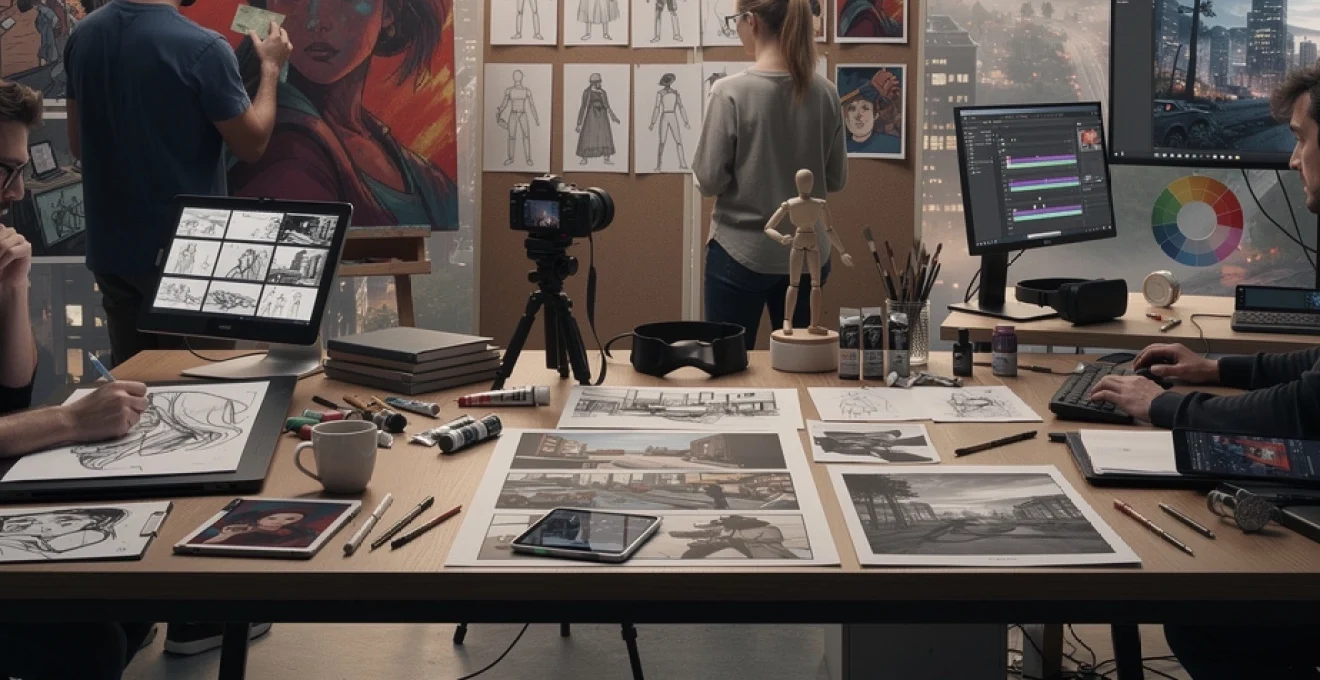
Visual storytelling stands as one of humanity’s most profound forms of communication, transcending language barriers and cultural boundaries to convey complex narratives through carefully crafted imagery. Artists throughout history have mastered the delicate art of weaving compelling stories through their visual creations, employing sophisticated techniques that speak directly to our emotions and imagination. In today’s digital age, the power of visual narrative has evolved beyond traditional canvas and paint, embracing cutting-edge technologies whilst maintaining the timeless principles that have captivated audiences for centuries.
The contemporary artistic landscape offers unprecedented opportunities for storytellers to engage audiences through immersive visual experiences. From ancient cave paintings to modern interactive installations, artists have consistently demonstrated that a single image can communicate volumes about human experience, social commentary, and personal revelation. This evolution of visual storytelling continues to reshape how audiences consume and interact with narrative content across multiple platforms and mediums.
Visual narrative composition techniques in contemporary art practice
Contemporary artists employ sophisticated composition strategies to create visual narratives that guide viewers through carefully orchestrated emotional journeys. These techniques combine traditional artistic principles with modern understanding of viewer psychology to maximize narrative impact. The arrangement of visual elements within a frame serves as the foundation for effective storytelling, where every component contributes to the overarching narrative structure.
Compositional hierarchy plays a crucial role in directing audience attention throughout the visual narrative. Artists strategically position focal points, utilise leading lines, and manipulate scale relationships to create a natural reading pattern that unfolds the story progressively. This deliberate orchestration ensures that viewers encounter story elements in the intended sequence, building tension and revelation at precisely calculated moments.
Sequential panel storytelling in graphic novel illustration
Sequential art represents one of the most sophisticated approaches to visual storytelling, where individual panels work collectively to create immersive narrative experiences. Artists working in this medium must master the delicate balance between individual panel composition and overall page flow. The transition between panels, known as the gutter space, becomes a critical storytelling tool where readers’ imaginations fill narrative gaps.
Panel size variation serves multiple narrative functions, from indicating temporal changes to emphasising emotional intensity. Large panels typically denote significant story moments or allow for detailed environmental storytelling, whilst smaller panels create rapid pacing for action sequences. Panel borders themselves become narrative devices, with jagged edges suggesting explosive action and soft, curved borders indicating dream sequences or memories.
Colour psychology and emotional arc development in visual narratives
Colour psychology forms the invisible backbone of emotional storytelling in visual art, where specific hues trigger predictable psychological responses that artists exploit to guide audience emotions. Warm colour palettes typically evoke feelings of comfort, passion, or aggression, whilst cool tones suggest tranquillity, melancholy, or detachment. Artists strategically shift colour temperatures throughout their narratives to mirror character development and plot progression.
The concept of colour temperature progression allows artists to create sophisticated emotional arcs that mirror traditional narrative structures. Beginning a visual story with warm, inviting colours and gradually shifting towards cooler tones can effectively communicate a character’s emotional journey from happiness to isolation. This technique proves particularly powerful in sequential art, where colour changes across panels create subconscious emotional responses in viewers.
Symbolic iconography and metaphorical visual language systems
Visual symbolism enables artists to communicate complex abstract concepts through recognisable imagery that transcends literal interpretation. Effective symbolic storytelling requires artists to balance universal symbols that resonate across cultures with personal iconography that adds unique narrative layers. Traditional symbols like roses for love or skulls for mortality provide immediate emotional context, whilst personalised symbolic systems create deeper engagement for attentive viewers.
Contemporary artists often develop signature symbolic vocabularies that evolve throughout their body of work, creating rich intertextual relationships between individual pieces. This approach allows for sophisticated narrative layering where each artwork contributes to a larger ongoing story. Metaphorical visual language enables artists to address sensitive or complex topics through allegorical representation, making difficult subjects more accessible to broader audiences.
Perspective manipulation and viewer engagement strategies
Perspective manipulation serves as a powerful tool for controlling viewer experience and emotional engagement within visual narratives. Artists strategically employ various perspective techniques to position viewers as active participants
in the unfolding story, shifting between first-person and omniscient viewpoints simply by adjusting the horizon line or camera angle. A low-angle perspective can make a character appear powerful or intimidating, while an overhead, almost surveillance-like view may suggest vulnerability or isolation. By deliberately breaking traditional rules—such as tilting the horizon or distorting scale—artists can induce tension, unease, or curiosity, pulling viewers closer into the narrative.
Contemporary visual storytellers also experiment with subjective perspective, where the image reflects what a character feels rather than what they literally see. Blurred edges, exaggerated foreshortening, or tunnel vision effects can all communicate panic, obsession, or focus, guiding the viewer to inhabit the character’s psychological space. In interactive media and immersive installations, perspective manipulation extends to physical movement, inviting audiences to walk around or through the artwork to uncover different story layers from multiple vantage points.
Digital art platforms and interactive storytelling technologies
Digital art platforms have radically expanded how artists use visuals to tell compelling stories, enabling multi-layered narratives that evolve over time and across devices. Instead of a single static image, visual storytelling can now unfold through animations, interactive interfaces, and responsive environments that adapt to viewer input. These technologies empower artists to blend illustration, motion design, sound, and data into holistic narrative experiences that feel more like living worlds than single artworks.
For many creators, the key advantage of digital storytelling tools lies in their flexibility and iteration speed. Artists can prototype story ideas, adjust compositions, and test different visual narrative arcs without the material limitations of traditional media. This digital workflow encourages experimentation: what happens if a scene shifts from day to night in real time, or if a character’s colour palette responds to audience choices? The answers to these questions are redefining contemporary visual narrative practice.
Adobe creative suite integration for multi-layered visual narratives
Adobe Creative Suite sits at the heart of many modern visual storytelling pipelines, allowing artists to integrate illustration, photo manipulation, motion graphics, and layout into a cohesive narrative system. Photoshop and Illustrator often serve as the foundation for concept development, character design, and environment building, while After Effects and Premiere Pro bring those elements to life through animation and editing. This multi-app workflow makes it possible to create complex visual narratives that move fluidly from static spreads to motion pieces and interactive prototypes.
Artists who master cross-application integration can treat each software as a narrative layer rather than an isolated tool. For instance, a graphic novel page designed in Photoshop can be imported into After Effects for subtle parallax animation, then composited into a video teaser for social media. Smart objects, shared libraries, and non-destructive workflows enable quick adjustments to story beats—change a character’s expression or wardrobe once, and it updates across multiple scenes. For visual storytellers working with clients, this adaptability is invaluable, allowing fast revisions while preserving the integrity of the visual story.
Procreate animation tools for mobile story development
Procreate has become a favourite among illustrators for mobile story development, turning the tablet into a portable visual storytelling studio. Its Animation Assist feature allows artists to create frame-by-frame sequences directly on the canvas, making it ideal for short animated loops, storyboard animatics, and expressive character moments. Because everything happens on a touch interface, drawing and animating feel intuitive, almost like flipping through a physical sketchbook that happens to move.
For artists exploring how to tell stories visually on social platforms, Procreate’s streamlined export options are particularly powerful. Animated GIFs, MP4 clips, and time-lapse recordings can be shared quickly, allowing creators to test audience reactions to characters, moods, and narrative hooks. This rapid feedback loop mirrors the way a writer might test story ideas in short scenes before committing to a full novel, giving visual storytellers the freedom to experiment and refine their narrative voice on the go.
Unity and unreal engine applications in interactive art experiences
Game engines like Unity and Unreal Engine have moved far beyond traditional gaming, becoming essential tools for interactive art experiences and immersive visual narratives. These platforms allow artists to build explorable environments, branching storylines, and responsive characters that react to user choices. Instead of passively viewing an image, audiences can walk through a digital city, trigger memory sequences, or uncover hidden symbolic details, effectively co-authoring the story as they move.
This shift from linear to interactive storytelling changes the artist’s role from sole narrator to world architect. Visual details must now support narrative from every possible angle, much like stage design in theatre but with infinite camera positions. Lighting, sound cues, and environmental effects—fog, rain, particle systems—become narrative tools that guide players subtly toward key story moments. As virtual and augmented reality continue to grow, we can expect more artists to harness these engines to craft deeply personal, yet participatory, visual stories.
NFT blockchain platforms for sequential art distribution
NFT blockchain platforms have introduced new possibilities for distributing sequential art and sustaining long-form visual storytelling projects. By minting individual panels, pages, or chapters as tokens, artists can create collectible narrative series where each visual piece has verifiable ownership and provenance. This model not only supports independent creators financially, it also encourages experimentation with limited editions, alternate covers, and branching narrative paths tied to specific tokens.
Some artists use NFT collections as evolving story-worlds, releasing new visual chapters over time and rewarding early collectors with exclusive narrative content. In this context, metadata becomes another layer of storytelling: traits, attributes, and rarity levels can reflect character backstories or plot twists embedded in the collection’s structure. While the NFT space remains volatile, it has undeniably pushed visual storytellers to rethink how stories are released, owned, and experienced in decentralized digital spaces.
Traditional media approaches to visual story construction
Despite the rise of digital tools, traditional media remains a vital foundation for visual storytelling, offering tactile qualities and imperfections that many audiences find deeply human. Oil painting, charcoal drawing, printmaking, and sculpture each bring unique textures and material constraints that shape how stories emerge. The physical process—the drag of a brush, the resistance of paper, the slow drying of layers—often mirrors the emotional pacing of the narrative itself.
Artists working in traditional media frequently rely on time-tested compositional strategies such as chiaroscuro, gesture, and layered glazing to construct narrative depth. A single brushstroke can suggest movement, while a subtle shift in value can imply a shift in mood. Because revisions are slower and sometimes irreversible, traditional visual storytelling often involves careful planning: thumbnails, value studies, and colour roughs that function much like storyboards for a film. This deliberate approach encourages clarity of intention—what exactly should the viewer feel or question at first glance?
Character design psychology and narrative voice development
Character design sits at the core of many compelling visual stories, acting as the primary channel through which audiences connect emotionally with the narrative. Every design choice—silhouette, posture, costume, facial features, even the way a character occupies space—communicates aspects of personality, backstory, and motivation before a single word is read. In this sense, character design functions as the visual equivalent of an author’s narrative voice.
Psychologically informed character design leverages principles from body language research and colour psychology. Rounded shapes and soft lines tend to signal approachability or innocence, whereas sharp angles and rigid posture can indicate tension, authority, or danger. A restrained, minimal costume palette might suggest discipline or repression, while layered, eclectic outfits can hint at complexity or internal conflict. When these visual cues align with the story’s themes, they create intuitive understanding for the viewer: we know who this character is, and we’re curious to see how they change.
To develop a consistent narrative voice across a series, many artists create character bibles that document expressions, poses, emotional triggers, and symbolic motifs associated with each figure. This practice ensures that the character’s visual evolution mirrors their internal arc rather than shifting randomly from piece to piece. For you as a visual storyteller, asking simple questions—What does this character fear? What do they hide? How would that show up in their posture or clothing?—can transform generic designs into memorable narrative anchors.
Environmental storytelling through background architecture and setting design
Environments function as silent characters in visual storytelling, shaping the mood, context, and subtext of every scene. A well-designed background does far more than fill negative space; it offers clues about history, culture, and conflict that deepen the narrative without a single line of text. In film, comics, games, and illustration, background architecture and setting design give viewers a sense of place that grounds the emotional stakes of the story.
Environmental storytelling often relies on visual evidence—objects left behind, weathered surfaces, light direction, and spatial composition—to imply what happened before the viewer arrived. Think of a cluttered studio, a derelict train station, or a meticulously maintained garden: each setting instantly frames expectations about the characters who inhabit it. By treating backgrounds as reservoirs of narrative information rather than decorative backdrops, artists can layer meaning and invite viewers to become detectives, piecing together the world through visual clues.
Atmospheric perspective techniques in landscape narrative painting
Atmospheric perspective offers landscape painters a powerful device for shaping narrative focus and emotional tone within wide vistas. By gradually softening edges, reducing contrast, and shifting colours toward cooler, lighter hues in the distance, artists can create a sense of depth that also directs attention to specific story elements in the foreground or mid-ground. This technique mimics how our eyes perceive space in the real world, making invented landscapes feel believable and immersive.
Beyond realism, atmospheric perspective can underscore narrative themes. A hazy, almost obscured horizon line might suggest uncertainty about the future, while a clear, crisp distance can symbolise hope or clarity. Artists can exaggerate these effects—thick mist swallowing distant mountains or smog blurring a city skyline—to comment on environmental issues or emotional states. In this way, the air itself becomes part of the story, shaping how we read the landscape and the journeys unfolding within it.
Urban decay and industrial aesthetic in contemporary visual stories
Urban decay and industrial aesthetics have become prominent motifs in contemporary visual storytelling, especially in genres exploring dystopia, memory, and social critique. Cracked concrete, rusted metal, graffiti layers, and broken windows all serve as visual metaphors for neglect, resilience, or transformation. These textures tell stories of former prosperity, conflict, or abandonment without needing explicit exposition, much like reading the rings of a tree to understand its history.
Many artists leverage decayed urban environments as stages where human narratives of survival and adaptation play out. A single plant growing through asphalt can symbolise hope; a boarded-up storefront covered in community murals can speak to collective resistance. The industrial aesthetic also carries a certain nostalgia—echoes of manufacturing eras, labour histories, and shifting economies—that can be tapped to explore themes of identity and displacement. When used thoughtfully, these visual elements prevent urban scenes from feeling generic, instead turning them into rich narrative archives.
Cultural architecture integration in character-driven visual narratives
Integrating cultural architecture into character-driven narratives allows artists to root their stories in specific histories and identities, avoiding the “nowhere” feeling of generic fantasy or sci-fi worlds. Distinctive rooflines, ornamentation, street layouts, and interior design all signal cultural context that shapes how characters move, dress, and interact. In many cases, architecture functions as an externalisation of values: communal plazas might indicate collective traditions, while fortified compounds suggest themes of protection or exclusion.
Thoughtful representation requires research and sensitivity. Rather than cherry-picking exotic visual motifs, artists can study how climate, materials, and social structures have influenced real-world buildings, then extrapolate believable, respectful designs. When characters are shown using these spaces—preparing food in a traditional kitchen, performing rituals in a courtyard, navigating dense alleyways—their relationships to culture become visible. For viewers, this depth of environmental detail transforms the setting from simple background to an active participant in the unfolding story.
Commercial applications of visual storytelling in brand communication
In commercial contexts, visual storytelling has become a cornerstone of effective brand communication, helping organisations cut through information overload and connect emotionally with audiences. Rather than presenting products or services as isolated features, brands now strive to frame them within narratives of aspiration, problem-solving, and identity. A well-crafted visual campaign can quickly answer unspoken questions: Who is this for? What change does it promise? Why should I care?
Commercial artists and designers draw on the same narrative tools as fine artists—composition, colour psychology, symbolism, and character design—but apply them to strategic objectives such as brand awareness, loyalty, and conversion. Consistent visual motifs across platforms reinforce the brand’s story world, from packaging and social media to in-store experiences. When done well, these visual narratives don’t feel like intrusive adverts; they feel like chapters in an ongoing story that audiences choose to follow.
Storyboard development for film and television pre-production
Storyboarding plays a pivotal role in film and television pre-production, transforming written scripts into a visual roadmap for directors, cinematographers, and production teams. Each panel in a storyboard represents a planned shot, indicating composition, camera movement, and key character actions. This pre-visualisation allows creators to test the rhythm of scenes, clarify emotional beats, and identify potential pacing issues long before cameras roll.
For storyboard artists, visual storytelling must balance clarity and efficiency. Simple, readable drawings are often more valuable than highly rendered images, as the purpose is to communicate intent quickly to the whole crew. Strategic use of arrows, framing notes, and value contrasts guides the viewer’s eye through each shot sequence, much like a graphic novel designed for professionals. As streaming platforms increase demand for content, strong storyboard skills have become even more critical in keeping productions on schedule and within budget.
Editorial illustration techniques for magazine and publishing industries
Editorial illustration translates complex articles and opinion pieces into single images that encapsulate key arguments or emotional tones. In magazines, newspapers, and online publications, these visuals must grab attention, hint at the story’s theme, and sometimes introduce a provocative twist that invites deeper reading. To achieve this, editorial illustrators often rely on metaphor, juxtaposition, and visual simplification, distilling dense topics into striking, memorable imagery.
Because editorial timelines are often tight, artists working in this field develop agile ideation processes. Thumbnail sketches exploring multiple conceptual directions—literal, symbolic, humorous, critical—help editors choose the narrative angle that best matches the article’s voice. Effective editorial visual storytelling feels like a good headline: concise, intriguing, and slightly open-ended, leaving room for interpretation. As readers increasingly skim digital content, a strong editorial illustration can make the difference between an article being ignored or widely shared.
Concept art creation for video game development studios
In video game development, concept art establishes the visual language of entire worlds before they are built in 3D. Concept artists design characters, environments, props, and key story moments that define the game’s tone and narrative possibilities. These paintings and sketches become reference points for modelers, animators, and level designers, ensuring that every asset supports a cohesive story vision.
Unlike standalone illustration, concept art must balance aesthetic impact with functionality. Designs need to be readable from multiple angles, work within gameplay mechanics, and support narrative progression over many hours of interaction. A hero’s outfit, for example, must communicate role and personality while accommodating animation and potential gear upgrades. In this way, concept art is both cinematic and systemic: it tells stories through singular images while laying groundwork for thousands of player-driven micro-narratives within the game world.
Advertising campaign visual strategy and consumer psychology
Advertising campaigns rely heavily on visual strategy informed by consumer psychology to craft stories that resonate quickly and persuasively. Research in cognitive science shows that people remember images far more readily than text alone, which is why strong campaign visuals focus on a single, emotionally charged idea rather than overcrowded compositions. Whether it’s a before-and-after scenario, an aspirational lifestyle snapshot, or a clever visual pun, the goal is to trigger recognition and desire in a fraction of a second.
To achieve this, art directors and visual designers use storytelling shortcuts: archetypal characters, familiar settings, and colour schemes that align with brand positioning. For instance, a health brand might lean into clean whites and greens to signal freshness and trust, while an entertainment brand opts for saturated, dynamic palettes that promise excitement. When you next encounter a campaign that sticks in your mind, consider how its visual narrative was constructed—chances are, every element from composition to typography was carefully orchestrated to guide your emotional journey in just a glance.