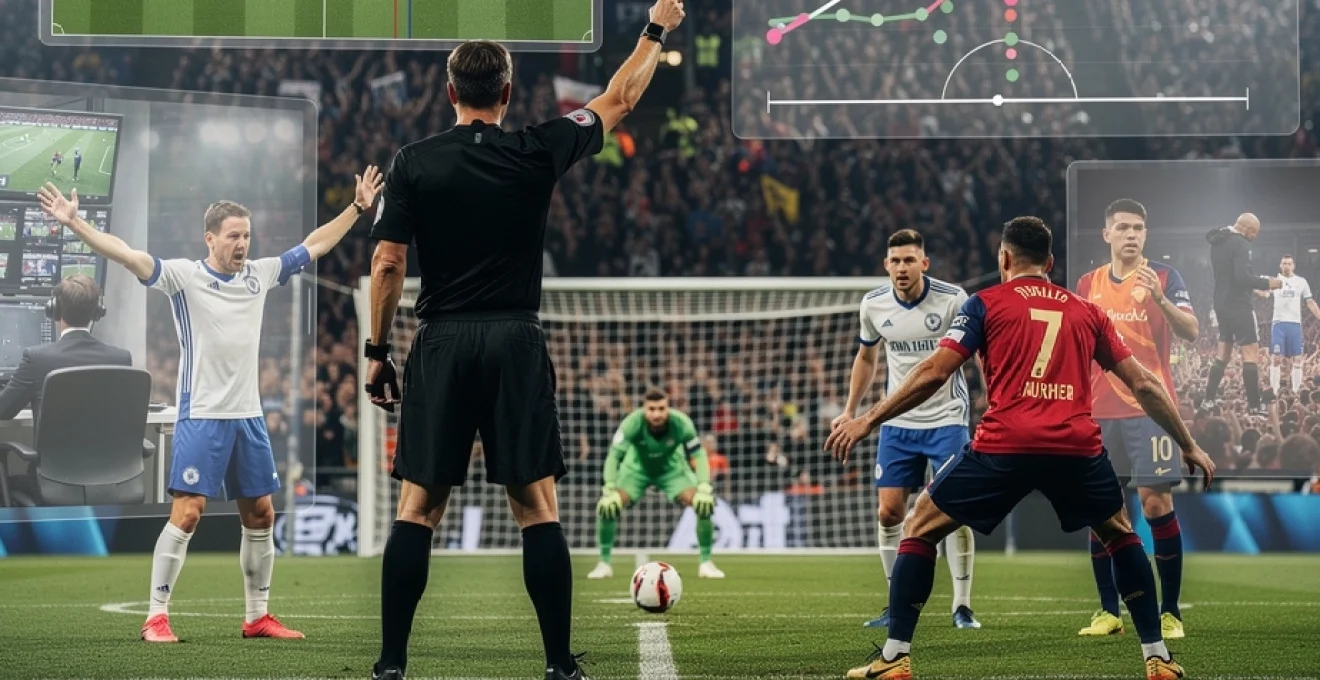
The final whistle blows, emotions run high, and debates ignite across stadiums, pubs, and social media platforms worldwide. While tactical brilliance and individual moments of magic often dominate post-match discussions, the influence of refereeing decisions on competitive outcomes remains one of football’s most contentious yet critical elements. Research has demonstrated that officiating decisions can fundamentally alter match trajectories, affect championship standings, and even determine which teams lift silverware at season’s end. Far from being passive arbiters, match officials actively shape the game through split-second judgements that carry profound consequences for players, clubs, and competitions alike.
Modern football officiating has evolved dramatically from its origins, transforming from a purely human endeavour reliant on instinct and positioning into a technologically augmented discipline. This evolution hasn’t eliminated controversy—rather, it has shifted the nature of debates whilst introducing new layers of complexity to decision-making processes. Understanding how refereeing decisions impact competitive outcomes requires examining not only the technological tools at officials’ disposal but also the psychological dimensions of authority, the statistical patterns emerging from disciplinary actions, and the systemic measures designed to ensure integrity throughout the sport.
VAR technology implementation and its impact on match outcomes
The introduction of Video Assistant Referee technology represents perhaps the most significant development in football officiating since the establishment of formal rules. Implemented across elite competitions globally, VAR has fundamentally altered the landscape of decision-making by providing officials with the ability to review critical incidents from multiple angles. The technology addresses four specific categories of match-changing events: goals, penalty decisions, direct red card incidents, and cases of mistaken identity. This targeted approach aims to correct clear and obvious errors whilst maintaining the flow and human element of the game.
Statistical analysis from the Premier League’s first complete season with VAR revealed that approximately 100 decisions were overturned or confirmed through video review, directly affecting match outcomes in roughly 30% of fixtures. These interventions prevented incorrect goals from standing, awarded legitimate penalties that on-field officials missed, and ensured appropriate disciplinary sanctions were applied. However, the technology’s impact extends beyond these direct interventions—its mere presence influences player behaviour, with tactical fouls and simulation attempts becoming riskier propositions when every incident faces potential scrutiny.
The implementation strategy varies across competitions, with some leagues adopting a high threshold for intervention whilst others encourage more frequent reviews. This inconsistency itself creates competitive implications, as teams competing in multiple tournaments must adapt to different officiating philosophies. The time required for reviews—averaging 60-90 seconds for complex decisions—also affects match dynamics, disrupting momentum and potentially disadvantaging teams that had seized psychological control of proceedings. Despite these challenges, data suggests that VAR has improved overall decision accuracy from approximately 82% to 94% in competitions where it’s been thoroughly integrated.
Hawkeye Goal-Line technology in premier league and bundesliga fixtures
Predating VAR’s widespread adoption, goal-line technology established the blueprint for technological intervention in football officiating. The Hawk-Eye system, utilising high-speed cameras positioned around the stadium, tracks the ball’s position with millimetre precision, providing instantaneous confirmation to match officials when the ball has fully crossed the goal line. Unlike VAR, which involves subjective interpretation, goal-line technology delivers binary, definitive answers that eliminate one of football’s most contentious decision categories entirely.
The Premier League’s deployment of this technology in 2013 marked a watershed moment, with the Bundesliga following suit shortly thereafter. Statistical evidence demonstrates that whilst goal-line incidents requiring technological intervention occur relatively infrequently—averaging 1-2 decisive incidents per season across major competitions—their impact on competitive outcomes proves disproportionately significant. The 2020 Sheffield United versus Aston Villa match exemplified this reality when a rare system failure allowed a goal that hadn’t crossed the line to stand, directly costing Sheffield United points in a relegation battle where single-point margins determined survival.
The technology’s implementation has effectively eliminated disputes regarding whether balls crossed the line, removing a source of injustice that previously plagued the sport. This certainty benefits all stakeholders: players can celebrate legitimate goals without anxiety, defenders avoid undeserved concessions, and officials escape criticism for decisions that human perception simply cannot judge accurately in real-time. The rapid signal transmission—occurring within one second of the ball crossing the line—ensures minimal disruption to match flow whilst
preserving the spontaneity that makes football compelling. In competitive terms, this reliability has narrowed the margin for error in title races and relegation battles, ensuring that crucial points hinge less on guesswork and more on verifiable fact.
Offside detection systems: Semi-Automated technology at FIFA world cup 2022
The 2022 FIFA World Cup introduced semi-automated offside technology, further reshaping how refereeing decisions influence tournament outcomes. This system combined 12 dedicated tracking cameras with a sensor embedded inside the match ball, capturing up to 29 data points on each player and the ball at 50 times per second. Using these inputs, the system generated real-time 3D offside lines, alerting the VAR team whenever a potential offside occurred in a goal-scoring sequence.
From a competitive perspective, this semi-automated offside technology reduced the average time to reach an offside decision from around 70 seconds to roughly 25 seconds. Quicker decisions mean fewer breaks in play and less disruption to attacking momentum, particularly vital in high-stakes knockout fixtures where a single goal can decide progression. FIFA reported that accuracy on tight offside calls was close to 100% across the tournament, significantly reducing the risk of a wrongly disallowed or incorrectly allowed goal shaping who advances.
Strategically, teams adjusted their defensive lines and attacking runs knowing that marginal offsides would be detected with surgical precision. High defensive lines became slightly less risky, as defenders could trust that delayed flags would still catch attackers straying beyond the last man. Conversely, forwards had to refine the timing of their runs, understanding that “benefit of the doubt” for attackers would be less common when data-driven offside detection removed much of the grey area that once existed.
Communication protocols between VAR officials and On-Field referees
Behind every VAR intervention lies an intricate communication protocol designed to balance accuracy with the flow of the game. VAR officials continuously monitor live feeds, checking key incidents in the background while play continues. When a “check” escalates to a formal “review”, the on-field referee receives clear, standardised instructions via headset, outlining what has been seen, which camera angles are most relevant, and whether a pitchside monitor consultation is recommended.
These protocols are not merely administrative; they directly influence how decisions affect competition outcomes. A concise, well-structured exchange can lead to a swift, confident decision that players accept, even when it goes against them. In contrast, lengthy, fragmented communication can create confusion, prolonged delays, and heightened tension in the stadium, sometimes swinging psychological momentum in favour of the team that appears to benefit from the uncertainty. Consistency in language, cues, and triggers is therefore critical at elite level.
Some associations have begun experimenting with partial transparency, allowing broadcasters to share limited audio between VAR and the referee after matches or in educational content. While live audio is still rare, post-match releases help explain controversial calls, reducing speculation about bias and improving public understanding of why a particular judgement shaped the result. Over time, clearer communication standards aim to minimise not only errors but also perceptions of injustice that can overshadow entire competitions.
Statistical analysis of overturned decisions in UEFA champions league matches
In the UEFA Champions League, where the financial and sporting stakes are immense, overturned decisions have had pronounced effects on competition trajectories. UEFA’s internal reports on recent seasons with VAR indicate that a modest number of interventions—typically between 60 and 80 per campaign—have altered key outcomes such as group standings, away-goal dynamics (before its abolition), and knockout progressions. Approximately one in every three VAR reviews has led to an on-field decision being changed, often involving penalties or disallowed goals.
When analysts map these overturns against final competition results, a clear pattern emerges: several knockout ties each season hinge on at least one major VAR decision. For example, a single overturned offside call or penalty award can swing an aggregate score, changing not only who advances but also future revenue, coefficient points, and seeding in subsequent tournaments. Over a five-year window, teams benefitting from more correctable errors in their favour (i.e., decisions originally wrong but corrected by VAR) often show marginally improved progression rates compared to those who see multiple favourable calls reversed.
From a performance-analysis standpoint, clubs now integrate VAR-related statistics into their preparation. They study referees’ and VAR crews’ historical patterns—how often they recommend on-field reviews, their thresholds for handball penalties or contact fouls, and their tendencies in borderline situations. In a competition where tiny details differentiate champions from also-rans, understanding the “officiating environment” of a tie has become as important as analysing an opponent’s pressing triggers or set-piece routines.
Psychological influence of referee authority on player performance
Beyond technology, the mere presence and authority of the referee exert a powerful psychological influence on players and coaches. Referees are not only enforcers of the Laws of the Game; they are also central figures in the emotional climate of a match. Their decisions can either calm or inflame tensions, encourage expressive attacking play or induce caution, and subtly shape how confident or anxious players feel in critical phases of a competition.
Research into decision-making under pressure shows that athletes and officials alike rely on heuristics—mental shortcuts—to respond swiftly in chaotic situations. As highlighted in work on referees’ use of heuristics at different competition standards, match officials may unconsciously adjust their strictness depending on context and perceived status of teams. This interplay between authority, context, and perception feeds back into player behaviour: if players believe a referee is more lenient or more influenced by pressure, they may push the boundaries more aggressively, especially in crucial fixtures.
Home advantage bias: pierluigi collina’s research on crowd effect
Home advantage has long been a feature of football, and officiating has historically been one of its contributing factors. Studies overseen and discussed by iconic referee Pierluigi Collina and others have shown that loud, partisan crowds can impact marginal decisions, especially on subjective calls like fouls or added time. Experimental research using crowd-noise simulations found that referees exposed to intense home support were more likely to award free kicks to the home team and slightly extend stoppage time when the home side was chasing a goal.
At competition level, this crowd effect can translate into cumulative advantages over a season: more free-kick opportunities in dangerous areas, fewer bookings for borderline challenges, and subtle time-management biases that favour home teams in tight finishes. In knockout competitions played over two legs, even small biases can tip the balance of an aggregate score, especially when one club is known for a particularly intimidating atmosphere. You could think of it as a “psychological extra player” who influences how confidently or cautiously the referee applies the laws.
The COVID-19 pandemic offered a natural experiment when matches were played behind closed doors. Data from top European leagues suggested a reduction in home advantage and a noticeable narrowing of the gap in fouls and cards awarded to home versus away teams. These trends reinforced the view that the crowd’s emotional energy can subtly sway officiating, and that mitigating this effect—through VAR, referee training, and awareness sessions—is central to preserving competitive balance.
Yellow card accumulation and tactical adjustments during knockout stages
Yellow cards may seem minor in isolation, but over the course of a tournament they create significant strategic and psychological ripple effects. In competitions such as the UEFA European Championship or FIFA World Cup, accumulation rules mean players risk suspension if they receive bookings in consecutive matches. Coaches must therefore manage not just fatigue and form, but also disciplinary exposure, especially in quarter-finals and semi-finals where one more card could rule a key player out of a final.
This reality often prompts tactical adjustments. Teams might instruct booked players to avoid certain types of challenges, accept being dribbled past in non-dangerous zones, or reduce their pressing intensity to minimise risk. Opponents, recognising this, may deliberately target yellow-carded defenders with one-on-one situations, hoping either to exploit their caution or to provoke a second booking. Thus, the referee’s early decisions on cautions can indirectly dictate match-ups and tactical patterns later in the competition.
Psychologically, carrying a booking into the latter stages of a match heightens stress and can impair decision-making, much like playing with the constant threat of a trapdoor beneath your feet. Some players respond by focusing more and refining their timing; others become tentative, which can disrupt a team’s pressing structure or transitional defence. At elite level, where margins are tiny, the way referees manage early yellow cards—whether they set a strict or lenient tone—can influence not only that game’s flow but also the composition of line-ups in subsequent rounds.
Momentum shifts following controversial penalty decisions
Few refereeing decisions shift momentum as dramatically as a controversial penalty award or non-award. Penalties are high-value events; in top-level football, conversion rates typically sit between 75% and 80%, making them one of the most decisive factors in close matches. When players and fans perceive a penalty decision as unjust, emotional responses can surge—anger, frustration, or a “siege mentality” that either galvanises or destabilises a team.
From a psychological standpoint, a contentious penalty can act like a plot twist in a thriller, changing not just the scoreline but the narrative the players tell themselves. The team benefitting might suddenly feel protected or “favoured by fate”, pushing forward with renewed conviction. The disadvantaged side, meanwhile, may either channel their frustration into more aggressive, high-risk play or lose composure, increasing the likelihood of further fouls and cards. In tournaments, where a single knockout tie defines success or failure, these emotional swings can be season-defining.
Interestingly, some performance data suggests that teams which respond constructively—maintaining tactical discipline after a controversial call—tend to recover better in the minutes that follow. Coaches and sports psychologists therefore work on pre-planned responses to refereeing shocks: emphasising controllable factors, reinforcing trust in the game plan, and avoiding “referee fixation” that distracts from the next phase of play. In other words, how players react to refereeing decisions can be as important as the decisions themselves.
Penalty kick awards and their statistical correlation with competition winners
Over the course of a season or tournament, the distribution of penalty kicks has a measurable relationship with who ultimately wins silverware. Analyses of Europe’s top leagues consistently show that title-winning teams often rank near the top in penalties awarded, but crucially, they also tend to concede relatively few penalties. This net penalty differential—awarded minus conceded—can equate to several expected goals across a campaign, often mirroring the slender margins in tight title races.
In knockout competitions, the impact of penalty awards is even more pronounced. A single spot-kick in a quarter-final or semi-final can decide progression, especially in low-scoring ties where chances are scarce. Historical data from the UEFA Champions League and World Cup knockouts indicates that teams awarded at least one penalty in a two-legged tie have a significantly higher probability of advancing, provided conversion rates remain in line with averages. When a referee points to the spot, they are often, in effect, tilting the entire bracket.
For analysts and clubs, studying how, when, and why penalties are awarded has become a core part of competitive preparation. Teams examine which referees are more likely to punish holding in the box, how VAR crews interpret handball according to the latest guidance, and whether certain attacking patterns—such as cut-backs and inside dribbles—correlate with higher penalty frequencies. From a strategic viewpoint, designing attacking schemes that increase the probability of drawing legitimate fouls in the area can be as valuable as perfecting long-range shooting.
Disciplinary action timing and its effect on championship rankings
The timing of disciplinary actions—yellow and red cards, as well as subsequent suspensions—plays a major role in shaping league tables and tournament brackets. A red card in the opening 15 minutes of a title-deciding fixture forces a team to play almost the entire match at a numerical disadvantage, dramatically reducing their expected points return. Conversely, a dismissal deep into stoppage time of a settled match may have little immediate impact, but its knock-on effect via suspension can weaken a side in the following round.
When analysts model league outcomes, they increasingly factor in disciplinary timing as a variable influencing performance. Teams that accumulate cards early in matches, or that suffer suspensions concentrated during congested periods of the calendar, often see sharper dips in results than those whose infractions occur in lower-stakes contexts. Put simply, not all bookings and dismissals are created equal; their competitive weight depends heavily on the match situation and the phase of the season in which they occur.
Red card incidents in el clásico: real madrid vs barcelona case studies
Few fixtures illustrate the competitive impact of red cards better than El Clásico, where Real Madrid and Barcelona often meet with titles or Champions League qualification at stake. Over the past two decades, this fixture has seen a notably high number of dismissals, many of them occurring in finely balanced matches. A red card in such a high-intensity environment not only alters the tactical equation but also amplifies emotional volatility among players and supporters.
Case studies from specific Clásicos show a recurring pattern: the team reduced to ten players typically experiences a sharp drop in possession and expected goals, especially in the 10–15 minutes immediately following the dismissal. However, there have also been notable exceptions where the sending-off galvanised the shorthanded side into a compact, counter-attacking unit that secured or even stole a result. These tactical adaptations—dropping a forward into midfield, switching to a back five, or sacrificing pressing intensity for defensive solidity—highlight how coaching decisions interact with refereeing calls to shape outcomes.
From a broader La Liga perspective, suspensions resulting from Clásico red cards often spill into subsequent league matches against other contenders. Missing a star forward or central defender in the next game can lead to dropped points, which in a tight title race may prove decisive. Thus, a single refereeing decision in one marquee fixture can indirectly influence the championship trajectory weeks later.
Suspension cascades during FIFA world cup Quarter-Final stages
World Cup quarter-finals frequently act as a disciplinary bottleneck, where accumulated yellow cards, fresh bookings, and red cards combine to shape who is available for the semi-finals and final. Historically, several tournaments have seen key players miss the showpiece match due to cards received one game earlier, prompting debates about the fairness of accumulation rules. When a referee brandishes a yellow card in a quarter-final, they are potentially affecting not only that contest but also the quality and narrative of the final itself.
Suspension cascades occur when multiple players from the same team carry bookings into the knockouts and then receive further cautions in quick succession. The resulting absences can force coaches to radically adjust formations or call upon less experienced squad members for the biggest matches of their careers. Such disruptions can be the difference between a cohesive, battle-hardened side and a patched-together XI vulnerable to high-pressure errors.
In response to past controversies, governing bodies have occasionally adjusted when yellow card tallies are reset, attempting to reduce the chance that minor infractions earlier in the tournament deny fans the spectacle of watching the best players in the final. Nevertheless, as long as accumulation systems exist, the way referees interpret borderline infractions in quarter-finals will continue to exert a disproportionate influence on World Cup and continental championship outcomes.
Second yellow card decisions in injury time scenarios
Few moments are more dramatic—or more contentious—than a second yellow card issued in stoppage time. With the clock almost expired, such a decision can instantly flip a result, either denying a team a crucial equaliser or preventing a last-gasp winner. For referees, these incidents test the balance between game management and strict rule enforcement: should the standard for a caution remain identical in the 93rd minute as in the third, even when the competitive consequences are enormous?
From a competition standpoint, the answer must be yes, but human psychology complicates the picture. Some officials may subconsciously hesitate to brandish a second yellow late on, fearing post-match criticism; others may lean towards consistency, determined not to let the timing dictate their judgement. Either approach can influence not just that single match but also the broader fairness of a title race or relegation battle, especially if comparable offences in other fixtures are treated differently.
Teams are increasingly aware of how fragile the endgame can be. Coaches drill players to avoid unnecessary risks when already booked—no risky slide tackles, no dissent, no time-wasting gestures that invite scrutiny. Yet fatigue and emotion often override rational guidance, leading to late, mistimed challenges or confrontations with opponents and officials. When second yellow cards arrive in these moments, they serve as a stark reminder that discipline must last not just 90 minutes but every second that follows.
Referee performance metrics and Post-Match assessment systems
Just as players and teams are scrutinised through data, modern refereeing is evaluated with increasingly sophisticated performance metrics. National associations and confederations track key indicators such as decision accuracy rates, fitness test results, positioning quality, sprint distances, and even response times to critical incidents. VAR clips, tracking data, and match footage are reviewed post-game by referee coaches, who assign grades that influence future appointments.
These assessment systems serve a dual purpose. First, they help identify strengths and weaknesses in individual officials, informing targeted development programmes on topics like foul recognition, advantage application, and crisis management. Second, they underpin appointment decisions, ensuring that the highest-performing referees are entrusted with the most consequential fixtures—title deciders, derbies, and knockout ties. Over time, this meritocratic approach aims to reduce inconsistency and raise the overall standard of officiating across competitions.
Importantly, the existence of robust evaluation frameworks also contributes to perceived integrity. When clubs, players, and fans know that referees are subject to systematic review and accountability, confidence in the fairness of outcomes tends to increase. While controversial incidents will never disappear entirely, transparent assessment processes—combined with public education on how referees are trained, selected, and promoted—help frame those incidents as part of a continuous improvement cycle rather than evidence of bias.
Historical Match-Fixing scandals and officiating integrity protocols
Any discussion of how refereeing decisions shape competition outcomes must also acknowledge darker chapters in football’s history, where officiating has been manipulated through match-fixing and corruption. High-profile scandals in various leagues—ranging from manipulated penalty awards to systematic influencing of referee appointments—have shown how compromised officials can distort not just single matches but entire seasons, affecting titles, relegations, and financial distributions.
In response, governing bodies have implemented extensive integrity protocols designed to insulate referees from undue influence. These measures include rigorous background checks, strict conflict-of-interest rules, controlled appointment processes, and monitoring of betting markets for suspicious patterns linked to specific officials or match events. Education programmes stress ethical responsibilities, while whistleblower channels and investigative units provide mechanisms to detect and act on potential wrongdoing.
Technological advances have also become allies in safeguarding integrity. Detailed data on unusual patterns of penalties, cards, or stoppage-time additions can flag anomalies for further review, much like financial audits highlight irregular transactions. Furthermore, the presence of multiple camera angles, VAR oversight, and post-match assessments makes it harder for any single individual to covertly manipulate a result. While no system is completely foolproof, these layered defences significantly reduce opportunities for corruption to take root at the highest levels.
Ultimately, the legitimacy of every competition depends on the trust that officiating decisions—whether made by whistle, flag, or video review—are grounded in fairness. By learning from past scandals and continually refining integrity protocols, football’s authorities aim to ensure that when we debate controversial calls, we are arguing about human judgement under pressure, not hidden agendas. In that sense, the ongoing evolution of refereeing is not just about accuracy; it is about protecting the very credibility of the sport.