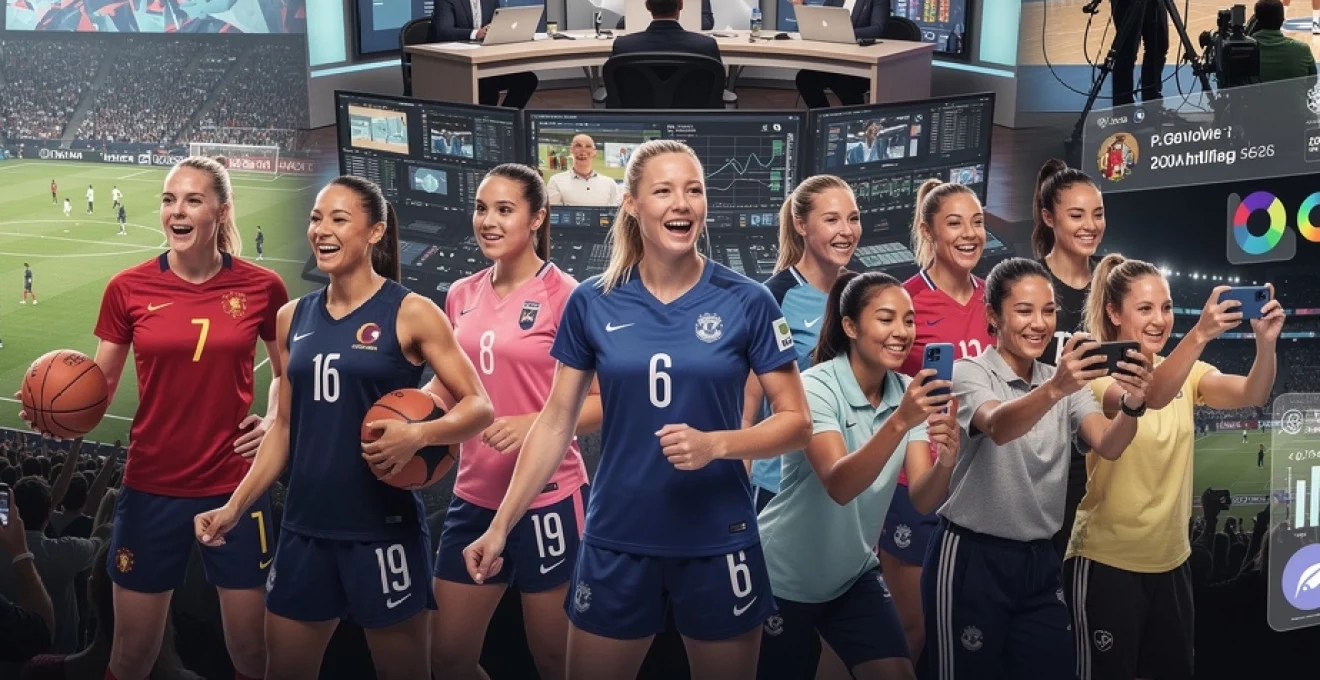
The landscape of women’s professional sport has undergone a remarkable transformation over the past five years, shifting from marginal visibility to mainstream prominence. This evolution isn’t merely anecdotal—it’s supported by substantial data across attendance figures, broadcasting agreements, digital engagement metrics, and commercial valuations. Global women’s elite sports generated $1.88 billion in revenue in 2024, nearly doubling year-over-year according to Deloitte’s analysis, whilst the WNBA set a new single-season attendance record in 2025. These figures represent more than statistical curiosities; they signal a fundamental recalibration of how sport is consumed, valued, and monetized in the 21st century.
Perhaps most tellingly, the shift extends beyond traditional metrics of success. Social media platforms have become powerful amplifiers for women athletes, with female competitors driving twice the engagement of their male counterparts on digital channels. Videos created around women’s sports increased by 73.7% on the WSC Sports platform in 2025, whilst highlights created during live matches surged by 172.3%. This digital momentum operates in tandem with traditional broadcasting expansion, sponsorship growth, and infrastructure development to create what many industry observers characterize as an inflection point—a moment when incremental progress gives way to transformational change.
Media rights monetisation and broadcasting revenue streams in women’s professional sport
The commercial architecture supporting women’s sport increasingly resembles the sophisticated ecosystem that has sustained men’s competitions for decades. Broadcasting rights negotiations, once afterthoughts in boardroom discussions, now command serious attention from major networks and streaming platforms. This shift reflects both growing audience demand and strategic positioning by media companies seeking to differentiate their content offerings in an increasingly fragmented marketplace.
The evolution of media rights deals has been particularly pronounced in football (soccer), basketball, and cricket—sports where women’s professional leagues have achieved sufficient scale to attract substantial broadcast investment. Rights holders are discovering that women’s competitions offer distinct advantages: passionate, engaged audiences; athletes who actively promote their sports on social media; and demographic profiles that appeal to advertisers seeking younger, more diverse consumers. The challenge lies in structuring agreements that reflect both current valuations and anticipated growth trajectories, balancing short-term revenue needs against long-term strategic positioning.
Sky sports and BBC sport investment in women’s super league broadcasting deals
The Barclays Women’s Super League (BWSL) broadcasting landscape exemplifies the complex dynamics shaping media rights in women’s sport. Sky Sports’ multi-year agreement to broadcast BWSL matches represents one of the most significant investments in women’s domestic football, whilst the BBC’s commitment to free-to-air coverage ensures accessibility for casual viewers. This dual-platform approach—combining subscription-based comprehensive coverage with strategic free-to-air fixtures—has become a template for other leagues seeking to balance revenue generation with audience development.
Data from the 2024/25 BWSL season reveals both the opportunities and challenges inherent in this model. Despite a 35% year-on-year decline in average broadcast audiences and a 10% drop in attendance, the league achieved remarkable digital gains. The official BWSL YouTube channel became the second most viewed women’s sports league globally, accumulating 39.6 million views since its July 2024 launch. The BWSL TikTok account recorded the highest average views per video—417,000—of any major women’s sports property, demonstrating how younger audiences increasingly discover sport through short-form digital content rather than traditional linear broadcasts.
This divergence between broadcast and digital performance raises important questions about how you measure success in modern sports media. BWSL clubs collectively earned 154 million Instagram engagements, outperforming the 24 EFL Championship teams’ 119 million—a striking achievement that traditional broadcast metrics fail to capture. Chelsea Women led all domestic women’s clubs with 258 million TikTok views and 42 million Instagram engagements, suggesting that individual clubs can build substantial digital audiences even when league-wide broadcast figures disappoint.
ESPN and CBS sports coverage expansion for women’s NCAA championships
American collegiate women’s sport has experienced unprecedented media exposure, driven by record-breaking attendance figures and compelling athlete narratives. ESPN’s comprehensive coverage of NCAA women’s basketball tournaments has transformed these events into cultural moments that transcend sport itself. The 2023 women’s championship game attracted substantial viewership, demonstrating that
appetite for high-quality women’s basketball when content is given equal production values and promotional weight. CBS Sports has complemented this by increasing its coverage of women’s NCAA volleyball and softball, recognising that collegiate women’s competitions can deliver strong regional audiences and highly engaged student and alumni bases. Rights packages have evolved from being bundled add-ons to distinct, negotiated properties, with dedicated shoulder programming, studio analysis and digital highlight rights forming part of the value proposition.
These expanded deals are not just about more hours on air; they are about reshaping perceptions of what drives ratings. ESPN’s investment in shoulder content—behind-the-scenes features, athlete profiles, and cross-platform storytelling—has helped elevate players into mainstream cultural figures. For brands, this creates a richer environment for integration and long-term partnerships. For the NCAA and its member institutions, it provides a test case in how women’s sports media rights can be unbundled, valued independently, and strategically leveraged, rather than being perpetually tethered to men’s tournaments.
Dazn’s strategic acquisition of women’s football broadcasting rights
Beyond traditional broadcasters, digital-first platforms such as DAZN have positioned women’s football as a strategic growth pillar. DAZN’s global deal for the UEFA Women’s Champions League (UWCL), including free live matches on YouTube in key territories, has been widely cited as a turning point for women’s football visibility. By treating UWCL as a premium property rather than a secondary rights package, DAZN has demonstrated that women’s competitions can anchor subscriber acquisition strategies and support long-tail engagement through highlights, tactical analysis and shoulder content.
The platform’s approach combines global reach with localised storytelling, using subtitled content, regional commentators and targeted social media to bring women’s football to new audiences. Importantly, DAZN has experimented with flexible distribution models—mixing paywalled streams with free-to-view matches—to balance monetisation and reach. For rights holders considering similar deals, the key lesson is clear: women’s sports rights can be a laboratory for innovation in formats, pricing, and fan data capture, rather than a discounted version of men’s rights packages.
Free-to-air television models driving audience growth in women’s cricket
In cricket, free-to-air (FTA) models have proven particularly powerful in driving audience growth for women’s fixtures. In markets such as the UK, Australia and India, women’s internationals and franchise tournaments like The Hundred and the Women’s Premier League (WPL) have benefited from a blend of pay-TV and FTA exposure. When women’s matches are made easily accessible—without subscription barriers—casual viewers are far more likely to sample the product, especially during marquee events and primetime slots.
Australia’s long-term commitment to broadcasting women’s internationals on FTA channels has underpinned record-breaking audiences for Ashes series and World Cups, helping convert one-off tournament interest into habitual viewing. Similarly, in the UK, the decision to show women’s matches from The Hundred on the BBC opened the door to families and younger viewers who may not typically pay for sport. For boards and broadcasters, the strategic question is not whether FTA reduces short-term rights fees, but whether it acts as a powerful marketing engine that builds the fan base, boosts commercial sponsorship valuations, and ultimately supports higher rights values in future cycles.
Commercial sponsorship valuations and brand partnerships in elite women’s competitions
As visibility has increased, commercial sponsorship in women’s sport has shifted from philanthropic-style support to performance-driven investment. Brands are no longer simply “doing the right thing”; they are seeking measurable returns in awareness, sentiment, and sales. The number of sponsorships in women’s professional sports grew by around 20% year-on-year in 2022, with women athletes signing 18% more partnerships over the same period. Crucially, these deals are beginning to command meaningful rights fees and long-term commitments, anchoring the commercial sustainability of leagues and tournaments.
What distinguishes elite women’s competitions in the sponsorship marketplace is their ability to offer clean, uncluttered inventory and highly engaged audiences. In many cases, women’s properties provide brands with top-tier visibility at a fraction of the cost of equivalent men’s assets, while also delivering powerful equity and inclusion narratives. The result is rising sponsorship valuations and a more sophisticated approach to packaging rights, from jersey sponsorships and title rights to content integrations and data-driven digital campaigns.
Barclays title sponsorship of the FA women’s super league economic impact
Barclays’ title sponsorship of the FA Women’s Super League has been a watershed moment in the commercialisation of women’s club football. The original deal, reportedly worth around £10 million over three years, and its subsequent extensions signalled that brands were prepared to invest at scale in women’s domestic competitions. Beyond the headline figures, the partnership has underpinned grassroots programmes, academy development and marketing campaigns that position the BWSL as a standalone, elite product rather than a subsidiary of the men’s game.
Economically, the Barclays relationship has helped unlock secondary sponsorships at club level, from sleeve partners to training kit deals. As league-wide visibility has grown, valuations for individual team partnerships have risen, mirroring the ripple effects seen in established men’s leagues. For rights holders and marketers, the BWSL case study reinforces a crucial point: when a credible, blue-chip sponsor commits early and visibly, it de-risks the space for others and accelerates the commercial maturation of the entire ecosystem.
Nike and adidas performance apparel contracts with national women’s teams
Performance apparel contracts with national women’s teams illustrate how global brands are recalibrating their investment strategies. Nike, Adidas and other manufacturers increasingly negotiate dedicated agreements for women’s squads—rather than bundling them as minor add-ons to men’s team deals. These contracts encompass not just kit supply but also bespoke design, athlete-led campaigns and women’s-specific product development, from football boots engineered for women’s biomechanics to maternity-friendly performance wear.
From a visibility perspective, such deals ensure that women’s teams receive tailored marketing support, including global advertising, social-first storytelling and retail activations timed to major tournaments. When fans see replica jerseys for women’s teams prominently displayed in stores or worn by ambassadors in campaigns, it reinforces the notion that women’s sport is not a niche, but a core pillar of the brand’s identity. For federations, negotiating clear value attribution within broader apparel deals is essential to demonstrate the standalone commercial power of their women’s programmes.
Visa and mastercard financial services partnerships with women’s FIFA world cup
Financial services giants such as Visa and Mastercard have identified women’s football, particularly the FIFA Women’s World Cup, as a strategic platform for brand storytelling. Visa’s long-term partnership with FIFA includes a specific focus on women’s tournaments, with activation spanning ticketing, fan experiences, financial literacy initiatives, and athlete ambassador programmes. By positioning themselves as enablers of access and opportunity, these brands align their core services with the inclusive, aspirational narratives that women’s football naturally generates.
The Women’s World Cup offers a rare combination of global reach and positive sentiment, making it highly attractive for financial institutions seeking to differentiate themselves in a crowded market. Sponsorship activations often extend well beyond the tournament window, supporting year-round campaigns that highlight women entrepreneurs, community projects and grassroots football programmes. For event organisers, securing such category-leading partners not only drives revenue but also validates the tournament’s status as a premium global property worthy of long-term strategic alignment.
Energy drink brands red bull and monster investing in women’s extreme sports
In action and extreme sports, brands like Red Bull and Monster have been instrumental in elevating women’s competitions and athletes. Red Bull’s event portfolio now includes women’s categories and standalone events across disciplines such as mountain biking, skateboarding, snowboarding and cliff diving, with equal production values and creative storytelling. These properties are built for digital consumption, with cinematic edits, athlete vlogs and behind-the-scenes content driving millions of views on YouTube, TikTok and Instagram.
Monster and other energy drink brands have followed suit, signing endorsement deals with female BMX riders, surfers, and motocross athletes, and ensuring their inclusion in team videos and branded content. Because extreme sports are less constrained by legacy broadcast structures, they have been quicker to embrace gender parity in visibility and prize money. For women’s sport more broadly, this space acts almost like a research and development lab: innovative formats, athlete-led media and sponsor integration models tested here can inform strategies in more traditional team sports.
Attendance metrics and stadium infrastructure development for women’s fixtures
Rising attendance figures at women’s sports fixtures have been one of the most visible indicators of changing demand. From Nebraska volleyball attracting over 92,000 fans to a match at Memorial Stadium to sold-out Women’s Champions League finals at Camp Nou, record-breaking crowds are no longer outliers; they are becoming recurring features of the calendar. These milestones generate powerful images that circulate widely on social media, reinforcing the message that women’s sport can fill major venues and deliver big-event atmospheres.
However, attendance growth brings infrastructure considerations. Many women’s teams have historically played in smaller venues or training grounds with limited facilities, constrained media gantries and inadequate hospitality areas. As demand increases, clubs and federations face strategic decisions: continue using intimate venues that guarantee strong atmospheres, or move into larger stadiums that offer greater revenue potential but require careful marketing and scheduling. Investment in stadium facilities—from improved sightlines and family-friendly amenities to enhanced broadcast infrastructure—is critical to turning occasional big crowds into a consistent matchday experience that fans want to repeat.
Social media engagement analytics and digital content consumption patterns
The surge in digital engagement around women’s sports is not a side story; it is central to how the industry is being reshaped. Female athletes consistently outperform their male counterparts on engagement metrics, often driving twice the interaction per post on major platforms. On the WSC Sports platform, videos created around women’s sports increased by 73.7% in 2025, with real-time highlights during live matches up 172.3%, indicating that fans increasingly expect to consume key moments in near real-time. This aligns with broader trends: Gen Z and Millennials show elevated interest in highlights, documentaries and social media storytelling compared with full live events.
For rights holders and brands, the question is no longer whether to invest in digital, but how to design content strategies that maximise reach and conversion. Short-form, vertical formats (9:16 and 4:5) are seeing explosive growth, particularly on TikTok, Instagram Reels and YouTube Shorts. At the same time, longer-form content on YouTube and streaming platforms plays a crucial role in deepening fandom, providing context and narrative depth that short clips cannot. Navigating this mix requires robust analytics, testing, and a willingness to let athletes take the creative lead.
Tiktok and instagram athlete-led content driving fan acquisition
Athlete-led content on TikTok and Instagram has become one of the most powerful engines for fan acquisition in women’s sport. Players such as Ilona Maher in rugby, Caitlin Clark in basketball, and numerous WSL and NWSL stars have built substantial followings by sharing authentic behind-the-scenes moments, training routines, and personal reflections. During the 2025 Women’s Six Nations, England’s Red Roses players posted more TikTok content than any other England team across rugby, cricket and football, driving 6.7 million views—75% higher than the men’s rugby team over the same period.
This direct connection between athlete and audience bypasses traditional gatekeepers and allows personalities to flourish. For teams and leagues, the strategic opportunity lies in supporting players with media training, content production resources and clear social media guidelines that preserve authenticity while protecting commercial interests. When done well, athlete-led content functions like a decentralised marketing network: every player is a micro-broadcaster, and every clip is a potential entry point for a new fan.
Youtube original documentaries featuring WNBA and NWSL players
YouTube has emerged as a key platform for longer-form storytelling around women’s sport, particularly through original documentaries and episodic series. WNBA players have featured in behind-the-scenes series that follow training camps, playoff runs and off-season ventures, while NWSL clubs have experimented with docu-series that profile teams across an entire season. These productions often blend game footage with personal narratives around identity, activism, and community work, providing a richer understanding of who these athletes are beyond the box score.
From a visibility standpoint, such content helps convert casual highlight viewers into committed fans. Documentaries create what you might think of as “relationship equity”: viewers invest emotionally in players and teams, making them more likely to watch live games, buy merchandise and follow along on social media. For sponsors, integration into this kind of storytelling—whether through product placement, branded segments or co-produced content—offers deeper engagement than standard advertising inventory, particularly among younger, digital-native audiences.
Twitter real-time match commentary engagement for women’s tennis grand slams
On X (formerly Twitter), real-time commentary around women’s tennis Grand Slams remains a potent driver of engagement and visibility. Hashtags tied to marquee matchups—such as Serena Williams’ final US Open run or emerging stars’ breakthroughs in Melbourne—regularly trend globally, drawing in not just die-hard tennis fans but also broader cultural audiences. Live tweeting by journalists, former players and fans creates a second-screen experience that complements broadcast coverage and keeps the conversation going between points and matches.
For tournaments and sponsors, tapping into this real-time dialogue means more than simply posting score updates. The most successful accounts share short highlight clips, statistical nuggets, tactical insights and fan polls, effectively turning the timeline into a dynamic companion to the live broadcast. As algorithmic feeds evolve, the ability of women’s tennis to generate high-engagement, conversation-driving moments will be critical in maintaining visibility, especially given that overall linear sports viewing is fragmenting across platforms.
Pay equity negotiations and collective bargaining agreement reforms
Financial visibility—who gets paid what, and why—has become a defining issue in women’s professional sport. Pay equity campaigns and collective bargaining agreement (CBA) reforms are not only transforming athletes’ livelihoods; they are reshaping industry norms around revenue sharing, working conditions and commercial rights. These negotiations are often highly public, leveraging fan support and media attention to put pressure on federations and leagues. As a result, pay equity has evolved from a fringe topic into a central component of strategic planning for any organisation serious about women’s sport.
From a business perspective, equitable pay structures can be seen as investments in talent retention, performance and brand reputation. They also intersect with media rights and sponsorships: when athletes receive a fairer share of commercial revenues, they have a stronger incentive to promote their leagues and tournaments. For fans and sponsors, transparent, progressive CBAs serve as signals that a property is well-governed and future-focused, making it a more attractive proposition for long-term engagement.
US women’s national team equal pay settlement with US soccer federation
The US Women’s National Team’s (USWNT) equal pay settlement with the US Soccer Federation stands as one of the most influential precedents in global sport. After a prolonged legal and public relations battle, the parties agreed in 2022 to equalise match fees and World Cup prize money distributions between the men’s and women’s national teams, supported by a landmark collective bargaining framework. This agreement not only improved compensation for current players but also created a revenue-sharing model that ties future earnings more directly to the commercial success of the teams.
Symbolically, the USWNT settlement demonstrated that persistent advocacy, backed by on-field success and fan support, can shift institutional positions that once seemed immovable. Practically, it has inspired similar campaigns in other countries and sports, giving athletes a template for how to structure negotiations and frame public narratives. For federations, the lesson is clear: proactive, collaborative approaches to pay equity can prevent protracted disputes and help position the organisation as a leader rather than a reluctant follower.
WNBA players association CBA negotiations on salary caps and revenue sharing
The WNBA Players Association (WNBPA) has also been at the forefront of reshaping economic structures in women’s professional sport. The 2020 CBA introduced significant increases in maximum and average salaries, improved maternity and family planning benefits, and enhanced travel standards, including premium economy or business-class upgrades for key fixtures. Crucially, the agreement included mechanisms for players to share in league revenue growth, effectively aligning incentives between athletes, teams and the league office.
As the WNBA enters a new phase of expansion and media rights negotiations, discussions around further raising salary caps and refining revenue-sharing formulas are intensifying. Players argue that record attendance, rising franchise valuations and lucrative new TV deals should be reflected in compensation structures. League executives, in turn, must balance competitive parity, financial sustainability and investor expectations. The outcome of these negotiations will send an important signal to other women’s leagues about how aggressively they can, and should, link athlete pay to the broader commercial trajectory of the sport.
ICC women’s cricket prize money parity with men’s tournament structures
In cricket, the International Cricket Council (ICC) has taken concrete steps toward prize money parity between men’s and women’s events. Recent announcements have outlined plans for equal prize pools at global tournaments, narrowing a gap that was once stark and difficult to justify. While equal prize money does not address all aspects of pay equity—such as central contracts, match fees and domestic league earnings—it carries significant symbolic weight and provides immediate financial benefits to successful women’s teams.
Aligning prize money structures also enhances the commercial narrative around women’s cricket. Sponsors and broadcasters can more credibly present women’s tournaments as premium properties when the governing body values them equivalently at marquee events. For players and fans, equality in prize money is both a recognition of performance and a tangible step towards a more level playing field, even as broader structural reforms continue.
Professional women’s hockey players association union formation impact
The formation of the Professional Women’s Hockey Players Association (PWHPA) and the subsequent creation of a unified professional league in North America illustrate how athlete organising can reshape an entire sport. Faced with fragmented leagues, unstable franchises and inadequate compensation, leading players chose to band together, negotiate collectively and push for a sustainable, player-centric league model. Their advocacy eventually helped catalyse investment and the establishment of a new professional structure designed with better salaries, medical support and travel standards.
This process, though challenging, has had important visibility implications. By taking control of their narrative and articulating a clear vision for what a professional women’s hockey league should look like, players attracted media attention and rallied fans around their cause. The resulting league has launched with significant broadcast and sponsorship backing, demonstrating how unionisation and collective bargaining can serve as catalysts for both economic and reputational transformation in women’s sport.
Global tournament viewership data and audience demographics expansion
Global tournaments remain critical accelerators of visibility for women’s sport, acting as peak moments that draw in casual viewers and generate mainstream media coverage. Events such as the FIFA Women’s World Cup, Olympic Games and Grand Slam tennis tournaments reach tens of millions of viewers worldwide, often setting new records for women’s sport. However, as organisations like Women’s Sport Trust have emphasised, moments alone are not enough; the challenge is to convert spikes in viewership into sustained, habitual engagement with domestic leagues and regular-season play.
Audience data from recent cycles reveals two encouraging trends. First, demographic profiles for women’s sports viewership skew younger and more gender-balanced than many men’s properties, offering advertisers access to hard-to-reach segments. Second, cross-platform measurement shows that digital and social engagement often outpaces linear broadcast metrics, especially among under-35s. For rights holders and brands, understanding these patterns—who is watching, where, and on which devices—is essential to designing products and campaigns that meet fans where they are.
FIFA women’s world cup 2023 australia and new zealand broadcast ratings analysis
The 2023 FIFA Women’s World Cup in Australia and New Zealand delivered record-breaking broadcast ratings in multiple territories. In host nations, average audiences for Matildas matches rivalled or exceeded those for men’s national team games, with semi-final fixtures drawing national viewing shares above 40%. In Europe and North America, key matches posted multi-million peak audiences, while streaming platforms reported significant surges in concurrent viewers, particularly for knockout-stage games scheduled in prime-time local slots.
Beyond headline numbers, the tournament revealed important insights into audience behaviour. Co-hosting across two countries helped spread match times across global time zones, allowing more markets to experience live prime-time fixtures. Digital highlight consumption exploded, with clips featuring dramatic goals, penalty shootouts and fan celebrations racking up hundreds of millions of views on social media. These patterns confirm that the Women’s World Cup is no longer a niche event but a core pillar of the global football calendar, capable of driving both reach and deep engagement when supported by robust broadcast and digital distribution strategies.
Wimbledon centre court gender parity in scheduling and prime-time slots
Wimbledon’s moves toward gender parity in Centre Court scheduling have had a notable impact on visibility for women’s tennis. By ensuring that women’s matches receive equal access to marquee courts and prime-time slots, the All England Club has helped normalise the idea that women’s and men’s contests are of equal importance to the tournament narrative. This approach not only affects live audiences on site but also shapes global broadcast windows, determining which matches receive maximum exposure on major networks.
Audience data suggests that high-profile women’s matches at Wimbledon can draw comparable ratings to men’s fixtures when given similar billing and promotional support. Moreover, storylines around rivalries, comebacks and emerging stars often resonate strongly across demographics, particularly when amplified through social media and digital content. For other tournaments considering scheduling reforms, Wimbledon offers a clear example of how equitable programming can enhance the overall product without diluting interest in men’s draws.
Olympic games women’s events television audience share growth trends
The Olympic Games provide one of the clearest lenses on the growth of women’s sport visibility. Paris 2024 marked the first Olympics with equal representation of male and female athletes on the field of play, and women’s events commanded substantial shares of global television and streaming audiences. Research indicates that while only around 43% of competition news coverage focused on women athletes, they generated over half of total social media engagement around the Games, underscoring the disproportionate impact of their stories.
Sports such as gymnastics, swimming, football and athletics saw women’s finals produce some of the highest audience peaks across the entire programme. Individual athletes—ranging from established stars like Simone Biles to breakout performers from smaller nations—became global icons almost overnight, driving search interest, follower growth and commercial enquiries. As broadcasters and the IOC refine their coverage strategies for future Games, sustained investment in storytelling around women’s events will be crucial to maintaining and expanding these audience share gains, ensuring that visibility is not just a four-yearly spike but part of a consistent, year-round narrative arc for women’s sport.