Layering transforms the most basic wardrobe pieces into sophisticated, dynamic ensembles that speak to both style consciousness and practical adaptability. This fundamental fashion technique bridges the gap between seasonal transitions, professional requirements, and personal expression whilst maximising the potential of every garment in your wardrobe. The art of layering extends far beyond simply throwing on additional pieces; it requires understanding fabric relationships, proportional mathematics, and the subtle interplay between texture, colour, and silhouette. When executed thoughtfully, layering elevates even the most modest outfit into a statement of intentional style that commands attention and respect.
Foundation garment selection for effective layering architecture
The success of any layered ensemble begins with establishing a solid foundation that serves as both structural support and stylistic anchor. Your base layer functions as the canvas upon which all subsequent pieces will build, making its selection critical to the overall composition’s integrity and visual impact.
Base layer fabric technology: merino wool vs synthetic blends
Modern textile technology offers sophisticated options for foundation garments that influence everything from comfort to visual flow. Merino wool base layers provide superior temperature regulation and moisture management whilst offering a luxurious hand feel that elevates the entire ensemble. These natural fibres create subtle texture variations that add depth when glimpsed beneath subsequent layers, particularly effective when you’re building professional or elevated casual looks.
Synthetic blends, particularly those incorporating modal or bamboo fibres, deliver exceptional drape characteristics essential for clean layering lines. These materials resist bunching and maintain their shape throughout extended wear, crucial factors when you’re constructing complex multi-layer compositions that must maintain their integrity from morning through evening.
Silhouette mapping: creating visual weight distribution points
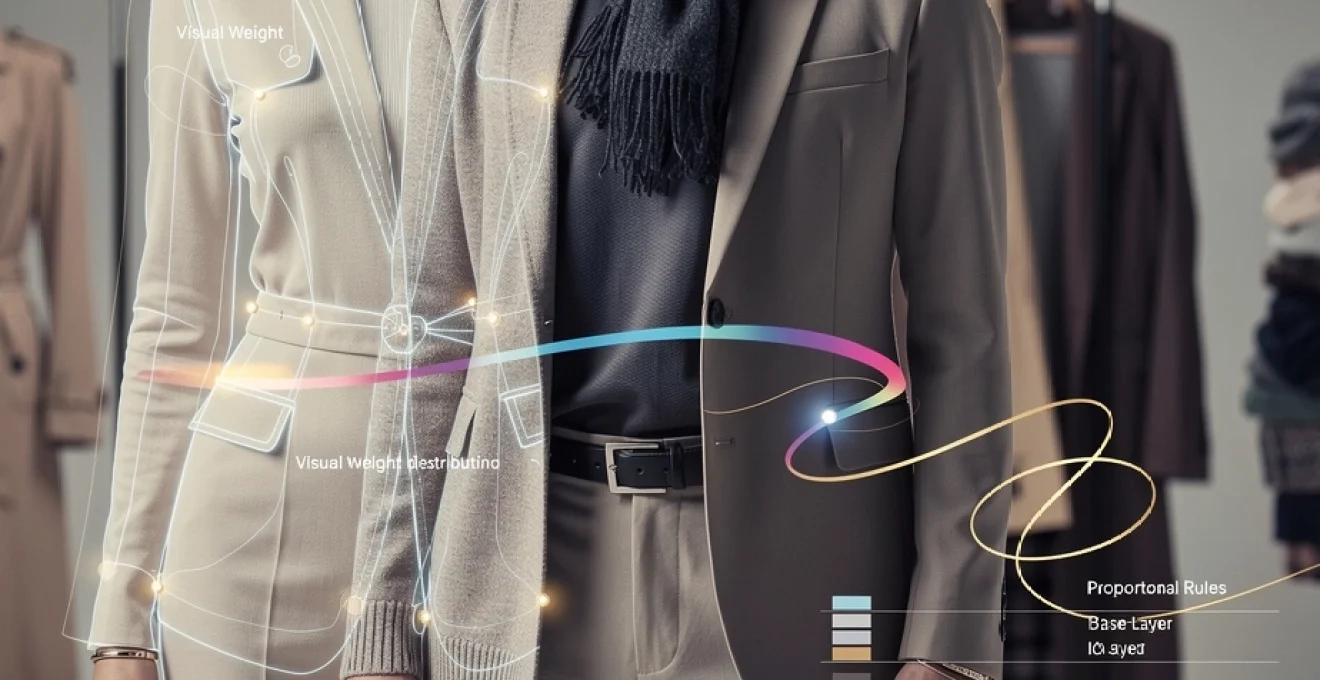
Professional stylists employ silhouette mapping to establish visual anchor points that guide the eye through a layered composition. This technique involves identifying three to five key areas where fabric volume, texture change, or colour transition creates intentional focus points. Strategic placement of these elements prevents the common mistake of creating visual chaos through random layering choices.
The shoulder line serves as your primary architectural element, establishing the framework from which all other proportions flow. Whether you choose structured blazer shoulders or soft, draped cardigans, this decision influences every subsequent layer’s relationship to your body and overall aesthetic direction.
Colour temperature theory in Multi-Layer coordination
Understanding colour temperature relationships becomes essential when you’re coordinating multiple garments within a single outfit. Warm undertones in base layers create cohesive flow when paired with similarly warm outer pieces, whilst cool undertones provide sophisticated contrast opportunities when strategically combined with warmer accent pieces.
The most sophisticated layered looks maintain consistent colour temperature throughout 70% of the composition, using the remaining 30% for strategic temperature contrast that creates visual interest without disrupting harmony.
Neutral foundations in varying colour temperatures allow for maximum versatility when building your layering wardrobe. Consider how different whites, greys, and beiges interact with your skin tone and existing wardrobe pieces to establish a cohesive foundation palette that supports multiple styling directions.
Texture contrast principles for dimensional styling
Texture variation provides the visual interest that distinguishes sophisticated layering from simple clothing accumulation. The interplay between smooth and textured surfaces creates depth that photographs beautifully and maintains visual engagement in person. Combining matte and lustrous finishes within a single ensemble adds professional polish whilst preventing the flat, monotonous appearance common in poorly executed layering attempts.
Consider the tactile experience your layering choices create alongside their visual impact. Rough tweeds paired with smooth silks generate both textural and visual interest, whilst similar textures in different scales create subtle sophistication ideal for professional environments where dramatic contrast might prove inappropriate.
Strategic proportional layering using the golden ratio method
Mathematical principles provide reliable frameworks for creating visually pleasing layered compositions that feel intentional rather than accidental. The golden ratio, approximately 1:1.618, appears throughout nature and art as a proportion that humans instinctively find pleasing and balanced.
<h
Fibonacci sequencing in garment length progression
Applying the golden ratio to layering starts with garment length progression. Think of each visible layer as a step in a Fibonacci sequence of lengths, where each subsequent layer covers roughly 60–65% of the one beneath. For instance, a hip-length base tee, mid-thigh cardigan, and knee-length coat create a visually pleasing cascade that feels intentional rather than random. This approach prevents that chopped-up effect you get when all hems end at similar points on the body, which can shorten your frame and disrupt visual flow.
To translate this into practical styling, begin by identifying your primary visual anchor, often your outermost layer. From there, work backward, ensuring each inner layer is noticeably shorter and visible by at least several centimetres. You might pair a slightly cropped knit over a longer shirttail, then top it with a blazer that hits mid-hip, creating a tiered effect that echoes natural visual hierarchies. Once you train your eye to see these proportional steps, using Fibonacci-inspired garment lengths becomes second nature.
Volume displacement techniques for balanced proportions
Proportional layering is not only about length; it also involves volume displacement to maintain balance across your silhouette. If you increase volume in one area, you typically reduce it in another, creating harmony rather than bulk. For example, an oversized city-chic scarf or cocoon coat combines best with streamlined trousers or a pencil skirt, while wide-leg trousers feel more flattering with a close-fitting turtleneck or minimal tailoring blazer. This push-and-pull of volume ensures that your outfit enhances, rather than obscures, your natural shape.
Visualise your body as three main zones: upper, mid, and lower. If your upper zone features an oversized knit and relaxed trench, keep the mid and lower zones cleaner with straight-leg jeans and sleek ankle boots. Conversely, if you choose dramatic wide-leg trousers or a voluminous midi skirt, counterbalance them with a fitted merino base layer and a sharp, tailored blazer. By consciously “displacing” volume in this way, you avoid the common layering mistake of looking overstuffed, while still enjoying the comfort and drama of generous silhouettes.
Hemline staggering: the 2-4-6 inch rule application
One of the simplest advanced layering techniques is hemline staggering using the 2-4-6 inch rule. This method suggests that each visible layer should extend beyond the one above it by approximately 2, 4, or 6 inches, depending on the total length of the outfit. These measured differences help create a deliberate step effect that reads as architectural rather than messy. When your shirt, knit, and coat hems all end within a centimetre or two of one another, the result is often blocky and visually heavy.
To apply this in practice, start with your base top, then add a mid-layer that peeks out by about 2 inches. Your outer layer might then extend a further 4 inches beyond that, especially effective in smart-casual office looks. On taller frames or for longline coats, you can expand to a 6-inch stagger for dramatic, editorial-style layering. Consider this rule a flexible guideline rather than a strict law; the goal is to create visible differentiation between layers so that each garment has space to contribute to the overall composition.
Neckline layering geometry for vertical line creation
While hemlines control horizontal segmentation, neckline geometry is your primary tool for creating flattering vertical lines in a layered outfit. Open necklines, draped scarves, and blazer lapels act like arrows directing the eye up and down your frame, which is particularly helpful if you want to appear taller or leaner. A simple way to leverage this is by pairing a high-neck base, such as a mock-neck or crew, with a V-neck knit and an open blazer or coat on top. The resulting layered V draws the gaze inward and downward, carving out a visually elongated centre line.
Scarves, especially oversized styles, can either support or sabotage this effect depending on how they are styled. Wrapped tightly around the neck, they create horizontal bulk; worn in a loose loop or draped in a waterfall style, they encourage vertical flow. Similarly, consider how collars interact: a crisp shirt collar under a blazer, with a long pendant necklace, produces stacked vertical elements that add polish without clutter. When you combine thoughtful neckline geometry with controlled hemlines and volume, your layering takes on an almost architectural clarity that feels both modern and intentional.
Advanced transitional layering for climate adaptability
Transitional layering bridges the gap between temperature shifts, allowing you to stay comfortable without sacrificing style. Instead of thinking in terms of “winter” or “summer” wardrobes, you begin to see your clothing as a set of modular components designed to respond to changing conditions throughout the day. Lightweight insulating pieces, breathable base layers, and wind-resistant outer shells become tools you can deploy in different combinations. This systems-based approach is especially valuable in urban environments where you move regularly between outdoor chill and overheated interiors.
Consider creating a core set of seasonless layering pieces such as fine-gauge merino turtlenecks, sleeveless shell tops, and unlined blazers that work under coats but also stand alone. Adding or removing a city chic oversized scarf, swapping a wool coat for a trench, or opening and rolling blazer sleeves are small adjustments with major impact on thermal comfort. Ask yourself throughout the day: can I adapt this outfit in 30 seconds without a mirror? When the answer is yes, you know your transitional layering is genuinely functional as well as stylish.
Professional capsule wardrobe layering systems
Within a professional context, effective layering is the backbone of a versatile capsule wardrobe. By selecting pieces that mix and match across roles and seasons, you reduce decision fatigue while consistently presenting a polished image. The key is to curate a compact selection of garments that share a coherent colour story, compatible fabric weights, and complementary silhouettes. When each blazer, shirt, knit, and trouser can layer in at least three different ways, your outfit possibilities expand exponentially without increasing wardrobe size.
Minimal tailoring plays a pivotal role here. A well-cut tailored blazer in a neutral shade can sit over a silk blouse, jersey tee, or lightweight knit with equal ease. Similarly, slim merino crewnecks slide effortlessly under suiting jackets, sleeveless dresses, or trench coats, providing warmth without bulk. By investing in these “connector” pieces, you create a modular system where each layer functions like a building block, supporting daily outfit-building with minimal effort and maximum impact.
Blazer integration techniques: structured vs deconstructed approaches
Blazers are arguably the most powerful layering tools in a professional wardrobe, and understanding the difference between structured and deconstructed styles is crucial. A structured blazer, with defined shoulders and sharp lapels, instantly formalises an outfit and creates strong vertical lines. It pairs beautifully with fine base layers and controlled mid-layers, such as a thin merino knit or cotton shirt, without adding unnecessary volume. This type of blazer is ideal when you want to sharpen a casual base, for example, elevating jeans and a tee into a meeting-ready look.
Deconstructed blazers, by contrast, use softer construction, less padding, and often unlined or partially lined interiors. They drape more like a cardigan while maintaining a tailored outline, making them excellent for relaxed yet professional layering. You can comfortably stack them over slightly bulkier mid-layers, such as a light sweatshirt or oversized shirt, without feeling restricted. For maximum versatility, aim to own at least one of each: a minimal tailoring blazer with strong lines for high-stakes days and a softer, deconstructed version for creative or hybrid work environments.
Statement piece anchoring in multi-layer compositions
When you introduce a statement piece into a layered outfit—whether it’s a boldly patterned coat, a sculptural knit, or a dramatic scarf—it must be anchored by simpler supporting layers. Think of the statement item as the lead actor and the rest of your garments as the ensemble cast whose role is to frame and enhance, not compete. If everything in your look is vying for attention, the eye has nowhere to rest and the impact of each element diminishes. Anchoring ensures that your statement item can be appreciated from across the room.
To anchor effectively, start by selecting one hero element, such as a richly textured coat or colour-saturated blazer. Surround it with neutral-toned, low-contrast layers in classic cuts: a black turtleneck, tailored trousers, or a simple slip dress. Accessories should echo, not rival, the main piece—perhaps a belt that picks up a colour from a print, or subtle jewellery that reflects its metal accents. This disciplined approach allows your favourite pieces to shine and makes it easier to repeat them frequently without your outfits feeling repetitive.
Accessory layering: scarves, belts and jewellery coordination
Accessories are the final, highly strategic layer that can subtly transform a simple outfit without adding significant bulk. Scarves, belts, and jewellery all contribute to visual rhythm when used with intent. A city chic oversized scarf, for example, adds volume and colour around the face, which you can counterbalance with a slim belt at the waist to reintroduce structure. Jewellery, meanwhile, functions like punctuation in a sentence, guiding the eye and setting the tone—minimal studs and a delicate chain quieten a busy print, while bold earrings or a cuff bracelet enliven a minimal look.
Coordinating these elements is less about perfect matching and more about shared visual language. Choose one accessory category to dominate—perhaps the scarf in autumn, a statement belt in spring, or layered necklaces in summer—and let the others play supporting roles. When in doubt, follow a simple guideline: two visible accessory zones per outfit (for instance, ears and wrists, or neck and waist) to avoid overwhelming your layering architecture. By viewing accessories as part of the same structural system as your garments, you ensure they enhance, rather than disrupt, your overall look.
Fabric weight classification and layering compatibility matrix
Understanding fabric weight is essential for building layered outfits that feel comfortable and move well with your body. We can broadly classify textiles into light, medium, and heavy weights, each serving a distinct purpose in a layering compatibility matrix. Light fabrics, such as silk, fine cotton, and lightweight merino, make ideal base layers because they sit close to the skin without adding bulk. Medium-weight materials, including denim shirts, flannel, and mid-gauge knits, typically function best as mid-layers, providing warmth and structure.
Heavy fabrics—think wool coats, padded jackets, thick tweeds—should be reserved for outer layers where their rigidity and insulation can shine without restricting movement. Problems arise when these categories are misaligned, such as wearing a heavy knit under a fitted blazer or stacking multiple medium-weight pieces with no true base layer. A simple mental matrix helps: light under medium under heavy, with at most one piece from each category in any single zone of the body. When you respect these weight relationships, your outfits feel lighter, more mobile, and significantly more refined.
Troubleshooting common layering mistakes: bulk management and visual flow
Even with strong style instincts, layering can go wrong if you’re not attentive to bulk management and visual flow. One frequent issue is hidden bulk—thick seams, heavy pocket linings, or chunky hems stacking up in the same area, particularly at the waist or under the arms. If you’ve ever felt inexplicably boxy in an outfit that looked good in theory, this is often the culprit. To counter this, choose at least one “slippery” layer, such as a silky camisole or smooth-lined blazer, which lets other fabrics glide rather than grip.
Visual flow can also break down when colour blocks or textures fight each other rather than working in sequence. Ask yourself: where does the eye travel first, second, and third in this outfit? If your gaze jumps erratically between competing elements, consider reducing contrast in one area or simplifying texture in another. Sometimes removing a single mid-layer, swapping a chunky scarf for a sleeker option, or tucking in a shirt to reveal more of a tailored trouser line is all it takes to restore harmony. By treating layering as an ongoing conversation between fabric, form, and function, you gain the confidence to adjust in real time and transform even the simplest outfit into a considered, stylish composition.