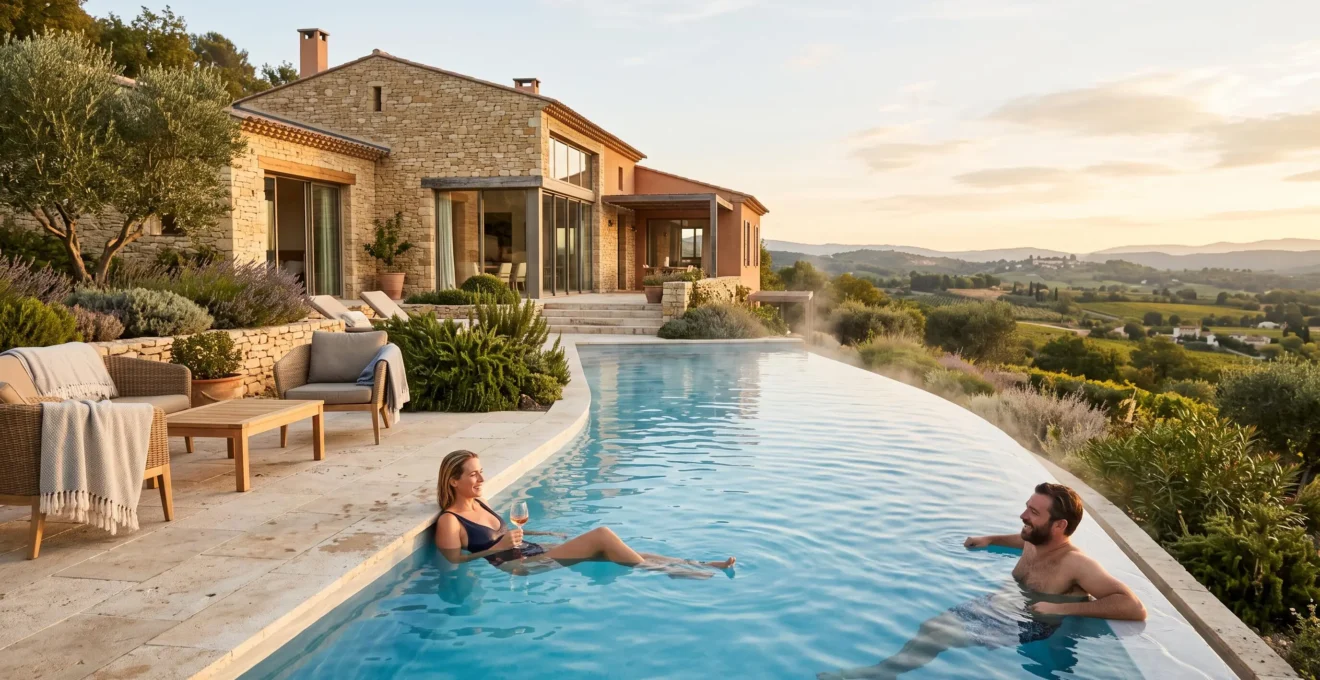
The luxury villa rental market has become saturated with properties claiming exceptional status, yet the gap between marketing promises and delivered reality often widens as prices climb. For discerning holidaymakers investing £8,000 to £12,000 per week, distinguishing genuine quality from polished photography requires more than trusting promotional descriptions. Three amenities have emerged as the modern benchmark separating truly exceptional villas from those merely well-equipped: heated swimming pools, private spa facilities, and dedicated chef services. Their significance lies not in luxury signalling, but in solving concrete problems that transform the holiday experience.
Understanding which features justify premium pricing—and crucially, how to verify their quality before committing financially—addresses the legitimate skepticism born from past disappointments. The amenities considered exceptional five years ago have become baseline expectations today, whilst only certain facilities remain genuine differentiators in an increasingly competitive market.
What defines an exceptional villa in today’s luxury market?
The luxury villa landscape has undergone considerable evolution. Amenities positioned as premium in 2018—standard swimming pools, fully equipped kitchens, high-speed WiFi, air conditioning—now constitute baseline expectations for any property marketed as luxury. This temporal shift matters because paying exceptional prices for what has become ordinary represents poor value, regardless of how sophisticated the marketing materials appear.
The distinction between baseline luxury and exceptional luxury rests on functional problem-solving rather than aesthetic appeal. Baseline luxury properties offer comfort and quality finishes, whilst exceptional villas provide amenities that extend autonomy, preserve intimacy, and eliminate logistical friction. A villa with beautiful interiors and a standard pool remains baseline; one offering heated swimming, private wellness facilities, and culinary services without external dependence crosses into genuinely exceptional territory.
This market evolution reflects broader changes in the luxury rental sector. According to Atout France’s May 2025 market briefing, returning international clientele is increasingly concentrated in premium and luxury segments, which strongly support rental demand in French metropolitan hubs. Yet this growth has created information asymmetry: as more properties claim exceptional status without objective criteria, buyers face difficulty assessing genuine quality from standardised promotional content.
How luxury villa standards evolved: 2019 versus 2024
2019 Premium amenities (now baseline in 2024): Standard swimming pool, fully equipped modern kitchen, high-speed WiFi, air conditioning, concierge phone line, professional photography.
2024 Exceptional amenities (genuine differentiators): Heated swimming pool with verified temperature control, private spa facilities (hot tub, sauna, hammam), on-site chef services with transparent pricing, comprehensive virtual tours enabling pre-booking verification, rigorous platform curation with property inspection.
The three amenities examined here—heated pools, private spas, and chef services—form a tripartite framework because each addresses a distinct problem: seasonal limitation, wellness access constraints, and meal planning burden. Together, they define the threshold between competent luxury and exceptional experience.
The heated swimming pool: extending the season, elevating the experience
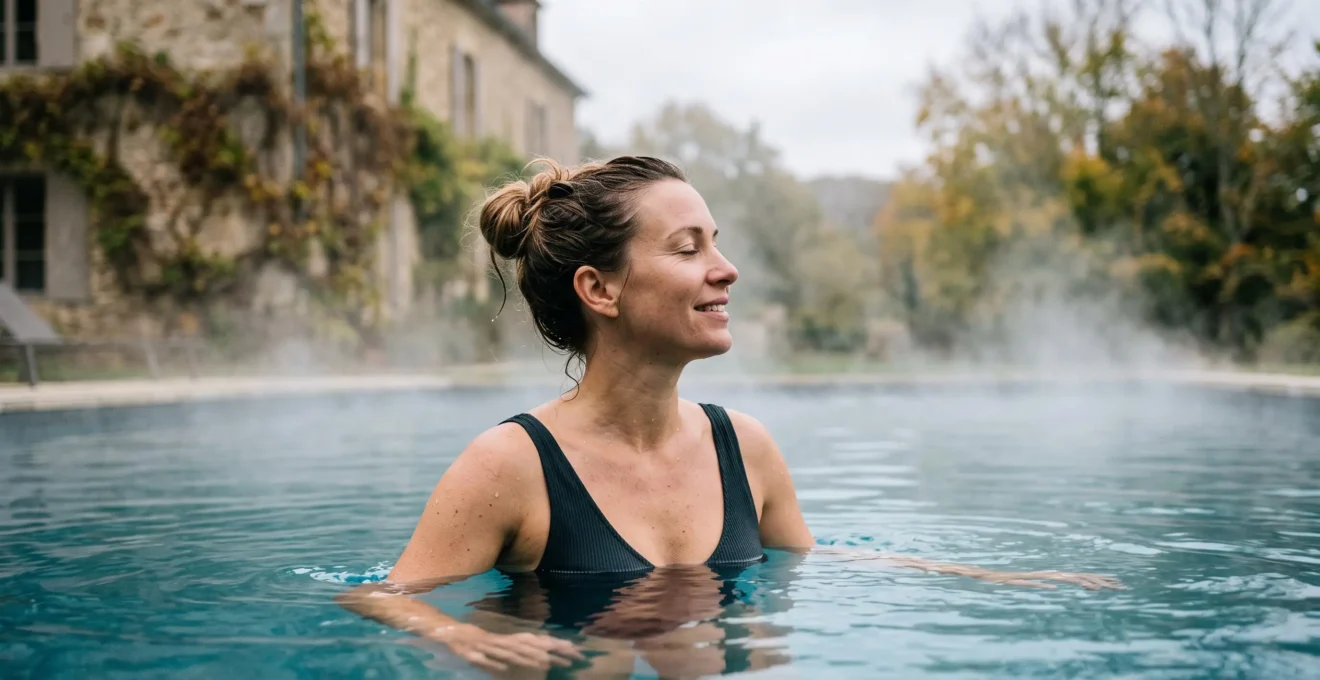
A heated swimming pool commands significantly higher rental prices than standard pools because it solves a fundamental constraint: seasonal limitation. Research from the CSTB study for the Fédération des Professionnels de la Piscine found that pools equipped with shelters can maintain water above 20°C for up to twice as long during the May-to-September swimming season. Heating systems extend this further, typically enabling comfortable swimming from April through October in Mediterranean climates—transforming a two-month peak-season amenity into a six-month usable facility.
This seasonal extension delivers concrete value beyond the temperature itself. Families booking May half-term or early September—when children return to school and rates often decrease—gain access to comfortable swimming when unheated pools remain at 18-20°C, temperatures most children find unusable. The heated pool transitions from decorative feature to genuinely utilised amenity, justifying its premium.
Beyond seasonality, heated pools provide schedule autonomy. Guests avoid dependence on public beach opening hours, crowd levels, weather-dependent water temperature, and travel time. For families with young children or groups preferring privacy, this independence proves particularly valuable. Morning or evening swims become viable without relying on midday sun warmth—impossible with standard pools outside peak summer months.
Verification before booking requires examining specific indicators. Listings should specify temperature range (typically 26-28°C), heating system type (solar heating proves insufficient for reliable year-round comfort; gas, electric, or heat pump systems offer more consistent performance), and photographic evidence of pool covers. Covers indicate serious heating commitment, as they prevent overnight heat loss. Virtual tours revealing visible heating equipment and temperature control panels provide stronger assurance than marketing claims alone.
Why is a private spa increasingly expected?
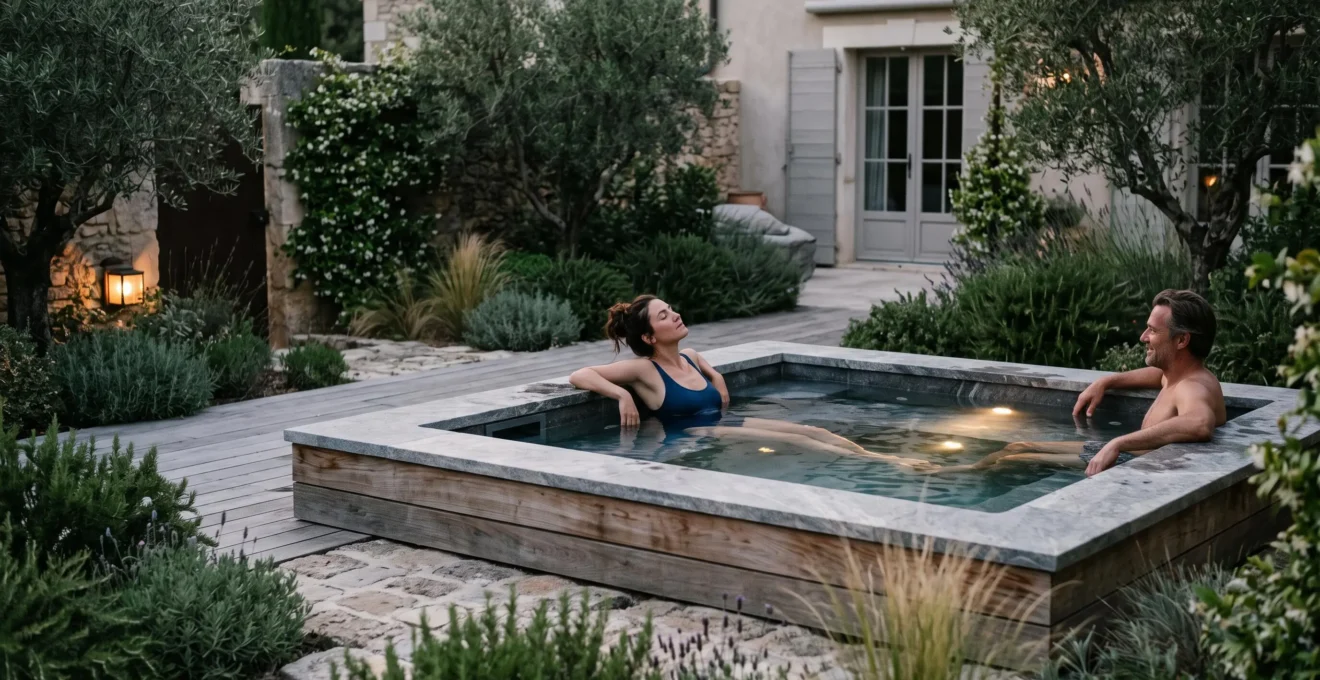
Private spa facilities—hot tubs, saunas, hammams—have transitioned from desirable extras to increasingly expected features in genuinely premium villas. This evolution reflects broader wellness prioritisation, particularly evident in post-pandemic travel preferences. According to France’s Direction générale des Entreprises, French thermal and wellness tourism facilities recorded around 2.8 million wellness visits and over 22 million overnight stays in 2022, demonstrating substantial demand for wellness experiences.
The value proposition rests on two foundations: intimacy and temporal autonomy. Private spas eliminate the presence of strangers, allowing families or friend groups to relax without self-consciousness, conversation constraints, or proximity to unknown guests. This privacy proves particularly significant for teenagers and adults who would avoid shared hotel spa environments but comfortably use private facilities.
Temporal autonomy complements privacy benefits. Private spas operate 24/7 without booking slots, opening hours, or advance reservation requirements. Guests can use facilities spontaneously after dinner, early morning, or whenever desired—eliminating the logistical friction that transforms hotel spa visits from relaxing experiences into scheduled obligations. The difference between deciding at 11pm to use a hot tub steps from the villa versus planning a next-day spa hotel visit, booking treatments 48 hours advance, and driving 25 minutes each way proves substantial.
Private spas also integrate with other villa amenities, creating holistic wellness environments impossible with external facilities. Post-swim relaxation, evening rituals after chef-prepared dinners, and spontaneous use throughout the day form a seamless experience rather than fragmented activities requiring travel and planning.
Private villa spa versus hotel wellness facilities: the autonomy advantage
Private spa advantages: Complete 24/7 access without booking requirements, zero travel time, absolute privacy for family or group, spontaneous use without advance planning, seamless integration with villa experience, no operating hour constraints.
Hotel spa advantages: Professional treatments and therapists available, often larger facilities with varied equipment, specialist maintenance handled by property staff, no guest responsibility for equipment care.
Private spa considerations: Facility size typically smaller than commercial spas, maintenance responsibility clarity (confirm host/guest responsibility split before booking), equipment variety may be limited.
Hotel spa limitations: Advance booking often required (typically 24-48 hours), restricted operating hours (commonly 10am-8pm), travel time required, shared facilities with other guests, spontaneous use impossible, advance planning necessary.
Private chef services: transforming dining into a highlight
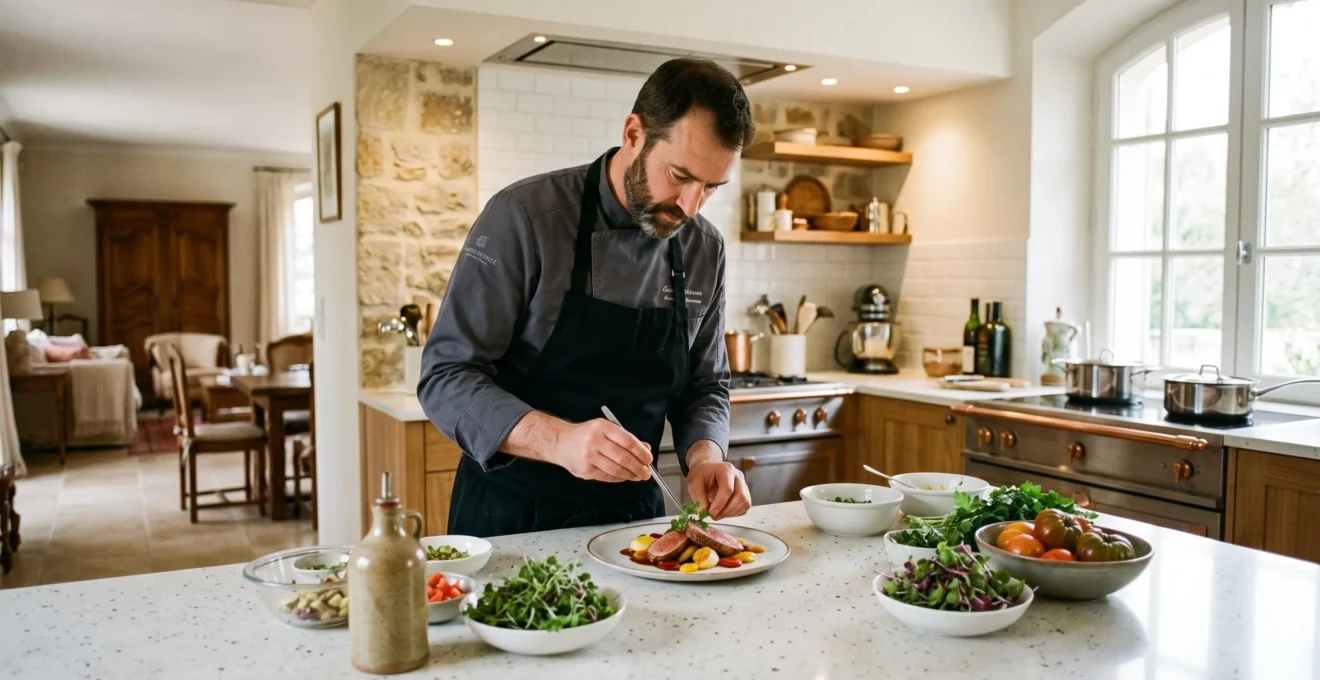
Private chef services address multiple problems simultaneously, justifying their position as the third pillar of exceptional villa amenity provision. The most undervalued benefit concerns mental load elimination—the hidden work of meal planning, grocery shopping, cooking, and cleanup that typically falls to one or two people in any group, preventing genuine relaxation for those individuals.
For an eight-person group staying one week, 21 meals require planning, ingredient sourcing, preparation, and cleanup. Even sharing this burden, several people spend significant holiday time on food logistics rather than relaxation. Chef services transfer this entirely, allowing everyone to remain with the group throughout dining rather than rotating kitchen duty whilst others socialise.
Beyond convenience, private chefs provide access to local gastronomic expertise and regional ingredients difficult to replicate without market knowledge. Authentic Provençal preparations, seasonal specialities, and dishes requiring techniques unfamiliar to most home cooks become accessible, transforming dining from sustenance into cultural immersion. This elevation of culinary experience distinguishes chef services from simple convenience—they enhance the holiday rather than merely reducing effort.
Personalisation adds practical value, particularly for families. Chefs adapt menus to dietary requirements, children’s preferences, and adult sophistication simultaneously—solving the common villa challenge of satisfying diverse group needs without multiple meal preparations. One menu accommodates varying tastes whilst maintaining quality throughout.
Service models vary significantly, affecting value assessment. Some villas include chef services in rental rates for specific meals (commonly four to five dinners weekly), whilst others offer chefs available on request with per-person, per-meal pricing. Grocery costs may be included or charged separately. Transparent pricing clarity in listings proves essential for accurate budget planning—vague “chef services available” descriptions without cost structure indicate potential hidden expenses.
The convivial dimension deserves emphasis. Chef-prepared meals enable hosts to remain with guests throughout dining, transforming meals into social highlights rather than work obligations where someone misses conversation to cook. For special occasions—anniversary celebrations, milestone birthdays—this shared experience proves particularly valuable.
How do virtual tours reveal these amenities before booking?
Virtual tours and 360-degree property photography provide objective verification mechanisms addressing the marketing-reality gap that creates booking uncertainty. Curated marketing photographs show properties from flattering angles under optimal lighting, whilst virtual tours for property searches reveal comprehensive views including less photogenic angles, enabling realistic quality assessment.
For heated pools, virtual tours should reveal heating equipment visibility, pool cover storage areas, and temperature control panels—tangible evidence supporting heating claims rather than marketing assertions alone. Listings claiming heated pools without visible heating infrastructure in comprehensive virtual tours warrant skepticism. Similarly, assessing spa facility size, equipment condition, and positioning relative to the main house becomes possible through 360-degree views rather than single curated angles that may misrepresent scale or appeal.
Chef facilities benefit from kitchen space assessment via virtual tours. Large, well-equipped kitchens with professional-grade appliances, ample workspace, and quality utensils indicate serious culinary capability. Small, poorly equipped kitchens suggest chef services may be afterthoughts rather than integral amenities, potentially affecting meal quality regardless of chef skill.
Advanced platform filtering complements virtual tour verification. Specialist villa rental platforms offering precise amenity filters—heated pool, private spa, chef availability—enable efficient shortlisting before detailed evaluation. This filtering saves considerable time compared to manually reviewing properties lacking required amenities. For regions like the Île de Ré rentals market, where luxury properties proliferate, filtering becomes essential for manageable research.
Verified reviews provide experiential validation beyond static imagery. Reviews specifically mentioning amenity performance—pool temperature adequacy in April or October, spa functionality and maintenance, chef culinary quality—offer real-guest perspectives on whether marketing claims match delivered reality. Multiple reviews confirming consistent amenity quality carry more weight than promotional descriptions alone.
Red flags when verifying heated pools and spa facilities
Warning signs indicating amenities may disappoint despite marketing claims: heated pool listed but no visible heating equipment, temperature control panels, or pool covers in photographs or virtual tours; spa or hot tub shown only from single flattering angle suggesting limited size or unappealing positioning; chef service described as “available on request” without transparent pricing or concrete arrangement details; absence of comprehensive virtual tour for high-priced listings (suggests reluctance to reveal full property detail); generic professional photography without property-specific detail shots of key amenities; reviews mentioning amenity quality issues without visible host responses addressing concerns.
Beyond amenities: location, curation and informed decision-making
Whilst heated pools, private spas, and chef services distinguish exceptional villas from baseline luxury properties, location quality and platform curation provide essential complementary factors. An impeccably equipped villa in a characterless modern development or isolated setting cannot deliver the exceptional experience achievable when the same amenities exist within a historic Provençal village offering walkable restaurants, weekly markets, and authentic regional character.
Location significance extends beyond aesthetic appeal to practical experience enhancement. Proximity to cultural sites, coastline quality, village character, and environmental setting contribute substantially to holiday satisfaction—sometimes outweighing amenity advantages if location disappoints. Virtual tours and mapping tools enable location assessment, revealing whether villas occupy appealing positions or merely market nearby attractions without acknowledging actual distances.
Platform curation introduces quality assurance absent from generic aggregator sites. Specialist platforms applying rigorous selection criteria—property inspections, amenity verification, owner vetting, photography standards—provide an additional verification layer reducing booking risk. Properties listed on curated platforms have typically undergone assessment processes filtering unsuitable offerings, whilst aggregator sites accepting any submitted listing offer no quality baseline.
This curation distinction matters particularly when investing £8,000-12,000 weekly. At this budget level, compromises should be minimal. Exceptional villas should deliver across all dimensions—amenities, location, condition, service responsiveness. Persistent compromises at premium price points signal overpricing rather than market reality.
Verified reviews complement curation and virtual tours, providing performance evidence. Reviews addressing the three core amenities specifically—heated pool temperature maintenance across seasons, spa equipment reliability, chef culinary standards—validate marketing materials with experiential testimony. Single negative reviews matter less than patterns; multiple guests reporting similar issues indicate systemic problems rather than isolated incidents.
- Confirm heated pool specification: check virtual tour for visible heating equipment, temperature control panels, pool cover storage. Verify temperature range stated (26-28°C typical) and heating system type (gas/electric/heat pump more reliable than solar alone).
- Assess private spa quality: use 360-degree views to evaluate facility size, equipment condition, and positioning. Confirm 24/7 access without booking requirements. Check reviews mentioning spa functionality and maintenance.
- Clarify chef service arrangements: verify pricing transparency (per-person per-meal rates or inclusion in rental), grocery cost structure (included or separate), and booking flexibility. Assess kitchen equipment quality via virtual tour.
- Use advanced platform filters: shortlist only properties meeting all three amenity requirements before detailed evaluation, saving research time and ensuring baseline standards.
- Evaluate location comprehensively: assess proximity to coast, cultural sites, village character, and environmental setting using maps and virtual tours. Verify actual distances to claimed nearby attractions.
- Prioritise curated specialist platforms: select platforms with rigorous property inspection and verification processes over generic aggregator sites lacking quality baseline.
- Consult verified reviews thoroughly: read reviews specifically mentioning the three amenities, noting patterns rather than isolated comments. Guest experiences validate marketing claims better than promotional content.
- Calibrate budget-expectation alignment: for £8,000-12,000 weekly budgets, expect excellence across all dimensions without significant compromises. Persistent shortcomings suggest overpricing.
The distinction between genuinely exceptional villas and well-marketed baseline luxury properties ultimately rests on problem-solving capability rather than aesthetic appeal. Heated pools extend seasonal autonomy, private spas provide intimate wellness without logistical constraints, and chef services eliminate mental load whilst elevating culinary experience. Together, these three amenities form a verifiable framework for assessing whether premium pricing delivers corresponding value.
Armed with specific verification criteria—virtual tour assessment, platform curation quality, review consultation, location evaluation—discerning holidaymakers can navigate marketing claims to identify properties genuinely justifying exceptional investment. The objective remains not spending more, but spending wisely on amenities that demonstrably transform the villa holiday from comfortable accommodation into a memorable experience worth the premium commanded. For those seeking real estate tips for better decisions, these principles apply equally to rental assessments and property evaluation more broadly.