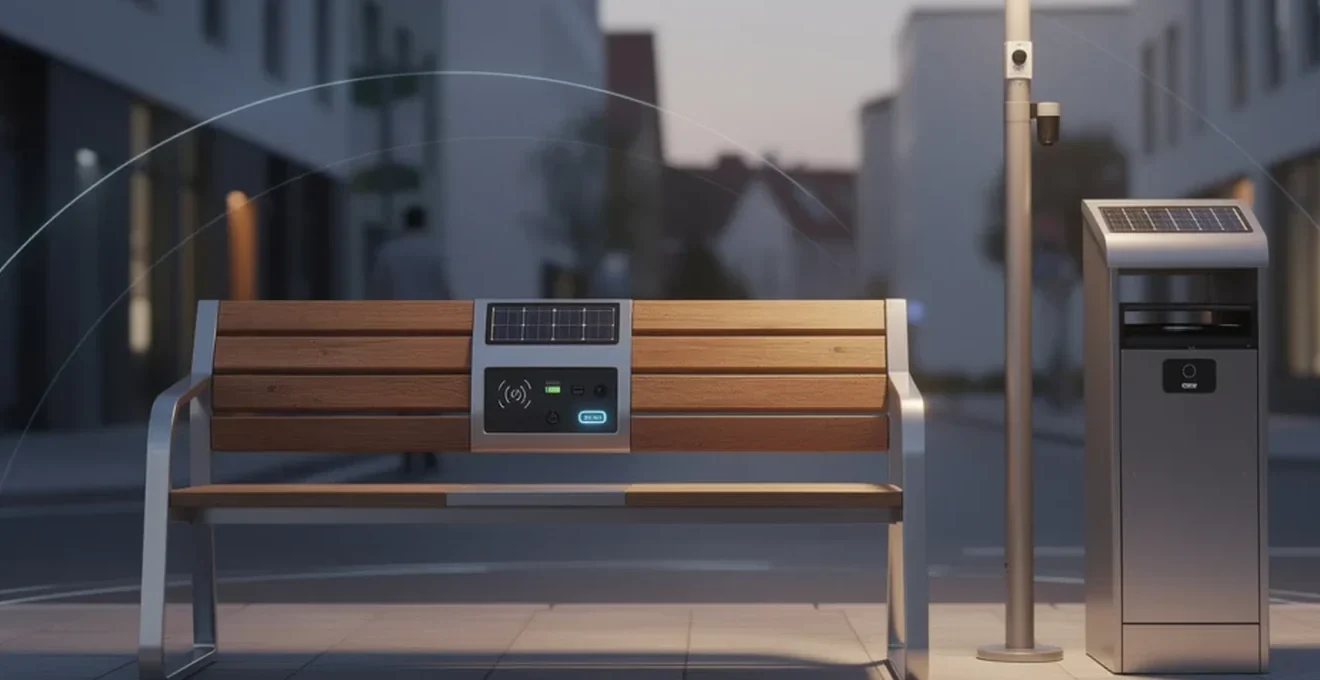
Cities are rethinking what a bench, a bin or a streetlamp can do. Rather than serving a single static purpose, urban fixtures are increasingly expected to gather data, generate power, connect residents to networks, and adapt to how people actually move through public space. This shift is being driven by three converging forces: the falling cost of sensors and connectivity, growing pressure on councils to demonstrate sustainability and value for money, and a public appetite for spaces that feel responsive rather than merely functional. Understanding what makes street furniture genuinely “smart”, how it differs from conventional fixtures, and which technologies are worth investing in helps planners, designers and procurement teams make choices that serve communities well into the future rather than becoming obsolete within a few years.
Defining smart street furniture in contemporary urban design
Smart street furniture refers to public fixtures — benches, lighting columns, waste bins, kiosks and shelters — that incorporate sensors, connectivity or embedded technology to collect data, respond to their environment, or offer services beyond their traditional physical function. A bench that charges a phone, a lamppost that dims when no one is nearby, or a bin that reports its own fill level are all examples of furniture that has moved from being a passive object to an active node in a wider urban network.
This evolution sits alongside a parallel trend in physical design: modular systems that let designers combine standardised components into varied configurations without the cost of fully bespoke manufacturing. The same logic that allows a modular bench, planter and BBQ range to be reconfigured like building blocks also applies to smart infrastructure, where sensor modules, solar panels and connectivity units can be added to a base product rather than designed from scratch each time.
Core technologies powering IoT-Enabled street assets
At the heart of most smart furniture is a combination of low-power sensors, wireless connectivity and, frequently, a small-scale energy source such as a solar panel. These components allow a single piece of furniture to monitor conditions such as footfall, air quality, noise or occupancy, and to transmit that information to a central platform. The value of this technology increases considerably when multiple pieces of furniture across a city are networked together, because isolated data points tell planners far less than an aggregated view of how an entire district behaves throughout the day.
Distinguishing smart furniture from traditional municipal fixtures
Traditional street furniture is judged on durability, cost and basic compliance — a bench must hold weight, resist weather and meet accessibility standards. Smart furniture must do all of this and also justify an ongoing technology lifecycle: firmware updates, data management, and eventual hardware replacement as standards evolve. The distinction matters for procurement, because councils choosing smart assets are effectively signing up for a longer-term relationship with a technology provider, not simply purchasing a fixed asset with a multi-decade lifespan.
Key manufacturers shaping the market: bankfoot, urbis schreder, and landscape forms
A number of established manufacturers have built reputations in this space by combining robust outdoor design with embedded technology. Bankfoot, Urbis Schreder and Landscape Forms each offer ranges that blend conventional street furniture materials — aluminium, stainless steel, timber composites — with lighting, sensor or connectivity options. The common thread across these providers is a recognition that smart features need to be layered onto furniture that already performs well as a physical object; technology cannot compensate for a bench that is uncomfortable or a light column that cannot withstand coastal weather.
Solar-powered smart benches and multifunctional seating solutions
Seating is often the first category where councils experiment with smart technology, largely because benches are already ubiquitous and their upgrade path — adding a solar panel and a small battery — is relatively straightforward compared with retrofitting lighting or waste infrastructure.
Integrated USB and wireless charging ports for public use
The most visible feature of smart benches is device charging, typically delivered through USB ports and, on newer models, wireless charging pads built into the seat or armrest. This addresses a genuine gap in public space: as personal devices become more central to how people navigate, work and communicate outdoors, the absence of charging infrastructure becomes a real limitation, particularly for people who rely on mobile devices for longer periods away from home or the office.
Environmental sensor arrays embedded in bench structures
Beyond charging, many smart benches house sensor arrays that monitor air quality, temperature, humidity and ambient noise. Positioning these sensors at bench height, rather than on a lamppost several metres up, gives a more accurate picture of the conditions people actually experience while sitting, walking or waiting nearby, which is particularly useful for identifying localised pollution hotspots or microclimates within a park or plaza.
Structural materials: recycled composite timber versus stainless steel
The choice of base material still matters as much for smart benches as for conventional ones. Recycled composite timber offers a warmer aesthetic and aligns with biophilic design trends, but stainless steel and marine-grade aluminium remain popular for their durability, resistance to weathering and lower long-term maintenance requirements. Councils weighing up these options need to balance the visual and tactile qualities of timber-effect finishes against the practical demands of housing sensitive electronics in an outdoor structure exposed to rain, salt air or heavy footfall.
| Material | Strengths | Considerations |
|---|---|---|
| Recycled composite timber | Natural aesthetic, biophilic appeal | May require more careful sealing around electronics |
| Stainless steel | High durability, low maintenance | Can retain heat or cold, affecting comfort |
| Powder-coated aluminium | Lightweight, corrosion-resistant | Wide colour and finish range for design flexibility |
Intelligent lighting systems and adaptive streetlamp networks
Lighting represents one of the largest ongoing energy costs for any municipality, which makes it a natural target for smart upgrades that reduce consumption without compromising safety.
LED adaptive lighting controlled via CMS platforms
Adaptive LED lighting, managed through centralised content or control management system (CMS) platforms, allows councils to adjust brightness levels remotely, schedule dimming during low-traffic hours, and diagnose faults without sending a technician to physically inspect each fixture. This centralised oversight reduces both energy waste and the labour cost associated with maintaining large lighting networks across a city.
Motion-sensor integration for energy consumption reduction
Motion sensors add a further layer of efficiency by allowing lights to brighten only when pedestrians, cyclists or vehicles are detected nearby, then dim again once the area is clear. This approach preserves safety in quieter periods while avoiding the energy waste of running streetlights at full brightness throughout the night in areas with minimal footfall.
Copenhagen’s connected streetlight initiative as a benchmark
Copenhagen has been widely referenced as an example of connected streetlighting at scale, using networked LED systems to manage energy use across large sections of the city. Initiatives of this kind are often cited by planners elsewhere as evidence that intelligent lighting can deliver meaningful reductions in municipal energy spend when deployed consistently across a network rather than as isolated installations.
Waste management innovation through smart bins and sensor networks
Waste collection is another area where sensor technology has moved from novelty to practical necessity, particularly in high-footfall areas such as parks, transport hubs and commercial districts.
Fill-level monitoring using ultrasonic sensors
Ultrasonic sensors mounted inside a bin can measure how full it is in real time, transmitting that data to waste management teams so collections can be scheduled based on actual need rather than a fixed timetable. This reduces both the number of unnecessary collection trips and the risk of overflowing bins in busier locations.
Solar-compacting bins: the bigbelly model explained
Bigbelly is a widely recognised example of a solar-powered compacting bin, using onboard solar panels to power a compaction mechanism that increases the bin’s effective capacity between collections. By compacting waste as it accumulates, these units can hold significantly more than a standard bin of the same footprint, which is particularly valuable in areas where frequent manual collection is impractical or costly.
Route optimisation for municipal waste collection fleets
When fill-level data from multiple bins is aggregated, waste collection fleets can plan routes based on which bins genuinely need emptying rather than following a fixed circuit regardless of actual demand. This data-driven approach reduces fuel consumption, vehicle wear and staff time, while also lowering the emissions associated with unnecessary collection journeys.
Digital signage and interactive kiosks in public spaces
As urban furniture becomes more connected, it increasingly doubles as a communication channel, offering information, navigation support and even revenue generation through advertising.
Wayfinding touchscreen totems for pedestrian navigation
Interactive touchscreen totems help pedestrians navigate unfamiliar areas, offering maps, directions and local information without requiring a personal device or data connection. These are particularly useful in transport interchanges, shopping precincts and tourist areas where visitors may be unfamiliar with the layout of the surrounding streets.
5g-enabled advertising panels: the link NYC model
LinkNYC is a frequently cited example of digital kiosk infrastructure that combines free public Wi-Fi, device charging and digital advertising panels within a single street-level structure. The model demonstrates how advertising revenue can help offset the cost of deploying connectivity infrastructure at scale, making it more feasible for cities to fund extensive public Wi-Fi coverage.
Real-time transit data integration on bus shelter displays
Digital displays at bus shelters that show real-time arrival information reduce uncertainty for passengers and can encourage greater use of public transport by making waiting times more predictable. Integrating this data directly into street furniture removes the need for passengers to rely solely on smartphone apps, which is particularly valuable for older residents or those with limited data access.
Data governance, connectivity infrastructure, and urban planning integration
The value of smart street furniture depends heavily on the underlying connectivity and data infrastructure that supports it, as well as the governance frameworks that determine how collected data is used.
Lorawan and narrowband IoT protocols for street furniture networks
Low-power wide-area network protocols such as LoRaWAN and Narrowband IoT (NB-IoT) are commonly used to connect distributed street furniture because they offer long battery life and reliable coverage over wide areas without the power demands of standard Wi-Fi or cellular connections. These protocols are particularly well suited to devices such as sensor-equipped bins or benches that need to transmit small amounts of data intermittently rather than continuous high-bandwidth streams.
GDPR compliance in Sensor-Based public data collection
Any sensor network that collects data in public spaces, particularly where cameras or footfall tracking are involved, must be designed with data protection regulations such as GDPR in mind. This means being clear about what data is collected, how long it is retained, and ensuring that any personal or potentially identifying information is anonymised or aggregated before analysis, so that public trust in smart infrastructure is not undermined by opaque data practices.
Digital twin modelling for smart city masterplans
Digital twin technology, which creates a virtual model of a city or district using real-time data feeds, allows planners to simulate how changes to street furniture, traffic flow or lighting might affect an area before committing to physical installation. As more street furniture becomes networked, the data it generates feeds directly into these models, giving planners a progressively more accurate picture of how urban spaces are actually used and helping justify further investment in smart infrastructure where it demonstrably improves outcomes.