
Coordinating transport for eight people arriving at Paris-Charles de Gaulle with six suitcases, carry-ons and a pushchair sounds straightforward until the practical questions emerge: will everyone actually fit in a vehicle advertised as ‘9-seater’ once luggage is loaded? Where exactly do groups meet their driver or collect a rental vehicle across CDG’s sprawling terminal network? And which approach—renting for multiple days or booking separate transfers—delivers better value when the itinerary includes both Disneyland and central Paris?
The answer depends less on finding a universally ‘best’ option than on matching four specific variables to the solutions structurally designed for them: actual passenger count with realistic luggage volume, total budget calculated beyond advertised rates, planned itinerary across the stay, and tolerance for pickup logistics complexity with a tired family group.
- A minibus marketed as ‘9 seats’ typically accommodates 7 adults comfortably once standard international flight luggage occupies boot space, not the nominal maximum
- Total rental costs include base rate plus insurance, fuel, tolls and optional extras—often 25–40% above the initially displayed price
- The economic tipping point sits at three or more separate journeys during the stay, where multi-day rental outperforms booking individual transfers
- Pickup logistics vary significantly: rental collection requires navigating to off-terminal car parks via shuttle, whilst private transfers offer terminal-door collection with coordinated meeting points
- Decision framework relies on four criteria—group size with luggage, budget including hidden fees, itinerary structure, logistics tolerance—rather than a single ‘best’ recommendation
- Group transportation at CDG: the real challenge behind the luggage trolley
- What defines the ‘best’ minibus option for your group?
- The three main options: rental, shuttle, and private transfer compared
- How does real capacity match your group size and luggage?
- Hidden costs and promotional codes: the true price breakdown
- Making it happen: pickup logistics and choosing your solution
Group transportation at CDG: the real challenge behind the luggage trolley
To bridge the gap between landing and reaching your final destination, securing a dedicated minibus hire at Paris-Charles de Gaulle provides the necessary autonomy for large groups. This professional approach ensures that the vehicle is perfectly suited to the specific requirements of international travelers, offering the flexibility required for navigating the surrounding regions without the constraints of public transport schedules.
Paris-Charles de Gaulle’s tri-terminal architecture creates a logistical layer absent from smaller airports. Terminal 2 alone subdivides into seven satellite buildings (2A through 2G), and the distance between an arrival gate at Terminal 2E—the main hub for long-haul international flights—and ground transportation meeting zones can exceed 800 metres of corridors, escalators and connecting walkways. Navigating this distance with elderly relatives, young children and loaded luggage trolleys transforms vehicle pickup from a simple detail into a primary decision criterion.
Yet the more significant challenge emerges before anyone reaches the meeting point: the structural gap between a vehicle’s advertised passenger capacity and its real-world ability to carry that many people plus the luggage volume generated by international flights. A family of eight returning from London with six medium checked suitcases, cabin bags, a pushchair and children’s travel accessories confronts a dimensional problem that marketing materials for ‘9-seater minibuses’ rarely address explicitly.
This discrepancy matters particularly for the most common group profiles arriving at CDG: extended families combining multiple generations for Disneyland visits, corporate groups heading to central Paris hotels, or multi-household friendship groups planning city breaks. These travellers typically require the vehicle not just for the airport transfer but for subsequent journeys—Disneyland to Paris centre, hotel to restaurant, sightseeing circuits—making the choice between a single transfer service and multi-day rental a strategic rather than merely transactional decision.
Three CDG-specific constraints that shape minibus decisions: Terminal-to-pickup distances averaging 10–15 minutes’ walk with luggage; realistic capacity dropping by 2 passengers once international flight baggage loads; itinerary structures typically requiring 3–4 separate journeys across a Disneyland-and-Paris combined stay.

What defines the ‘best’ minibus option for your group?
The search for the ‘best’ minibus solution at CDG starts by rejecting the premise that such a universal recommendation exists. Instead, four measurable criteria determine which option architecturally fits a specific group situation, and each criterion eliminates certain solutions whilst favouring others.
Criterion one: effective group size. Count the actual number of passengers, then measure—rather than estimate—luggage volume. A group of eight adults generates different spatial requirements than six adults plus two children using compact car seats. Similarly, six medium checked suitcases (typically 68–72cm height) plus carry-ons occupy substantially more boot space than the same passenger count travelling with cabin baggage only. This measured total determines minimum vehicle size, which in turn dictates whether standard options suffice or bespoke solutions become necessary.
Criterion two: total budget structure. Calculate the complete cost including mandatory insurance, fuel (either prepaid or budgeted for fill-up), motorway tolls between CDG and typical destinations, and any supplements for additional drivers or child seats. Compare this total—not the advertised base rate—against available budget. A rental displaying €220 for three days may reach €320 after these additions, whilst a private transfer quoted at €110 might include all fees upfront. The comparison requires like-for-like totals.
Criterion three: complete itinerary. Map every planned journey: airport to first accommodation, Disneyland to Paris hotel, potential restaurant trips, return to airport. A single airport transfer functions differently from a five-day stay requiring four separate journeys. This count directly determines whether rental economics outweigh transfer convenience, typically tipping at three or more distinct trips.
Criterion four: logistics tolerance. Assess the group’s realistic capacity to manage vehicle collection procedures, navigate to off-terminal rental car parks via shuttle buses, handle vehicle return processes, and—for UK drivers—operate right-hand-drive vehicles in right-side traffic. Groups including elderly members with reduced mobility after long flights, young children prone to tiredness-induced difficulties, or travellers anxious about language barriers may prioritise door-to-door simplicity over cost savings, even when rental appears economically superior.
-
If budget flexibility exists but logistics anxiety runs high:
Criterion four (logistics tolerance) becomes primary—directing towards private transfer solutions that eliminate collection complexity even if costlier per journey.
-
If itinerary includes four or more separate journeys:
Criterion three (itinerary structure) dominates—rental economics improve dramatically with journey count, often justifying the logistics investment.
-
If passenger count reaches 8+ with substantial luggage:
Criterion one (effective group size) eliminates standard solutions—verify actual capacity specifications before booking any option.
The three main options: rental, shuttle, and private transfer compared
Three solution families serve group transportation at CDG, each optimised for different criterion profiles. Understanding their structural trade-offs prevents mismatched bookings where a group selects an option fundamentally unsuited to their documented situation.
Minibus rental with airport delivery provides maximum itinerary flexibility and the lowest per-journey cost when multiple trips occur, but transfers complexity and navigation responsibility to the customer. Rental requires navigating to collection points (often requiring a shuttle bus from the terminal to off-airport car parks), completing paperwork, inspecting the vehicle, and managing driving in unfamiliar territory. For groups planning extensive movement—the archetypal Disneyland-then-Paris itinerary with four to six distinct journeys—rental economics become compelling despite upfront cost appearing higher.
Shared airport shuttles offer the most economical per-person pricing for small groups (two to four passengers) with minimal luggage, but their structure makes them unsuitable for the eight-person scenario. Shuttle services impose fixed departure schedules, shared vehicles with other passengers heading to different destinations, and strict luggage limits (typically one checked bag plus one carry-on per person). Attempting to book a group of eight typically requires splitting across two separate shuttle bookings with potentially non-synchronised schedules—a coordination problem that negates the cost advantage. These services solve a different problem for a different profile.
Private transfer services (VTC or chauffeur-driven vehicles) maximise door-to-door convenience and eliminate all collection logistics, navigation concerns, and vehicle management tasks. Drivers meet groups directly at terminal arrival zones with name boards, handle luggage loading, and deliver passengers to exact destination addresses. This convenience commands premium pricing per journey, making transfers economically rational for single airport runs but increasingly expensive as journey count rises. For a group of eight requiring a 9-seater vehicle, expect private transfer rates from CDG to central Paris or Disneyland in the €110–140 range per journey depending on final destination and booking timing.
| Decision criterion | Rental (multi-day) | Shared shuttle | Private transfer |
|---|---|---|---|
| Real capacity for 8 adults + luggage | Achievable with verified 9-seat models | Requires 2 separate bookings | Achievable with 9-seat VTC |
| Cost structure (3-day stay, 4 journeys) | €280–320 total inclusive | €15–25 per person per journey | €110–140 per journey (€440–560 total) |
| Itinerary flexibility | Complete control, any schedule | Fixed departure times only | On-demand but requires advance booking |
| Logistics simplicity | Requires collection, driving, return procedures | Simple boarding at designated zone | Terminal-door collection with driver assistance |
3
journeys
The economic tipping point where multi-day rental typically becomes more cost-effective than booking separate private transfers for groups of 6–9 passengers.
How does real capacity match your group size and luggage?
The ‘9-seater’ designation creates systematic confusion because it counts installed seats in an empty vehicle configuration, not the practical passenger limit once luggage occupies the space those seats require. This gap between nominal and actual capacity explains why groups booking based on advertised numbers frequently discover at pickup that comfortable transport requires a larger vehicle or luggage reduction.
The physical principle operates straightforwardly: vehicle manufacturers design minibuses with either passenger seats installed or boot space available, rarely both at maximum simultaneously. A Ford Transit Custom Kombi—among the most common rental options at CDG—illustrates this trade-off precisely. According to Ford France’s official specifications, the Transit Custom Kombi is designed to accommodate up to eight passengers together with their equipment, not nine in a luggage-loaded configuration. Technical data from automotive reference source L’Argus confirms the Transit Custom Kombi 310 L1H1 provides 1,300 litres of boot space with all nine seats in position, expanding to 3,100 litres only when rear seats fold down.
Translating these specifications into practical guidance: a standard medium checked suitcase (68–72cm height, typical for international flights) occupies approximately 85–95 litres of three-dimensional space. Six such suitcases therefore require roughly 510–570 litres, consuming nearly half the Transit’s available 1,300-litre boot before accounting for cabin bags, pushchairs, or additional items. The remaining space accommodates passengers, but the rear bench seating becomes cramped when luggage stacks behind it or occupies footwells.
Practical capacity rule verified against manufacturer specifications: A minibus marketed as 9 seats comfortably transports 7 adults with standard international flight luggage (one checked bag plus carry-on per person), or stretches to 8–9 passengers when travelling with cabin baggage only or minimal checked luggage.
Premium fleet operators recognise this capacity reality explicitly. Services using Ford Transit and Mercedes V-Class vehicles guarantee genuine capacity for 7–8 passengers with full luggage, rather than advertising the nominal maximum. For groups precisely matching the eight-person profile with six medium suitcases plus accessories—the scenario described earlier—verification before booking becomes essential: request boot volume specifications in litres, confirm whether the quoted capacity includes standard luggage, and calculate based on measured baggage dimensions rather than assumptions.
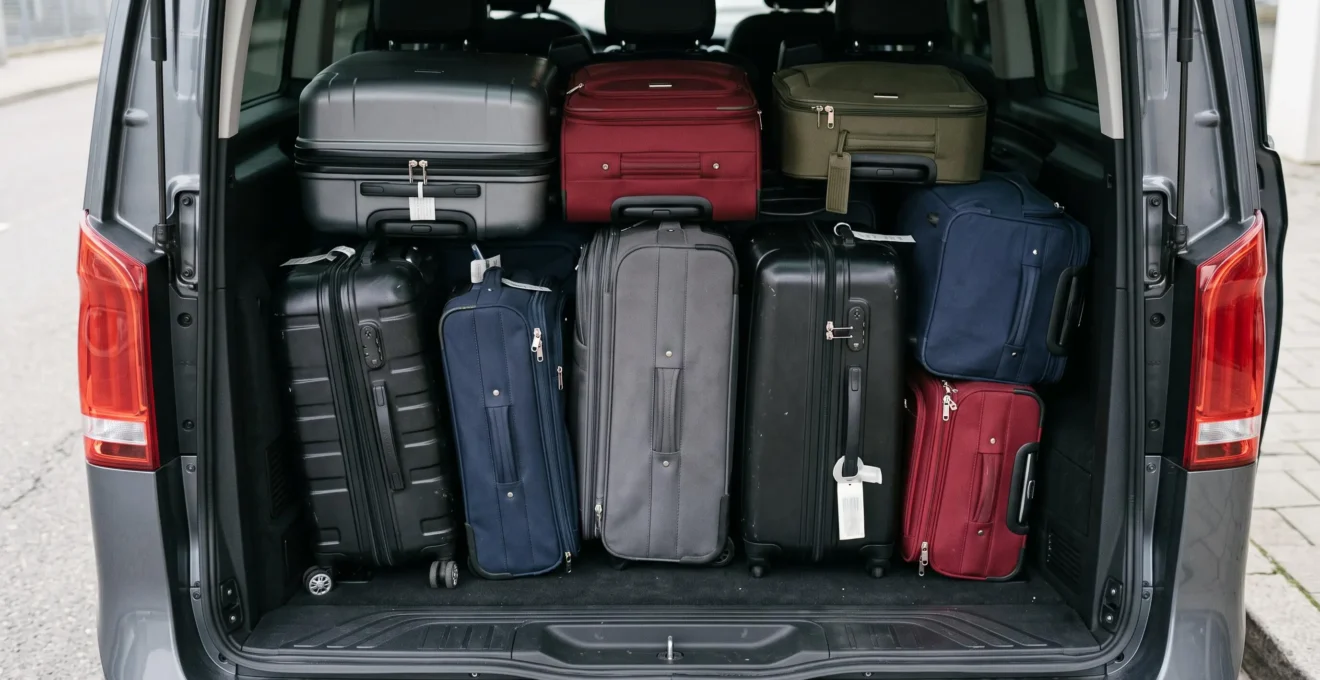
The recommended verification approach before finalising any booking: count actual passengers, measure existing luggage (or reference airline baggage dimensions for planned packing), subtract two places from any advertised capacity to account for luggage displacement, then confirm the calculation with the provider specifying exact baggage load. This process prevents the arrival-day discovery that the booked vehicle cannot physically accommodate the documented group.
Hidden costs and promotional codes: the true price breakdown
Advertised minibus rental rates at CDG function as base prices that exclude several mandatory or near-mandatory additions, creating a systematic gap between displayed costs and final payment. Understanding this structure—and the available optimisations—enables accurate budget comparison rather than false economy based on incomplete figures.
The standard cost architecture layers five components: base rental rate (the displayed daily or multi-day price), collision damage waiver insurance (CDW or LDW, typically €20–30 per day and practically essential to avoid liability exposure reaching thousands of euros), fuel costs (either full-to-full policy requiring customer refill, or prepaid fuel at premium rates), motorway tolls for the planned route, and optional supplements such as additional driver authorisation, child seats, or GPS devices.
Applying this structure to a realistic scenario demonstrates the magnitude: a three-day Ford Transit rental displaying a promotional base rate of €220 adds approximately €25 daily for CDW insurance (€75 total), requires budgeting €55–70 for fuel depending on distance covered, and incurs tolls on the primary routes. The A1 motorway from CDG to Paris centre costs around €2.40, whilst the A4 route to Disneyland (Marne-la-Vallée exit) runs approximately €2.70. Return journeys double these figures, and any additional trips accumulate further charges. The apparently economical €220 rental realistically totals €280–320 once these documented additions apply.
Promotional codes provide one mechanism for narrowing this gap. The code MINIGO26 offers reductions on qualifying bookings, though exact discount levels and eligibility conditions vary by booking date and rental duration. Such codes typically deliver €25–50 off total costs for multi-day hires, materially affecting the rental-versus-transfer economic comparison without fundamentally altering the decision framework.
Four frequently omitted charges that inflate final rental costs: CDW insurance appearing as optional but practically mandatory (€20–30 daily); fuel policies charging premium rates for prepaid options or requiring documented refills; tolls accumulating €8–15 for typical CDG-Disneyland-Paris-CDG circuits; additional driver fees (€8–12 daily) when multiple licensed drivers share responsibility.
Comparing this total against private transfer economics clarifies the strategic calculation. Two private transfers (CDG to Disneyland outbound, Paris to CDG return) for eight passengers cost approximately €220–280 total at prevailing VTC rates. If the itinerary requires only these two journeys, transfers prove economically competitive whilst eliminating logistics burden. However, adding a third journey (Disneyland to Paris hotel mid-stay) pushes transfer total costs to €330–420, crossing the threshold where rental becomes financially superior despite higher upfront complexity. The fourth or fifth journey—restaurant trips, sightseeing circuits—cements rental’s economic advantage for multi-movement itineraries.
The verification checklist before confirming any booking: Is CDW insurance included or additional? Does the quoted rate require full-to-full fuel, prepaid fuel, or include fuel costs? Are tolls estimated for the planned route documented separately? Do additional drivers, child seats, or other supplements apply to the group profile? Requesting explicit answers prevents payment surprises at the collection desk or return inspection.
Making it happen: pickup logistics and choosing your solution
Theoretical vehicle selection becomes operational reality only when groups successfully navigate CDG’s pickup procedures without stress-induced delays or confusion. Each solution family imposes distinct logistics, and matching these requirements to group tolerance completes the decision framework established earlier.
Rental collection procedures typically direct customers from their arrival terminal to designated meeting points or directly to off-airport car park facilities via free shuttle buses. Many rental agencies position their vehicle fleet in secured lots several kilometres from passenger terminals, requiring 10–20 minutes’ shuttle transfer after customers complete paperwork at terminal-based counters. Services offering airport delivery models—where vehicles wait at more convenient pickup points such as the Ibis CDG Terminal 2 hotel—reduce this complexity, though such convenience sometimes carries premium pricing. Upon collection, expect vehicle inspection documentation, insurance verification, fuel policy confirmation, and equipment checks before departing the facility.
Private transfer pickup procedures operate through coordinated meeting systems. VTC drivers typically position themselves in designated zones at each terminal, holding name boards displaying passenger details. Terminal 2’s various satellite buildings each maintain specific VTC collection areas, marked with clear signage in both French and English. Groups should confirm terminal-specific pickup locations during booking confirmation, noting that driver contact numbers prove essential for coordinating final meeting when multiple family members or delayed flights complicate timing. Average wait time from baggage claim to meeting driver ranges 15–25 minutes for efficiently organised transfers.
UK drivers considering the rental option face one additional calculation: comfort operating right-hand-drive vehicles (common in French rental fleets) whilst driving on the right side of the road. This mirror-image scenario demands adjustment to roundabout navigation, motorway lane discipline, and spatial awareness when the driver sits opposite their accustomed position. Experienced international drivers typically adapt within 30–60 minutes, but those uncomfortable with this inversion should factor it as a meaningful logistics barrier favouring driven transfer solutions.
-
Profile A – Eight passengers, 4+ journeys planned, budget flexible, confident drivers:
Multi-day rental delivers best value and complete itinerary control. Calculate total cost including insurance and fuel, verify 9-seat capacity with luggage, confirm pickup logistics at airport location.
-
Profile B – Six to seven passengers, single or dual airport transfers only, logistics simplicity prioritised:
Private transfer optimises for convenience and eliminates vehicle management. Book both outbound and return simultaneously for potential multi-journey discounts, confirm terminal-specific meeting point.
-
Profile C – Budget-constrained, 2-3 journeys, willing to accept moderate complexity:
Hybrid approach using private transfer for airport arrival (maximum convenience when fatigued) plus short-term rental for mid-stay movements balances cost against logistics burden.
The final decision synthesises all documented variables: actual passenger count with measured luggage volume determines minimum vehicle specification; complete cost calculation including hidden fees establishes economic comparison; itinerary journey count identifies the rental-versus-transfer tipping point; group composition and tolerance for logistics complexity weights convenience against cost savings. No universal ‘best’ option exists—only the solution that matches these four quantified inputs to operational requirements for the specific documented scenario.
- Confirm actual passenger count and measure total luggage volume against vehicle boot specifications in litres
- Calculate complete rental cost including base rate, CDW insurance, estimated fuel, tolls, and supplements
- Compare total rental cost against (number of planned journeys × private transfer rate per journey)
- Identify specific pickup location: terminal building, shuttle requirement, or off-site car park address
- Verify cancellation policy and modification flexibility for flight delay scenarios
- For rentals: confirm fuel policy (full-to-full or prepaid), additional driver eligibility, and vehicle return procedures
- For transfers: obtain driver contact number and confirm terminal-specific meeting zone
- Apply available promotional codes (such as MINIGO26) before final payment to capture applicable discounts
Selecting group transportation at CDG shifts from searching for validation of a predetermined ‘best’ choice to constructing a decision based on four measurable criteria applied to verified data. The resulting recommendation emerges from this framework rather than marketing materials—matching documented passenger load, calculated budget, planned itinerary structure, and realistic logistics tolerance to the solution architecturally designed for exactly that profile. This approach eliminates the systematic gap between advertised promises and arrival-day reality, delivering the genuine outcome groups require: reaching their destination comfortably, predictably, and without the stress that poor dimensional planning or hidden cost surprises create when coordinating eight people and their luggage across Paris.
For additional context on evaluating service options using transparent comparison frameworks, a guide to comparing offers provides broader decision-making principles. Groups planning their complete Paris itinerary may also benefit from tips for a smart city break that complement transport logistics with efficient sightseeing strategies.