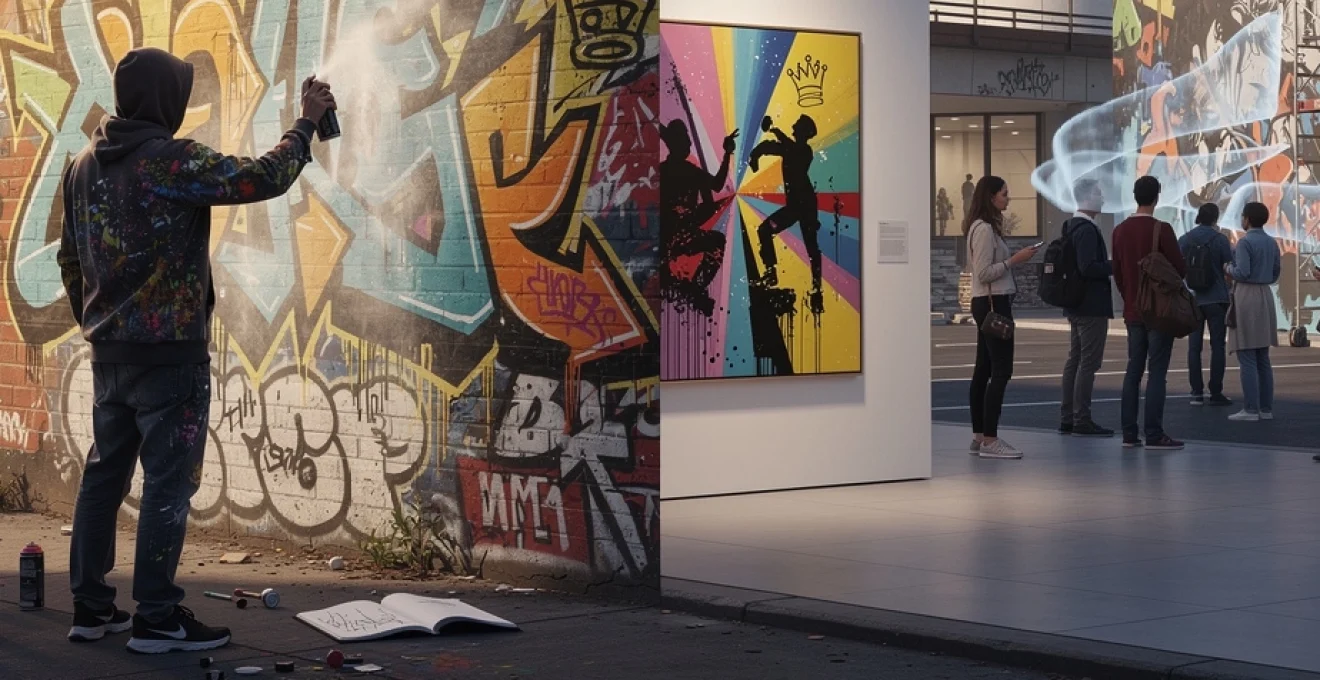
The transformation of street art from illegal tagging to celebrated gallery exhibitions represents one of the most remarkable cultural shifts in contemporary art history. What began as clandestine spray-painted messages on subway cars and warehouse walls has evolved into a multimillion-pound industry, with works commanding astronomical prices at prestigious auction houses and permanent installations gracing museum collections worldwide. This journey from the margins of society to institutional validation has fundamentally redefined our understanding of what constitutes legitimate artistic expression. Today, street art serves as a powerful medium for social commentary, political activism, and cultural identity, whilst simultaneously navigating the complex tensions between authenticity and commercialisation. The rise of digital platforms and new authentication technologies has further accelerated this transformation, creating unprecedented opportunities for artists who once operated entirely outside the traditional art world.
The graffiti movement: from subway bombing to aerosol art legitimacy
New york city subway culture and the pioneering work of TAKI 183
The modern graffiti movement’s origin story is inseparable from New York City’s subway system in the late 1960s. Demetrius, a Greek-American teenager from Washington Heights, adopted the moniker TAKI 183—a combination of his nickname and street number—and began systematically tagging subway cars and stations throughout Manhattan. His prolific output caught the attention of The New York Times, which published a profile in 1971 that inadvertently sparked a citywide tagging phenomenon. Within months, hundreds of young people were competing for visibility, transforming the underground transport network into a constantly evolving canvas of overlapping signatures and territorial markers.
What made TAKI 183’s approach revolutionary wasn’t merely the act of writing his name in public spaces—graffiti had existed for millennia—but rather the systematic, strategic nature of his placements. He understood that subway cars travelled across boroughs, carrying his tag to audiences far beyond his neighbourhood. This mobility transformed graffiti from localised vandalism into a form of mass communication, where fame was measured by geographic reach and frequency of sightings. The subway became both gallery and distribution network, a democratised platform where anyone with a marker could potentially achieve citywide recognition overnight.
Philadelphia’s cornbread and the birth of modern tagging systems
Whilst New York often receives primary credit for graffiti’s emergence, Philadelphia’s Cornbread (Darryl McCray) was actually pioneering similar techniques several years earlier. Beginning in 1965, Cornbread developed a sophisticated tagging methodology that prioritised high-visibility locations and repetitive placement. His motivations were refreshingly straightforward: to gain the attention of a girl he fancied. However, his approach to saturating neighbourhoods with his tag established foundational principles that would influence graffiti culture for decades. Cornbread’s legacy includes some of the movement’s most audacious early stunts, including tagging an elephant at Philadelphia Zoo and allegedly writing on the Jackson 5’s private jet.
Philadelphia’s contribution to graffiti culture extended beyond individual practitioners to develop a distinct stylistic tradition. The city’s writers emphasised elegance and readability in their letterforms, contrasting with New York’s later preference for increasingly abstract and complex designs. This philosophical difference reflected broader debates within graffiti culture about accessibility versus artistic virtuosity. Should tags be immediately comprehensible to the general public, or were they primarily intended as coded messages for other writers? These questions remain relevant as street art continues to negotiate its relationship with mainstream audiences.
Wildstyle typography and the technical evolution of Spray-Can techniques
By the mid-1970s, graffiti had evolved from simple tags into elaborate, multicoloured productions known as “pieces” (short for masterpieces). The development of wildstyle—characterised by interlocking letters, arrows, and complex three-dimensional effects—represented a quantum leap in technical sophistication. Pioneered by writers such as Tracy 168 and Blade, wildstyle transformed spray paint from a crude marking tool into a legitimate artistic medium capable of producing works of genuine aesthetic complexity. These intricate compositions required extensive planning, with artists sketching designs in blackbooks before executing them on walls or trains.
The technical mastery required for wildstyle productions demanded innovations in spray-can application techniques. Writers experimented with different
nozzles, or “caps”, salvaged from household products to achieve different line widths and textures. Fat caps allowed for broad fills and soft fades, while thin caps enabled razor-sharp outlines and intricate details. Writers also refined techniques such as can control, flaring, and shading, pushing aerosol paint to behave more like traditional airbrush or brushwork. This technical evolution helped dismantle the notion that graffiti was simply messy vandalism, demonstrating instead that it required discipline, practice, and a sophisticated understanding of colour theory and composition.
As wildstyle grew more complex, it became increasingly illegible to uninitiated viewers, operating almost like a secret language. For insiders, decoding a piece was akin to reading a virtuoso solo in jazz: you needed a trained eye to appreciate the subtleties. This tension between legibility and complexity mirrored graffiti’s broader struggle for recognition as art. Was the primary audience the general public, or a tight-knit community of writers? The answer often shifted from wall to wall, foreshadowing the debates that would later surround street art in galleries and museums.
The transition from vandalism legislation to cultural documentation
Throughout the 1970s and 1980s, authorities in cities like New York responded to the graffiti movement with increasingly strict anti-vandalism legislation. Mayor Ed Koch’s administration declared a “war on graffiti”, investing millions of dollars in buffing programmes, surveillance, and fencing off train yards. New laws criminalised not only the act of painting trains and walls, but also the possession of spray cans and markers by minors in certain contexts. For policymakers, graffiti symbolised urban decline and lawlessness, and eradicating it became a visible way to signal control over the city.
Yet even as official suppression intensified, a parallel movement of cultural documentation began to emerge. Photographers such as Martha Cooper and Henry Chalfant systematically recorded subway pieces before they were cleaned, publishing seminal books like Subway Art (1984) that circulated globally. These publications reframed graffiti as a legitimate cultural movement worthy of study rather than just a policing problem. Ironically, while transit authorities were buffing trains, international audiences were falling in love with the images, drawing inspiration for local graffiti scenes from London to Berlin and beyond.
Over time, urban policy slowly began to reflect this shift in perception. Some municipalities experimented with legal walls and mural programmes, recognising that controlled spaces for aerosol art could reduce illegal tagging while enriching the visual environment. Academics in fields such as anthropology, visual culture, and urban studies started producing research on graffiti and street art, placing them within broader discussions of public space, youth culture, and resistance. The very practices once used as evidence of social disorder were now being archived in libraries and exhibited in institutions, setting the stage for street art’s eventual acceptance in the mainstream art world.
Keith haring and Jean-Michel basquiat: bridging underground culture and fine art markets
Haring’s subway drawings and the democratisation of public art spaces
Keith Haring’s rise in early 1980s New York illustrates how street art could function as both public service and professional springboard. Armed with sticks of white chalk, Haring began drawing on the empty black paper panels that covered unused subway advertisements. These quick, energetic line drawings—radiant babies, barking dogs, dancing figures—appeared on platforms across the city, turning mundane commutes into encounters with spontaneous art. Unlike coded wildstyle pieces, Haring’s imagery was immediately legible, deliberately designed so children and adults alike could understand it at a glance.
Haring treated the subway as a genuinely democratic exhibition space, where no ticket, art education, or social status was required to access the work. He often engaged passers-by in conversation while drawing, answering questions and embracing the curiosity of New Yorkers who watched him work. This emphasis on accessibility prefigured many of the values we now associate with contemporary street art: open participation, minimal barriers to entry, and a direct relationship between artist and public. At the same time, his subway drawings functioned as a form of self-promotion, building a recognisable visual identity that would soon transfer to galleries and museums.
When Haring transitioned into the formal art world, he did so without abandoning his commitment to public space. Large-scale murals, collaborations with community organisations, and his Pop Shop—a retail space selling affordable items bearing his motifs—extended his philosophy that “art is for everybody”. In many ways, Haring pioneered a hybrid model of practice that many street artists follow today: working both on the street and within commercial circuits, using each sphere to amplify the other. His example raised an enduring question for street art: can artists accept institutional validation and commercial success while still claiming to be radically accessible and anti-elitist?
Basquiat’s neo-expressionism and the SAMO© graffiti collaboration
Jean-Michel Basquiat’s path from downtown graffiti writer to international art star further blurred the line between underground culture and high art. Before his meteoric rise, Basquiat collaborated with fellow artist Al Diaz under the tag SAMO© (short for “Same Old”), scrawling cryptic, poetic slogans across SoHo and the Lower East Side. Rather than traditional tags, SAMO© statements resembled fragments of philosophy or advertising gone wrong: “SAMO© as an end to mindwash religion, nowhere politics and bogus philosophy.” These enigmatic texts transformed walls into sites of conceptual provocation, inviting interpretation rather than simply asserting presence.
When Basquiat began exhibiting on canvas, he carried the raw energy and visual vocabulary of the street into the gallery. His neo-expressionist paintings fused text, symbols, anatomical diagrams, crowns, and references to Black history, jazz, and Caribbean heritage. Critics quickly recognised that his work retained the urgency of graffiti while engaging directly with the legacies of Picasso, Cy Twombly, and Cypriot iconography. In effect, Basquiat was performing a cultural translation: he proved that the aesthetics and attitudes of street culture could hold their own in dialogue with centuries of Western art history.
Basquiat’s rapid ascent also exposed the precarious dynamics surrounding the legitimation of marginalised voices in elite art markets. While his paintings broke auction records even during his lifetime, he faced intense scrutiny, racial stereotyping, and pressures to continuously produce. His story forces us to ask: when the art market embraces a former graffiti writer, is it celebrating the subculture or extracting value from it? The complexities of Basquiat’s legacy continue to inform how we discuss street art’s integration into galleries and the ethical responsibilities of collectors and institutions.
Gallery representation and the role of annina nosei in artist legitimisation
The mechanisms by which street artists enter the fine art market often hinge on visionary gallerists willing to take risks. Italian-born dealer Annina Nosei played a pivotal role in this process during the early 1980s. She gave Basquiat studio space in the basement of her SoHo gallery, providing not only material support but also access to a network of curators, collectors, and critics. This infrastructural backing allowed Basquiat to transition from painting on scavenged doors and found materials to large-scale canvases suitable for institutional exhibition and acquisition.
Nosei’s strategy highlighted how gallery representation can function as a legitimising filter for formerly underground artists. By framing Basquiat’s work within curated shows and critical discourse, she helped shift perceptions from “graffiti kid” to “serious painter”. Similar dynamics would later unfold for other artists with roots in graffiti and street art, whose careers often depended on a single influential dealer or curator willing to advocate for them. The gallery became a kind of translation device, converting the informal currency of street fame into the formal valuation systems of the art market.
However, this legitimisation process is not without controversy. Questions around control, authorship, and profit-sharing frequently surface when artists from marginalised communities are brought into commercial circuits. Who benefits most when a street artist’s work begins selling for six or seven figures: the artist, the gallery, or speculative collectors? The experience of Basquiat and his contemporaries continues to shape debates about fair representation and ethical patronage within the intersection of street art and fine art markets.
Auction house records: christie’s and sotheby’s street art sales data
The final stage in street art’s journey from urban walls to global recognition is its consolidation within the secondary market, particularly at major auction houses. Since the early 2000s, Christie’s and Sotheby’s have increasingly featured works by artists with graffiti or street art backgrounds in their contemporary sales. Basquiat’s paintings have become emblematic of this shift: in 2017, his untitled skull painting from 1982 sold at Sotheby’s for $110.5 million, setting a record for an American artist at auction. This headline sale signalled to investors that artists with street origins could occupy the very top tier of the market.
Other figures associated with street culture have also posted impressive results. Works by KAWS, whose career began in graffiti and subvertising, have fetched multi-million dollar prices in Hong Kong and New York. Even Banksy’s pieces, despite (or because of) his anti-establishment stance, routinely exceed their high estimates. According to various market reports, global auction sales for street art and graffiti-related works surpassed $200 million annually by the early 2020s, reflecting both institutional confidence and speculative enthusiasm.
This surge in value reflects more than simple fashion. It indicates that collectors now view street art as a long-term cultural asset rather than a passing trend. At the same time, the rapid financialisation of works once created freely in public raises difficult questions. When a mural painted for a community is chiselled off a wall and sold at auction, what happens to its original context and audience? As we follow price charts and sales data, we also need to consider how market validation reshapes the ethics and expectations surrounding street art practice.
Banksy’s anonymity strategy and the commercialisation of subversive imagery
Pest control authentication system and provenance verification methods
No discussion of street art’s global recognition is complete without examining Banksy, the anonymous British artist whose stencilled interventions have become cultural touchstones. One of the most intriguing aspects of Banksy’s practice is the way he has formalised authenticity while remaining personally invisible. In 2008, he established Pest Control, a dedicated authentication service that verifies whether a work is genuinely by Banksy. Collectors seeking to buy or sell pieces must submit detailed photographs and documentation; in return, Pest Control issues certificates rather than signing or stamping the works themselves.
This system addresses a persistent challenge in the street art market: how do you prove authorship for an artist who never publicly reveals their identity and rarely works through traditional dealers? By centralising verification, Pest Control protects buyers from fakes and allows Banksy to maintain control over his catalogue. At the same time, the service functions as a gatekeeper, deciding which objects—canvases, prints, or even removed walls—count as legitimate artworks. In an art ecosystem where provenance can add or subtract millions from a price, such a mechanism is crucial.
Banksy’s approach has influenced broader conversations about provenance verification methods for street art more generally. As other artists achieve higher sales, they too are experimenting with certificates of authenticity, embedded microchips, and digital registries to track ownership. In a sense, Pest Control operates like a brand’s official app, providing a trusted reference point in a market crowded with imitations. The paradox is hard to miss: an artist celebrated for critiquing capitalism has simultaneously built one of the most effective intellectual property management systems in contemporary art.
Girl with balloon shredding incident and conceptual art market disruption
The 2018 shredding of Girl with Balloon at Sotheby’s in London crystallised Banksy’s unique ability to undermine and profit from the art market at the same time. Moments after the hammer fell at just over £1 million, an alarm sounded and the framed work began to pass through a hidden shredder, partially destroying the canvas in front of a stunned audience. The prank was carefully staged: Banksy later released a video showing the device’s construction, framing the act as a critique of commodification and the fetishisation of objects that were originally conceived as free street interventions.
Instead of collapsing the work’s value, the shredding incident arguably increased it. Sotheby’s quickly rebranded the piece as Love is in the Bin, and when it returned to auction in 2021, it sold for £18.5 million—more than triple its high estimate. This outcome demonstrated how the art market can absorb even direct acts of sabotage and repurpose them as spectacles that enhance rarity and narrative value. It also highlighted how conceptual gestures, when attached to a globally recognised street artist, can rival or surpass the market power of more traditional forms of painting or sculpture.
For practitioners and observers of street art, the episode functions like a case study in how disruption and commercialisation can be intertwined. Can an action still be subversive if it ultimately feeds into the very structures it claims to critique? Or does the visibility of such interventions nudge broader audiences to question how value is constructed? As with many aspects of Banksy’s career, the answers depend as much on our own expectations as on the artist’s intentions.
Dismaland and large-scale immersive installation techniques
Banksy’s 2015 project Dismaland pushed street art into the realm of large-scale, time-limited immersive environments. Installed in a disused seaside lido in Weston-super-Mare, the “bemusement park” parodied corporate theme parks while addressing themes such as consumerism, migration, and media saturation. Visitors navigated decaying fairy-tale castles, subversive sideshows, and works by more than 50 invited artists, turning the entire site into a cohesive, dystopian narrative. The project attracted over 150,000 visitors in just five weeks and generated an estimated £20 million for the local economy.
From a technical perspective, Dismaland showcased how techniques developed in street art—site-specificity, quick build times, and adaptability—could scale up to complex multi-artist environments. Temporary structures, theatrical lighting, and choreographed visitor flows transformed the venue into a living artwork in which the audience played an active role. Much like a city street, the park offered overlapping experiences: you could encounter satire, beauty, and discomfort within a few steps. This form of immersive installation has since influenced how festivals, museums, and brands approach experiential art.
At the same time, Dismaland exemplified the commercial paradox of subversive imagery. Tickets sold out within hours, merchandise queues stretched across the site, and social media was flooded with selfies taken in front of anti-capitalist artworks. In effect, Banksy demonstrated that critique itself can become a sought-after product. For street artists considering large-scale installations, the project offers both inspiration and a cautionary tale: immersive street art can generate profound engagement, but it also risks being consumed as entertainment rather than reflective commentary.
Institutional validation through major museum exhibitions and curatorial frameworks
Moca’s art in the streets exhibition and attendance metrics analysis
The Museum of Contemporary Art, Los Angeles (MOCA) took a decisive step toward institutional validation with its 2011 exhibition Art in the Streets. Curated by Jeffrey Deitch alongside Roger Gastman and Aaron Rose, the show traced the history of graffiti and street art from 1970s New York to global contemporary practices. Featuring artists such as Futura, Os Gemeos, Swoon, and Banksy, it recreated entire environments—including a replica of a New York subway station and an installation of skate ramps—inside the museum’s Geffen Contemporary space. For many visitors, this was the first time street art had been presented with such historical depth and curatorial rigor.
The numbers reflected the public’s appetite. Over its three-month run in Los Angeles, Art in the Streets attracted more than 200,000 visitors, becoming one of MOCA’s most attended exhibitions to date. Surveys indicated a significant proportion of first-time museum-goers, suggesting that the show successfully reached audiences beyond the typical contemporary art demographic. However, the exhibition was not without controversy: local media reported an increase in illegal graffiti in surrounding neighbourhoods, reigniting debates about whether institutional celebration of street art inadvertently encourages vandalism.
From a curatorial standpoint, Art in the Streets was groundbreaking because it treated graffiti and street art as subjects of serious historical inquiry rather than novelties. Wall texts, archival photographs, and documentary films contextualised the works within broader social and political movements. Yet the show also highlighted a persistent tension: how can museums capture the spontaneity, scale, and ephemerality of street art within static white cubes? The solutions—full-room installations, videos, and reconstructed facades—were inventive but inevitably partial, reminding us that any institutional frame will change how we experience art born in the street.
Tate modern’s street art acquisition policies and conservation challenges
In Europe, London’s Tate Modern has played a key role in consolidating street art’s status within major museum collections. Its 2008 Street Art project invited artists including Blu, JR, and Nunca to paint directly on the exterior river façade, making the building itself a temporary canvas. Inside, Tate began acquiring works on paper, canvases, and installations by artists with roots in graffiti and street art, integrating them into its broader contemporary holdings. These moves signalled that street art was no longer confined to special exhibitions; it was becoming part of the permanent canon.
However, formal acquisition introduces complex conservation challenges. Unlike traditional oil paintings, aerosol works often rely on industrial paints, wheatpaste, and mixed materials that were never designed for longevity. Conservators must grapple with questions such as whether to preserve drips and flaking as part of the work’s character, or to stabilise surfaces even if that alters the original appearance. Outdoor pieces pose additional problems: exposure to UV light, pollution, and vandalism can degrade works within years, forcing institutions to decide when to intervene and when to accept natural decay.
Tate and other museums are increasingly collaborating with conservation scientists and the artists themselves to develop best practices for preserving street art. Techniques such as high-resolution 3D scanning, pigment analysis, and experimental coatings are being tested to extend the life of aerosol works without compromising their integrity. These efforts reveal a profound shift in attitude: materials once considered disposable are now the subject of meticulous care and research. Yet the core dilemma remains: how much should we fight the ephemerality that originally defined street art, and at what point does preservation become a form of domestication?
Fondation cartier’s boulevard périphérique commission and urban integration
In Paris, Fondation Cartier pour l’art contemporain has explored more integrated models of urban engagement. Its 2009 project along the Boulevard Périphérique, the ring road encircling the city, commissioned artists to create large-scale works that interacted directly with the surrounding architecture and traffic flows. Rather than simply relocating street art into a gallery, the initiative sought to embed commissioned pieces within the living fabric of the city. Motorists and pedestrians encountered these works in transit, much like the early New York subway graffiti, but now under the auspices of a respected cultural institution.
This kind of commission highlights the potential for partnerships between museums, municipalities, and street artists to reshape how we experience urban infrastructure. The Périphérique, often perceived as a symbol of division between central Paris and its banlieues, became a corridor of visual dialogue. By working with local authorities on issues such as safety, maintenance, and access, Fondation Cartier demonstrated that institutional validation need not be confined to indoor spaces. Instead, it can manifest as carefully negotiated interventions that respect both artistic intent and civic considerations.
For practitioners, such projects offer models for balancing freedom and support. Artists benefit from budgets, permits, and technical assistance, while institutions gain relevance by participating in the everyday life of the city rather than remaining isolated cultural islands. Still, the question of co-option lingers: when street aesthetics are sanctioned by foundations, do they lose some of their oppositional force? The Boulevard Périphérique commission makes clear that urban integration is as much a political choice as an artistic one.
The whitewashing debate: 5pointz demolition and artists’ rights litigation
If museum exhibitions and commissions represent the welcoming arm of institutional engagement, the demolition of 5Pointz in Queens, New York, illustrates the conflicts that arise when property interests clash with cultural value. For years, the former factory complex served as an informal graffiti mecca, curated by artist Jonathan Cohen (Meres One) with the building owner’s permission. Writers from around the world contributed pieces, turning the site into a de facto outdoor museum and a major attraction for mural tourism. In 2013, however, the owner abruptly whitewashed the buildings overnight, erasing hundreds of works in advance of redevelopment into luxury apartments.
The artists sued under the U.S. Visual Artists Rights Act (VARA), arguing that their works had achieved “recognized stature” and that the owner had violated their moral rights by destroying them without proper notice. In a landmark 2018 ruling, a federal judge agreed, awarding the artists $6.7 million in damages. This decision sent shockwaves through the real estate and art communities, establishing that even unsaleable, site-specific aerosol works could enjoy legal protection. For the first time, a court explicitly acknowledged that certain forms of street art warranted the same respect as traditional fine art.
The 5Pointz case has since become a touchstone in debates over the whitewashing of murals and graffiti worldwide. It raises difficult but necessary questions: when an artist paints on private property with permission, what long-term responsibilities does the owner assume? How should we balance the rights of artists, developers, and communities when urban landscapes change? As cities continue to redevelop former industrial zones and warehouse districts, the precedents set by 5Pointz will shape how the law treats street art as both cultural asset and vulnerable expression.
Digital platforms and NFT technology reshaping street art economics
Instagram’s algorithmic impact on mural tourism and artist visibility
The rise of social media, particularly Instagram, has transformed how street art is discovered, documented, and monetised. Once, you had to physically visit a neighbourhood to see a new mural; now, a single post can broadcast it to millions within hours. Artists curate their feeds as living portfolios, using geotags and hashtags to reach new audiences and potential clients. In many cities, popular walls become “Instagrammable” landmarks, driving what researchers call mural tourism, where visitors seek out photogenic artworks as part of their travel itineraries.
Instagram’s algorithmic dynamics, however, shape which street artworks gain visibility. Pieces with bold colours, clear central figures, and easily cropped compositions often perform better than subtle, context-dependent interventions. This can incentivise artists to design murals with social media optimisation in mind, much like photographers once composed images for magazine covers. We might liken this to writing headlines for search engines: the desire to rank highly can subtly push creators toward certain formats and away from others.
For artists, understanding these dynamics can be an asset rather than a constraint. Regular posting, behind-the-scenes process videos, and strategic collaborations help build loyal followings that translate into commissions, print sales, and workshop opportunities. At the same time, relying too heavily on platform visibility carries risks: algorithm changes can suddenly reduce reach, and viral fame rarely guarantees sustainable income. As we navigate this digital landscape, the challenge is to use social media as a tool without allowing it to dictate the full scope of street art’s creative possibilities.
Blockchain authentication for ephemeral works and edition control
Beyond social media, blockchain technology and non-fungible tokens (NFTs) have opened up new ways for street artists to monetise and authenticate their work. At its core, a blockchain is a distributed ledger; NFTs use this infrastructure to create unique, traceable records of ownership for digital assets. For a practice defined by ephemerality—walls that can be painted over, buffed, or demolished—this offers an intriguing proposition. An artist can mint an NFT associated with a mural, effectively creating a certified digital counterpart that survives long after the physical piece disappears.
This approach has several practical advantages. First, it allows artists to establish clear edition control, specifying how many official digital versions of a work exist and who owns them. Second, smart contracts can be programmed so that artists automatically receive royalties each time an NFT is resold on secondary markets—a stark contrast to the traditional art world, where creators rarely benefit from rising resale values. In theory, this creates a more equitable economic model, aligning long-term value with the original maker.
However, the adoption of NFTs in street art is not without controversy. Environmental concerns about energy-intensive blockchains, speculative bubbles, and questions about what exactly is being sold (the image, the experience, or the concept?) complicate the picture. Moreover, tokenising a public mural can feel paradoxical: how do you reconcile the freely accessible nature of street art with the idea of a single owner of its digital twin? As with earlier shifts—from walls to galleries, from anonymity to authentication—blockchain-based street art forces us to renegotiate our assumptions about value, access, and authorship.
Virtual gallery spaces and augmented reality street art applications
Parallel to NFTs, virtual gallery spaces and augmented reality (AR) applications are expanding where and how we can experience street art. Online platforms now host 3D-rendered urban environments where visitors can “walk” through curated exhibitions, encountering digital murals on virtual buildings. This can be particularly powerful for showcasing works that no longer exist in the physical world, effectively reconstructing vanished cityscapes. For artists without access to high-profile walls, virtual spaces offer a low-barrier way to experiment with scale and placement.
Augmented reality takes this a step further by layering digital artworks onto real-world scenes viewed through smartphones or AR glasses. Projects like AR mural trails allow you to point your device at blank walls and see invisible artworks appear, or to experience existing murals with added animations, sound, or interactive elements. It’s a bit like having a hidden city within the city, revealed only when you look through the right lens. This fusion of physical and digital realms aligns neatly with street art’s tradition of playful intervention in everyday spaces.
For practitioners, these tools present both creative opportunities and strategic considerations. Virtual and AR street art can reach global audiences without the constraints of geography or permission, but they also depend on proprietary platforms and devices. As technology evolves, artists will need to think carefully about file formats, software obsolescence, and long-term accessibility—issues that echo, in digital form, the conservation challenges faced by museums. Still, the potential is enormous: in combining code with concrete, we’re witnessing the emergence of a new hybrid language for urban visual culture.
Global street art festivals and government-sanctioned mural programmes
The global spread of street art has been accelerated by festivals and government-backed mural programmes that provide legal walls, logistical support, and international visibility. Events such as POW! WOW! (now known as Worldwide Walls), Nuart in Norway, and Upfest in Bristol invite dozens of artists to transform neighbourhoods over the course of a few days or weeks. These gatherings turn cities into open-air studios, where residents can watch works take shape in real time and engage directly with visiting painters. For local tourism boards, the results are tangible: revitalised districts, increased foot traffic, and media coverage that reframes urban areas as creative destinations.
Municipal mural programmes operate on similar principles but with closer integration into urban planning. Cities from Melbourne to Mexico City have designated specific zones for large-scale works, often prioritising underutilised façades, viaducts, and industrial structures. By offering permits, lifts, and materials, authorities aim to channel unsanctioned tagging into more controlled, visually cohesive projects. Some initiatives involve community consultation, inviting residents to vote on themes or participate in workshops, thereby strengthening local ownership of the visual landscape.
Yet institutional embrace brings its own set of tensions. When rebellious aesthetics are folded into official branding campaigns, they risk becoming a kind of urban wallpaper—pleasant but politically defanged. Gentrification is a particular concern: as formerly neglected neighbourhoods become street art hotspots, property values and rents often rise, threatening to displace the very communities that inspired the murals. Navigating this requires careful policy design: transparent selection processes, fair compensation for artists, and commitments to social equity that go beyond cosmetic beautification. As we celebrate the vibrancy that festivals and mural programmes bring, we must also ask who ultimately benefits and how to ensure that street art remains a tool for inclusive cultural expression rather than a mere instrument of real estate marketing.
Conservation science and the preservation of outdoor aerosol works
As street art gains global recognition, the question of how to preserve outdoor aerosol works has become increasingly urgent. Unlike studio paintings, murals and graffiti are constantly exposed to rain, sunlight, pollution, and physical abrasion. Pigments can fade within a few years, while underlying plasters crack or peel, taking sections of imagery with them. For conservators trained to stabilise centuries-old oil paintings, the relatively rapid decay of spray-painted walls presents both a challenge and an opportunity to rethink what preservation should mean for inherently ephemeral art forms.
Conservation science is responding with a mix of analytical research and practical experimentation. Laboratories test the lightfastness of different spray paints, map the chemical interactions between pigments and substrates, and develop consolidants tailored to porous urban materials like concrete and brick. Techniques such as laser cleaning, which can remove surface grime without damaging underlying paint layers, are being adapted from classical conservation to treat murals. High-resolution imaging and 3D scanning document works in detail before intervention, creating digital records that can be studied or even used for future reconstructions.
At the same time, many artists and scholars caution against treating every outdoor piece as a candidate for indefinite survival. Street art’s power often lies in its responsiveness to the moment—a visual conversation that evolves as walls are repainted and contexts shift. In some cases, the most ethical form of preservation may be thorough documentation rather than physical stabilisation, accepting that loss is part of the medium’s DNA. As cities, collectors, and institutions invest in protecting aerosol works, a more nuanced approach is emerging: one that combines scientific rigour with respect for the temporal nature of urban expression. In balancing these forces, we are effectively negotiating what kind of visual history we want our future streets—and museums—to remember.