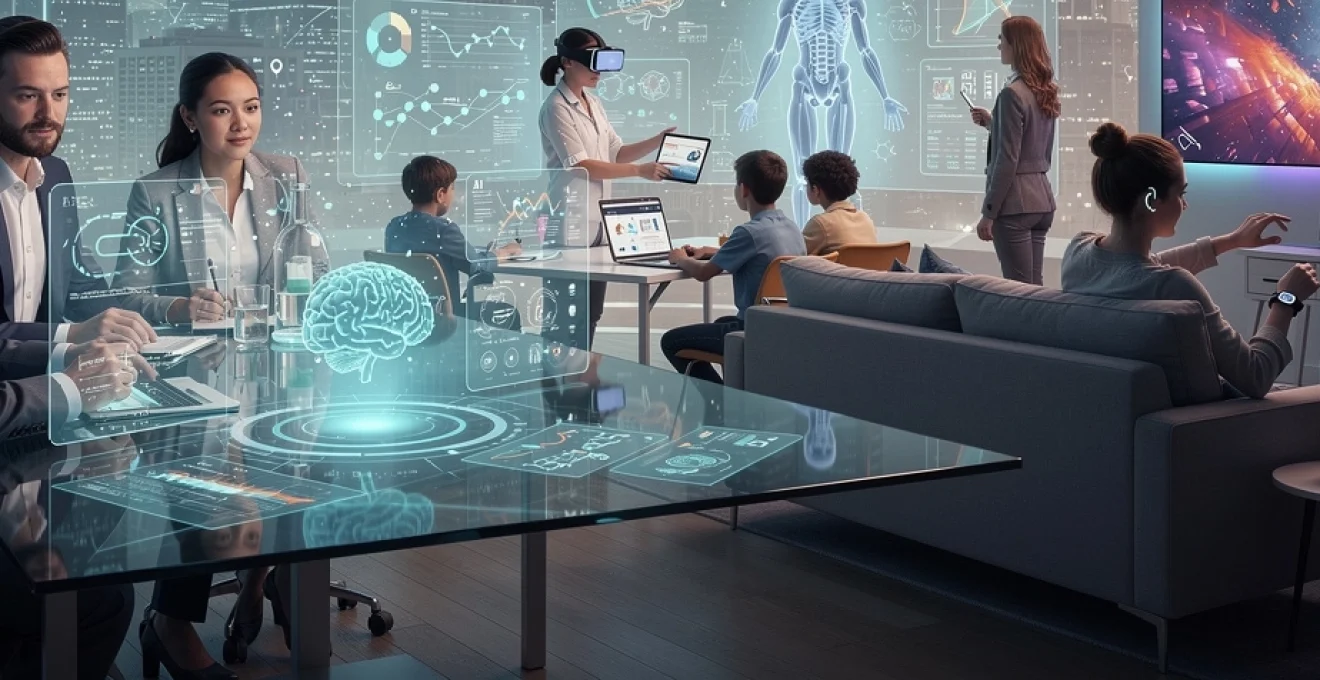
# How New Technologies Influence Business, Education, and Leisure
The contemporary landscape of human activity is undergoing a profound transformation driven by technological innovation. From the boardrooms of multinational corporations to university lecture halls and entertainment venues, emerging technologies are reshaping how we work, learn, and spend our leisure time. This transformation isn’t merely about adopting new tools; it represents a fundamental shift in operational paradigms, pedagogical approaches, and consumer experiences. The integration of artificial intelligence, cloud infrastructure, blockchain protocols, and immersive reality technologies has created an ecosystem where efficiency, personalization, and engagement reach unprecedented levels. Understanding these technological influences provides critical insights into the future trajectory of human enterprise across all sectors of society.
Artificial intelligence and machine learning integration in enterprise resource planning systems
Artificial intelligence has transcended its experimental phase to become a cornerstone of modern business operations. The integration of AI and machine learning into enterprise resource planning systems represents one of the most significant technological shifts in corporate infrastructure. These intelligent systems now process vast datasets, identify patterns invisible to human analysts, and generate actionable insights that drive strategic decision-making across organizations of all sizes.
The transformation extends beyond simple automation. Modern AI systems learn from historical data, adapt to changing market conditions, and continuously refine their predictive capabilities. This evolutionary approach to business intelligence fundamentally alters how companies forecast demand, manage inventory, and allocate resources. When you consider that traditional ERP systems required manual configuration and constant human oversight, the autonomous learning capabilities of AI-enhanced platforms represent a quantum leap in operational efficiency.
Predictive analytics through IBM watson and salesforce einstein
Predictive analytics platforms have revolutionized how businesses anticipate customer behaviour and market trends. IBM Watson and Salesforce Einstein exemplify the sophisticated application of machine learning algorithms in commercial environments. These platforms analyze millions of data points across customer interactions, purchasing patterns, and market indicators to generate forecasts with remarkable accuracy.
Watson’s natural language processing capabilities enable it to interpret unstructured data from customer communications, social media interactions, and industry publications. This comprehensive analysis provides businesses with a holistic view of market sentiment and emerging trends. Similarly, Einstein integrates directly into Salesforce’s CRM ecosystem, automatically scoring leads, predicting deal closure probabilities, and recommending optimal engagement strategies for sales teams. The predictive power of these systems has transformed sales from an art into a data-driven science.
Robotic process automation deployment in supply chain management
Robotic process automation has emerged as a game-changing technology in supply chain optimization. RPA software robots execute repetitive tasks such as data entry, invoice processing, and inventory tracking with perfect consistency and speed. Unlike human workers who require breaks and may introduce errors during monotonous tasks, RPA bots operate continuously with precision.
The deployment of RPA in supply chain management extends to complex processes such as supplier onboarding, compliance verification, and quality control documentation. These automated workflows reduce processing times from days to minutes whilst eliminating the human error factor that previously caused costly delays. Modern supply chains incorporate RPA alongside IoT sensors and AI analytics to create self-optimizing logistics networks that respond dynamically to disruptions, weather patterns, and demand fluctuations.
Natural language processing for customer relationship management platforms
Natural language processing has fundamentally transformed customer relationship management by enabling machines to understand, interpret, and respond to human communication with increasing sophistication. NLP-powered chatbots now handle thousands of simultaneous customer enquiries, providing instant responses whilst learning from each interaction to improve future performance.
Beyond basic chatbot functionality, advanced NLP systems analyze customer sentiment across communication channels, identifying dissatisfaction patterns before they escalate into churn. These systems parse email communications, social media mentions, and support tickets to provide customer service teams with comprehensive context for each interaction. The technology also powers voice analytics platforms that evaluate sales calls in real-time, providing representatives with conversational guidance and identifying training opportunities. This intelligent automation allows human staff to focus on complex problem-solving whilst routine enquiries receive immediate, accurate responses.
Ai-driven decision intelligence in financial forecasting models
Financial forecasting has evolved from spreadsheet projections to sophisticated AI models that incorporate hundreds of variables simultaneously. Decision intelligence platforms combine machine learning algorithms with domain expertise to generate financial
intelligence that reflects the nuanced judgement of experienced analysts.
These AI-driven financial forecasting models incorporate real-time data from markets, supply chains, and macroeconomic indicators, allowing organisations to simulate multiple scenarios in seconds. Instead of relying on static annual budgets, enterprises can now run continuous rolling forecasts that adjust as conditions change. This shift from retrospective analysis to proactive scenario planning enables finance teams to identify risks earlier, test alternative strategies, and allocate capital more effectively.
Moreover, decision intelligence platforms increasingly integrate with ERP, CRM, and HR systems to provide a unified view of financial health. By correlating sales pipelines, production capacity, and workforce dynamics with financial outcomes, AI helps leaders understand the cause-and-effect relationships underlying revenue and profitability. Of course, these systems do not eliminate the need for human oversight; rather, they enhance it by surfacing insights that would be impossible to identify manually, while leaving final judgement in the hands of experienced professionals.
Cloud computing architecture transforming remote workforce infrastructure
The rapid expansion of remote and hybrid work has elevated cloud computing from a convenient option to a strategic necessity. Cloud-based infrastructure enables organisations to provide secure, scalable access to applications and data regardless of employee location. This has profound implications for how companies design their digital workplaces, structure teams, and maintain business continuity in the face of disruption.
Cloud-native architectures support distributed teams by decoupling work from specific physical offices or devices. Employees can collaborate in real time, access shared resources, and participate in complex workflows via web-based interfaces and mobile apps. At the same time, IT leaders must carefully orchestrate cloud migration strategies, security models, and compliance controls to ensure that this flexibility does not come at the expense of data protection or operational stability.
Microsoft azure and aws migration strategies for distributed teams
For many organisations, moving workloads to Microsoft Azure or Amazon Web Services represents the backbone of their remote workforce strategy. Rather than attempting a single “big bang” migration, successful enterprises typically adopt a phased, workload-based approach. Critical collaboration tools, identity management systems, and line-of-business applications are prioritised to ensure that distributed teams can function effectively from day one.
Lift-and-shift migrations may provide a quick path to the cloud, but they rarely unlock the full benefits of cloud-native design. Forward-looking organisations refactor key applications to leverage managed databases, serverless computing, and auto-scaling services that adapt to fluctuating demand from remote users. This not only improves performance for globally distributed teams but also optimises costs by aligning resource consumption with actual usage.
Equally important is the governance layer that surrounds Azure and AWS deployments. Clear policies around access control, data residency, and backup are essential when employees may be connecting from multiple jurisdictions. By combining technical migration strategies with robust governance frameworks, businesses can create a resilient cloud environment that supports remote work without sacrificing control.
Software-as-a-service solutions: slack, asana, and monday.com implementation
While infrastructure clouds provide the foundation, Software-as-a-Service platforms such as Slack, Asana, and Monday.com have become the everyday tools through which remote teams coordinate their efforts. These SaaS solutions centralise communication, task management, and project tracking, reducing reliance on fragmented email chains and ad hoc spreadsheets. For many employees, these platforms are the new “digital office” where work actually happens.
Implementing collaboration tools effectively requires more than simply provisioning licenses. Organisations need to design clear channel structures, naming conventions, and workflow templates so that information is easy to find and responsibilities are transparent. For example, dedicated channels for projects, incident management, and leadership updates can help teams avoid information overload while ensuring that critical updates reach the right people at the right time.
Integration is another crucial consideration. When Slack or Asana connects directly to CRM systems, code repositories, or customer support platforms, teams gain real-time visibility into work across departments. This creates a shared source of truth that reduces duplication, accelerates decision-making, and supports asynchronous collaboration across time zones. The result is a remote work environment where coordination feels seamless rather than fragmented.
Zero trust security frameworks in cloud-based business operations
As organisations shift more operations to the cloud, traditional perimeter-based security models become insufficient. The rise of remote work, personal devices, and third-party integrations has given way to the “zero trust” security paradigm. In a zero trust framework, no user, device, or application is automatically trusted—even if it is inside the corporate network. Every access request is continuously verified based on identity, context, and risk.
Practically, zero trust involves implementing strong identity and access management, multi-factor authentication, micro-segmentation of networks, and continuous monitoring of user behaviour. Instead of granting broad, persistent access, systems provide just-in-time, least-privilege permissions tailored to specific tasks. If a user’s behaviour deviates from established patterns—such as accessing sensitive data from an unusual location—automated controls can trigger additional verification or restrict access.
This approach is particularly important for cloud-based business operations where employees log in from diverse locations and devices. While zero trust can initially seem complex, it ultimately simplifies security by applying consistent principles across on-premises and cloud environments. For business leaders, adopting zero trust is less about distrust and more about building a resilient, adaptive security posture that aligns with modern working patterns.
Hybrid cloud environments for data sovereignty compliance
Many organisations operate in heavily regulated industries or across multiple jurisdictions with strict data sovereignty requirements. In these contexts, a pure public cloud strategy may not be feasible. Hybrid cloud environments—combining on-premises infrastructure with public and private clouds—offer a flexible way to balance scalability with regulatory compliance.
In a hybrid model, sensitive data may remain in local data centres or private clouds located within specific countries, while less sensitive workloads run on global public cloud platforms. Data classification frameworks help determine which information can leave a jurisdiction and which must remain local. Modern integration tools and APIs then ensure that applications can securely access and process data across these boundaries without exposing it unnecessarily.
Designing hybrid cloud architectures demands careful planning around latency, interoperability, and governance. Yet when executed well, they allow organisations to respect data protection laws while still leveraging the innovation and cost efficiencies of major cloud providers. For globally distributed businesses, this balance is essential to maintaining both competitive advantage and legal compliance.
Blockchain technology applications in supply chain transparency and smart contracts
Blockchain technology has moved beyond its origins in cryptocurrencies to become a powerful tool for enhancing transparency and trust in business ecosystems. In supply chain management, distributed ledgers provide an immutable record of transactions and asset movements, allowing stakeholders to verify the provenance, authenticity, and handling conditions of goods. This is particularly valuable in sectors such as food, pharmaceuticals, and luxury goods, where traceability is both a regulatory requirement and a competitive differentiator.
Smart contracts—self-executing agreements encoded on a blockchain—automate the enforcement of business terms between parties. For example, a smart contract can release payment automatically when sensors confirm that a shipment has arrived on time and within specified temperature ranges. By embedding business logic directly into the transaction layer, organisations reduce administrative overhead, minimise disputes, and accelerate cash flow.
However, effective blockchain adoption requires more than technical deployment. Participants must agree on data standards, governance rules, and dispute resolution mechanisms. Interoperability between different blockchain networks and legacy systems also remains a challenge. As with any emerging technology, pilot projects that focus on specific, high-value use cases—such as tracking high-risk components or automating cross-border trade documentation—tend to deliver the most tangible benefits in the short term.
Extended reality technologies reshaping educational pedagogy and learning outcomes
Extended Reality (XR)—an umbrella term covering virtual reality (VR), augmented reality (AR), and mixed reality (MR)—is redefining how educators design learning experiences. Instead of relying solely on textbooks and lectures, instructors can immerse students in interactive environments that replicate real-world scenarios or visualise abstract concepts. This shift has significant implications for learner engagement, knowledge retention, and the development of practical skills.
XR technologies bridge the gap between theory and practice by allowing students to experiment in safe, controlled environments. For example, a chemistry student can conduct virtual experiments without the risk of hazardous spills, while a business student can participate in simulated negotiations with AI-driven avatars. As hardware costs fall and software platforms mature, these immersive tools are moving from experimental pilots to mainstream components of digital pedagogy.
Virtual reality laboratories using oculus quest and htc vive in stem education
Virtual reality laboratories are particularly impactful in STEM education, where hands-on experimentation is essential but often constrained by cost, safety, or physical infrastructure. Using headsets such as Oculus Quest and HTC Vive, students can enter fully simulated labs where they manipulate virtual equipment, observe microscopic phenomena, or explore complex engineering systems at scale.
These VR labs enable universities and schools to provide consistent, high-quality practical experiences regardless of their physical resources. A rural school without advanced lab facilities can still offer students the opportunity to practise physics experiments or explore 3D models of molecular structures. The immersive nature of VR also supports embodied learning, where students remember concepts better because they have “experienced” them rather than merely reading about them.
Of course, effective implementation requires careful instructional design. Educators must align VR activities with learning objectives, provide scaffolding to prevent cognitive overload, and ensure accessibility for students who may experience motion sickness or have visual impairments. When thoughtfully integrated, however, VR laboratories can transform abstract STEM theory into memorable, experiential learning.
Augmented reality textbooks through apple arkit and google arcore
While VR transports learners to entirely virtual worlds, augmented reality overlays digital content onto the physical environment. Using AR frameworks like Apple ARKit and Google ARCore, publishers and educators are beginning to create “living textbooks” where static images come to life as interactive 3D models, animations, or simulations viewed through smartphones or tablets.
Imagine pointing your device at a diagram of the human heart and seeing it beat in three dimensions, with labels that you can tap to explore blood flow or common diseases. Or consider a geography textbook where maps transform into dynamic topographical models that show climate patterns over time. These AR-enhanced resources cater to diverse learning styles by combining visual, auditory, and kinesthetic elements.
From a pedagogical standpoint, AR textbooks encourage active learning. Students are not just reading information; they are exploring, manipulating, and questioning it. The challenge for institutions lies in developing or curating high-quality AR content and ensuring that classroom infrastructure—devices, bandwidth, and teacher training—can support its consistent use.
Mixed reality simulations in medical training with microsoft hololens
Mixed reality, as enabled by devices like Microsoft HoloLens, blends digital objects with the real world in ways that preserve spatial awareness. In medical education, this capability is particularly valuable. Trainees can view holographic anatomical models projected onto physical mannequins, practise procedures with real instruments, and receive real-time guidance from instructors who annotate the shared MR environment.
These simulations allow medical students and residents to rehearse complex surgeries or emergency responses repeatedly, without risking patient safety. Performance data—such as precision of instrument placement or time taken to complete a procedure—can be captured and analysed to provide targeted feedback. This data-driven approach to skills development supports more objective assessment than traditional observation alone.
Mixed reality also facilitates remote collaboration. A specialist in another city can join a training session virtually, seeing what the local learner sees and adding holographic cues. While MR hardware remains relatively expensive, institutions that adopt it strategically for high-stakes training scenarios often find that improved competency and reduced error rates justify the investment.
Gamification platforms: kahoot, classcraft, and duolingo methodologies
Beyond immersive headsets, gamification platforms such as Kahoot, Classcraft, and Duolingo demonstrate how game design principles can enhance motivation and learning outcomes. By integrating points, leaderboards, narratives, and immediate feedback into educational activities, these tools tap into learners’ innate desire for achievement and progress.
Instructors can use Kahoot to transform formative assessments into fast-paced quizzes that energise a lecture hall or virtual classroom. Classcraft adds role-playing elements to classroom management, rewarding positive behaviours and collaboration. Duolingo’s language-learning methodology, with its bite-sized lessons and streak mechanics, illustrates how consistent engagement over time can lead to substantial skill development.
The key to effective gamification is alignment with meaningful learning goals. Superficial rewards may generate short-term excitement but little lasting understanding. When used thoughtfully, however, gamified experiences can encourage persistence, support spaced repetition, and make difficult subjects feel more approachable—especially for learners who might otherwise disengage.
Learning management systems evolution: canvas lms, moodle, and blackboard analytics
Learning Management Systems (LMS) such as Canvas, Moodle, and Blackboard have long provided the digital backbone for online and blended education. In recent years, these platforms have evolved from simple content repositories into sophisticated ecosystems that support data-driven teaching, personalised learning paths, and institutional analytics. This evolution is reshaping how educators design courses and how administrators evaluate educational effectiveness.
Modern LMS solutions integrate discussion forums, assessment tools, plagiarism detection, and video conferencing into a single interface. More importantly, they collect granular data on learner behaviour: which resources students access, how long they spend on tasks, and where they struggle. Analytics dashboards translate this raw data into actionable insights, highlighting at-risk students, common misconceptions, or content that may require redesign.
For instructors, LMS analytics provide an early-warning system that supports timely interventions. Instead of discovering performance issues only at exam time, educators can see in-week engagement patterns and adjust accordingly. For institutions, aggregated data helps evaluate programme outcomes, inform accreditation processes, and guide investments in curriculum development or support services. As privacy and ethical considerations come to the forefront, successful institutions are those that leverage LMS data transparently and responsibly, with a clear focus on enhancing student success rather than surveillance.
Internet of things ecosystems in smart entertainment venues and interactive media
The Internet of Things (IoT) is not limited to factories and smart homes; it is also transforming how we experience entertainment and leisure. Sensors, connected devices, and real-time analytics are turning stadiums, cinemas, and gaming spaces into responsive environments that adapt to audience behaviour. At the same time, connected media platforms use IoT data to personalise content, optimise operations, and create entirely new forms of interactive experiences.
In smart entertainment venues, everything from lighting and sound systems to concession stands and access control can be monitored and controlled centrally. This not only improves energy efficiency and crowd management but also opens up creative possibilities—such as synchronising light shows with live performances or tailoring digital signage to specific audience segments. For consumers, the line between physical and digital leisure experiences continues to blur.
Connected gaming consoles: playstation network and xbox live cloud infrastructure
Connected gaming consoles like those on PlayStation Network and Xbox Live exemplify how cloud infrastructure underpins modern leisure. Games are no longer isolated, offline experiences; they are persistent online worlds that players access, update, and share across devices. Cloud-based matchmaking services, content delivery networks, and social features allow millions of players to interact in real time, regardless of location.
From a technical perspective, these networks rely on distributed servers and edge computing to minimise latency and ensure smooth gameplay. Updates and new content can be pushed to consoles seamlessly, extending the life of titles and enabling “games as a service” business models. For players, this means that the game they buy on launch day is often quite different—richer, more balanced, more social—six months later.
The social dimension of connected consoles is equally significant. Friends lists, voice chat, shared achievements, and community events have turned gaming into a primary mode of social interaction for many people. As we consider how new technologies influence leisure, these platforms illustrate how cloud computing and networking have transformed solitary pastimes into highly connected, communal experiences.
Streaming platform algorithms: netflix, spotify, and youtube recommendation engines
Streaming platforms such as Netflix, Spotify, and YouTube use sophisticated recommendation algorithms to shape our leisure choices. These systems analyse vast amounts of behavioural data—what you watch or listen to, when you pause, what you skip—to predict which content you are most likely to enjoy next. In effect, algorithms have become personal curators of our entertainment diets.
Collaborative filtering, content-based analysis, and deep learning models work together to create highly personalised feeds. When done well, this reduces decision fatigue and helps users discover niche content that would never surface through traditional broadcast channels. From the perspective of content creators, recommendation engines can turn a small upload into a global hit if the algorithm detects strong engagement signals.
Yet there are also cultural implications. If algorithms primarily reinforce existing preferences, they risk creating “filter bubbles” where we encounter fewer diverse perspectives or genres. For businesses, the challenge lies in balancing relevance with serendipity—designing recommendation systems that delight users while still exposing them to new ideas. As consumers, being aware of how these engines work allows us to make more conscious choices about how we spend our leisure time.
Wearable technology integration in fitness and wellness applications
Wearable devices such as smartwatches, fitness bands, and connected earphones have turned personal health and fitness into data-rich leisure activities. Sensors track steps, heart rate, sleep patterns, and even blood oxygen levels, feeding this information into wellness applications that provide insights, goals, and personalised coaching. What was once an occasional workout has become an ongoing quantified journey.
These devices leverage IoT connectivity to sync data to cloud platforms where advanced analytics and AI interpret patterns over time. Users receive nudges to move more, reminders to hydrate, or tailored training plans based on recovery metrics. Some platforms even incorporate social features and gamification—leaderboards, challenges, badges—to motivate consistent engagement. In this way, technology transforms solitary exercise into a connected, community-driven experience.
However, the integration of wearables into everyday life also raises questions about data privacy and the potential for over-optimisation. When every run, heartbeat, or hour of sleep is tracked, leisure can start to feel like another metric-driven task. The most balanced approach may be to treat these tools as supportive companions rather than strict supervisors—using data to inform healthier habits while preserving the simple joy of movement and rest.