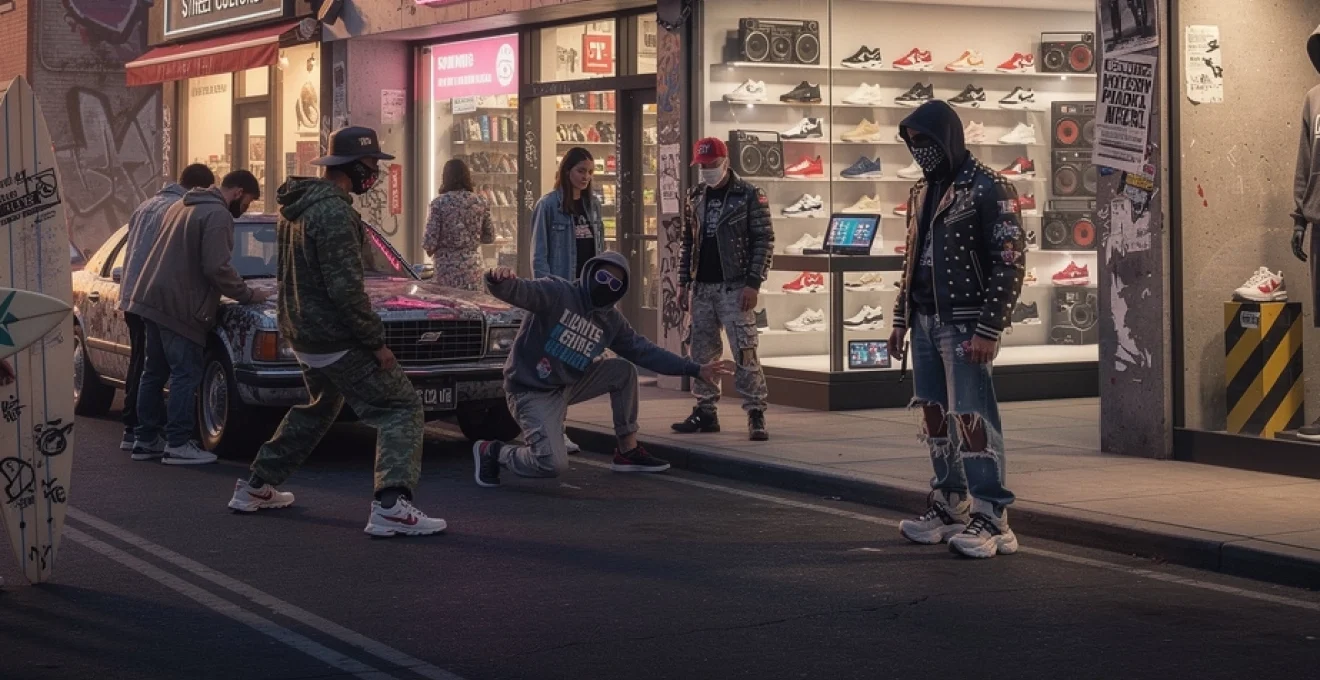
Streetwear has fundamentally transformed from its rebellious underground origins into a dominant force shaping contemporary fashion culture. What began as a grassroots movement born from skate parks and urban streets has evolved into a multi-billion-dollar industry that bridges the gap between high fashion and everyday wear. This cultural phenomenon represents more than mere clothing trends—it embodies a philosophy of self-expression, community building, and authentic storytelling that resonates with diverse global audiences. The convergence of traditional luxury houses with streetwear brands has redefined fashion hierarchies, creating new paradigms for how consumers interact with and perceive clothing.
Origins and cultural foundations of streetwear movement
The streetwear movement emerged from multiple cultural epicentres during the late 1970s and early 1980s, each contributing distinct aesthetic elements and philosophical approaches that would eventually coalesce into a unified global phenomenon. These foundational influences established the core principles of authenticity, rebellion, and community that continue to define streetwear culture today.
Californian surf and skate culture genesis in 1970s santa monica
California’s surf and skate culture provided streetwear with its initial blueprint for functional yet distinctive apparel. The practical needs of surfers and skateboarders demanded clothing that could withstand rigorous physical activity while maintaining comfort and mobility. This utilitarian approach to fashion design became a cornerstone of streetwear philosophy, prioritising performance and wearability over conventional aesthetic standards. The DIY ethos prevalent in these communities encouraged customisation and personalisation, laying the groundwork for streetwear’s emphasis on individual expression through clothing.
Shawn Stussy’s transition from crafting custom surfboards to creating apparel marked a pivotal moment in streetwear’s commercial evolution. His distinctive signature logo became one of the first examples of streetwear branding that transcended its subcultural origins to achieve broader recognition. The exclusivity model introduced through limited-edition varsity jackets for the “International Stussy Tribe” established the scarcity-driven marketing approach that would become synonymous with streetwear retail strategies.
Hip-hop underground scene influence from south bronx communities
The South Bronx hip-hop scene of the late 1970s contributed streetwear’s bold graphic sensibilities and oversized silhouettes that challenged conventional fashion proportions. Artists and their communities developed a distinctive visual language through clothing that reflected the raw energy and creative innovation of hip-hop culture. This aesthetic approach emphasised bold statements, logo prominence, and the strategic layering of different garments to create unique looks that stood apart from mainstream fashion trends.
The relationship between athletic brands and hip-hop culture proved instrumental in streetwear’s development, with groups like Run-D.M.C. establishing the template for music-fashion collaborations. Their endorsement of Adidas sneakers demonstrated how streetwear could bridge performance functionality with cultural significance, creating products that served both practical and symbolic purposes within community contexts.
Japanese Ura-Harajuku subculture integration and aesthetic Cross-Pollination
Japan’s Ura-Harajuku district contributed a uniquely refined approach to streetwear design that balanced Western influences with distinctly Japanese aesthetic sensibilities. This cultural cross-pollination introduced new levels of craftsmanship and attention to detail that elevated streetwear beyond its purely functional origins. Japanese designers brought innovative approaches to colour, pattern, and silhouette that expanded streetwear’s visual vocabulary while maintaining its subcultural authenticity.
The Japanese interpretation of streetwear emphasised quality construction and innovative design techniques that would influence global streetwear production standards. This attention to craftsmanship helped establish streetwear as a legitimate fashion category worthy of serious design consideration and premium pricing structures.
Punk rock DIY ethos and Anti-Establishment fashion philosophy
Punk rock culture infused streetwear with its anti-establishment philosophy and DIY aesthetic approach that challenged traditional fashion industry structures. The punk movement’s emphasis on self-modification, customisation, and rejection of mainstream commercial fashion provided streetwear with its rebellious spirit and commitment to authenticity. This influence encouraged streetwear brands to maintain independence from conventional fashion systems while developing alternative distribution networks and community-based marketing approaches.
The punk aesthetic contributed streetw
punk rock its visual codes of ripped denim, safety pins, band patches, and distressed graphics. These elements translated directly into the streetwear aesthetic through customised jackets, hand-screen-printed T-shirts, and reworked thrift-store garments. By treating clothing as a canvas for protest and personal messaging, punk reinforced the idea that style could function as a visible manifesto—an idea that remains central to contemporary streetwear in both physical and digital spaces.
Pioneering brands and design innovation frameworks
As streetwear evolved from loosely connected subcultures into a recognisable global movement, a handful of pioneering brands became laboratories for design innovation and new business models. These labels did more than sell clothes; they experimented with scarcity, storytelling, and community-driven marketing that reshaped how we understand fashion consumption today. Examining their strategies helps us understand why the evolution of streetwear in contemporary fashion culture has been so disruptive and enduring.
Stüssy’s tribal typography and shawn stussy’s signature aesthetic
Stüssy is often cited as the first modern streetwear brand because it codified many of the movement’s visual and commercial rules. Shawn Stussy’s graffiti-inspired signature—originally scrawled on surfboards—became a powerful logo that functioned almost like a band name for an emerging tribe of global youth. His use of “tribal” typography and irreverent graphics created a visual language that felt both exclusive and accessible, speaking directly to surfers, skaters, DJs, and club kids who rejected traditional fashion labels.
The brand’s early strategy of small production runs, selective distribution, and insider references laid the groundwork for contemporary drop culture. Rather than chasing mass-market visibility, Stüssy cultivated a network of like-minded retailers and collaborators, turning its customers into members of an “International Stüssy Tribe.” This framework—part social club, part fashion label—demonstrated how streetwear could create emotional loyalty and cultural capital long before social media amplified these dynamics.
Supreme’s drop culture methodology and james jebbia’s retail strategy
Supreme refined and scaled the scarcity model, transforming it into a repeatable retail system that many brands now attempt to emulate. James Jebbia’s decision to release new product in limited quantities on a weekly basis—known as “drops”—created a ritualised shopping experience that encouraged queues, community gathering, and a thriving resale economy. The unpredictability of which items would appear each week turned every visit into a discovery, making the Supreme store itself a cultural destination rather than a simple retail space.
This drop culture methodology aligned perfectly with the emerging hype-driven internet era. As forums, blogs, and later platforms like Instagram and TikTok amplified each release, Supreme’s products became symbols of both taste and access. Jebbia’s strategy blurred the line between retail and event marketing: each drop functioned like a mini concert or film premiere, generating storytelling, reviews, and debate. For brands studying how to grow a streetwear label today, Supreme’s approach is a masterclass in orchestrating anticipation and managing controlled scarcity.
A bathing ape’s camouflage pattern engineering and nigo’s design philosophy
A Bathing Ape (BAPE), founded by Nigo in early 1990s Tokyo, brought a distinctly Japanese sensibility to streetwear through meticulous design and playful pop culture references. The brand’s iconic BAPE camo—engineered from layered ape heads and abstract shapes—demonstrated how pattern design could become as recognisable as a logo. By applying this custom camouflage to everything from hoodies and sneakers to furniture and lifestyle products, BAPE created an immersive universe that felt more like a fictional world than a simple clothing line.
Nigo’s design philosophy fused Americana, hip-hop, and otaku culture with an almost obsessive attention to detail. Limited in-store releases, hidden boutiques, and opaque distribution strategies made BAPE products feel like rare collectibles. This approach not only boosted perceived value but also turned the act of finding BAPE items into a cultural scavenger hunt. In many ways, BAPE anticipated today’s obsession with world-building in fashion, where brands craft narratives and ecosystems rather than isolated products.
Off-white’s deconstructionist approach and virgil abloh’s quotation marks technique
Off-White, founded by Virgil Abloh in 2013, represented a new chapter in the evolution of streetwear in contemporary fashion culture by explicitly bridging luxury and street style. Abloh’s deconstructionist approach—visible in exposed seams, industrial belts, and recontextualised workwear—treated familiar garments as design case studies. His now-famous quotation marks, applied to words like “SHOELACES” or “LOGO,” functioned as meta-commentary on branding, authenticity, and consumer desire. They invited the wearer to question what makes an object “luxury” or “street.”
Off-White’s collaboration-heavy strategy, especially with Nike’s “The Ten” sneaker project, showcased how conceptual design could live comfortably inside mainstream product categories. Abloh described his work as operating in “the grey area between black and white,” a metaphor for the tension between high fashion and streetwear. For many younger consumers, Off-White legitimised the idea that hoodies, sneakers, and graphic tees could carry the same cultural and monetary value as traditional tailoring and couture.
Fear of god’s minimalist silhouettes and jerry lorenzo’s luxury streetwear integration
Fear of God, led by Jerry Lorenzo, pushed streetwear further into the luxury arena through elongated silhouettes, premium fabrics, and a muted, almost spiritual colour palette. Instead of relying heavily on logos, Lorenzo focused on proportion play—oversized hoodies, cropped trousers, extended T-shirts—that subtly referenced both sportswear and religious vestments. This minimalist, layered look resonated with a generation seeking elevated essentials that still aligned with casual, everyday streetwear styling.
Lorenzo’s work with Fear of God and its ESSENTIALS diffusion line also demonstrated a two-tiered strategy that many modern streetwear brands now follow. High-end mainline collections establish prestige and design credibility, while more accessible basics reach a wider audience without diluting the core aesthetic. By integrating luxury construction methods with street-ready comfort, Fear of God helped solidify “luxury streetwear” as a legitimate category rather than a passing trend.
High fashion convergence and luxury maison collaboration models
The merging of streetwear with high fashion transformed both industries, forcing traditional maisons to rethink their product lines, marketing strategies, and even their definitions of luxury. Collaborations became the primary mechanism for this convergence, allowing heritage brands to tap into youth culture while giving streetwear labels access to craftsmanship and global reach. The resulting partnerships changed not only what we see on the runway, but also how fashion is produced, priced, and perceived.
Louis vuitton x supreme partnership economics and brand valuation impact
The 2017 Louis Vuitton x Supreme collaboration is widely regarded as a watershed moment in modern fashion. For the first time, a 19th-century luxury luggage house formally partnered with a 1990s skate shop that once received a cease-and-desist letter for riffing on its monogram. The resulting collection—featuring red monogram trunks, logo-heavy denim, and co-branded accessories—sold out instantly and reportedly generated queues so large that some pop-up locations had to be shut down for safety reasons.
Economically, the partnership signalled to the market that youth-driven streetwear demand could materially affect a maison’s brand valuation. Analysts linked the buzz around the collaboration to increased visibility for Louis Vuitton among Gen Z and millennial consumers, reinforcing its position as a culturally relevant luxury leader. For Supreme, the collaboration effectively canonised the brand: what began as anti-fashion streetwear was now validated at the highest echelon of the fashion hierarchy. This recalibrated expectations across the industry, encouraging other luxury houses to pursue similar collaborations.
Balenciaga’s triple S sneaker architecture and demna gvasalia’s oversized proportions
Under creative director Demna Gvasalia, Balenciaga became a symbol of how luxury fashion could absorb streetwear sensibilities without traditional collaborations. The Triple S sneaker, launched in 2017, became an instant icon of “ugly” or maximalist sneaker design with its stacked soles, exaggerated volume, and overt branding. Its architecture drew from running, basketball, and track shoe elements, merging them into a single, hyperbolic statement piece that felt more like a sculpture than a conventional sneaker.
Demna’s broader aesthetic—oversized hoodies, logo-emblazoned scarves, and normcore-inspired outerwear—brought everyday streetwear shapes to the couture runway. By amplifying proportions and recontextualising banal items like branded shopping bags or high-visibility jackets, Balenciaga challenged conventional ideas of elegance. The success of these collections illustrated that consumers were ready to pay luxury prices for pieces rooted in streetwear silhouettes, provided they carried strong conceptual narratives and high production quality.
Vetements’ ironic commercialism and deconstructed garment construction
Vetements, the collective co-founded by Demna Gvasalia before his tenure at Balenciaga, played a crucial role in normalising streetwear aesthetics within high fashion. The brand’s early collections deconstructed everyday garments—DHL-logo T-shirts, oversized hoodies, repurposed jeans—and presented them on Paris runways with tongue-in-cheek irony. By elevating mundane or corporate imagery to luxury status, Vetements questioned the very mechanisms by which fashion assigns value.
This ironic commercialism resonated with a digital-native audience fluent in memes and remix culture. Vetements’ approach showed that high fashion could comment on mass consumption while simultaneously participating in it, much like streetwear had long done through bootlegs and parodies. Technically, the label’s experimental pattern cutting and unconventional styling—extra-long sleeves, asymmetric hems, layered shirting—pushed streetwear toward more avant-garde territory, expanding what was possible within the genre.
Dior homme’s kim jones era and streetwear aesthetic legitimisation
When Kim Jones took over menswear at Dior (now Dior Men), he brought decades of experience in blending luxury with street culture. His tenure has been marked by collaborations with artists and brands deeply rooted in streetwear and skate culture, including partnerships with Shawn Stussy and the highly coveted Dior x Air Jordan 1 sneaker. These projects not only sold out but also generated substantial media coverage and secondary market premiums, underscoring the economic power of streetwear within a luxury context.
Jones’s work at Dior helped legitimise the streetwear aesthetic in the eyes of more conservative fashion consumers. Tailored suits walked the runway alongside logo saddlebags, technical outerwear, and sneakers, presenting a cohesive vision where heritage and youth culture coexist. For many observers, this era confirmed that the evolution of streetwear in contemporary fashion culture was not a fad but a structural shift in how menswear, in particular, would be designed and worn going forward.
Digital commerce infrastructure and hypebeast culture mechanics
The rise of digital platforms has amplified streetwear’s reach, turning niche drops into global events and local scenes into international communities. E-commerce, social media, and resale marketplaces collectively form the infrastructure that supports modern hypebeast culture. Understanding how these systems interact helps explain why certain hoodies or sneakers can sell out in seconds and reappear minutes later on secondary platforms at several times the original price.
At the core of hypebeast culture is a feedback loop between scarcity, visibility, and perceived status. Brands release limited quantities online or in select stores; influencers and early adopters showcase their pickups on platforms like Instagram, TikTok, and Discord; and resale sites quantify demand through rapidly escalating prices. For younger consumers, owning a coveted piece becomes a way to signal knowledge, access, and participation in a broader cultural conversation. In effect, digital channels have turned streetwear into a live, gamified marketplace where timing, information, and community networks are key advantages.
From a practical standpoint, brands entering the streetwear space need to design their digital commerce strategies as carefully as their garments. Queue systems, raffle-based releases, and region-specific drops can help manage bot activity and create fairer access. At the same time, transparent communication about restocks, collaborations, and sustainability initiatives builds trust with a consumer base that is increasingly informed and vocal. The most successful labels treat their online presence less as a shop window and more as an evolving community hub.
Sneaker culture symbiosis and athletic brand positioning strategies
Sneaker culture sits at the heart of the evolution of streetwear in contemporary fashion culture, acting as both an entry point for new enthusiasts and a sophisticated collector’s arena for seasoned fans. Athletic brands like Nike, Adidas, New Balance, and Puma have repositioned themselves from performance-focused companies to lifestyle powerhouses by strategically embracing streetwear collaborations and limited-edition releases. Sneakers function simultaneously as functional products, nostalgic artefacts, and financial assets in a thriving resale ecosystem.
Collaborations with designers, musicians, and artists—such as Nike x Off-White, Adidas x Yeezy, or New Balance partnerships with Aimé Leon Dore—illustrate how sneakers can tell complex cultural stories. Each release is carefully framed with campaign imagery, behind-the-scenes content, and historical references that deepen emotional engagement. For wearers, choosing a particular pair becomes akin to selecting a record from a collection: it signals taste, era, and affiliation in a single gesture.
From a brand strategy perspective, sneakers allow athletic companies to segment their audience without fragmenting their identity. General-release models maintain broad accessibility, while limited collaborations drive hype and halo effects across the catalogue. However, the balance is delicate. Oversaturating the market with too many collaborations can erode exclusivity, while ignoring community feedback can quickly damage credibility. Brands that succeed tend to treat sneakerheads and streetwear enthusiasts as partners in dialogue rather than passive consumers, responding to trends visible in local scenes as well as in global data.
Contemporary market dynamics and future fashion technology integration
Today’s streetwear market operates at the intersection of culture, technology, and shifting consumer values. On one hand, demand for exclusive drops and logo-heavy pieces remains strong; on the other, there is growing scrutiny around sustainability, ethical production, and overconsumption. Brands navigating this landscape must reconcile hype-driven release strategies with longer-term commitments to environmental and social responsibility. This tension is reshaping how streetwear is designed, marketed, and even experienced.
Technological innovation is central to the next phase in the evolution of streetwear in contemporary fashion culture. Smart fabrics, NFC chips embedded in garments, and augmented reality experiences offer new ways to merge physical products with digital layers of meaning. Imagine scanning a hoodie to unlock behind-the-scenes content, proof of authenticity, or access to a members-only community—this is no longer speculative, but increasingly common. Such features not only combat counterfeiting but also extend the lifecycle of a product by adding narrative and interactive value.
Digital fashion and virtual wearables are also expanding what streetwear can be. Gamers and metaverse users are purchasing skins and outfits from streetwear-inspired brands, often before physical versions exist. For designers, this opens a sandbox where silhouettes, colours, and concepts can be tested in virtual environments without the environmental cost of physical sampling. For consumers, it offers a way to experiment with identity in spaces where constraints like climate, budget, or dress codes do not apply.
Looking ahead, data-driven personalisation will likely transform how we access streetwear. Using purchase histories, browsing behaviour, and community input, brands can tailor recommendations, sizing, and even limited drops to specific micro-communities. For you as a consumer, this could mean more relevant releases and fewer impulse buys that end up unworn; for brands, it can translate into reduced waste and tighter production runs that better match real demand. The challenge will be to harness these tools while preserving the spontaneity and serendipity that make streetwear culture so compelling.
Ultimately, the future of streetwear will be defined by how effectively it integrates technology without losing its human core: the local scenes, DIY creativity, and shared experiences that birthed the movement. As brands experiment with virtual showrooms, sustainable materials, and AI-guided design, the most resonant pieces will still be those that tell authentic stories about the communities that wear them. In that sense, even as the tools change, the original spirit of streetwear—rebellious, collaborative, and deeply personal—remains its most valuable asset.