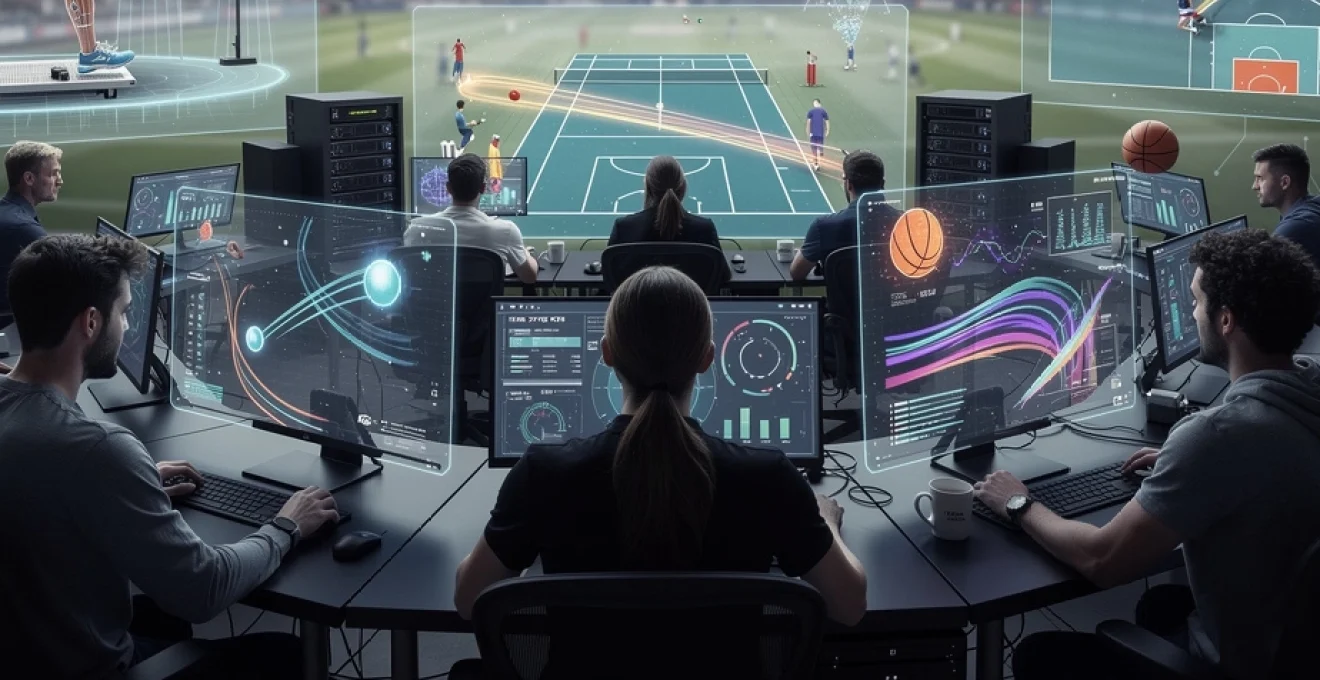
Performance analysis has undergone a revolutionary transformation over the past two decades, fundamentally reshaping how athletes, coaches, and sports organisations approach training, strategy, and competition. What once relied heavily on subjective observation and basic statistics has evolved into a sophisticated ecosystem of interconnected technologies that capture, process, and interpret vast amounts of data in real-time. This technological evolution represents more than just an upgrade to existing methods—it constitutes a paradigm shift that enables unprecedented insights into athletic performance, injury prevention, and strategic optimisation.
The integration of advanced technologies in performance analysis has democratised access to elite-level insights, allowing organisations at all levels to benefit from data-driven decision making. From grassroots clubs utilising affordable GPS tracking systems to professional franchises investing in comprehensive biomechanical laboratories, technology has become the great equaliser in sports performance enhancement. The convergence of artificial intelligence, computer vision, and sophisticated sensor technologies has created opportunities for analysis that were previously impossible, offering granular insights that can make the difference between victory and defeat.
Computer vision and machine learning applications in sports analytics
Computer vision technology has fundamentally altered the landscape of sports analytics by enabling automated collection and analysis of movement data that would be impossible to capture manually. Machine learning algorithms process thousands of hours of video footage, identifying patterns and extracting meaningful insights from complex visual information. These systems can track multiple players simultaneously, analyse tactical formations, and provide detailed breakdowns of performance metrics that were previously accessible only through labour-intensive manual coding processes.
The sophistication of modern computer vision systems extends beyond simple player tracking to encompass complex behavioural analysis. Advanced algorithms can recognise playing styles, predict player movements, and identify tactical patterns that may not be immediately apparent to human observers. Machine learning models continuously improve their accuracy through exposure to larger datasets, creating increasingly precise analytical capabilities that evolve alongside the sports they monitor.
Hawk-eye ball tracking systems in tennis and cricket
Hawk-Eye represents one of the most recognisable implementations of computer vision technology in sports, utilising multiple high-speed cameras positioned strategically around playing venues to track ball trajectories with millimetre precision. The system processes visual data at extraordinary speeds, creating three-dimensional reconstructions of ball flight paths that officials and broadcasters use to make critical decisions. In tennis, Hawk-Eye has become integral to the challenge system, allowing players to contest line calls with confidence in the technology’s accuracy.
Cricket applications of Hawk-Eye extend beyond simple trajectory tracking to include predictive analytics that estimate where deliveries would have travelled if uninterrupted by the batsman or wicket. The system’s ability to process complex physics calculations in real-time demonstrates the remarkable convergence of sports science and computational power. Ball tracking accuracy has reached levels exceeding 99.9%, making these systems indispensable tools for both officiating and strategic analysis.
Playertek GPS wearables for movement pattern analysis
GPS-enabled wearable devices have revolutionised the monitoring of athlete movement patterns during training and competition. PlayerTek systems utilise advanced satellite positioning technology combined with inertial sensors to provide comprehensive data on distance covered, speed variations, acceleration patterns, and directional changes. These compact devices, weighing less than 50 grams, collect data at frequencies up to 18.18 Hz, ensuring that even the most rapid movements are captured accurately.
The analytical capabilities of modern GPS wearables extend to sophisticated load monitoring that helps prevent injuries and optimise training schedules. Coaches can track cumulative fatigue indicators, identify when players are approaching dangerous workload thresholds, and adjust training intensities accordingly. Movement efficiency metrics derived from GPS data enable personalised training programmes that address individual weaknesses while building upon existing strengths.
OPTA sports data collection through automated video recognition
OPTA Sports has pioneered the use of automated video recognition technology to collect comprehensive match statistics across multiple sports disciplines. Their systems process live video feeds using sophisticated algorithms that can identify specific events, track player actions, and compile detailed performance databases in real-time. The technology recognises thousands of different event types, from simple passes and shots to complex tactical movements and set-piece variations.
The depth of data collection achieved through automated video recognition surpasses traditional manual methods by several orders of magnitude. OPTA’s systems can simultaneously track multiple data streams
related to possession, territory, and transitional phases of play, providing analysts with the raw material needed to build advanced performance models. For clubs and federations, this level of granularity supports everything from opposition scouting to individual player development plans. As automated video recognition improves through deep learning techniques, error rates continue to fall and the system’s ability to recognise complex, context-dependent events increases. The result is a richer, more reliable foundation for data-driven performance analysis that can be scaled across leagues and competitions worldwide.
Second spectrum NBA player tracking using optical recognition technology
Second Spectrum has become synonymous with next-generation player tracking in professional basketball, particularly within the NBA. Using an array of high-resolution cameras and advanced optical recognition algorithms, the system tracks every player and the ball at high frequency, generating a detailed spatial and temporal map of each possession. This data goes far beyond simple box score statistics, capturing off-ball movements, defensive rotations, screening actions, and spacing patterns that were previously invisible in traditional performance analysis.
Coaches and analysts leverage Second Spectrum’s visualisations and metrics to dissect offensive and defensive schemes in unprecedented detail. For example, they can quantify how effective a particular pick-and-roll combination is against different defensive coverages, or measure the impact of spacing on shot quality. Machine learning models built on top of this tracking data can estimate possession value in real time, predict outcomes of certain play types, and identify inefficiencies in team strategies. For organisations committed to performance optimisation, this type of computer vision-driven analysis becomes a powerful competitive advantage, informing both tactical adjustments and player development priorities.
Biomechanical motion capture technologies for athlete assessment
While computer vision and tracking systems excel at describing what happens on the field or court, biomechanical motion capture technologies focus on how it happens from a physiological and mechanical perspective. By precisely measuring joint angles, segment velocities, ground reaction forces, and muscle activation patterns, these systems offer a window into the internal mechanisms that underpin external performance. For high-performance environments, understanding these underlying mechanics is essential for improving technique, reducing injury risk, and tailoring strength and conditioning programmes to individual needs.
Modern biomechanical assessment blends multiple data sources—optical motion capture, force platforms, electromyography, and inertial sensors—into a unified model of an athlete’s movement. This integrated approach allows practitioners to assess everything from sprint mechanics and change-of-direction efficiency to throwing, kicking, or striking techniques. As processing power and machine learning methods advance, biomechanical analysis is moving from the lab to the field, enabling more frequent, ecologically valid assessments. In practical terms, this means you can embed elite-level motion analysis into regular training cycles rather than reserving it for occasional research-style evaluations.
Vicon camera systems for 3D kinematic analysis
Vicon camera systems have long been regarded as the gold standard in three-dimensional kinematic analysis for both clinical and sports performance settings. These multi-camera setups capture reflective markers placed on an athlete’s body at extremely high sampling rates, reconstructing precise 3D joint movements and segment trajectories. The resulting kinematic data allow practitioners to analyse technical execution frame by frame, identifying subtle inefficiencies or asymmetries that may be imperceptible to the naked eye.
In high-performance sport, Vicon-based motion capture is frequently used to refine complex skills such as sprinting, pitching, or golf swings. By comparing an athlete’s movement pattern to normative data or to their own historical benchmarks, coaches can quantify progress and evaluate the impact of technique changes with objective evidence. Increasingly, researchers and practitioners integrate Vicon outputs with musculoskeletal modelling software, enabling simulation of joint loads and tissue stresses under different movement strategies. This level of biomechanical insight helps inform decisions about load management, return-to-play protocols, and long-term performance development plans.
Force platform integration with AMTI AccuGait measurement
Force platforms, such as the AMTI AccuGait system, provide crucial information about how athletes interact with the ground—a key determinant of performance in almost every sport. These platforms measure ground reaction forces in three dimensions, capturing variables like peak force, rate of force development, and centre of pressure movement. When integrated with motion capture data, they allow practitioners to connect external forces with joint kinematics, building a more complete picture of movement quality and efficiency.
In practical performance analysis, AMTI AccuGait platforms are used to assess jump performance, balance, gait, and change-of-direction ability. For example, strength and conditioning coaches can monitor asymmetries between limbs during countermovement jumps or drop landings, identifying potential risk factors for lower-limb injuries. Over time, longitudinal data from force platforms help track adaptations to training programmes, ensuring that increases in gym-based strength translate into meaningful improvements in sport-specific power and stability. When combined with machine learning models, force-time signatures can even be used to classify fatigue states or detect early signs of overtraining.
Electromyography sensors for muscle activation monitoring
Electromyography (EMG) sensors provide an additional layer of detail by measuring the electrical activity associated with muscle contractions. Surface EMG systems, often integrated into wearable garments or adhesive electrodes, allow practitioners to monitor which muscles are active, when they fire, and how intensely they contribute to a given movement. This information is invaluable for understanding coordination patterns, identifying compensations, and optimising exercise selection for specific performance goals.
In a performance analysis context, EMG can help answer questions such as: Are the intended prime movers actually driving the movement, or are synergists and stabilisers overcompensating? During high-speed actions—like sprinting, cutting, or swinging—timing data from EMG reveals whether muscles are activating at the right moments to provide propulsion or joint stability. When combined with kinematic and kinetic data, EMG enables a truly multi-dimensional view of performance, linking technique, force production, and neuromuscular control. For practitioners, this means more targeted interventions, from technical coaching cues to tailored strength and rehabilitation strategies.
Inertial measurement units in catapult sports wearables
Inertial Measurement Units (IMUs) embedded within wearables such as Catapult Sports systems bridge the gap between laboratory-grade assessment and on-field practicality. These compact sensors typically combine accelerometers, gyroscopes, and magnetometers to measure linear acceleration, angular velocity, and orientation. When processed through advanced algorithms, IMU data can provide detailed insights into player load, impact forces, jump counts, and movement intensity during real-world training and competition.
For teams seeking to manage workload and reduce injury risk, Catapult’s IMU-enabled wearables offer a continuous stream of objective performance metrics. Coaches can monitor acute and chronic load ratios, detect spikes in high-intensity efforts, and tailor recovery protocols accordingly. Importantly, IMUs allow for sport-specific metrics—such as scrum impacts in rugby or high-intensity bursts in football—that are difficult to capture with GPS alone. As edge computing capabilities improve, more processing will occur directly on the device, enabling faster feedback loops and more responsive decision making during sessions.
Advanced statistical modelling and predictive analytics frameworks
The explosion of tracking and biomechanical data has created a natural demand for advanced statistical modelling and predictive analytics in sports performance analysis. Raw numbers, no matter how detailed, are only as valuable as the insights they support. To move from descriptive to prescriptive analytics, organisations increasingly rely on probabilistic models, simulation techniques, and machine learning algorithms. These frameworks help answer not only what happened and why, but also what is likely to happen next and how to influence those outcomes.
From a strategic standpoint, predictive analytics underpins decisions around player recruitment, tactical planning, risk management, and long-term squad building. For example, models can estimate how a player’s performance might age over a multi-year contract, or how different tactical setups affect the probability of scoring or conceding. As computing power increases and data pipelines become more robust, these analytics frameworks are shifting from back-office research tools to everyday decision-support systems embedded in coaching workflows. The key challenge is turning complex models into actionable insights that coaches and athletes can understand and trust.
Expected goals models using bayesian statistical methods
Expected goals (xG) models have become one of the most prominent examples of advanced metrics in football and other invasion sports. At their core, xG systems estimate the probability that a given shot will result in a goal, based on factors such as shot location, angle, body part used, preceding actions, and defensive pressure. Bayesian statistical methods are particularly well suited to building these models, as they allow analysts to incorporate prior knowledge, update estimates as new data arrives, and quantify uncertainty around predictions.
In performance analysis, Bayesian xG models provide a more stable indicator of attacking quality than raw goals scored, which can be heavily influenced by short-term variance. Teams can use xG trends to evaluate whether a run of good or bad results reflects underlying performance or simple randomness, supporting more rational decision making. At the player level, Bayesian approaches help filter noise in small sample sizes, offering more reliable assessments of finishing ability or chance creation. By treating performance metrics probabilistically rather than deterministically, organisations can better understand risk, regression to the mean, and the true impact of tactical changes.
Monte carlo simulations for performance forecasting
Monte Carlo simulations extend probabilistic thinking by running thousands or millions of simulated scenarios to explore the range of possible outcomes in a season, tournament, or match. Instead of relying on a single-point prediction, analysts specify distributions for key variables—such as player availability, scoring rates, or defensive performance—and then repeatedly sample from these distributions to create a comprehensive forecast. The resulting output gives not only expected values but also probabilities of best- and worst-case scenarios.
For performance staff and front offices, Monte Carlo simulations can inform everything from squad rotation strategies to long-term planning. For example, you can simulate how different load management approaches might influence the probability of achieving specific league positions while controlling injury risk. In tournament settings, simulations help quantify the impact of draw difficulty, home advantage, or weather conditions on advancement odds. By embracing this form of probabilistic forecasting, clubs can make more robust decisions under uncertainty, aligning performance analysis with risk management principles widely used in finance and engineering.
Machine learning algorithms in player valuation systems
Machine learning has become a cornerstone of modern player valuation systems, helping organisations navigate increasingly competitive and complex transfer markets. Instead of relying solely on traditional scouting reports and basic statistics, clubs can now train algorithms on vast historical datasets that include performance metrics, tracking data, contextual variables, and contractual information. Techniques such as gradient boosting, random forests, and neural networks can uncover non-linear relationships between inputs and future performance, providing more nuanced estimates of player value.
Effective player valuation models consider both on-pitch contribution and financial dimensions, such as wage demands, resale potential, and injury risk. For instance, algorithms can estimate how a player’s style will translate to a new league, or how their performance is likely to age given their physical profile and playing history. Importantly, these systems should not replace human expertise but augment it, offering a data-driven “second opinion” that challenges biases and highlights overlooked opportunities. When combined with clear communication and visualisation tools, machine learning-driven valuation can help clubs allocate resources more efficiently and build more sustainable, competitive squads.
Real-time data streaming and edge computing infrastructure
The growing reliance on high-frequency tracking, biomechanical sensors, and video analytics has placed new demands on the underlying technology infrastructure in sports. Real-time data streaming and edge computing have emerged as critical enablers, allowing performance analysts to process and act on information during training sessions and live competition. Instead of sending all raw data to distant servers for processing, edge devices—such as on-site servers, smart cameras, and wearables—perform initial analysis locally, reducing latency and bandwidth requirements.
This shift towards edge computing means coaches can receive feedback on workload, tactical shape, or technical execution within seconds, rather than waiting for post-session reports. For example, a staff member on the sideline might monitor live player load metrics and adjust drills before fatigue reaches risky levels. Similarly, real-time video annotation and tagging support in-game tactical adjustments based on objective data rather than intuition alone. As 5G networks become more widespread and sensor ecosystems mature, the ability to orchestrate complex data streams in real time will become a defining feature of elite performance environments.
Implementing robust streaming and edge infrastructures does, however, require careful planning and investment. Organisations must consider data security, system redundancy, and interoperability between devices from different vendors. It is also essential to design user-friendly dashboards that distil continuous data flows into clear, actionable insights for coaches, medical staff, and decision makers. When executed well, real-time performance analytics can act like an extra member of the coaching team—one that constantly monitors the game’s invisible dimensions and highlights issues before they become problems.
Integration challenges between legacy systems and modern analytics platforms
As the volume and variety of performance data increase, many organisations face a familiar obstacle: integrating new analytics platforms with existing legacy systems. Historical databases, older tracking solutions, and manual record-keeping practices often coexist with state-of-the-art technologies, creating fragmented information silos. Without a coherent data integration strategy, performance analysts can spend more time cleaning and reconciling data than generating insights. This not only slows down decision making but also increases the risk of errors and inconsistencies.
One of the core challenges lies in differing data formats, sampling rates, and naming conventions across systems. For example, GPS data, optical tracking outputs, and force platform metrics may all describe aspects of an athlete’s movement, but aligning them temporally and semantically can be complex. Middleware solutions, application programming interfaces (APIs), and unified data warehouses are increasingly used to bridge these gaps, creating a single source of truth for performance information. However, successful integration also depends on governance: clear protocols for data entry, quality control, and access permissions are essential to maintain reliability and trust.
Change management adds another layer of complexity. Introducing modern analytics platforms often requires shifts in workflows, staff roles, and organisational culture. Coaches and practitioners accustomed to traditional methods may initially resist new tools, especially if interfaces are cumbersome or insights are not clearly communicated. To mitigate this, it is crucial to involve end users early in the selection and implementation process, ensuring that technologies address real needs and integrate seamlessly into existing routines. Training, ongoing support, and transparent communication about the benefits of integrated performance analysis can make the difference between a stalled project and a transformative success.
Future developments in quantum computing applications for performance optimisation
Looking ahead, quantum computing represents one of the most intriguing frontiers for performance analysis, even though practical applications in sport are still in their infancy. Quantum systems exploit principles such as superposition and entanglement to perform certain types of calculations far more efficiently than classical computers. For performance optimisation, this could eventually unlock new capabilities in areas like complex scheduling, high-dimensional optimisation, and real-time tactical simulations that account for millions of interacting variables.
Consider squad rotation and travel planning across congested fixture lists, where clubs must balance performance, recovery, and logistical constraints. Quantum-inspired optimisation algorithms are already being explored in other industries to tackle similar combinatorial problems, and it is reasonable to expect sports organisations to follow. In theory, quantum approaches could generate near-optimal solutions to scheduling and load management challenges that are currently addressed with heuristics or simplified models. Likewise, quantum-enhanced machine learning may offer new ways to process the ever-expanding datasets generated by tracking and biomechanical systems, identifying subtle patterns that classical methods struggle to detect.
Of course, significant technical and practical hurdles remain before quantum computing becomes a mainstream tool in performance analysis. Hardware is still experimental, specialised expertise is scarce, and many existing algorithms must be rethought to take advantage of quantum architectures. For now, the most realistic path involves hybrid models in which classical systems handle day-to-day analytics while quantum or quantum-inspired solvers are applied selectively to particularly complex optimisation tasks. For practitioners and leaders in sport, the key is to stay informed and open-minded: by monitoring developments in quantum technology and building flexible data infrastructures today, organisations can position themselves to capitalise on these breakthroughs when they mature.