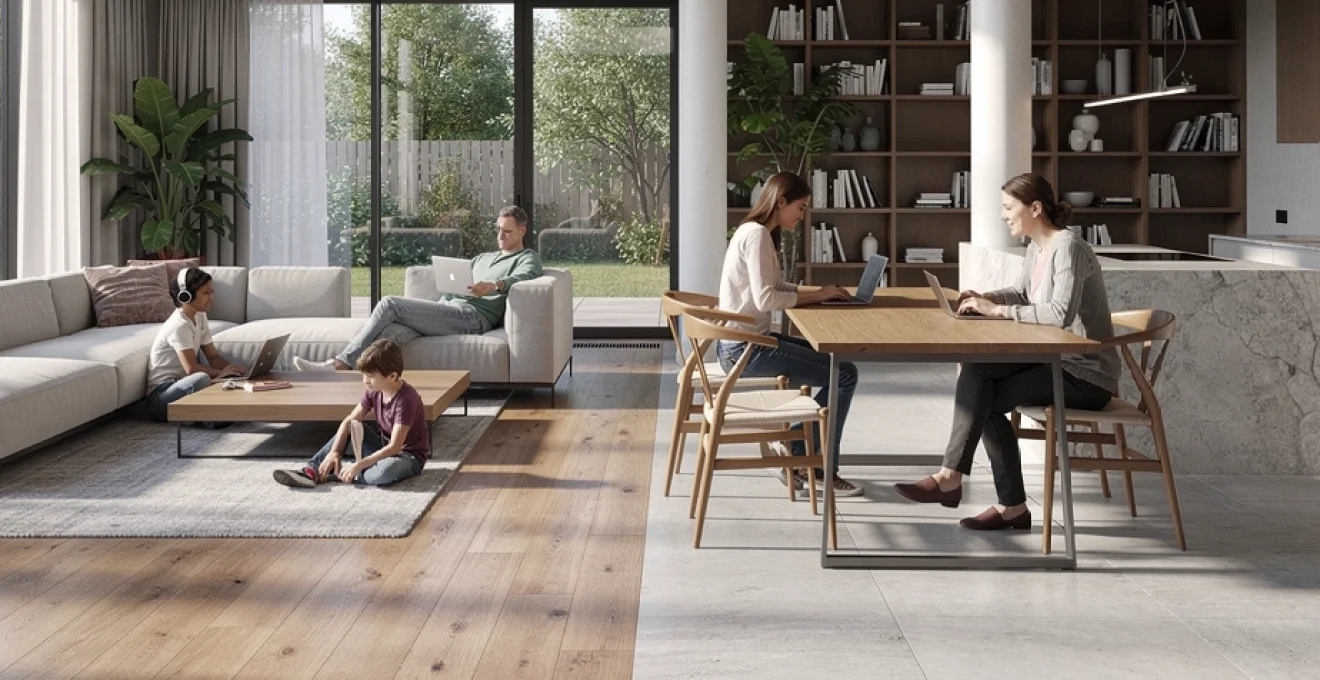
Contemporary residential design has undergone a profound transformation over the past century, with open-plan layouts emerging as a defining characteristic of modern living. These barrier-free environments have fundamentally altered how families interact, work, and experience their domestic spaces. The removal of traditional walls between kitchen, dining, and living areas represents more than an aesthetic choice; it reflects changing social dynamics, technological capabilities, and lifestyle preferences that prioritise flexibility and connection. As urban living spaces become increasingly compact and property values rise, the efficient utilisation of available square footage through open-plan design has become both a practical necessity and a desirable feature for contemporary homeowners.
Spatial design principles in contemporary Open-Plan architecture
The foundation of successful open-plan design rests on sophisticated spatial organisation principles that maintain functional clarity whilst embracing visual continuity. Modern architects and interior designers employ a range of techniques to create distinct zones within unified spaces, ensuring that the absence of walls doesn’t result in chaotic or undefined areas. These principles draw from both traditional architectural theory and contemporary understanding of human behaviour in domestic environments.
Scale and proportion play crucial roles in open-plan effectiveness. Designers must carefully balance the relationship between different functional areas, ensuring that no single zone dominates the space whilst maintaining appropriate sizing for intended activities. The concept of visual weight becomes particularly important, where larger furniture pieces or darker colours can create anchoring points that define specific areas without physical barriers.
Zone delineation techniques using furniture and flooring materials
Strategic furniture placement serves as the primary method for creating invisible boundaries within open-plan environments. Sectional sofas positioned perpendicular to walls can effectively separate living areas from dining spaces, whilst kitchen islands function as natural dividers between cooking and socialising zones. These furniture barriers maintain sight lines whilst providing clear functional separation.
Flooring materials offer another powerful tool for zone definition. Transitioning from hardwood in living areas to tile in kitchens creates subtle but clear demarcation between spaces with different functional requirements. Area rugs serve as particularly effective zone markers, with their edges defining intimate seating arrangements or dining areas within the larger open space. The key lies in selecting complementary materials that work harmoniously whilst providing sufficient contrast to establish distinct territories.
Ceiling height manipulation and mezzanine integration strategies
Vertical dimension manipulation adds complexity and interest to open-plan layouts. Varying ceiling heights can create intimate zones within expansive spaces – lowered ceilings over dining areas or kitchen peninsulas establish cosy gathering spots whilst maintaining connection to higher-volume living spaces. This technique draws from traditional architecture where different ceiling heights indicated different functions and levels of formality.
Mezzanine levels represent the ultimate expression of three-dimensional open-plan design. These elevated platforms can house home offices, reading nooks, or additional sleeping areas whilst maintaining visual connection to main living spaces below. The integration of mezzanines requires careful consideration of sight lines, acoustic properties, and structural requirements, but when executed successfully, they dramatically increase usable space without compromising the open-plan concept.
Natural light distribution through strategic fenestration planning
Light distribution becomes exponentially more complex in open-plan environments where single sources must illuminate multiple functional areas. Strategic window placement ensures even light distribution throughout the day, with designers often incorporating multiple orientations to capture morning light in breakfast areas and afternoon sun in living spaces. Clerestory windows and skylights can supplement wall-mounted fenestration, bringing light deep into floor plans where conventional windows might not reach.
The relationship between natural and artificial lighting requires careful orchestration in open-plan spaces. Layered lighting schemes incorporate ambient, task, and accent lighting to support different activities occurring simultaneously within the unified space. Dimmable systems allow occupants to adjust lighting levels throughout the day, supporting everything from morning coffee preparation to evening entertainment.
Acoustic zoning methods for Multi-Functional living areas
Sound management presents one of the greatest challenges in open-plan design. Without walls to contain noise, designers must employ creative strategies to manage acoustic environments across different zones. Soft furnishings such as upholstered seating, curtains, and area rugs absorb sound and reduce reverberation. Strategic placement of bookcases or decorative screens can provide acoustic
buffering between louder functions like cooking and quieter activities such as reading or working. In more technically advanced schemes, acoustic panels integrated into ceilings or feature walls help to dampen echo in large volume spaces. Even small design decisions—like choosing fabric lamp shades over hard glass, or opting for textured wall finishes—can meaningfully reduce sound transmission without visually closing down the open-plan layout.
Psychological and behavioural implications of Barrier-Free interior environments
Beyond aesthetics, open-plan layouts exert a profound influence on how occupants feel and behave in their homes. The constant visual connection between zones reshapes notions of privacy, territory, and personal space. For some, this permeability fosters togetherness and transparency; for others, it can produce low-level stress through constant exposure to activity and clutter. Understanding these psychological dimensions is essential if we want open-plan living to support well-being rather than undermine it.
Research in environmental psychology indicates that humans instinctively seek a balance between prospect (the ability to see what is happening around us) and refuge (the ability to retreat from view). Open-plan layouts excel at prospect but can struggle with refuge if not carefully planned. Designers and homeowners therefore need to supplement open spaces with micro-zones of retreat and subtle spatial cues that help everyone understand where they can claim temporary ownership.
Territorial behaviour patterns in undefined personal spaces
When walls and doors are removed, people still carve out territory—only now they do it with objects and routines instead of built partitions. A favourite armchair, a specific spot at the dining table, or the end of the sofa nearest the window all become symbolic “claims” on space. In households where multiple people share a single large room for different functions, these unspoken rules can become surprisingly strong, especially in smaller apartments.
Problems often arise when territorial markers are ambiguous or constantly shifting. A dining table that doubles as a home office, for example, may create tension if one person’s work spread clashes with another’s expectation of a clear surface for meals. To reduce friction, we can define semi-personal zones with subtle design strategies: a dedicated side table for one person’s reading materials, a compact desk niche for remote work, or even colour-coded storage baskets for each family member. These cues act like invisible borders, clarifying who uses what, when, without reintroducing solid walls.
Privacy paradox and its effect on family dynamics
Open-plan homes embody a privacy paradox: they promise greater togetherness while sometimes making it harder to be alone. Families often appreciate being able to see and chat with one another while cooking, studying, or relaxing; at the same time, constant visibility can reduce the sense of psychological privacy. Children may find it harder to develop independent routines, and adults may struggle to decompress when every activity is “public” within the shared volume.
This does not mean that open-plan living is incompatible with privacy; instead, privacy must be reimagined as partial and time-based rather than absolute. Lightweight partitions, sliding screens, and heavy curtains can temporarily shield zones without permanently dividing them. Sound-absorbing panels or strategically placed tall plants can offer a sense of seclusion even where sight lines remain open. By acknowledging that different family members have different privacy thresholds, you can design flexible solutions that adapt across the day—from busy family breakfasts to quiet late-night reading.
Cognitive load factors in visually connected living zones
Because open-plan layouts expose more of the home at once, they also expose more visual information to process. From a cognitive perspective, this can increase mental load, especially for people sensitive to clutter or movement. When the sink, the sofa, the toy corner, and the home office are all visible from one vantage point, the brain is continually monitoring multiple stimuli—much like having several browser tabs open at all times.
We can think of visual noise in an open-plan home as similar to background noise in a busy café: stimulating in small doses, draining if constant. To minimise cognitive overload, designers often employ strategies like restrained colour palettes, ample closed storage, and consistent material choices across zones. Grouping smaller decorative items into curated vignettes rather than scattering them also reduces visual fragmentation. The aim is not to create a sterile environment, but to ensure that what you see at a glance feels coherent and calm rather than chaotic.
Social interaction frequency changes in Open-Layout households
One of the main promises of open-plan living is increased social interaction, and everyday observations tend to support this. With fewer doors to close, casual conversations become more frequent: someone chopping vegetables can easily chat with a partner working at the dining table or children playing nearby. Studies on family communication patterns suggest that spatial openness correlates with higher levels of incidental interaction, which can strengthen bonds over time.
Yet more interaction is not always better. Without quiet pockets, introverted family members may feel overstimulated, and teenagers may retreat to bedrooms more often to reclaim control over their environment. A balanced open-plan layout therefore provides both “public” hubs for gathering and “semi-private” niches where one or two people can comfortably withdraw. Ask yourself: where in the space can someone read undisturbed, take a video call, or simply enjoy a moment of solitude? Designing these micro-retreats into the open-plan concept helps preserve healthy boundaries while still encouraging connection.
Thermal comfort and HVAC challenges in large volume spaces
While open-plan layouts can improve natural ventilation, they also introduce distinct challenges for heating, cooling, and overall thermal comfort. Large, continuous volumes are harder to condition evenly because air tends to stratify: warm air rises into double-height areas, leaving lower seating zones cooler in winter, while summer heat gains can be more difficult to control without compartmentalisation. This means conventional radiator placement or single thermostat systems often underperform in expansive open-plan homes.
To address these issues, modern HVAC strategies typically combine zoned systems with careful envelope design. Underfloor heating, for example, delivers consistent warmth at occupant level, counteracting stratification in tall spaces. In hot climates, high-performance glazing, shading devices, and ceiling fans work together to reduce cooling loads, keeping open spaces pleasant without excessive air-conditioning use. Smart thermostats and temperature sensors can further refine comfort by activating specific zones based on occupancy, ensuring that you are not expending energy to condition unused corners of a large room.
From a sustainability perspective, the energy performance of open-plan layouts depends heavily on insulation quality, airtightness, and solar control. Large expanses of glass may offer impressive views and daylight but must be paired with low-emissivity coatings, external shading, or deep overhangs to prevent overheating. Mechanical ventilation with heat recovery (MVHR) can also be valuable in tightly sealed open-plan homes, maintaining fresh air while recycling warmth. By considering thermal comfort from the outset rather than as an afterthought, designers can ensure that open-plan living feels as good as it looks across all seasons.
Noise pollution management and sound transmission control
Noise is often the most immediate drawback people notice after converting to an open-plan layout. Without internal partitions to block or absorb sound, everyday activities—coffee machines, phone calls, streaming media—can easily spill across the entire space. Reverberation times also tend to increase in large, hard-surfaced rooms, so sounds linger longer and feel harsher, particularly in kitchens with abundant tile, glass, and metal surfaces.
Effective noise management in open-plan homes relies on a layered approach, much like thermal design. At the architectural level, adding absorbent materials to ceilings—through acoustic plaster, baffles, or even timber slats backed with insulation—can dramatically reduce echo. At the interior level, soft furnishings, upholstered seating, and generous curtains perform double duty as both decorative elements and sound absorbers. Even simple moves like placing a thick rug beneath a dining table or using fabric-covered pinboards in a study nook can make conversations clearer and less fatiguing.
Where households include remote workers or students, acoustic micro-zoning becomes especially important. Locating work areas away from the noisiest kitchen appliances, installing solid-core doors to adjacent bedrooms, or using sliding acoustic partitions for occasional separation all help maintain productivity without permanently undermining openness. Think of these solutions as volume controls rather than mute buttons: they allow you to tune the soundscape of your open-plan living space to match different activities and times of day.
Case study analysis: iconic Open-Plan residential projects
The evolution of open-plan living is closely tied to a handful of seminal residential projects that challenged conventional domestic layouts. By examining these case studies, we can trace how ideas about transparency, flexibility, and minimal enclosure have influenced today’s homes—from compact city apartments to expansive suburban houses. Each project offers distinct lessons about what works, what compromises are involved, and how cultural context shapes the reception of open-plan design.
While the technological and regulatory environments have changed since the mid-twentieth century, the core ambitions remain strikingly similar: to dissolve unnecessary barriers, bring nature and light deeper into the interior, and create spaces that adapt to changing patterns of living. Contemporary designers continue to reinterpret these ideas, blending them with advances in materials, sustainability, and smart home technology to suit modern expectations of comfort and performance.
Eames house pacific palisades: Post-War modernist integration
The Eames House, completed in 1949 in Pacific Palisades, California, exemplifies an early and sophisticated version of open-plan living. Designed by Charles and Ray Eames as both residence and studio, the building uses an industrial steel frame and prefabricated panels to create a flexible, loft-like interior. The main living level operates as a single flowing volume where work, leisure, and display intermingle, reflecting the couple’s belief that life, play, and creativity should not be rigidly separated.
Rather than relying on full-height partitions, the Eameses used furniture, storage units, and rich layers of textiles to define activity areas. This approach anticipated many of the zone delineation strategies common in today’s open-plan apartments, where shelving systems or freestanding cabinets act as filters rather than barriers. The extensive glazing, which frames views of the surrounding landscape, demonstrates how visual connection to nature can prevent open interiors from feeling monotonous—an insight that continues to inform biophilic design in modern homes.
Glass house connecticut: philip johnson’s transparency concept
Philip Johnson’s Glass House in New Canaan, completed in 1949, pushes the open-plan ideal to its conceptual extreme. Enclosed almost entirely in glass, the house presents a single room where living, dining, and sleeping functions coexist within a continuous space. Only the central brick cylinder, containing the bathroom and fireplace, offers a sense of enclosure. The surrounding landscape effectively becomes the “walls,” making the boundaries between inside and outside almost entirely visual.
As a prototype, the Glass House raises provocative questions that still resonate: how much privacy are we willing to trade for openness, and in what contexts does total transparency feel comfortable? While few people would choose such radical exposure for everyday living, the project underscores the emotional power of continuous space and unobstructed views. Contemporary open-plan layouts often echo this concept at a more practical scale, using large sliding doors, corner windows, or internal glass partitions to maintain light and connection while restoring a basic level of seclusion.
Farnsworth house illinois: mies van der rohe’s minimal enclosure theory
Mies van der Rohe’s Farnsworth House (1951) in Plano, Illinois, refines the idea of minimal enclosure even further. Elevated above the ground on slender steel columns and wrapped in floor-to-ceiling glass, the home consists of a single open volume loosely divided by a central service core. Living, sleeping, and dining areas flow into one another, defined primarily by furniture placement and subtle shifts in orientation rather than walls.
The Farnsworth House highlights both the beauty and the challenges of radical openness. Climatic control and privacy were persistent concerns, reminding us that elegant minimalism must still account for everyday comfort. Today’s designers borrow its clarity of structure and spaciousness but typically temper them with higher-performance glazing, shading, and more nuanced zoning. In effect, many contemporary open-plan homes aim to capture the serene, gallery-like quality of Farnsworth while avoiding its practical drawbacks.
Contemporary interpretations in scandinavian housing developments
In recent decades, Scandinavian housing has offered some of the most influential and widely adopted interpretations of open-plan living. Apartments and houses across Denmark, Sweden, and Norway frequently combine kitchen, dining, and living functions into a single “family room,” reflecting cultural values that prioritise informality, togetherness, and efficient use of space. Light-coloured timber, white walls, and large windows maximise daylight in northern climates, while simple, functional furniture supports flexible rearrangements.
These projects also demonstrate how open-plan layouts can feel calm rather than overwhelming when paired with rigorous storage solutions and minimalist styling. Built-in cabinets, integrated bench seating with hidden compartments, and carefully edited decor keep visual clutter under control. At the same time, textiles, warm wood tones, and soft lighting create the hygge-inspired sense of cosiness that Scandinavian interiors are known for. For many homeowners around the world, this balanced approach—open yet intimate, minimal yet inviting—represents a highly achievable model for modern open-plan living.
Future evolution trends and smart home technology integration
Looking ahead, open-plan layouts are likely to remain a central feature of modern homes, but their implementation will evolve in response to new technologies and changing lifestyles. The rise of hybrid working, for instance, has underscored the need for adaptable zones where a kitchen island can host breakfast at one moment and a video conference the next. Rather than static open spaces, we are moving toward programmable interiors where lighting, acoustics, and even partitioning can shift at the touch of a button.
Smart home systems already play a key role in this transformation. Zonal lighting controls allow different parts of an open-plan space to adopt distinct moods simultaneously—bright task illumination over the cooking area, warm ambient light in the lounge, focused downlighting over a desk. Intelligent HVAC systems use sensors to monitor occupancy and adjust temperature and airflow accordingly, making large volume spaces more energy efficient. Integrated sound systems can direct audio to specific zones, ensuring that background music in the kitchen does not interfere with a work call in a nearby study nook.
We can expect further innovation in movable and responsive architecture: motorised sliding panels, fold-away workstations, and furniture with embedded power and data points that support seamless transitions between modes of use. As materials technology advances, acoustic fabrics, phase-change wall panels for thermal regulation, and dynamic glazing that tints in response to sunlight will make open-plan environments more comfortable and customisable. The core aspiration—flexible, light-filled spaces that encourage connection—will remain, but the tools for achieving it will become more precise and more responsive to individual preferences.
Ultimately, the future of open-plan living lies in orchestrating space, light, sound, and technology so that large, shared interiors can still feel personal and supportive. When we combine classic design principles with smart systems and a clear understanding of human behaviour, open-plan layouts can continue to adapt to modern life—whether that means remote work, multigenerational households, or simply a desire for homes that feel generous, social, and deeply attuned to the people who inhabit them.