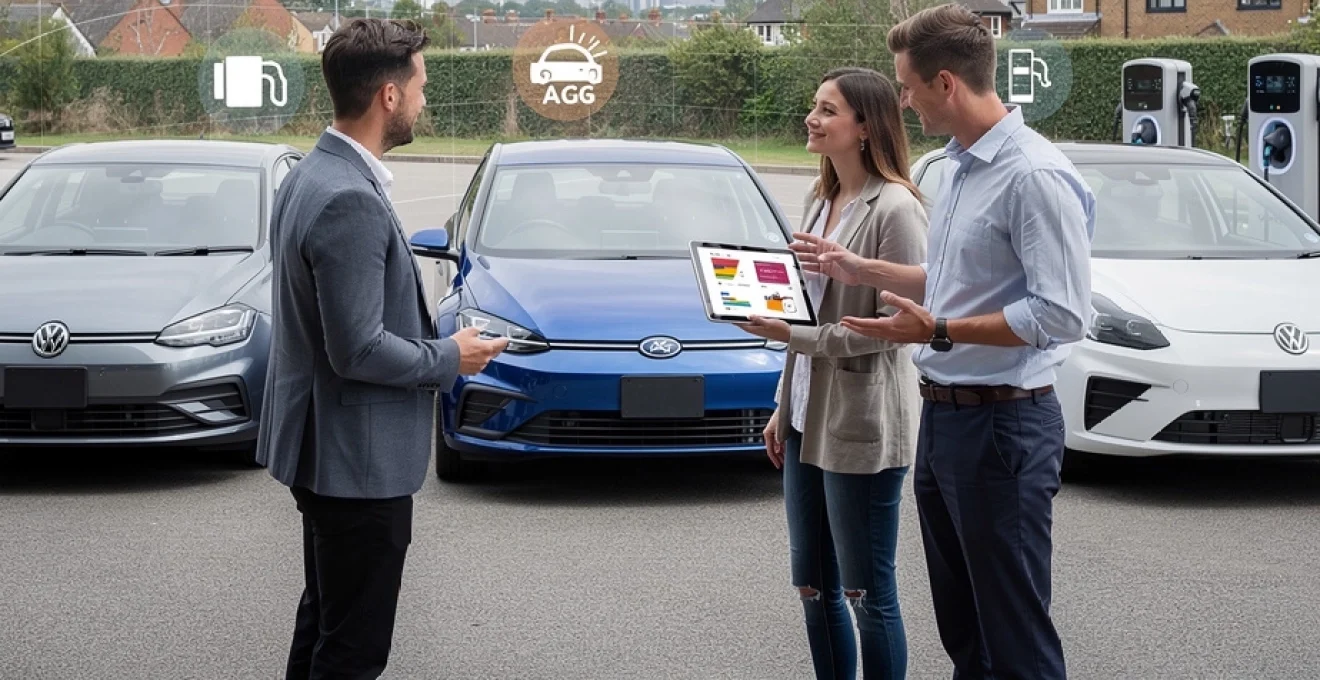
The automotive landscape has transformed dramatically over the past decade, presenting drivers with an unprecedented array of powertrain choices. Where petrol engines once dominated British roads without question, today’s motorists face a complex decision between traditional internal combustion engines, sophisticated hybrid systems, and fully electric vehicles. This shift isn’t merely about technology—it represents a fundamental change in how you approach vehicle ownership, running costs, and environmental responsibility. With the UK government’s commitment to phasing out new petrol and diesel car sales by 2030, understanding these powertrain options has moved from academic interest to practical necessity. Each technology brings distinct advantages and compromises that directly impact your daily driving experience, long-term finances, and carbon footprint.
Total cost of ownership analysis: purchase price, running costs, and depreciation rates
Understanding the true financial impact of your vehicle choice extends far beyond the showroom sticker price. Total cost of ownership encompasses everything from initial purchase through fuel, maintenance, insurance, taxation, and eventual resale value. This comprehensive financial picture often reveals surprises that contradict initial assumptions about which powertrain offers the best value.
Upfront investment: comparing MSRP across petrol, hybrid, and battery electric vehicles
The initial purchase price remains the most visible barrier for many buyers considering alternatives to petrol. Battery electric vehicles typically command a premium of £8,000-£15,000 over equivalent petrol models, though this gap has narrowed considerably since 2020. Hybrid vehicles position themselves in the middle ground, usually costing £2,000-£5,000 more than their petrol counterparts. For instance, a typical family hatchback might cost £24,000 in petrol form, £27,500 as a full hybrid, and £35,000 as a battery electric vehicle. These figures reflect current market conditions in 2025, where economies of scale in battery production have begun reducing EV premiums substantially.
However, focusing solely on MSRP overlooks crucial financial considerations. Manufacturer incentives, dealer discounts, and finance arrangements can significantly alter the actual cost you’ll pay. Many manufacturers are currently offering competitive finance rates on electric vehicles to accelerate adoption, sometimes resulting in monthly payments comparable to petrol equivalents despite higher list prices. Additionally, company car drivers face dramatically different financial equations due to Benefit-in-Kind tax structures that heavily favour electric vehicles.
Fuel economy and energy consumption: MPG vs kwh/100km calculations
Running costs represent where electric and hybrid vehicles begin recouping their initial premium. A modern turbocharged petrol engine might achieve 45-50 MPG in real-world driving, translating to approximately 12-14 pence per mile at current fuel prices of £1.45 per litre. Full hybrids typically improve this to 55-65 MPG, reducing costs to 10-11 pence per mile. Battery electric vehicles dramatically undercut both options, with typical consumption of 3.5-4.5 miles per kWh resulting in costs of just 2-4 pence per mile when charging at home on off-peak tariffs.
These differences compound rapidly over annual mileage. A driver covering 12,000 miles yearly would spend approximately £1,560 on petrol, £1,260 on hybrid fuel, or just £360-£480 on home electricity. Over a typical three-year ownership period, the electric vehicle saves £3,240-£3,600 compared to petrol—a significant offset against the higher purchase price. However, drivers who frequently rely on public rapid charging face considerably higher electricity costs of 8-12 pence per mile, which narrows this advantage substantially.
Government incentives and tax credits: plug-in car grant and BiK rates for company cars
While the Plug-in Car Grant for passenger vehicles ended in June 2022, various financial incentives continue supporting electric and hybrid adoption. The most substantial benefit comes through company car taxation, where battery electric vehicles attract just 2% Benefit-in-Kind rates for the 2024/25 tax year, compared to 25-37% for petrol and diesel vehicles. For a higher-rate taxpayer driving a £40,000 company car, this transl
continue would pay tax on just £800 of benefit each year, versus £10,000-£14,800 for an equivalent petrol car. Over a typical three- or four-year company car cycle, that difference can run into many thousands of pounds in take-home pay.
Private buyers also benefit from lower Vehicle Excise Duty (road tax) on low-emission cars, with zero-emission vehicles currently exempt from standard VED until 2025. Local incentives, such as discounted or free residents’ parking and exemption from Clean Air Zone or Congestion Charge fees, can further tilt the financial equation in favour of plug-in hybrids and battery electric vehicles, especially if you regularly drive into city centres. When comparing hybrid vs electric vs petrol cars, it is crucial to factor in these policy-driven savings alongside fuel and purchase price.
Residual value projections: three-year depreciation curves for each powertrain type
Depreciation is often the single largest cost in car ownership, and it behaves differently across petrol, hybrid, and electric models. Historically, petrol vehicles enjoyed predictable depreciation curves, losing around 45-55% of their value over three years and 36,000 miles. Hybrids tended to perform slightly better, particularly for popular models such as the Toyota Prius and Corolla Hybrid, thanks to strong demand in the used market and perceived reliability.
Electric vehicles initially suffered steeper depreciation due to rapid technology improvements and concerns over battery longevity. However, from 2023 onwards, used EV demand has strengthened significantly as more buyers seek lower running costs without paying new-car premiums. Current UK market data suggests three-year depreciation for mainstream EVs now averages 50-60%, with best-in-class models matching or outperforming comparable petrol and hybrid cars. When you evaluate total cost of ownership, a well-chosen EV or hybrid can therefore retain value as effectively as a conventional car, particularly if it offers strong real-world range and reputable battery warranties.
Maintenance and service intervals: comparing ICE, HEV, PHEV, and BEV requirements
Maintenance costs form another crucial piece of the hybrid vs electric vs petrol decision. Internal combustion engine (ICE) vehicles have the most complex mechanical systems, with regular oil and filter changes, timing belts or chains, exhaust components, and more frequent brake wear. Typical service intervals are every 10,000-12,000 miles or annually, and cumulative costs over three years can be substantial, especially if major components need replacement.
Full hybrids (HEV) and plug-in hybrids (PHEV) share many of these ICE maintenance requirements but can reduce wear on certain components because the electric motor often assists or replaces the engine at low speeds. Brake pads and discs, for example, tend to last longer due to regenerative braking systems capturing energy instead of turning it all into heat. Battery electric vehicles (BEV) simplify things further, eliminating oil changes, exhaust systems, clutches, and gearboxes with multiple ratios. While BEV servicing still includes checks on brakes, tyres, steering, and suspension, the overall maintenance schedule is usually lighter, and many manufacturers offer extended warranties on high-voltage batteries (often eight years or 100,000 miles), reducing long-term risk for the owner.
Powertrain technology deep dive: internal combustion, hybrid systems, and electric motors
To make an informed choice between hybrid, electric, and petrol cars, it helps to understand what is actually happening beneath the bonnet. Each powertrain uses a different method to convert energy into motion, and these engineering choices explain why driving characteristics and running costs vary so much. Think of it like three different ways of heating your home: a gas boiler, a heat pump, and a hybrid system that combines both—each has distinct strengths depending on how you live.
Mild hybrid (MHEV) vs full hybrid (HEV) vs plug-in hybrid (PHEV) architectures
Mild hybrids (MHEV) are the simplest step away from pure petrol. They use a small electric motor and 48-volt battery to assist the engine under acceleration and enable smoother stop-start operation, but they cannot drive the car on electric power alone. You refuel them exactly like a normal petrol car, and fuel savings typically range from 5-10% in everyday driving. Because the hardware is relatively inexpensive and compact, many manufacturers now fit mild hybrid systems to mainstream hatchbacks and SUVs as standard.
Full hybrids (HEV), such as the Toyota Corolla Hybrid, go further by using a larger battery and more powerful motor to move the car at low speeds without the engine running. They automatically switch between petrol, electric, or a combination of both, depending on demand. Plug-in hybrids (PHEV) add an even bigger battery that you recharge from the mains, offering 20-40 miles of electric-only range in typical UK conditions. Used correctly—charging daily and using electric mode for commutes—PHEVs can deliver impressive fuel economy. However, if you rarely plug in and mostly rely on the petrol engine, real-world consumption can be disappointing despite the impressive official figures.
Battery chemistry comparison: lithium-ion NMC, LFP, and solid-state technologies
Modern electric and hybrid vehicles largely rely on lithium-ion batteries, but not all lithium-ion chemistries are created equal. Nickel Manganese Cobalt (NMC) cells are common in European EVs, offering high energy density for long range in a relatively compact package. Their drawback is reliance on expensive and sometimes controversial materials like cobalt, which raises both cost and ethical sourcing questions. Manufacturers have worked to reduce cobalt content and improve supply chains, but the concern remains part of the wider environmental and social discussion.
Lithium Iron Phosphate (LFP) batteries, by contrast, use no cobalt or nickel and typically offer longer cycle life and robust thermal stability, making them very resistant to overheating. They are slightly heavier for the same energy capacity, which can marginally reduce range, but they suit city cars and lower-cost EVs where durability and affordability matter most. Solid-state batteries, still in development for mass-market cars, promise even higher energy density, faster charging, and improved safety by replacing liquid electrolytes with solid materials. While you may see concept cars and early prototypes in the late 2020s, widespread adoption in everyday UK models is expected closer to the 2030s, so current purchase decisions still revolve around NMC and LFP chemistries.
Regenerative braking systems and energy recovery efficiency
One of the key advantages of hybrid and electric cars is regenerative braking, which captures kinetic energy that would otherwise be lost as heat when you slow down. The electric motor effectively works in reverse as a generator, feeding power back into the battery. In urban stop-start traffic, this can make a huge difference: some studies suggest that up to 20-30% of energy used in city driving can be recovered through regeneration, which goes a long way to explaining why hybrids and EVs feel so efficient in town.
Energy recovery efficiency varies by model and driving style. Aggressive driving with hard braking leaves less opportunity for smooth regeneration, while anticipating traffic and lifting off early allows the system to harvest more energy. Many electric cars now offer adjustable regeneration levels or “one-pedal driving” modes, where simply lifting off the accelerator provides strong deceleration and maximises energy capture. If you frequently drive in congested areas, learning to use these features can significantly boost your real-world range and reduce brake wear, offering a tangible benefit over traditional petrol cars.
Turbocharged petrol engines: downsizing trends and real-world performance
On the petrol side, the past decade has seen widespread adoption of small-displacement, turbocharged engines designed to deliver the power of a larger engine with the fuel economy of a smaller one. A 1.0-litre three-cylinder turbo can now produce similar performance to an older 1.6-litre unit, helping manufacturers meet strict CO₂ targets under Euro 6d regulations. In official WLTP tests, these engines show impressive figures, often exceeding 50 MPG in mixed driving.
Real-world fuel consumption, however, can diverge from the brochure when engines are driven hard, heavily loaded, or used predominantly for short journeys where they rarely reach optimal operating temperature. Turbocharged petrol engines can feel punchy and refined on the motorway but may not match hybrids or EVs in stop-start traffic. When comparing petrol vs hybrid vs electric in the UK, it is worth honestly considering your driving style and route profile: if you spend most of your time commuting through city centres, the theoretical efficiency of a downsized turbo may not materialise in your fuel receipts.
Charging infrastructure and refuelling considerations across the UK
Your access to charging or refuelling infrastructure can be as important as the car itself. A highly efficient EV is of limited use if you cannot conveniently charge it, just as a petrol car becomes inconvenient if you frequently travel in areas with sparse fuel stations. The good news is that the UK’s charging network has expanded rapidly, while traditional forecourts are beginning to adapt for a lower-carbon future.
Home charging solutions: 7kw wallbox installation and off-peak tariffs
For many drivers, the ability to charge at home is the single biggest advantage of owning an electric or plug-in hybrid car. A dedicated 7kW wallbox, installed on your driveway or in a garage, can typically add 25-30 miles of range per hour, fully charging most EVs overnight. Installation costs in 2025 usually range from £800-£1,200, depending on your property and electrical setup, though occasional government grants and energy-supplier offers can reduce this. If you rent or live in a flat, it is essential to confirm with your landlord or managing agent whether charging infrastructure can be installed.
Pairing a home charger with an off-peak EV tariff can dramatically cut your cost per mile. Many UK energy providers now offer cheap overnight electricity rates—sometimes under 10p per kWh—specifically for EV drivers. Scheduling your car to charge between midnight and 5am, for example, can make running an EV comparable in cost to driving a car that does 150-200 MPG in petrol terms. If you have solar panels, you may be able to offset part of your charging with home-generated electricity, further improving the total cost of ownership for your electric vehicle.
Public charging networks: ionity, BP pulse, and tesla supercharger access
Public charging is essential for longer journeys and for drivers without off-street parking. The UK now hosts tens of thousands of public charge points, with networks such as BP Pulse, Ionity, Osprey, Gridserve, and Shell Recharge covering major routes and urban centres. Many of these stations support contactless payment, removing the need for multiple RFID cards or apps, although membership schemes can still offer discounted rates for frequent users. Coverage is strongest along motorways and in larger cities, with rural areas improving but still more variable.
Tesla’s Supercharger network has historically been reserved for Tesla owners, but many locations are now open to non-Tesla EVs via the Tesla app. Superchargers are known for high reliability and simple user experience, which can significantly reduce “charging anxiety” on long trips. When weighing up hybrid vs electric vs petrol cars, it is worth checking typical routes you take using public charger maps to understand how comfortably an EV would fit into your routine. If local provision is still sparse, a hybrid or plug-in hybrid might currently offer a more flexible compromise.
Rapid charging speeds: 50kw vs 150kw vs 350kw CCS capabilities
Not all rapid chargers—or cars—are created equal. Early rapid chargers typically offer 50kW DC output, which can add around 60-80 miles of range in 30 minutes for many EVs. Newer high-power chargers deliver 150kW or even 350kW, slashing charge times for compatible vehicles. However, your car’s maximum DC charging rate and battery size ultimately determine how fast you can realistically charge, much like a bottle neck limits how quickly you can pour water regardless of how powerful the tap is.
Many mainstream EVs on UK roads today support 100-150kW charging, enabling a 10-80% top-up in 25-40 minutes under ideal conditions. Ultra-rapid 350kW capability is currently limited to a smaller group of premium or performance models. Charging speeds also slow as the battery fills, so arriving at a charger with 10-20% remaining and stopping around 80% is usually the most time-efficient strategy. If you regularly undertake long motorway journeys, looking for an EV with strong rapid-charging performance, or opting for a petrol or hybrid car, can make the difference between relaxed travel and frustrating delays.
Petrol station availability and future forecourt transformation plans
Petrol stations remain ubiquitous across the UK, offering quick refuelling and familiar convenience. Even as sales of new petrol and diesel cars decline, the existing fleet will ensure fuel demand for many years, so you should not fear imminent shortages. However, the nature of service stations is beginning to change: many major fuel retailers are investing heavily in on-site rapid chargers, recognising that future forecourts will cater to both liquid fuel and electrons.
For now, the sheer density of petrol stations still gives petrol and hybrid cars an advantage for spontaneous long-distance trips, particularly in remote regions of Scotland, Wales, and Northern Ireland. As the UK charging infrastructure matures, this gap will narrow, but during the current transition period, your personal travel patterns should guide whether you prioritise the convenience of filling up in five minutes or the low running costs of home charging.
Real-world range and performance metrics: WLTP vs actual driving conditions
Official WLTP range and fuel economy figures provide a useful baseline when comparing hybrid, electric, and petrol cars, but they are not guarantees of what you will see day-to-day. WLTP testing is more representative than the older NEDC standard, yet it still cannot perfectly replicate the infinite variety of UK driving conditions, from winter motorway slogs to summer city congestion. As a rule of thumb, many drivers experience 10-25% lower efficiency than WLTP suggests, and for EVs in particular, cold weather, high speeds, and use of heating can further reduce range.
For petrol and hybrid vehicles, short journeys where the engine rarely warms up can hurt fuel economy, while steady motorway cruising may exceed official figures. Electric vehicles typically come closest to their WLTP range in mild temperatures at mixed speeds, but may drop to 60-70% of rated range in a cold snap with heavy heater use. When planning which powertrain suits you best, consider your longest regular journey, whether you have charging at the destination, and how comfortable you are with planning charging stops. A good rule is to choose an EV with at least 20-30% more WLTP range than your typical worst-case trip, or opt for a hybrid or petrol car if that margin is hard to achieve within budget.
Environmental impact assessment: lifecycle emissions and carbon footprint analysis
Beyond cost and convenience, many drivers now weigh environmental impact heavily when choosing between hybrid, electric, and petrol cars. The full picture involves not only tailpipe emissions but also the carbon footprint of manufacturing, electricity generation, and end-of-life recycling. While the analysis can be complex, broad trends are clear: over a typical vehicle lifetime, electric and efficient hybrid vehicles generally emit significantly less CO₂ than conventional petrol cars, especially in a country like the UK where the electricity grid is rapidly decarbonising.
Tailpipe emissions: euro 6d standards and zero emission vehicle mandates
Euro 6d emissions standards set strict limits on pollutants such as nitrogen oxides (NOx) and particulate matter for petrol and diesel vehicles. Modern petrol cars with particulate filters are far cleaner than older models, but they still emit CO₂ in direct proportion to the fuel they burn. Hybrids reduce tailpipe CO₂ by lowering fuel consumption, especially in urban driving where the electric motor contributes more. Plug-in hybrids can show even lower official CO₂ figures, often under 50 g/km, but only deliver those benefits if they are regularly charged and used in electric mode.
Battery electric vehicles are classed as zero-emission at the tailpipe, producing no exhaust gases or particulate emissions during driving. This makes them particularly attractive in urban areas struggling with air-quality issues. The UK government’s Zero Emission Vehicle mandate requires an increasing percentage of new car sales to be zero-emission each year, accelerating the shift towards EVs. For you as a driver, this means that choosing an electric or ultra-low-emission hybrid vehicle aligns with the direction of national policy and may future-proof your car against potential restrictions on older, higher-emitting models in city centres.
Manufacturing carbon debt: battery production and raw material extraction
Critics of electric vehicles rightly point out that battery production is energy-intensive and currently carries a higher “carbon debt” at the manufacturing stage than building a petrol car. Mining and processing raw materials like lithium, nickel, and cobalt also raise environmental and social concerns. However, multiple lifecycle studies from organisations such as the International Council on Clean Transportation (ICCT) show that, even accounting for these factors, an average mid-size EV in Europe still achieves lower total CO₂ emissions than an equivalent petrol car after roughly 1-3 years of driving, depending on mileage and energy mix.
Manufacturers are working to reduce the carbon intensity of battery production by sourcing renewable electricity for factories, improving recycling rates, and shifting to chemistries with fewer critical materials. As a buyer, you may not be able to audit every supply chain, but you can favour brands that publish sustainability reports and commit to ethical sourcing standards. If your primary concern is minimising lifecycle emissions, a long-lived electric car charged whenever possible from low-carbon electricity remains one of the most effective options currently available.
UK grid decarbonisation: renewable energy mix and future projections to 2030
The environmental case for electric vehicles depends heavily on how clean the electricity grid is. In the UK, the story has been one of rapid improvement: coal’s share of electricity generation has fallen from around 40% in 2012 to virtually zero in most months today, replaced by wind, solar, and gas. In 2023, low-carbon sources (renewables plus nuclear) supplied over half of UK electricity, and government targets aim for a largely decarbonised grid by 2035. This means that each year, the emissions associated with charging an EV in the UK continue to fall.
By 2030, if current policies hold, the carbon intensity of UK grid electricity is expected to be less than half what it was a decade earlier. For you, this implies that an electric car bought today will become cleaner to run over its lifetime, even if your driving habits remain the same. Hybrids and petrol cars, by contrast, are locked into the carbon content of petrol, which will not improve significantly without widespread adoption of sustainable fuels that are still in their infancy for mainstream road use.
End-of-life recycling: battery second-life applications and disposal regulations
What happens when an EV battery reaches the end of its useful life in a car? Contrary to common fears, it is not simply sent straight to landfill. Most automotive batteries retain 70-80% of their original capacity after 8-10 years of service, making them valuable for second-life applications such as stationary energy storage. These “retired” batteries can be repurposed to store solar energy for homes or support grid balancing, extending their productive life and spreading the manufacturing carbon footprint over more years of use.
The UK and EU also impose strict regulations on battery recycling, requiring manufacturers to take responsibility for end-of-life processing. Specialist facilities can now recover a significant proportion of the valuable metals, which can then be fed back into new battery production, gradually reducing dependence on fresh raw materials. While recycling infrastructure is still scaling up to match future volumes, the direction of travel is clear: as technology and regulation mature, the environmental impact of battery disposal will continue to decline, improving the long-term sustainability of electric and hybrid vehicles.
Model-specific comparisons: toyota corolla hybrid vs volkswagen ID.3 vs ford puma petrol
To make all of this more tangible, it helps to compare three popular models representing each main powertrain type: the Toyota Corolla Hybrid (full hybrid), the Volkswagen ID.3 (battery electric), and the Ford Puma Petrol (modern turbocharged ICE). Each appeals to different priorities, yet all sit within a broadly similar size and price bracket for UK buyers looking at family hatchbacks and compact crossovers.
The Toyota Corolla Hybrid pairs a practical hatchback body with Toyota’s well-proven hybrid system, delivering real-world fuel economy in the 55-65 MPG range for many drivers. It excels in town and mixed driving, with smooth, quiet operation at low speeds and no need to plug in. The Volkswagen ID.3, by contrast, is a dedicated electric platform with WLTP ranges typically between 260 and 350 miles depending on battery size. It offers brisk acceleration, a quiet cabin, and very low running costs if you can charge at home on an off-peak tariff. The Ford Puma Petrol, often equipped with a 1.0-litre EcoBoost mild-hybrid engine, provides a more traditional driving experience with lively performance and the reassurance of ubiquitous petrol stations.
Which is best for you? If you want to minimise fuel stops and enjoy straightforward ownership without installing a charger, the Corolla Hybrid provides an excellent balance of efficiency and convenience. If you have off-street parking, access to home charging, and mostly predictable journeys, the ID.3 can deliver the lowest running costs and smallest carbon footprint, especially as the UK grid continues to decarbonise. The Puma Petrol remains a strong choice if upfront budget is tight, you often travel to areas with limited charging infrastructure, or you simply prefer the familiar feel and sound of a petrol engine. By honestly assessing your daily routes, charging options, and long-term priorities, you can decide whether a hybrid, electric, or petrol car fits best into your life today.