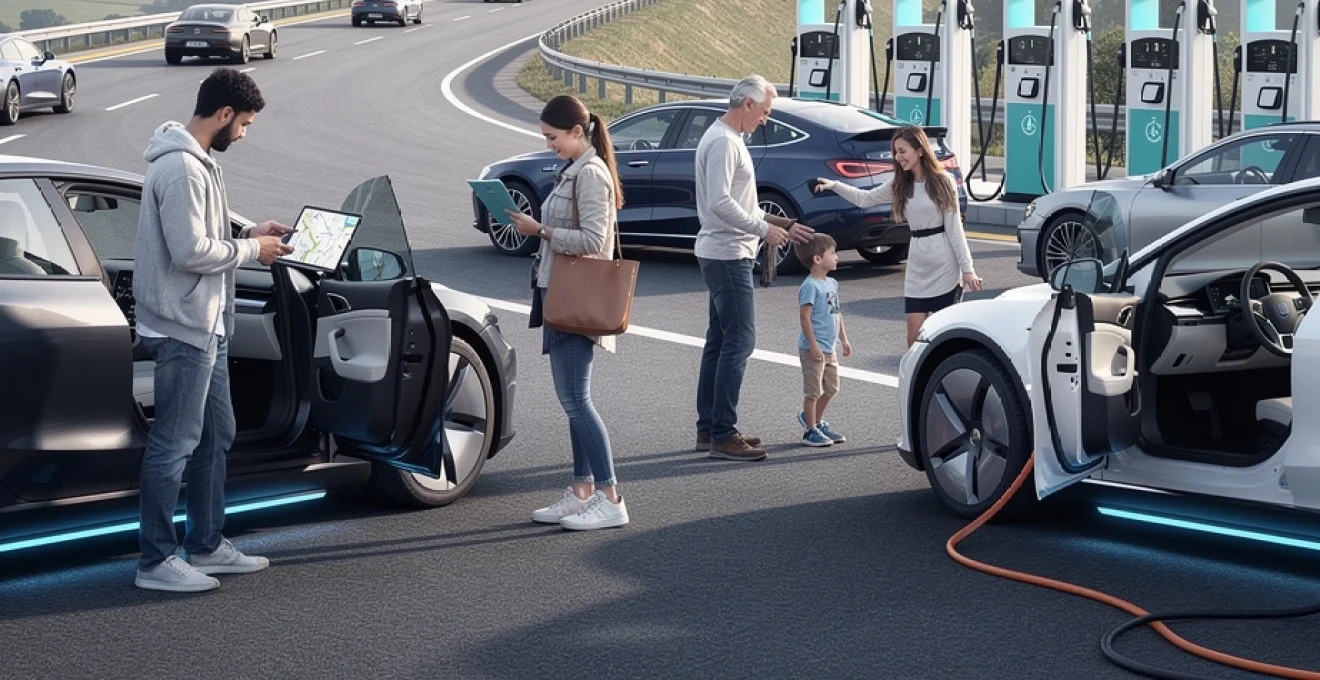
The landscape of long-distance travel is experiencing a fundamental transformation as electric vehicles (EVs) evolve from experimental curiosities to practical alternatives for extended journeys. This shift represents more than just a change in propulsion technology; it signals a complete reimagining of how we approach route planning, travel timing, and the very concept of what constitutes a satisfying road trip experience. The convergence of advanced battery technology, expanding charging infrastructure, and sophisticated navigation systems has created an ecosystem where long-distance electric travel is not merely possible but increasingly preferable for many drivers.
What was once considered the primary limitation of electric vehicles—their range capability—has become a catalyst for innovation across multiple industries. From automotive manufacturers developing more efficient powertrains to energy companies establishing comprehensive charging networks, the push towards sustainable long-distance travel is reshaping entire sectors of the economy. This transformation extends beyond technical specifications to influence consumer behaviour, urban planning, and even the hospitality industry as businesses adapt to accommodate the unique needs of electric vehicle travellers.
Battery technology advancements enabling extended range capabilities
The heart of any electric vehicle’s long-distance capability lies within its battery pack, and recent advancements in energy storage technology have fundamentally altered the parameters of what constitutes viable range for extended travel. Modern lithium-ion battery systems now routinely deliver 300 to 400 miles of real-world range, with some premium models exceeding 500 miles on a single charge. This represents a dramatic improvement from early electric vehicles that struggled to achieve 100 miles of practical range under optimal conditions.
Lithium-ion cell chemistry evolution in tesla model S plaid and lucid air
The latest generation of lithium-ion batteries incorporates sophisticated cell chemistry improvements that maximise energy density whilst maintaining thermal stability during high-power operations. Tesla’s Model S Plaid utilises advanced 2170 cells with silicon nanowire anodes that increase capacity by approximately 20% compared to traditional graphite anodes. This technology enables the vehicle to maintain consistent performance across varying temperature conditions, a crucial factor for long-distance travel reliability.
Similarly, the Lucid Air employs proprietary cell technology that achieves an industry-leading energy density of over 900 watt-hours per litre. This exceptional efficiency translates directly into extended range capabilities, allowing drivers to cover substantial distances between charging stops. The vehicle’s sophisticated battery management system continuously optimises cell performance, ensuring that range predictions remain accurate even during demanding driving conditions such as sustained highway speeds or challenging terrain.
Solid-state battery development by toyota and QuantumScape corporation
The next frontier in battery technology lies with solid-state systems that promise to revolutionise long-distance electric travel through dramatically improved energy density and charging speeds. Toyota’s solid-state battery programme targets energy densities exceeding 500 watt-hours per kilogram, potentially doubling the range capabilities of current electric vehicles whilst reducing overall vehicle weight. These batteries utilise ceramic electrolytes instead of liquid electrolytes, eliminating many safety concerns associated with thermal runaway whilst enabling operation across a broader temperature range.
QuantumScape’s lithium-metal solid-state technology demonstrates the potential for ultra-rapid charging capabilities, with the ability to charge from 15% to 80% capacity in under 15 minutes. This advancement addresses one of the most significant concerns for long-distance travellers: charging time. When combined with improved energy density, these batteries could enable 500-mile range vehicles that recharge as quickly as refuelling a conventional petrol vehicle.
Fast-charging infrastructure impact on range anxiety mitigation
The proliferation of high-power charging infrastructure has fundamentally altered the relationship between battery capacity and practical long-distance travel capability. Modern DC fast chargers operating at 350 kilowatts can replenish hundreds of miles of range in 20-30 minutes, making the absolute battery capacity less critical than the charging curve efficiency. This development has enabled manufacturers to optimise battery packs for weight and cost rather than purely maximising capacity.
Range anxiety, once the primary barrier to electric vehicle adoption for long-distance travel, has been substantially reduced through the combination of improved battery technology and strategic charging network deployment. Studies indicate that drivers experience significantly less stress when they understand that charging opportunities are readily available and predictably fast, even if their vehicle’s absolute range
continues to vary depending on route familiarity and journey length, underscoring the importance of intuitive planning tools built into modern EVs.
Thermal management systems in BMW ix and mercedes EQS models
Beyond raw capacity and charging speed, thermal management has become a decisive factor in how electric vehicles handle long-distance travel. The BMW iX employs an integrated liquid cooling and heating circuit that manages the temperature of the battery, power electronics, and cabin from a unified system. By preconditioning the battery before a fast-charging stop and maintaining an optimal operating window on the motorway, the iX preserves both performance and long-term battery health over repeated high-speed segments.
The Mercedes EQS takes a similarly sophisticated approach, using a combination of coolant circuits, heat pumps, and intelligent software control to balance efficiency with comfort. When you select a long-distance route in the navigation system, the vehicle anticipates high-load segments and adjusts thermal conditions in advance, much like an athlete warming up before a race. This results in more consistent charging curves at DC fast chargers, reduced energy loss in extreme temperatures, and a noticeably calmer cabin environment on multi-hour drives.
For drivers, the practical outcome is that range estimates in vehicles like the BMW iX and Mercedes EQS are more reliable across seasons and climates. You are less likely to see dramatic drops in available range when climbing mountain passes in winter or crossing hot desert highways in summer. In effect, modern thermal management transforms the battery from a sensitive component into a robust energy reservoir that can confidently support interstate travel without constant micro-planning.
Charging infrastructure networks transforming route planning algorithms
As battery technology has matured, the focus of long-distance electric travel has shifted toward how efficiently we can connect vehicles to charging networks. Instead of simply locating the nearest plug, route planning algorithms now evaluate power levels, network reliability, historical congestion, and even real-time availability before suggesting the next stop. This evolution turns the charging network into an intelligent layer that actively shapes how and where we travel, rather than being a passive backdrop.
Modern navigation systems integrate live data feeds from charging providers to generate dynamic itineraries that adapt as conditions change. If a particular station along a highway corridor becomes busy or reports a fault, your EV can automatically reroute you to an alternative stop with minimal impact on total travel time. For many drivers, this feels closer to flying with a smart air-traffic controller than undertaking a traditional road trip, as algorithms quietly optimise each leg of the journey in the background.
Tesla supercharger network expansion across european corridors
Tesla’s Supercharger network remains a benchmark for how dedicated charging infrastructure can transform long-distance travel habits. Across major European corridors—such as the routes connecting Scandinavia to Central Europe or Spain to France—the density of Supercharger sites allows drivers to plan multi-country trips with the same confidence they once reserved for petrol vehicles. Stations are strategically placed near motorways, services, and amenities, ensuring that charging stops align naturally with rest breaks and meals.
In recent years, Tesla has expanded access to selected Supercharger sites for non-Tesla vehicles in several European countries. This shift not only increases the utilisation of existing hardware but also changes how route planning algorithms evaluate options for all EV drivers. When more brands can tap into a fast, reliable network, long-distance routes become more flexible and less dependent on a single provider. For you as a traveller, this means fewer “dead zones” on the map and a broader safety net if your preferred network is congested.
Crucially, Tesla’s navigation system is tightly integrated with the Supercharger network, automatically factoring in elevation changes, speed, temperature, and headwinds when estimating arrival charge. The car suggests optimal charging stops and durations, often recommending shorter, more frequent sessions to align with the most efficient part of the battery’s charging curve. This interplay between hardware and software illustrates how infrastructure can directly shape driving patterns, encouraging smoother, more predictable long-distance travel.
Ionity high-power charging stations integration with navigation systems
Ionity’s high-power charging (HPC) network, built by a consortium of major European automakers, is another cornerstone of the emerging long-distance EV ecosystem. With charging capacities up to 350 kilowatts, Ionity stations can add hundreds of kilometres of range in a short stop for vehicles that support these power levels. The stations are positioned along key trans-European transport corridors, making it feasible to drive from, for example, Amsterdam to Milan or Berlin to Barcelona with a series of predictable, efficient charges.
Where Ionity stands out is its deep integration with in-vehicle navigation systems from brands like BMW, Mercedes-Benz, Audi, and Hyundai. When you set a long route, your car doesn’t just show Ionity locations; it actively uses live data on station status and pricing to recommend optimal stops. If a specific site is experiencing high utilisation or reduced capacity, the software can propose an alternative station a short distance off the main route, often saving time overall.
This level of integration changes how we think about long-distance route planning in an electric vehicle. Instead of manually cross-checking apps and calculating buffers, you can rely on the car’s algorithms to make trade-offs between distance, speed, and charging efficiency. It is similar to having a digital co-pilot that constantly recalculates the best plan based on conditions ahead, allowing you to focus on the driving experience and your destination rather than spreadsheet-style logistics.
Chargepoint and electrify america network coverage analysis
In North America, networks like ChargePoint and Electrify America have become central to the practical realities of long-distance EV travel. Electrify America, which has installed hundreds of DC fast-charging sites across interstate highways, offers high-power chargers that rival European HPC networks. Coverage maps now show near-continuous corridors along major routes such as I-5, I-95, and key east–west connectors, making cross-country journeys technically feasible and increasingly comfortable.
ChargePoint, while known for its extensive Level 2 footprint, also operates DC fast chargers that fill important gaps between other networks. Together, these systems create a patchwork that navigation software can stitch into coherent itineraries. For drivers planning a multi-state trip, it’s no longer a question of whether chargers exist, but which combination of stations will deliver the fastest, most cost-effective journey. Apps allow you to filter by connector type, power level, and amenities, ensuring that each stop aligns with your personal preferences and your vehicle’s capabilities.
However, coverage is not yet uniform, and rural regions can still present challenges, especially in harsh weather. Here, route planners encourage conservative strategies—such as charging to a higher state-of-charge or adding an extra stop—to maintain comfortable buffers. You might think of it like flying a small aircraft: the infrastructure is reliable in major corridors, but prudent planning is still needed when venturing off the busiest routes. As investments continue, these remaining “white spots” on the map are expected to shrink, further normalising long-distance EV travel.
Vehicle-to-grid technology implementation in long-distance travel
Vehicle-to-grid (V2G) technology adds an intriguing new dimension to how electric vehicles interact with energy systems during long journeys. In V2G-enabled scenarios, your EV is not only a consumer of electricity but also a mobile energy asset that can return power to the grid or local facilities when parked and plugged in. While this capability is still in its early rollout, pilot projects in Europe, Japan, and parts of North America show how V2G could change the economics of long-distance travel over time.
Imagine stopping overnight at a hotel with bidirectional chargers: your car could feed energy back to the local grid during peak evening demand and recharge at lower off-peak rates later at night. For fleet operators running long-distance routes, such as delivery vans or intercity shuttles, this opens the door to new revenue streams or reduced energy costs. In some trials, aggregated groups of EVs function like a virtual power plant, providing frequency regulation and backup capacity in exchange for financial incentives.
From a traveller’s perspective, V2G may eventually influence where you choose to stop and how long you remain plugged in. Destinations that offer compensation or discounted stays in return for grid services could become preferred waypoints on popular corridors. While technical standards and regulatory frameworks are still evolving, the underlying idea is clear: long-distance EV travel isn’t just about drawing power from the grid, but also about participating in a more flexible, resilient energy ecosystem.
Dynamic charging prediction software in mercedes MBUX and BMW idrive
Dynamic charging prediction is where the sophistication of modern EV route planning truly becomes visible to everyday drivers. Systems like Mercedes-Benz’s MBUX and BMW’s latest iDrive platforms continuously analyse variables such as driving style, traffic patterns, elevation profiles, and weather forecasts to refine range estimates in real time. Instead of static predictions, you receive evolving guidance that reflects what is actually happening on the road, reducing surprises and moments of uncertainty.
In Mercedes models, the “Electric Intelligence” feature within MBUX proactively suggests charging stops and adjusts them as conditions change. If you encounter an unexpected traffic jam or strong headwinds, the system will recalculate whether you can still reach your planned charger comfortably or if a closer alternative is advisable. BMW’s iDrive uses similar logic, presenting a visual buffer around your destination and charging points, giving you a clear sense of margin rather than a single, fragile number.
This dynamic approach to planning long-distance electric travel feels almost like having a weather forecast for your battery. You can see not only your current status but also likely scenarios over the next 100 or 200 kilometres. For many drivers transitioning from petrol cars, this transparency is transformative: it replaces vague “range anxiety” with informed decision-making. When you understand why the system recommends a particular charging stop—and how factors like speed or temperature affect your margin—you are far more likely to relax and enjoy the journey.
Consumer behaviour adaptation in EV long-distance journey planning
As the technology behind electric vehicles matures, consumer behaviour is quietly evolving to match the new possibilities and constraints of long-distance electric travel. Instead of treating refuelling as a brief, purely functional task, many EV drivers now integrate charging stops into the rhythm of their trip. They plan to stretch their legs, eat, or explore local attractions while the car replenishes its battery, turning what once felt like downtime into a natural part of the experience.
One noticeable behavioural shift is the move away from driving a battery down to near empty. Most experienced EV travellers aim to operate between roughly 10% and 80% state-of-charge, where charging is fastest and battery stress is lower. This encourages more frequent but shorter stops, which often align better with safe driving practices and human comfort. On a 600-kilometre journey, you might take two or three 20–30 minute breaks rather than one long stop, arriving less fatigued and with a more predictable arrival time.
Digital tools also influence planning habits. Trip-planning apps and in-car navigation systems allow you to simulate different strategies—such as slower driving to reduce charging needs versus faster driving with an extra stop—and choose the one that fits your schedule and preferences. Younger drivers, in particular, appear comfortable treating energy management as a game of optimisation, similar to planning the fastest route in a navigation app or the most efficient itinerary for a city break. As more people share their experiences on forums and social media, best practices spread quickly, making each new adopter’s learning curve shorter.
At the same time, expectations are changing about what constitutes an acceptable level of infrastructure reliability. Early adopters often tolerated detours or occasional out-of-service chargers as part of the adventure. Mainstream drivers, however, expect a level of predictability closer to that of traditional petrol networks. This shift pressures operators to improve uptime, customer support, and transparency, while encouraging governments and regulators to establish minimum service standards. Over time, these rising expectations will make long-distance EV travel feel less like pioneering and more like a routine, dependable choice.
Traditional petrol station networks transitioning to multi-energy hubs
The growth of long-distance electric travel is also prompting a visible transformation of traditional petrol station networks into multi-energy hubs. Rather than serving only petrol and diesel, many service areas now offer a mix of high-power DC chargers, slower AC points, and in some cases hydrogen refuelling alongside conventional fuels. For drivers, this means that familiar roadside locations are evolving into flexible energy stops that can serve a broad range of powertrains during a transitional period.
Major fuel retailers and oil companies are investing heavily in charging infrastructure at motorway service stations and urban forecourts. In Europe, brands such as Shell, BP, and TotalEnergies have announced plans for thousands of fast-charging points, often colocated with existing convenience stores and food outlets. This co-location strategy leverages established real estate and amenities, making it easier for you to integrate charging into existing travel habits. Instead of learning an entirely new network of locations, you can continue to stop at the same service areas—but plug in rather than fill up.
From a business perspective, the rise of long-distance electric travel pushes traditional fuel retailers to rethink revenue models. As margins on fossil fuels come under pressure and volumes gradually decline, operators are pivoting toward higher-value services such as premium food, coworking spaces, parcel lockers, and even wellness facilities. Charging sessions, which last longer than a quick fuel stop, create new opportunities for these services. In effect, the time you spend connected to a charger becomes an anchor around which roadside businesses can build richer, more diversified offerings.
This transition is not without challenges. Upgrading a conventional forecourt to support multiple high-power chargers often requires significant investment in grid connections, transformers, and on-site energy management systems. In some locations, distributed energy resources such as solar canopies and battery storage are added to smooth peaks in demand and reduce strain on the local grid. Yet the direction of travel is clear: over the coming decade, we are likely to see more service stations rebadged as “energy hubs” that feel as natural for long-distance EV trips as they once did for petrol-powered journeys.
Government policy framework accelerating EV adoption for interstate travel
While technology and infrastructure play a central role in reshaping long-distance travel habits, government policy frameworks provide much of the momentum behind widespread adoption. By setting clear targets, offering financial incentives, and investing in enabling infrastructure, policymakers create the conditions under which interstate and cross-border electric travel can flourish. Without these measures, progress would rely solely on market forces, likely resulting in patchy coverage and slower behavioural change.
National and regional governments increasingly view long-distance EV infrastructure as strategic economic and environmental assets. Funding programmes support the deployment of fast chargers along key freight and tourism corridors, while regulatory tools push automakers and energy providers toward cleaner solutions. For you as a driver, many of these policies are invisible day-to-day, yet they define the availability of chargers on your route, the cost of electricity at the plug, and the variety of electric models you can choose from in the showroom.
Zero emission vehicle mandates in california and european union
Zero Emission Vehicle (ZEV) mandates are among the most powerful tools governments use to accelerate EV uptake, especially for vehicles that will regularly undertake long-distance trips. In California, the Advanced Clean Cars regulations and subsequent updates require a growing share of new vehicle sales to be zero-emission, with the state targeting 100% ZEV sales of new passenger cars and light trucks by 2035. Similar goals are emerging in other U.S. states that follow California’s standards, shaping the national market and increasing the availability of long-range models suitable for interstate travel.
The European Union has adopted comparable measures through its CO2 emissions standards for new cars and vans, effectively phasing out the sale of new internal combustion engine vehicles by 2035. Automakers responding to these regulations are prioritising the development of EVs with competitive range, fast-charging capabilities, and robust durability under sustained motorway use. For long-distance travellers, this means that each new model year brings more options tailored not just to urban commuting but to continental road trips as well.
These mandates also have a knock-on effect on charging infrastructure planning. As the share of zero-emission vehicles on the road increases, the economic case for high-power chargers along highways becomes stronger, justifying larger installations and more redundancy. Governments can then complement market-driven deployments with targeted support in underserved regions, ensuring that rural communities and cross-border routes are not left behind. In this way, ZEV policies act as both a demand signal and a roadmap for the investments needed to make long-distance EV travel practical for everyone.
National grid infrastructure investment programmes
Behind every fast charger on a motorway or in a remote service area lies a complex network of grid infrastructure that must be upgraded to handle new loads. National and regional investment programmes are therefore crucial in supporting the electrification of long-distance transport. Initiatives such as the U.S. National Electric Vehicle Infrastructure (NEVI) Formula Program, the EU’s Connecting Europe Facility, and various national recovery funds channel billions of dollars and euros into grid reinforcement and charging corridors.
These programmes typically focus on ensuring that high-power chargers are spaced at regular intervals along major highways—often every 50 to 80 kilometres—while also upgrading substations, transformers, and local distribution lines. Without such investments, even the most ambitious charging deployments would face bottlenecks, especially during peak travel seasons when many EVs are on the move simultaneously. For drivers, robust grid support translates into more reliable charging speeds and fewer instances of throttled power at busy sites.
In addition, some countries are exploring smart-grid solutions that coordinate charging with renewable energy production and grid demand. Time-of-use tariffs and dynamic pricing encourage drivers to charge when wind and solar output is high or when overall demand is lower, which can be particularly relevant for overnight charging during long trips. Looking ahead, these investments will help ensure that the surge in electric mobility does not compromise grid stability, but instead becomes a catalyst for a more flexible and sustainable energy system.
Cross-border charging standardisation initiatives
As more drivers undertake long-distance journeys that cross national borders, the importance of charging standardisation becomes clear. Without common connector types, payment systems, and roaming agreements, an EV road trip from one country to another could quickly become a maze of incompatible cards and cables. To address this, governments, industry bodies, and charging networks are pursuing a range of standardisation and interoperability initiatives.
In Europe, the widespread adoption of the Combined Charging System (CCS) as the default fast-charging standard for passenger vehicles has already simplified hardware compatibility. Regulations also require transparent pricing and ad hoc access—meaning you can start a charge without subscribing to a specific provider—reducing friction for cross-border travellers. Roaming platforms allow multiple networks to share authentication and billing, so your preferred app or RFID card can unlock chargers in several different countries.
Similar conversations are taking place in other regions, with efforts to harmonise technical standards and roaming frameworks across large markets. The aim is to make charging an electric vehicle on a long-distance trip as straightforward as using your mobile phone abroad: you may pay different rates, but the basic functionality remains familiar and accessible. As these initiatives mature, they will remove one of the last significant psychological barriers to international electric travel, allowing drivers to plan holidays and business trips across borders with the same confidence they once associated only with petrol-powered cars.