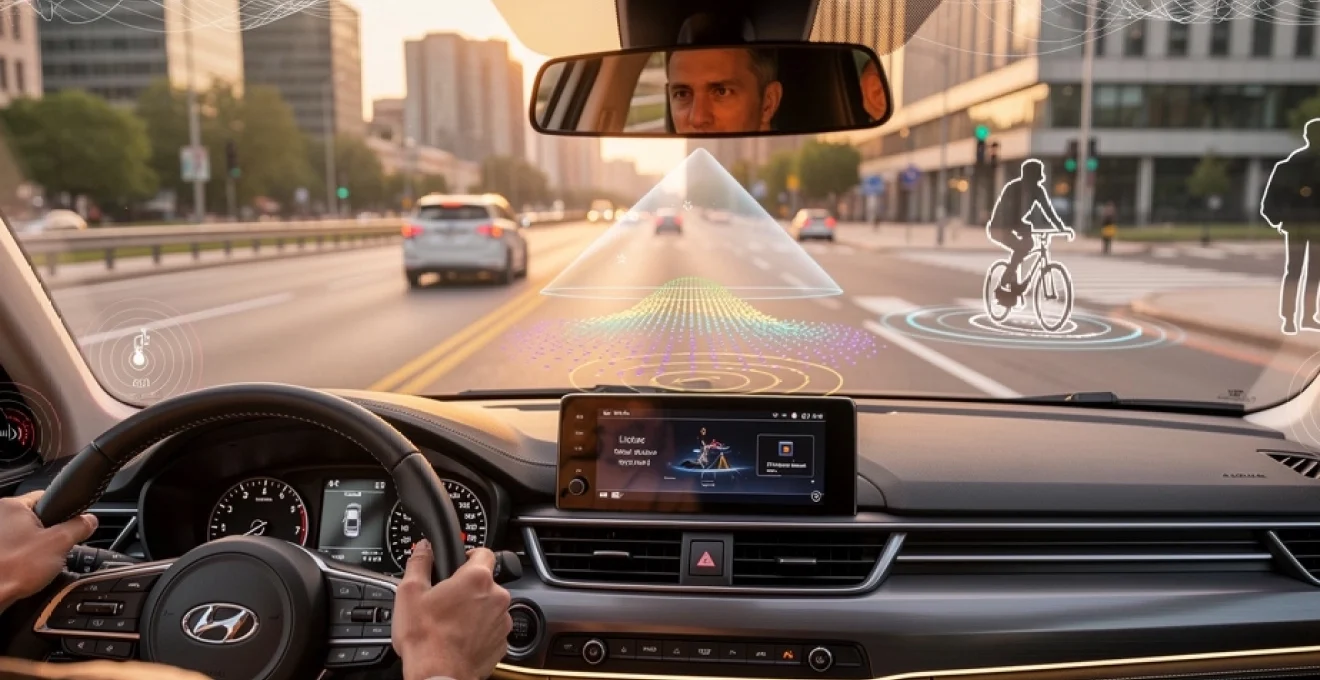
Modern vehicles have transformed from simple mechanical machines into sophisticated safety platforms that actively protect drivers, passengers, and pedestrians. Advanced Driver Assistance Systems represent one of the most significant technological leaps in automotive safety since the introduction of airbags and anti-lock braking systems. Recent research from Thatcham Research reveals that 82% of UK drivers feel safer with ADAS technology, whilst 55% report that these systems have actively prevented collisions within the past year. These aren’t just incremental improvements—they represent a fundamental shift in how vehicles interact with their environment and respond to potential hazards. As sensor technology, artificial intelligence, and automotive engineering converge, ADAS is becoming the cornerstone of a safer transportation future.
The journey towards autonomous driving begins with these driver assistance technologies. Each system serves as a building block, gradually reducing the burden of constant vigilance that drivers must maintain. From detecting vehicles in blind spots to automatically applying brakes when a collision seems imminent, these features work tirelessly in the background, monitoring conditions that human drivers might miss during moments of distraction or fatigue.
Core technologies behind ADAS: sensors, cameras, and LiDAR integration
The foundation of any Advanced Driver Assistance System lies in its ability to perceive the surrounding environment with remarkable precision. Modern ADAS platforms employ a sophisticated array of sensors, each contributing unique capabilities to create a comprehensive picture of the vehicle’s surroundings. This multi-layered approach to environmental perception is known as sensor fusion, and it represents the technological backbone that enables features like automatic emergency braking and adaptive cruise control to function reliably across diverse driving conditions.
The integration of multiple sensor types isn’t merely redundant engineering—it’s a strategic approach to compensate for the inherent limitations of each technology. Whilst cameras excel at identifying lane markings and reading traffic signs, radar systems perform better in adverse weather conditions. LiDAR provides exceptional depth perception but can struggle with certain reflective surfaces. By combining these technologies, automotive engineers create systems that are more robust, accurate, and dependable than any single sensor could achieve alone.
Radar and ultrasonic sensor arrays for proximity detection
Radar technology has been the workhorse of automotive safety systems for decades, and its role in modern ADAS continues to expand. Operating on electromagnetic wave principles, radar sensors emit radio frequency signals that bounce off objects and return to the sensor, allowing the system to calculate distance, speed, and even the trajectory of surrounding vehicles. These sensors typically operate in the 24 GHz and 77 GHz frequency bands, with the higher frequency offering greater resolution and accuracy for detecting smaller objects at longer ranges.
Ultrasonic sensors complement radar by providing exceptional close-range detection capabilities, typically effective within five metres of the vehicle. You’ll find these sensors working during parking manoeuvres, where they detect obstacles that might be too close for radar to distinguish effectively. The combination of long-range radar and short-range ultrasonic sensors creates a continuous detection envelope around the vehicle, ensuring that no blind spots exist in the proximity detection network.
Forward-facing camera systems and machine vision processing
Camera systems represent the eyes of modern ADAS, providing rich visual information that algorithms can process to identify lane markings, traffic signs, traffic light states, and even the body language of pedestrians preparing to cross the road. Advanced forward-facing camera systems employ high-resolution sensors coupled with sophisticated image processing units capable of analysing millions of pixels in real-time. These systems don’t simply capture images—they interpret them, distinguishing between a plastic bag blowing across the road and a genuine hazard requiring intervention.
The processing power behind machine vision has increased exponentially in recent years, driven by advances in neural network architecture and specialised computing hardware. Modern camera systems can identify dozens of object classifications simultaneously, tracking their movement patterns and predicting potential conflicts before they occur. This predictive capability is what allows systems like Autonomous Emergency Braking to intervene before a driver might even recognise the danger, potentially shaving crucial milliseconds off reaction times that could mean the difference between a near-miss and a collision.
Lidar point cloud technology in premium ADAS platforms
Light Detection and Ranging technology represents the premium tier of ADAS sensing capability, offering three-dimensional mapping precision that exceeds what cameras and radar
can reliably capture. By emitting rapid laser pulses and measuring the time it takes for them to return, LiDAR generates a dense “point cloud” that maps nearby objects with centimetre-level accuracy. This three-dimensional model allows premium ADAS platforms to understand not just that an object is present, but precisely where it is in relation to the vehicle, its height, and its contour.
In practice, this means LiDAR-equipped systems can better distinguish between static roadside structures, moving vehicles, and vulnerable road users such as pedestrians or cyclists. The technology is particularly valuable in complex urban environments, where vehicles, scooters, and people converge in tight spaces and unpredictable patterns. Although the cost of LiDAR has traditionally limited it to higher-end models and pilot deployments, rapid price reductions and solid-state designs are accelerating its inclusion in mainstream advanced driver assistance systems. As LiDAR becomes more widespread, you can expect even more reliable hazard detection and fewer false alarms in everyday driving.
Sensor fusion algorithms for multi-source data integration
Of course, having multiple sensors is only half the story; the real magic of ADAS lies in how these data streams are combined. Sensor fusion algorithms ingest inputs from radar, ultrasonic sensors, cameras, and LiDAR, then reconcile any discrepancies to create a unified, highly accurate model of the driving environment. Think of it as asking several eyewitnesses for their account of an incident, then using advanced mathematics and AI to piece together what really happened.
These algorithms must operate under tight time constraints, often updating their environmental model dozens of times per second. They use probabilistic methods and machine learning to handle uncertainty, such as when a camera struggles in low light but radar still has a clear view. When done well, sensor fusion dramatically improves the reliability of advanced driver assistance systems, reducing the likelihood of missed detections and unnecessary interventions. This integrated approach is what enables higher-level features such as adaptive cruise control, lane keeping assist, and autonomous emergency braking to work together seamlessly rather than as isolated components.
Autonomous emergency braking systems and collision mitigation
Among all advanced driver assistance systems, Autonomous Emergency Braking (AEB) has perhaps the most direct and measurable impact on road safety. AEB continuously monitors the road ahead and automatically applies the brakes if it detects an imminent collision that the driver is failing to avoid. According to multiple studies from organisations such as the Insurance Institute for Highway Safety (IIHS) and Thatcham Research, vehicles equipped with AEB show significant reductions in rear-end collisions and injury claims compared with those without the technology.
What makes AEB so powerful is its ability to react faster than human drivers can in many situations. Even a half-second reduction in reaction time can dramatically shorten stopping distances at urban speeds. As more car makers make AEB standard across their line-ups, and as regulators in Europe and beyond move towards mandatory fitment, the cumulative effect on collision rates and serious injuries is expected to be substantial. Yet, as we’ll see, the effectiveness of AEB depends heavily on how well it predicts time-to-collision and how intuitively it communicates with the driver.
Pre-collision warning mechanisms and time-to-collision calculations
Before an AEB system slams on the brakes, it typically issues a series of escalating warnings designed to prompt the driver to act. These pre-collision alerts may include visual icons on the instrument cluster, flashing heads-up display indicators, and distinctive auditory tones. Many vehicles also employ haptic feedback, such as a rapid vibration in the steering wheel or seat, to cut through background noise and capture the driver’s attention. The goal is simple: give you just enough time and notice to avoid the crash yourself.
Under the surface, sophisticated algorithms are constantly estimating time-to-collision (TTC), which is the time remaining before impact if both vehicles continue at their current speeds and trajectories. Using sensor data on speed, distance, and relative velocity, the system calculates whether the TTC has crossed a critical threshold requiring intervention. This is a delicate balance; trigger too early and you risk annoying drivers with false alarms, trigger too late and the system may not have enough distance to avoid the impact. Engineers continuously refine these TTC thresholds based on real-world data and human factors research to keep AEB both effective and acceptable in everyday traffic.
Dynamic brake support and automatic braking intervention
When the AEB system determines that a collision is likely, it can respond in several stages. Dynamic brake support is often the first step, pre-charging the brake system and increasing hydraulic pressure so that even a light press on the pedal delivers maximum stopping power. In many cases, this subtle assistance is enough to turn a near miss into a complete avoidance, without the driver ever realising that technology lent a helping hand.
If the driver fails to react or does not brake hard enough, the system escalates to full automatic braking intervention. In this phase, AEB can apply partial or full braking force independently, decelerating the vehicle as rapidly as grip levels allow. Some systems also coordinate with other advanced driver assistance systems, such as tightening seatbelts or pre-tensioning them and pre-charging steering assist to help stabilise the vehicle. Although the intervention can feel abrupt, studies show that automatic braking significantly reduces impact speeds, which translates directly into fewer serious injuries and lower repair costs. In many urban collisions, AEB can prevent the crash entirely, especially at speeds under 30 mph.
Pedestrian and cyclist detection through neural network classification
Early generations of AEB focused mainly on vehicle-to-vehicle impacts, but modern systems increasingly protect vulnerable road users. Using forward-facing cameras, radar, and in some premium models LiDAR, ADAS platforms now apply deep neural networks to recognise pedestrians, cyclists, and even e-scooter riders. These networks are trained on millions of labelled images and video clips, learning to distinguish human shapes and movement patterns from surrounding clutter such as street furniture or roadside vegetation.
Why does this matter in real traffic? Consider a child stepping out from between parked cars or a cyclist emerging from a side street; human drivers often have only a fraction of a second to respond. Pedestrian and cyclist detection systems extend your awareness beyond your immediate field of vision, spotting partially obscured or fast-moving people and calculating their likely path. If the system predicts that a vulnerable road user will cross your trajectory, it issues targeted warnings and can trigger emergency braking if you fail to react. Real-world evaluations from European safety bodies show that AEB with pedestrian detection can dramatically reduce the severity of collisions in busy city centres, where vulnerable road users are most at risk.
Euro NCAP safety ratings and AEB performance criteria
Independent testing organisations play a vital role in driving improvements in AEB technology. In Europe, Euro NCAP has made autonomous emergency braking a cornerstone of its safety ratings, evaluating how well vehicles avoid or mitigate collisions across a wide range of scenarios. These include tests at different speeds, with stationary and moving targets, and increasingly with pedestrians, cyclists, and oncoming traffic in junction situations. Vehicles that perform strongly in these assessments are more likely to receive higher star ratings, which in turn influence consumer purchasing decisions.
As test protocols become more demanding, manufacturers are incentivised to refine their systems beyond the bare minimum required for regulatory compliance. This has led to better performance in low-visibility conditions, more reliable detection of small or partially obscured objects, and reduced false-positive braking events that can frustrate drivers. For you as a buyer, looking at independent ratings such as Euro NCAP’s “Safety Assist” score is one of the most practical ways to compare AEB effectiveness between different models. Over time, as these benchmarks continue to evolve, they help ensure that advanced driver assistance systems deliver real-world safety gains rather than just ticking boxes on a spec sheet.
Lane keeping assist and lane departure warning technologies
While AEB helps in sudden, high-risk situations, lane keeping assist (LKA) and lane departure warning (LDW) focus on the more subtle, everyday drift that can still lead to severe accidents. Many crashes, especially on motorways, are caused not by aggressive manoeuvres but by gradual lane departures due to distraction, fatigue, or momentary inattention. Advanced driver assistance systems that monitor lane position and gently guide the vehicle back to the centre of the lane can therefore have a profound impact on road safety.
LKA and LDW systems rely heavily on computer vision to interpret road markings, combined with electronic power steering to deliver smooth corrections. In many models, these features now work hand-in-hand with adaptive cruise control to form “lane centring” functions that keep your car tracking safely within its lane on dual carriageways and highways. For drivers, this can reduce the cognitive load of long journeys and help prevent the kind of microsleeps or distraction-related drifts that often precede serious collisions.
Computer vision edge detection for lane marker recognition
At the heart of lane keeping technology is the ability to detect lane markings in a wide range of environments. Forward-facing cameras capture continuous video of the road ahead, while image processing algorithms perform edge detection and pattern recognition to identify solid and dashed lane lines. These algorithms must be robust enough to cope with worn paint, shadows, wet surfaces, and varying lighting conditions, from bright sunlight to oncoming headlights at night.
Modern systems often use machine learning models trained on vast datasets of road imagery to improve accuracy and resilience. Instead of relying solely on the brightness contrast of lane lines, they also infer the most probable lane path from road geometry, vehicle dynamics, and map data when available. This is why some lane keeping systems can still function, at least in a limited capacity, even when markings are partially obscured by snow or debris. As with other advanced driver assistance systems, the trend is towards greater robustness in real-world conditions, not just ideal test tracks.
Electronic power steering integration for corrective interventions
Once lane position has been established, the next step is to translate that information into smooth, confidence-inspiring steering inputs. Electronic power steering (EPS) systems are essential here, because they allow the vehicle’s control unit to apply small, precise torque adjustments to the steering rack. Rather than suddenly jerking the wheel, the system gently nudges the car back towards the lane centre, often in a way that feels natural and easy to override if the driver chooses.
Well-calibrated LKA systems strive to maintain a balance between assistance and control. You remain responsible for steering, but the system acts like a subtle guide, similar to a bowling alley bumper that prevents you from veering too far off course. If you indicate to change lanes, LKA typically suspends its intervention so that the manoeuvre feels fluid and intuitive. Overly intrusive steering corrections can undermine trust and lead drivers to disable the feature, so manufacturers work closely with test organisations and user feedback to fine-tune the steering feel. When executed well, EPS-based lane keeping can significantly reduce unintentional lane departures, particularly on monotonous motorway stretches.
Haptic feedback systems and driver alert protocols
Lane departure warning systems add another layer of protection by alerting drivers when they begin to drift without signalling. Instead of immediately taking control, LDW typically uses haptic feedback—such as steering wheel vibration—or audible chimes combined with dashboard icons to prompt corrective action. This approach keeps you firmly in charge while still reducing the likelihood of an unnoticed drift into an adjacent lane or onto the hard shoulder.
Many vehicles also incorporate driver monitoring and alertness checks into their lane support strategies. For example, if the system detects erratic lane position or repeated corrections that resemble drowsy driving, it may trigger a “take a break” message or recommend a rest stop. Some advanced systems use infrared cameras to monitor eye and head movements, ensuring that drivers remain engaged even when advanced driver assistance systems are active. These layered alert protocols are crucial in preventing over-reliance on automation and are a central focus of ongoing research into human factors and ADAS safety.
Adaptive cruise control with Stop-and-Go functionality
Adaptive cruise control (ACC) extends the familiar convenience of conventional cruise control with an important safety upgrade: automatic distance management. Instead of simply maintaining a set speed, ACC uses radar and camera data to keep a safe following gap from the vehicle ahead, smoothly adjusting your speed as traffic conditions change. This “set-and-forget” capability can make long drives more relaxing, while also reducing the risk of rear-end collisions caused by delayed reactions in stop-and-go traffic.
In its more advanced forms, adaptive cruise control includes full stop-and-go functionality, allowing the vehicle to slow to a complete stop in heavy congestion and then resume driving when traffic moves again. For drivers who commute through dense urban corridors or frequently encounter motorway traffic jams, this can significantly reduce fatigue and frustration. Importantly, however, ACC is still an assistance feature rather than a self-driving system; you are expected to keep your hands on the wheel and remain ready to intervene at all times. Misunderstanding this distinction is one of the key human factors challenges that regulators and safety researchers continue to address.
Blind spot monitoring and rear Cross-Traffic alert systems
Even the most attentive drivers cannot see everything around their vehicle, especially in modern cars with thick pillars and high beltlines. Blind spot monitoring (BSM) and rear cross-traffic alert (RCTA) systems are designed to supplement your situational awareness, particularly during lane changes and reversing manoeuvres. By using radar or ultrasonic sensors mounted in the rear corners of the vehicle, these systems monitor adjacent lanes and the area behind the car for approaching traffic.
When a vehicle enters your blind spot, BSM typically illuminates a small icon in the corresponding side mirror or on the A-pillar. If you signal a lane change while another vehicle is in that danger zone, the system may add an audible warning or a steering wheel vibration to deter the manoeuvre. Rear cross-traffic alert extends this concept when reversing out of parking spaces, detecting cars, cyclists, and even pedestrians approaching from the sides that you might not be able to see. For many drivers, especially in busy car parks or tight urban streets, these advanced driver assistance systems can be the difference between a smooth exit and a minor collision that leads to costly repairs.
Statistical impact of ADAS on collision rates and fatality reduction
For all the impressive technology under the bonnet, the ultimate test of advanced driver assistance systems is their real-world impact on collision rates and road deaths. Over the past decade, a growing body of evidence from safety agencies, insurers, and independent researchers has confirmed that well-implemented ADAS features do reduce crashes. Yet the picture is nuanced; effectiveness varies by feature, driving environment, and how consistently drivers keep the systems activated.
Studies from organisations such as IIHS, NHTSA, and the European Commission show that technologies like AEB, lane keeping assist, and blind spot monitoring are associated with double-digit percentage reductions in certain types of crashes. Insurance industry data, including that gathered by Thatcham Research in the UK, also indicates lower claim frequencies and severities for vehicles equipped with comprehensive ADAS packages. At the same time, surveys reveal that nearly a quarter of drivers find some features intrusive or distracting, underscoring the need for continued refinement to maximise benefits while minimising annoyance.
IIHS and NHTSA crash data analysis for ADAS-equipped vehicles
In the United States, the Insurance Institute for Highway Safety and the National Highway Traffic Safety Administration have conducted extensive analyses of crash data to quantify the safety impact of ADAS. For example, IIHS studies have found that vehicles with front crash prevention systems, including AEB, experience substantially fewer rear-end collisions than similar models without the technology. In some analyses, reductions of 40% or more in rear-end crash claims have been observed, particularly in urban and suburban driving where low-speed impacts are common.
NHTSA has also highlighted the promise of ADAS in its road safety strategies, promoting voluntary commitments from manufacturers to make features like AEB standard equipment. By linking crash outcomes to vehicle equipment levels in national databases, researchers can tease out how much of the observed decline in certain collision types can be attributed to advanced driver assistance systems. This evidence base is essential not only for regulators but also for consumers trying to understand whether paying extra for an ADAS package will translate into tangible safety benefits for their families.
European commission road safety statistics post-ADAS implementation
Across Europe, road safety policy has increasingly embraced advanced driver assistance systems as critical tools in achieving “Vision Zero” goals, which aim to eliminate road fatalities in the long term. The European Commission has reported steady declines in serious injuries and deaths over the past two decades, with vehicle safety technology playing a central role alongside infrastructure improvements and enforcement. The rollout of mandatory ESC (Electronic Stability Control) and the growing penetration of AEB, lane support systems, and intelligent speed assistance are expected to accelerate these trends.
Euro NCAP’s influence has been particularly notable in driving higher ADAS adoption, as manufacturers compete for top safety ratings in a highly informed market. As more vehicles on European roads are equipped with these technologies, the collective effect becomes more pronounced: not only are individual drivers better protected, but the overall traffic system becomes less prone to the chain-reaction crashes and multi-vehicle pileups that strain emergency services. While it is difficult to attribute precise percentages of fatality reduction to any single feature, the consensus among European safety researchers is that ADAS is now a major pillar of the region’s road safety improvements.
Insurance industry actuarial data on ADAS claim frequency
Insurers have a direct financial incentive to understand how advanced driver assistance systems affect claim patterns, and their actuarial models increasingly reflect this. Data from various markets, including the UK, indicates that vehicles equipped with ADAS features such as AEB, blind spot monitoring, and parking assistance often have lower claim frequencies and reduced average claim costs. For example, Thatcham Research has reported that AEB alone can lead to meaningful reductions in low-speed collision claims, which are among the most common and costly for insurers due to repair expenses.
This actuarial evidence is gradually influencing the pricing of motor insurance premiums. Some insurers now offer discounts or preferential terms for vehicles fitted with specific ADAS packages, recognising the reduced risk profile they represent. However, the picture is not entirely straightforward; repairs to advanced sensors and cameras can be expensive after a crash, sometimes offsetting savings from fewer collisions. As ADAS technology becomes more widespread and repair processes standardise, we can expect insurance models to continue evolving, with clearer incentives for choosing vehicles that offer robust, user-friendly driver assistance features.
Real-world effectiveness studies from tesla autopilot and volvo city safety
Beyond broad statistical analyses, case studies of specific manufacturers provide valuable insight into how ADAS performs in the real world. Tesla’s Autopilot system, which combines adaptive cruise control, lane centring, and automatic lane change features, has been the subject of intense scrutiny and multiple safety evaluations. Company-reported data has suggested lower accident rates per mile when Autopilot is engaged compared with purely manual driving, although independent researchers caution that usage patterns and driver demographics must be carefully considered. Regulators and safety bodies continue to analyse crash reports involving partial automation to better understand where the technology excels and where human factors pose new risks.
Volvo’s City Safety system offers another widely cited example, particularly in Europe. Designed to prevent or mitigate low-speed urban collisions through AEB and pedestrian detection, City Safety has been associated with significant reductions in rear-end crashes and whiplash injuries in independent studies. These real-world effectiveness evaluations reinforce the broader statistical picture: when advanced driver assistance systems are well designed, clearly communicated, and used as intended, they can deliver substantial improvements in road safety. The ongoing challenge for manufacturers, regulators, and researchers is to ensure that the next generation of ADAS maintains these gains while addressing concerns about driver over-reliance, distraction, and system limitations in complex environments.