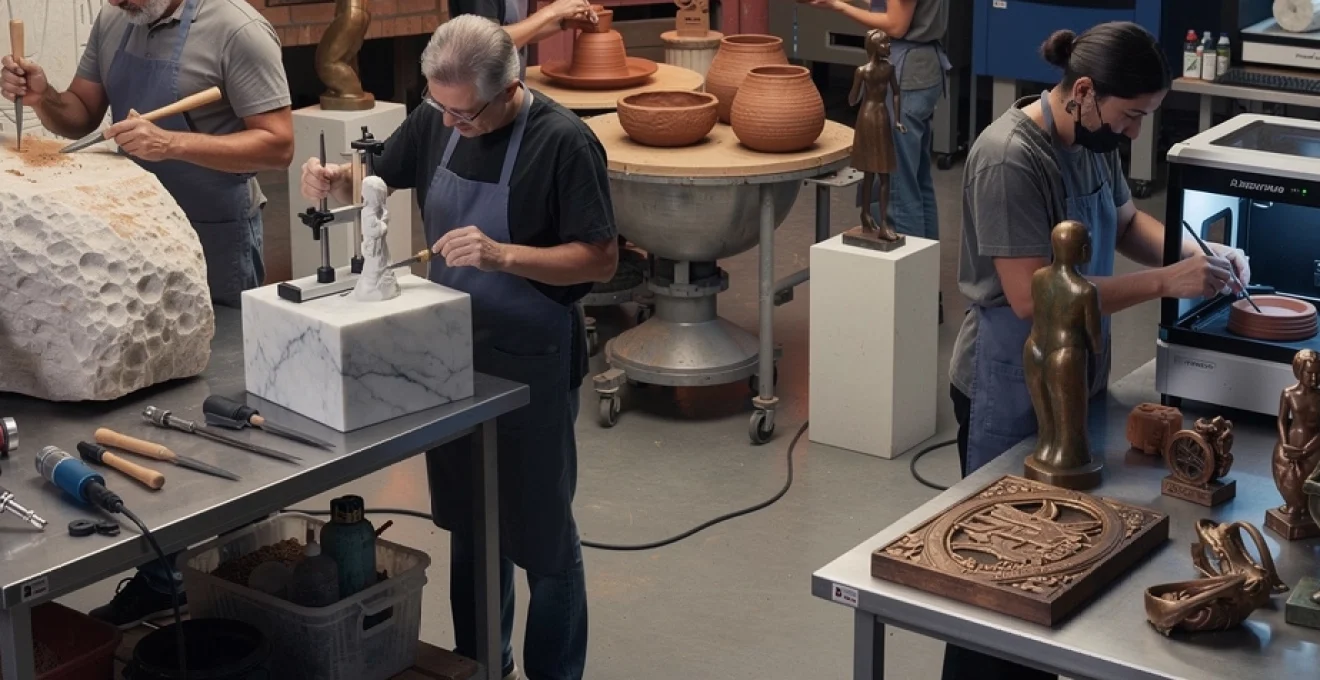
Sculpture represents one of humanity’s most enduring forms of artistic expression, transcending cultural boundaries and spanning millennia of creative innovation. From the monumental stone carvings of ancient civilizations to today’s digitally fabricated installations, sculptural techniques have evolved dramatically while maintaining deep connections to traditional craftsmanship. This evolution reflects not only technological advancement but also the diverse cultural contexts that have shaped artistic practices across the globe. Contemporary sculptors continue to draw inspiration from ancient methodologies whilst embracing cutting-edge technologies, creating a rich tapestry of techniques that honour both heritage and innovation. The intersection of traditional craftsmanship with modern digital workflows has opened unprecedented possibilities for artistic expression, fundamentally transforming how we conceptualise and create three-dimensional art.
Stone carving methodologies: from ancient egyptian hieroglyphs to contemporary marble sculpting
Stone carving remains one of the most enduring and technically demanding sculptural disciplines, requiring both physical strength and exceptional artistic vision. The fundamental principles established by ancient civilizations continue to inform contemporary practice, though modern tools have revolutionised the efficiency and precision of the carving process. Archaeological evidence suggests that early Egyptian sculptors developed sophisticated techniques for working with various stone types, from soft limestone to the hardest granite, establishing methodologies that would influence sculptural practices for thousands of years.
The evolution of stone carving techniques reflects humanity’s perpetual quest to transform raw geological materials into objects of beauty and meaning. Ancient Egyptian artisans developed comprehensive systems for quarrying, transporting, and carving massive stone blocks, creating monuments that have withstood millennia of environmental exposure. Their understanding of stone grain direction, structural integrity, and surface treatment established foundational principles that modern sculptors still employ today.
Direct carving techniques in michelangelo’s david and modern reductive approaches
Direct carving represents the purest form of subtractive sculpture, where the artist removes material from a single block to reveal the form within. Michelangelo’s approach to marble carving exemplified this methodology, famously claiming he merely liberated the figure already present in the stone. His technique involved careful study of the block’s natural characteristics, including flaws, veining patterns, and grain direction, which informed his compositional decisions and carving strategy. Modern practitioners continue to employ similar reductive approaches, though contemporary understanding of stone geology and structural engineering has refined these techniques significantly.
The direct carving method demands exceptional spatial visualisation skills and an intimate understanding of stone behaviour under various carving tools. Contemporary sculptors often begin with detailed drawings and maquettes but must remain flexible as the stone reveals its inherent characteristics during the carving process. This organic relationship between artist and material creates unique artistic opportunities whilst presenting significant technical challenges that require years of experience to master effectively.
Pointing systems and callipers: transferring plaster models to carrara marble
The pointing system revolutionised stone carving by enabling accurate enlargement from small models to full-scale works, dramatically expanding sculptural possibilities during the Renaissance and beyond. This mechanical transfer method employs a three-dimensional coordinate system to map precise points from a plaster model onto the stone block, ensuring accurate proportional relationships throughout the carving process. Professional pointing machines, developed during the 19th century, automated much of this measurement process, allowing sculptors to work more efficiently on complex figurative compositions.
Modern pointing techniques have evolved to incorporate digital measurement technologies, including laser scanning and computer-controlled pointing machines that can achieve unprecedented accuracy. These technological advances have democratised access to precise enlargement techniques, enabling emerging sculptors to tackle ambitious projects without the extensive workshop systems traditionally required for pointing operations. However, many contemporary artists deliberately choose direct carving methods to maintain the spontaneous, intuitive relationship with their material that pointing systems can sometimes compromise.
Pneumatic tools revolution: Diamond-Tipped chisels and rotary grinders in contemporary practice
The introduction of pneumatic carving tools transformed stone sculpture in the 20th century, dramatically increasing the speed and precision of material removal whilst reducing physical strain on artists. Diamond-tipped chisels and rotary grinders enable sculptors to work efficiently with the hardest stone types, including granite and quartzite, which were previously extremely challenging to carve using traditional hand tools. These technological innovations have expanded the range of achievable surface textures and enabled more complex undercut forms that
push the structural limits of the medium. While purists sometimes criticise pneumatic and power tools for distancing artists from the tactile feedback of hand carving, many sculptors combine both approaches: blocking out forms with air hammers and grinders before refining details with traditional chisels and rifflers. This hybrid workflow preserves the sensitivity of hand carving while taking advantage of modern efficiencies, making contemporary marble sculpting more accessible and sustainable for long-term practice.
Surface finishing protocols: from bush hammering to diamond polishing compounds
The final surface treatment of a stone sculpture profoundly affects how we perceive its form, volume, and detail. Traditional finishing sequences often begin with toothed or flat chisels, followed by rasps, rifflers, and abrasives of increasing fineness. Techniques such as bush hammering—using a specialised hammer with multiple points—create a textured, stippled surface that diffuses light and can evoke weathered architectural stone, while claw chisels produce linear textures that emphasise directional movement.
In contemporary studios, silicon carbide and diamond abrasives have largely replaced natural stones and sand for polishing. Sculptors progress through multiple grit stages, from coarse grinding discs that remove tool marks to fine diamond pads and polishing compounds that can bring marble to a mirror-like sheen. Some artists deliberately stop at intermediate stages, retaining subtle tool traces that communicate the work’s handmade origin, while others juxtapose rough-hewn areas with highly polished passages to heighten visual contrast and tactile interest.
Surface chemistry also plays a role in modern conservation-conscious practice. Stone consolidants, breathable sealers, and protective waxes are carefully selected to stabilise fragile surfaces without altering the stone’s natural appearance or interfering with future restoration. For outdoor works, finishing protocols must anticipate weathering, pollution, and biological growth; consequently, many sculptors collaborate with conservators to develop finishing systems that balance aesthetic intent with long-term durability in specific environmental conditions.
Clay modelling and ceramic firing processes across global traditions
Clay modelling sits at the heart of both traditional sculpture and modern ceramic art, offering unmatched immediacy and flexibility. Because clay is plastic when wet, leather-hard as it dries, and stone-like after firing, it allows artists to explore form across multiple stages of transformation. Globally, cultures have developed distinct clay bodies, forming techniques, and firing methods that respond to local materials and ritual needs, from African terracotta figures to East Asian porcelain and contemporary installation-based ceramic sculpture.
What makes clay such a powerful sculptural medium today is its ability to bridge fine art, craft, and design. Sculptors may use clay as a temporary modelling material for bronze casting, or as the final medium in large-scale ceramic installations that push the limits of kiln technology. Understanding traditional hand-building methods and kiln processes not only deepens our appreciation of historical works but also equips contemporary artists to experiment intelligently with surface, structure, and scale.
Pinch, coil, and slab construction methods in african terra cotta traditions
Hand-building techniques such as pinching, coiling, and slab construction represent some of the oldest sculptural methodologies, still central to many African terracotta traditions. Pinch pots, formed by pressing the thumb into a ball of clay and gradually thinning the walls, remain a foundational exercise in tactile control and are often used to create small ritual vessels. Coiling, in which long ropes of clay are stacked and blended, enables the construction of larger, hollow forms—from storage jars to figurative sculptures—with remarkable structural integrity.
Across West and Central Africa, coil-built terracotta figures and vessels frequently incorporate sculpted additions such as heads, limbs, and symbolic motifs applied to the surface. Slab construction, involving rolled sheets of clay cut and joined at the edges, appears in architectural tiles, shrine elements, and some mask forms. These methods allow artists to work without a potter’s wheel, relying instead on rhythm, touch, and incremental building—much like assembling a woven basket from strands rather than carving it from a single block.
For contemporary ceramic sculptors, revisiting pinch, coil, and slab techniques can be a way to slow down, reconnect with material intuition, and explore non-industrial aesthetics. When you roll a coil or compress a joint, you are participating in a lineage that predates written history. Many artists intentionally leave tool and finger marks visible, echoing the expressive surfaces of African terracotta while using modern clays and firing regimes to achieve greater scale or durability.
Wheel throwing dynamics: japanese raku versus chinese porcelain techniques
Wheel throwing introduced rotational symmetry and new possibilities for refinement into ceramic sculpture, but cultural approaches to the wheel vary significantly. In Japanese raku traditions, closely tied to the tea ceremony, vessels are often thrown quickly and intuitively, with an emphasis on spontaneity and imperfect beauty, or wabi-sabi. Thick walls, subtle distortions, and expressive trimming marks are celebrated, and the subsequent firing process—rapid heating and post-firing reduction—further enhances unpredictability.
By contrast, Chinese porcelain techniques, especially from Jingdezhen, prioritise extreme precision and thinness. Porcelain’s high kaolin content and vitrification temperature demand exceptional throwing control; potters must balance plasticity and memory in the clay body to avoid warping or collapse. Historically, teams of specialised artisans would collaborate on a single piece, from throwing and trimming to glazing and painting, resulting in objects of remarkable consistency and delicacy.
Modern sculptors frequently borrow aspects of both approaches. Some use the potter’s wheel as a tool for generating cylindrical or spherical modules that are later cut, joined, and deformed into complex sculptural assemblages. Others intentionally disrupt perfect symmetry—altering rims, paddling sides, or combining thrown and hand-built elements—to create hybrid forms. Thinking of the wheel as a “lathe for clay” rather than a purely functional tool opens new avenues for integrating thrown components into contemporary ceramic sculpture.
Kiln chemistry: oxidation and reduction atmospheres in contemporary ceramic sculpture
Firing transforms fragile, air-dried clay into a durable ceramic matrix through complex physical and chemical changes. The kiln atmosphere—whether oxidising or reducing—plays a crucial role in determining colour development, glaze effects, and even the durability of the fired body. In an oxidation firing, ample oxygen allows fuel to burn cleanly, producing predictable glaze colours and stable clay bodies, which is why most electric kilns operate in this mode.
Reduction firing, common in gas, wood, and some raku kilns, deliberately limits oxygen, causing the flame to “steal” oxygen from clay and glaze materials. This can produce rich, variegated surfaces, copper reds, and iron-breaking effects that many ceramic sculptors prize for their depth and unpredictability. However, reduction atmospheres also increase technical risk—over-reduction can weaken clay bodies or cause glazes to blister, and controlling temperature gradients within large kilns is challenging.
Contemporary ceramic artists often treat kiln firings as collaborative events with the elements, planning for broad effects while accepting subtle variations as part of the artwork’s character. In large-scale sculpture, differential shrinkage and thermal stress become critical concerns; careful ramping schedules, soaking periods, and controlled cooling help prevent cracking or warping. Understanding kiln chemistry allows you to design clay bodies and glazes that respond intentionally to specific firing regimes, rather than leaving outcomes entirely to chance.
Glazing formulations: lead-based byzantine techniques versus modern food-safe alternatives
Historical glaze technologies reveal much about a culture’s materials science and aesthetic priorities. Byzantine and early Islamic potters, for instance, frequently used lead-based glazes to achieve brilliant, low-temperature gloss surfaces and rich colours. Lead flux dramatically lowers the melting point of silica, enabling smooth, glassy coats on relatively soft earthenware bodies fired in simple kilns. However, we now recognise the significant health risks of lead leaching, especially in functional ware.
Modern glaze chemistry has shifted towards safer flux systems—boron, alkaline earths, and zinc, among others—while maintaining or even surpassing historical colour ranges. Commercial glaze manufacturers and studio artists alike rely on rigorous testing, including leach and durability tests, to ensure food-safe ceramic surfaces. For sculptural work not intended for food use, a wider palette of materials remains available, but responsible practice still prioritises stable, non-toxic formulations, particularly for public or interactive installations.
Understanding the contrast between lead-based Byzantine techniques and contemporary alternatives also highlights how regulation and ethics influence artistic decisions. Many artists consciously reference historical surfaces—like lustreware or tin-opacified whites—while re-engineering recipes with modern, less hazardous materials. Glaze calculation software, line-blend testing, and small-scale test tiles have become standard tools, allowing sculptors to fine-tune surface qualities while aligning with current health and environmental standards.
Metal casting technologies: lost-wax processes and digital fabrication integration
Metal casting has long allowed sculptors to translate fragile models into durable, repeatable forms, from ritual bronzes to modern public art. Lost-wax casting, sand casting, and investment techniques have been refined over centuries, and today they intersect with digital fabrication tools that streamline pattern-making and mould design. As a result, contemporary metal sculpture sits at a crossroads where traditional foundry craft and computer-aided technologies complement rather than replace one another.
For artists, understanding casting workflows is essential when designing pieces that must withstand structural loads, weathering, and public interaction. How thick should a bronze wall be? Where should sprues and vents be placed to ensure clean metal flow? These questions sit at the intersection of aesthetics and engineering. Collaborations between sculptors, foundry technicians, and digital modellers increasingly shape the look and feasibility of ambitious metal works.
Investment casting precision: from benin bronze plaques to rodin’s gates of hell
Investment casting, a refined form of lost-wax casting, enables exceptional detail reproduction, as seen in the renowned Benin bronze plaques and the intricate surfaces of Rodin’s Gates of Hell. In both historical and modern processes, the workflow begins with a detailed original model—traditionally in wax or clay—that is encased in a refractory investment material. When heated, the wax melts out, leaving a negative cavity ready for molten metal.
The Benin bronzes demonstrate how complex narrative scenes, armour patterns, and facial expressions can survive the translation from wax to metal with astonishing fidelity. Rodin’s workshops, similarly, used lost-wax techniques to capture his expressive modelling, preserving every fingerprint and tool mark. Investment casting today uses improved refractories, controlled burnout cycles, and vacuum or centrifugal casting equipment to minimise defects such as porosity or incomplete fills, thereby increasing reliability for both small editions and large, multipart sculptures.
For contemporary sculptors, investment casting offers a balance between artisanal touch and production flexibility. You can experiment freely in wax or clay knowing that the investment mould will faithfully record subtle textures. At the same time, digital tools now interface with investment casting: 3D-printed wax patterns and computer-controlled burnout schedules bring new levels of repeatability, which is particularly valuable for artists producing complex, modular works or limited editions.
Sand casting applications in large-scale public monuments and henry moore’s bronzes
Sand casting, by contrast, excels in producing large, robust forms and has been widely used in architectural sculpture and public monuments. A pattern—sometimes carved in wood, milled from foam, or assembled from multiple materials—is pressed into prepared sand to create a mould cavity. Molten metal is then poured in, and the sand is broken away after cooling. Henry Moore relied on sand casting for many of his monumental bronzes, using multipart moulds to translate his maquettes into large-scale forms.
One of sand casting’s major advantages is scalability: moulds can be enlarged from original models using pointing systems, plaster enlargements, or, more recently, CNC-milled patterns. The texture of packed sand often imparts a subtle grain to the cast surface, which artists may retain or work back through chasing and patination. While sand casting generally does not capture micro-detail as finely as investment casting, it is cost-effective and structurally suited to thick-walled, outdoor pieces designed to endure decades of environmental exposure.
Public art projects frequently combine sand casting with modular fabrication strategies. Large sculptures are cast in sections, with internal armatures and flanges that allow pieces to be welded or bolted together on site. For you as an artist or commissioner planning a civic sculpture, early dialogue with a foundry about sand casting limitations—such as minimum section thickness, gating requirements, and crane access—can prevent costly redesigns later in the process.
3D printing in wax pattern creation for contemporary foundry workflows
The integration of 3D printing into foundry workflows has reshaped how wax patterns and casting models are produced. Instead of sculpting every element by hand, artists can design complex geometries in digital sculpting software, then print them directly in castable wax or resin. These printed patterns enter the traditional investment casting sequence, effectively merging digital precision with time-tested metallurgical techniques.
This approach proves especially powerful for intricate lattices, interlocking components, or forms with undercuts that would be extremely difficult to carve or mould conventionally. For example, jewellery-scale sculptures with filigree detail or large-scale, repeating modules for installations can be modelled once in software and reproduced as needed. Foundries increasingly maintain in-house 3D printers or partner with specialised bureaus to supply high-resolution wax prints tailored to their burnout and casting systems.
However, digital pattern-making also introduces new considerations. Layer lines and print artefacts must be accounted for if the artist desires perfectly smooth surfaces, while resin burnout requires precise firing schedules to avoid incomplete ash removal. By thinking of 3D printing as another modelling tool—rather than a shortcut—you can strategically decide which aspects of a sculpture benefit from digital exactitude and which should retain the irregularities of the human hand.
Patination chemistry: verde gris formation and controlled oxidation techniques
Once a metal sculpture is cast and chased, patination offers a powerful means of shaping its final appearance and symbolic resonance. Traditional verdigris (green) patinas on copper and bronze arise from the natural formation of basic copper carbonates and sulfates as the metal oxidises over time. Historically, artists and metalworkers accelerated this process using vinegar, urine, and other acidic solutions applied repeatedly to the surface.
Modern patina artists rely on more predictable chemical formulas—such as cupric nitrate, ferric nitrate, and ammonium sulfide—applied with heat or cold processes to produce greens, browns, blacks, and blues. Controlled oxidation techniques allow for layered, translucent effects; for example, a warm brown underlayer topped with subtle green highlights can give the impression of aged bronze while preserving crisp detail. Sealants like microcrystalline wax or clear lacquer then stabilise the patina, slowing further environmental change.
Outdoor sculptures inevitably continue to react with their surroundings, so patination is as much about anticipating future colour shifts as it is about achieving an initial look. Conservators and artists collaborate to choose patinas that weather gracefully, considering factors such as pollution levels, coastal salts, and UV exposure. Understanding patina chemistry helps you decide whether a pristine, uniform surface or a living skin that evolves over decades best serves your artistic and curatorial goals.
Digital sculpting workflows: zbrush modelling to cnc milling applications
Digital sculpting platforms such as ZBrush, Blender, and Mudbox have expanded the sculptor’s toolkit far beyond physical materials, allowing for intuitive “virtual clay” modelling with brushes that push, pull, smooth, and carve in three dimensions. Artists can iterate rapidly, store multiple versions of a design, and test scale changes or compositional variations without the time or material cost of traditional maquettes. Complex forms that would be nearly impossible to construct by hand—such as fractal structures or mathematically precise surfaces—can be explored with relative ease.
Once a digital model is finalised, it can be translated into physical form through CNC milling, 3D printing, or a combination of both. CNC routers and mills carve foam, wood, stone, or metal directly from digital files, using toolpaths generated by CAM (computer-aided manufacturing) software. In stone sculpture, for example, large blocks of marble may be rough-shaped by a multi-axis CNC machine before being finished by hand, echoing the relationship between pointing systems and traditional carving but with far greater speed and flexibility.
Digital workflows also streamline scaling and editioning. A single ZBrush model can generate a small resin test print, a mid-scale clay 3D print for refinement, and a full-size foam positive for mould-making or direct casting. However, these tools are not without challenges: issues such as polygon density, mesh integrity, and toolpath optimisation require technical literacy. Many sculptors therefore work in hybrid teams, pairing their artistic vision with the expertise of digital fabricators and technicians to ensure that virtual forms translate successfully into durable, physical sculpture.
Mixed media assemblage: contemporary artists merging traditional craftsmanship with industrial materials
Mixed media assemblage has become a defining strategy of contemporary sculpture, enabling artists to juxtapose materials, histories, and techniques within a single work. Traditional craftsmanship—wood carving, stone masonry, textile weaving—often appears alongside industrial materials like steel beams, concrete, plastics, and electronic components. This fusion can create powerful dialogues between past and present, hand-made and mass-produced, organic and synthetic.
Artists such as El Anatsui, for instance, weave discarded bottle caps into monumental tapestry-like forms that reference both Ghanaian kente cloth and global consumer waste. Others integrate found objects and architectural fragments into sculptural installations, treating the urban environment as a vast resource of ready-made components. For you as a maker, thinking of assemblage as three-dimensional collage can be helpful: each material brings its own “sentence” to the visual language of the piece, and your role is to orchestrate how those sentences interact.
Working with disparate materials also introduces technical questions. How do you join wood to steel, or resin to stone, so that the sculpture remains stable over time? Adhesives, mechanical fasteners, and concealed armatures all play a role, and material compatibility—thermal expansion, corrosion potential, off-gassing—must be considered carefully. Planning for transport, installation, and maintenance is especially crucial for large mixed media works, as a failure in one component can compromise the integrity of the whole.
Conceptually, mixed media assemblage invites viewers to decode layered meanings embedded in everyday objects and industrial remnants. By integrating traditional carving or casting techniques into these assemblages—perhaps a hand-carved wooden figure suspended within a welded steel frame—artists highlight the persistence of craft knowledge within a rapidly industrialising and digitising world. The result is sculpture that not only occupies space but also actively critiques and reconfigures the material culture surrounding us.
Conservation methodologies: preserving archaeological sculptures and maintaining contemporary installations
As sculpture practices diversify, conservation methodologies must adapt to protect both ancient artefacts and cutting-edge contemporary works. Archaeological sculptures—whether stone reliefs, terracotta figures, or corroded bronzes—require stabilisation strategies that respect their historical integrity and material fragility. Contemporary installations, by contrast, may incorporate perishable materials, electronics, or site-specific elements that challenge traditional notions of preservation. In both cases, conservators aim to balance minimal intervention with long-term stability, ensuring that future generations can engage meaningfully with these works.
For archaeological sculpture, conservation typically begins with detailed documentation: high-resolution photography, 3D scanning, and condition mapping record existing damage, previous repairs, and surface features. Cleaning is approached cautiously, often using dry methods, micro-abrasion, or carefully formulated solvents to remove harmful deposits without erasing tool marks or patina. Structural treatments might involve pinning fractured stone with stainless steel or fibreglass dowels, filling losses with reversible mortars, and controlling the microclimate in storage and display environments to reduce further deterioration.
Maintaining contemporary sculpture introduces different complexities. Installations may depend on technologies that become obsolete—CRT monitors, specific software versions, or proprietary lighting systems—raising the question: should conservators preserve the original hardware or update components while retaining the work’s conceptual essence? Materials like plastics, foam, and adhesives can degrade faster than stone or bronze, leading museums and collectors to develop preventive conservation plans that include light-level monitoring, off-gassing tests, and periodic condition reviews.
Collaboration is increasingly central to conservation practice. For living artists, conservators seek input on acceptable levels of ageing, potential future replacements, and the importance of specific materials to the artwork’s meaning. For historical works, interdisciplinary teams of scientists, historians, and conservators analyse pigment residues, alloy compositions, and tool traces to inform treatments. As you encounter sculptures in museums or public spaces, subtle signs of conservation—small fills, stabilising mounts, environmental controls—remind us that preserving three-dimensional art is an ongoing, active process rather than a one-time intervention.